The $1.65T did not vanish: AI data centers are moving debt out of sight
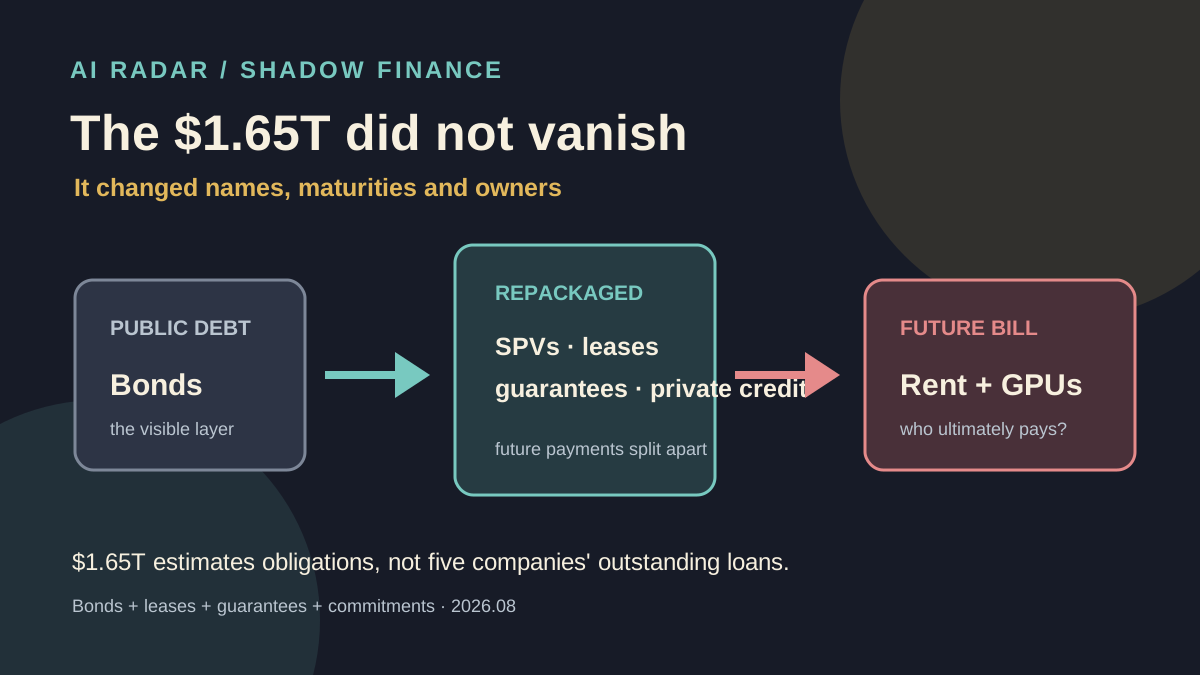
The roughly $1.65 trillion “hidden debt” estimate combines bonds, leases, purchase commitments, guarantees and project finance across five hyperscalers. It is not their outstanding traditional debt, but it shows AI infrastructure turning technology companies into real-estate-like heavy asset businesses. Meta's roughly $27.3 billion Hyperion joint project with Blue Owl, a later plan of about $50 billion for the campus, and GPU residual-value finance all point to risk being split across leases, SPVs, private credit and future cash flows rather than removed.
The short version
The $1.65 trillion did not vanish. It simply did not all appear in the line where you expected it.
Recent discussions of AI data-center “shadow debt” combine bonds, leases, purchase commitments, guarantees and project finance for Meta, Microsoft, Google, Amazon and Oracle. That total is not five companies' outstanding bank loans. It is an estimate of the infrastructure bills they may have to carry in the future.
That is what makes the story both dangerous and interesting: Big Tech is starting to look more like real-estate developers, while Wall Street is repackaging data centers, GPUs and future rent as financial assets.
The debt did not disappear; it changed names
Public bonds still appear on balance sheets. But data-center construction is financed through more than public bonds.
Companies can also use:
- special-purpose vehicles (SPVs) to hold projects and debt;
- finance leases or long-term leases that spread payments;
- payment or residual-value guarantees;
- securitization of future compute rent;
- purchase and construction commitments that are paid later.
That is why “hidden debt” figures in different reports are not equivalent. The roughly $1.65 trillion figure repeated by Nikkei and U.S. News is closer to an estimate of future obligations and off-balance-sheet commitments. It should not be written as “the five companies have already borrowed $1.65 trillion.”
That distinction does not remove the risk. For investors, the real question is: whose cash flow ultimately repays these contracts?
Meta's Hyperion is the closest thing to a template
When Meta began building its Hyperion data-center campus in Louisiana, it formed a roughly $27.3 billion joint project with funds managed by Blue Owl. Meta owns a minority stake, while investment funds hold most of the equity and the project raises financing through separate entities.
Meta's investor announcement confirms the joint venture, the campus and Blue Owl's involvement. CNBC later reported that planned investment had expanded to about $50 billion, targeting roughly 5GW of AI-compute load.
That is the key to “off balance sheet” structures. Project debt may not be fully consolidated into Meta's liabilities, yet Meta can still provide the most important credit through rent, minimum-use commitments, payment guarantees and residual arrangements.
In other words, the debt did not disappear. “How much did Meta borrow?” became “how much rent, value and compute has Meta promised to support in the future?”
Why hyperscalers accept a higher price
Public bonds are transparent and easy for ratings agencies and shareholders to see. Leases, SPVs and private credit are more flexible: maturities can be longer, projects can be financed separately, and some obligations do not show up as a conventional bond balance in the most visible debt metrics.
The price is usually higher interest, guarantees and contract complexity. A clean balance sheet is not free; it often means writing the risk into leases and support clauses instead.
That helps explain the private-credit rush into data centers after 2025. Blue Owl, Blackstone, KKR and BlackRock can use insurance and pension capital to take infrastructure risk that banks are less willing to hold for decades, then package stable rent as an infrastructure-like yield product.
GPUs are becoming financial assets too
The more aggressive layer is GPU financing.
Compute providers can borrow against GPUs, data-center rent and customer contracts. Lenders value the equipment partly by the income it can generate and its expected residual value. Market reports have also described Nvidia's role in encouraging large-scale AI-infrastructure financing and using residual support to reduce lender concerns.
The problem is that a GPU is not land. It depreciates, gets replaced and may lose value quickly when a new generation arrives.
If hardware with little value after five years supports a twenty-year cash-flow promise, the loan is not really secured by the GPU. It depends on future AI demand, cloud-rental prices and the ability of a few large customers to keep paying.
Is this 2008? We cannot write that yet
Calling it an “AI subprime crisis” is clickable, but the evidence is not there yet.
The more defensible view is:
- data-center debt is still smaller than the 2008 housing-credit system;
- much of the risk sits across private funds, insurers and pensions rather than concentrated in bank balance sheets;
- AI cloud revenue and large-customer contracts are still growing, with no industry-wide default wave;
- credit spreads for heavy spenders such as Oracle are rising, showing that markets are repricing supposedly asset-light technology companies.
The real stress test has not happened: if AI demand slows, GPU residuals fall and customers do not renew, does the SPV run out of cash first, or does the parent have to step in?
Our judgment
This is not proof that hyperscalers are fabricating numbers, and it is not debt vanishing into thin air.
It is a migration in capital structure: public bonds become private credit, buying a data center becomes leasing one, a GPU becomes collateral that supposedly earns rent, and twenty years of expected AI demand becomes today's credit foundation.
The structure is efficient while demand keeps rising. If that assumption breaks, risk can travel back through leases, guarantees, insurance and fund shares.
What to watch next
- Whether leases, guarantees and purchase commitments keep expanding in 10-K and 10-Q filings.
- The actual cost, delivery date and utilization of projects such as Hyperion.
- How GPU-finance contracts calculate residual value and what Nvidia support really covers.
- Whether private funds permit exits, pushing risk toward insurers and retirement accounts.
- Whether AI-cloud revenue can outrun capital spending and interest costs.
The most accurate reading of $1.65 trillion is not “a debt bomb that has already exploded,” but “a future bill being financialized, layered and recognized later.”