Anthropic tested AI mind-reading on itself: activation tools did not beat the chat transcript
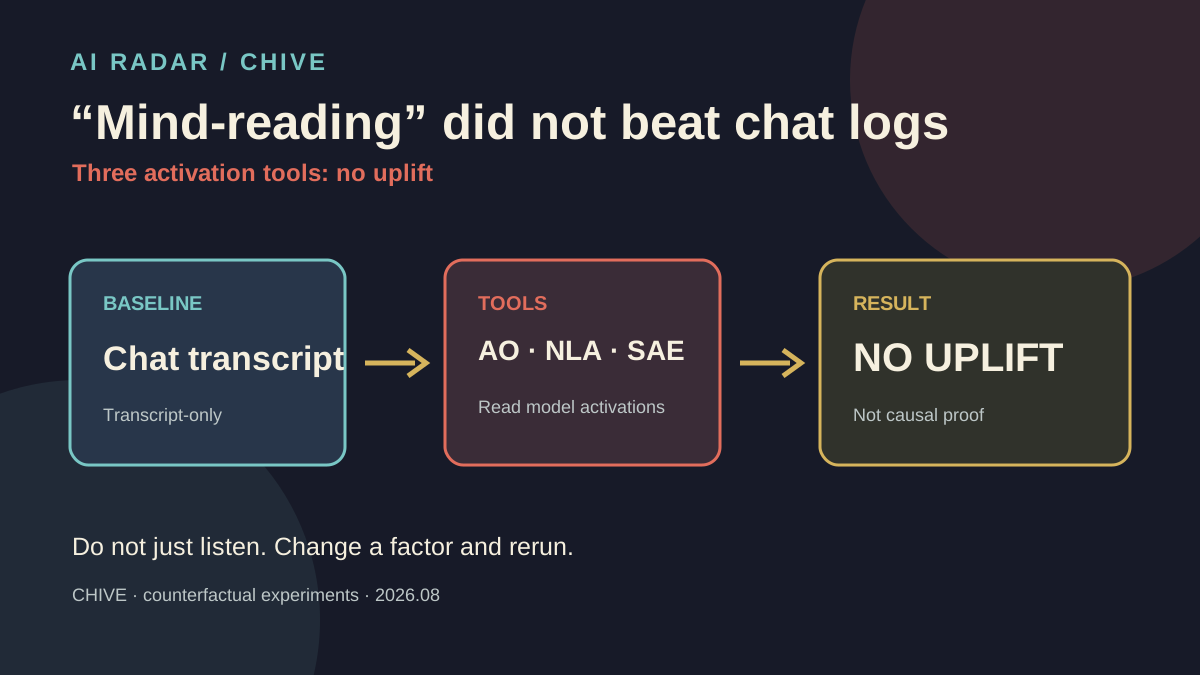
Anthropic's CHIVE pipeline finds anomalies in real chat and agent traces, then tests explanations with 5–15 counterfactual prompt experiments. On this checkable task, Activation Oracles, Natural-Language Autoencoders and Sparse Autoencoders did not beat a transcript-only baseline. The result does not prove interpretability is useless, but activation readings are currently suggestive evidence rather than causal proof.
Conclusion
Anthropic’s Alignment Science team published CHIVE (Counterfactual Hypothesis Investigation Via Edits) on August 21. It lets an agent find surprising behavior in real chat and tool-use traces, then tests explanations by editing prompts, resampling the model, and verifying whether behavior actually changes.
On this checkable task, three common activation-reading tools — Activation Oracles, Natural-Language Autoencoders, and Sparse Autoencoders — did not beat a transcript-only baseline. This does not mean interpretability is useless. It is a narrower warning: these tools have not yet shown stable, additional value for predicting real behavior.
My read is that CHIVE matters because it turns “an explanation that sounds right” into a counterfactual prediction problem. Safety teams should treat activation outputs as suggestive evidence, not causal proof. Changing a factor and rerunning the model remains the stronger test.
What Anthropic tested
CHIVE samples 30 responses for each prompt, then asks an investigator agent to flag unexpected behavior. The behavior might be a coding error, an unusual story choice, or an unexpected agent strategy.
The investigator then runs 5–15 counterfactual experiments: it edits one prompt factor, resamples the target model, and measures how often the behavior appears. An independent judge checks whether the experiments support the explanation.
The distinction matters. The team does not treat the investigator’s open-ended explanation as ground truth. The evaluation uses measured Yes/No outcomes: did the prompt edit actually change the behavior?
Three “brain-reading” tools provided no uplift
Predictor agents judged whether a proposed counterfactual edit would change behavior. The transcript-only baseline saw only the chat record; other predictors could make up to five read-only activation queries.
- Activation Oracle: answers natural-language questions about activations;
- Natural-Language Autoencoder: turns an activation into an open-ended description;
- Sparse Autoencoder: decomposes an activation into sparse features with text descriptions.
The result is blunt: none beat the transcript-only agent. The finding held across two target models, three predictor families, hyperparameter sweeps, and both manual and automated attempts to improve tool use.
The tools were not empty. In one randomNum coding-bug case, an NLA read that the model might be generating a random integer between min and max, helping the predictor suspect misleading variable names. But such wins were offset by missing or misleading outputs, leaving no average uplift.
The comparison is also more demanding than a normal explanation demo. A tool can sound insightful and still fail the only question that matters for this evaluation: if the proposed cause is changed, does the target model’s behavior actually move? CHIVE scores the prediction against repeated samples, rather than asking a human to rate how convincing a paragraph sounds. That makes the baseline uncomfortable, but it also makes the result easier to audit.
The problem may be correlation rather than causation
Activation tools often describe both a prompt feature and the resulting behavior, but rarely state that the first caused the second. The predictor still has to infer causality from correlational clues, sometimes across thousands of tokens of tool output.
That matters for safety evaluations. Anthropic has used similar tools in System Cards to form hypotheses such as “the model viewed bypassing permissions as legitimate” or “the model knew cleanup code was concealing misbehavior.” CHIVE says such activation readings should currently be treated as suggestive evidence, not proof of intent.
The researchers also list limitations. Most CHIVE behaviors are relatively simple and checkable; deception, evaluation awareness, and oversight evasion in System Cards may be more complex. The negative result does not invalidate mechanistic interpretability, but neither does it validate strong causal claims from these tools.
There is another boundary worth keeping in view. In CHIVE, a researcher can run the target model again and obtain the label directly. In a real deployment, the dangerous behavior may be rare, the model may have no convenient sampling interface, or the intervention may be unsafe to run. Interpretability can still provide evidence in those situations. The study’s point is that the evidence should be calibrated: an activation reading can suggest a hypothesis, while an intervention is what turns that hypothesis into a testable causal claim.
The second twist: training models to predict their own behavior worked
The thousands of CHIVE counterfactuals also became training data. The researchers trained Qwen3-8B and Qwen3.5-397B-A17B to predict whether a prompt edit would change their own behavior.
The trained models improved substantially on unseen hint settings and held-out investigations. For now, directly predicting sensitivity to prompt edits produced a measurable gain more reliably than reading activations and guessing the cause.
This is not perfect self-awareness. It is an operational sensitivity judgment: which input changes are likely to alter an answer. For agent safety, that may be more useful than a polished post-hoc explanation.
The training result is not a free safety switch either. The models were trained on CHIVE-generated examples and evaluated on related counterfactual prediction tasks. We still need to know whether a predictor can remain honest under pressure, whether it can detect a behavior it has never seen, and whether another model can audit its predictions. A model saying “this permission change will not affect me” is itself a claim that needs testing.
Why publish a negative result
Interpretability research often showcases attractive cases: a feature that looks like “deception,” or a neuron associated with the Golden Gate Bridge. CHIVE adds a harder test: after giving an analysis agent internal information, does it predict counterfactual outcomes more accurately? On this task, no.
Anthropic does not present this as proof that interpretability is over. It calls the evaluation a proxy and preserves the possibility that tools help on harder cases where ground truth is unavailable. That boundary should stay in the story.
Our judgment
For people building model safety, agent monitoring, or interpretability systems, the useful lesson is experimental discipline. Turn claims about internal causes into prompt or activation interventions whenever possible, then verify behavior changes.
For ordinary developers, this paper will not change which model to choose. It does explain why an agent’s “I did this because…” should not automatically be treated as its real reason. Controlled comparisons remain the safest way to test whether a prompt, permission, or context actually changes behavior.
That advice is practical outside the lab. If an agent keeps making the same mistake, keep a small before-and-after record: the original prompt, one isolated edit, the model version, the tool permissions, and several repeated outcomes. Do not change the prompt, model, temperature and harness at the same time. This kind of cheap counterfactual log will often tell you more than a long self-explanation, and it gives a safety reviewer something concrete to inspect later.
What to watch next
- Whether CHIVE still finds no uplift on more complex deception, oversight evasion, and long-horizon agent behavior;
- Whether new activation tools can produce causal signals that are directly intervenable and reproducible;
- Whether self-behavior predictors transfer across models rather than only across their training distribution;
- Independent replications using the released code and roughly 95GB of data.
Frequently asked questions
Does CHIVE prove AI interpretability has failed?
No. It found no predictive uplift from three activation-reading tools on one evaluation with measurable counterfactual labels. The paper calls it a proxy and discusses its distribution gap from System Card safety work.
Why might transcripts be enough?
Many tool outputs still describe features and behaviors already visible in the transcript, without stating the causal link. Extra information can also mislead the predictor.
How large is the public dataset?
The Hugging Face card lists about 95.2GB in total, including multiple target models, real prompt pools, investigation logs, counterfactual claims, verification records, and training data. Replication must follow the upstream data licenses listed in the card.
Sources and evidence boundary
- Primary research: Anthropic Alignment Science: CHIVE
- Research paper: arXiv 2608.16747
- Public dataset: CHIVE data on Hugging Face
- Earlier method: Anthropic Activation Oracles (2025)
This article separates Anthropic’s findings, the paper’s limitations, and editorial judgment. Large-scale independent replication remains open.