Paying $1,999 for a Foldable Only to Face Daily Rate Limits? Apple Unveils iPhone 18 & Duo, but AI Remains in Beta with Subscription Fees Ahead
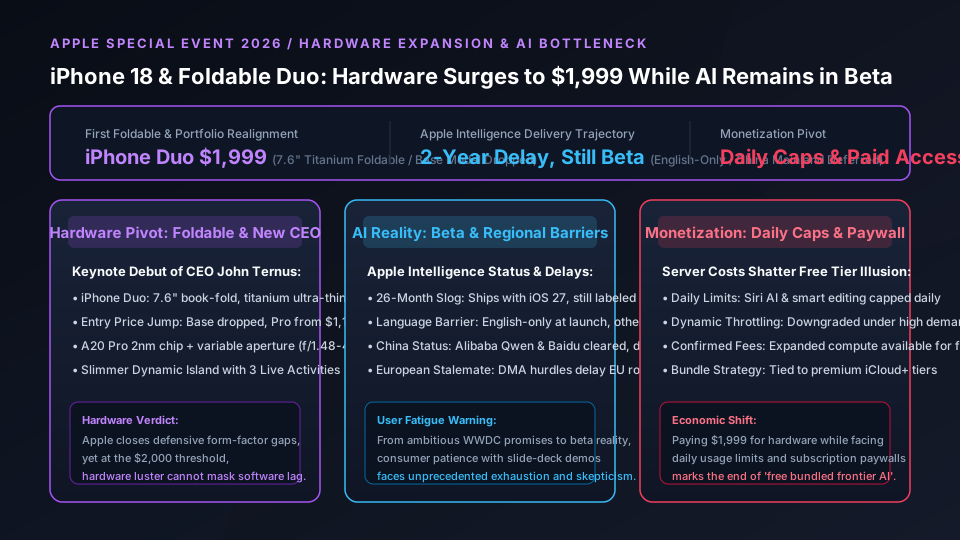
On September 10, 2026, new CEO John Ternus introduced Apples first foldable iPhone Duo ($1,999) while eliminating the base iPhone 18. Yet Apple Intelligence remains an English-only beta after a 26-month delay, with China mainland deferred; crucially, Apple confirmed daily server usage limits and prospective paid subscriptions, shattering the illusion of bundled free frontier AI.
# Paying $1,999 for a Foldable Only to Face Daily Rate Limits? Apple Unveils iPhone 18 & Duo, but AI Remains in Beta with Subscription Fees Ahead
In the early hours of September 10, 2026, Apple hosted its highly anticipated autumn keynote presentation from Cupertino. Marking the maiden iPhone unveiling orchestrated by newly appointed Chief Executive Officer John Ternus following Tim Cook's transition, the event showcased the most aggressive hardware restructuring observed in more than a decade: Apple revealed the long-rumored book-style foldable flagship dubbed iPhone Duo (commanding an eye-watering baseline price of $1,999), outfitted the iPhone 18 Pro series with mechanical variable apertures alongside TSMC 2-nanometer A20 Pro silicon, and radically terminated the standard base iPhone 18, unilaterally elevating the generational entry barrier to $1,199.
However, beneath the gleaming allure of two-thousand-dollar titanium hinges and ultra-thin flexible glass, the true intellectual core of modern smartphone competition—Apple Intelligence—delivered a sobering, deeply conflicted outcome.
A grueling twenty-six months after its inaugural promises at WWDC 2024, the newly overhauled Siri AI scheduled for commercial release alongside iOS 27 on September 14 remains firmly saddled with an explicit "Beta" classification, while operating exclusively in English. Even more jarring for early adopters, Apple quietly confirmed across developer documentation and event footnotes that cloud-dependent features—such as deep conversational Siri AI, Image Playground canvases, and spatial generative photo editing—will be governed by daily usage caps (Daily Usage Limits), with the company officially verifying that unrestricted high-tier access will transition into a paid recurring subscription in the future.
Forking out premium capital for top-tier hardware, waiting over two years for artificial intelligence only to receive an incomplete beta, and confronting daily query throttling alongside prospective software paywalls: this keynote did not alleviate market skepticism, but instead thrust Apple into an unprecedented trial of consumer trust and ecosystem monetization.
---
What Happened: The First Foldable Arrives as the New CEO Eliminates the Base Tier
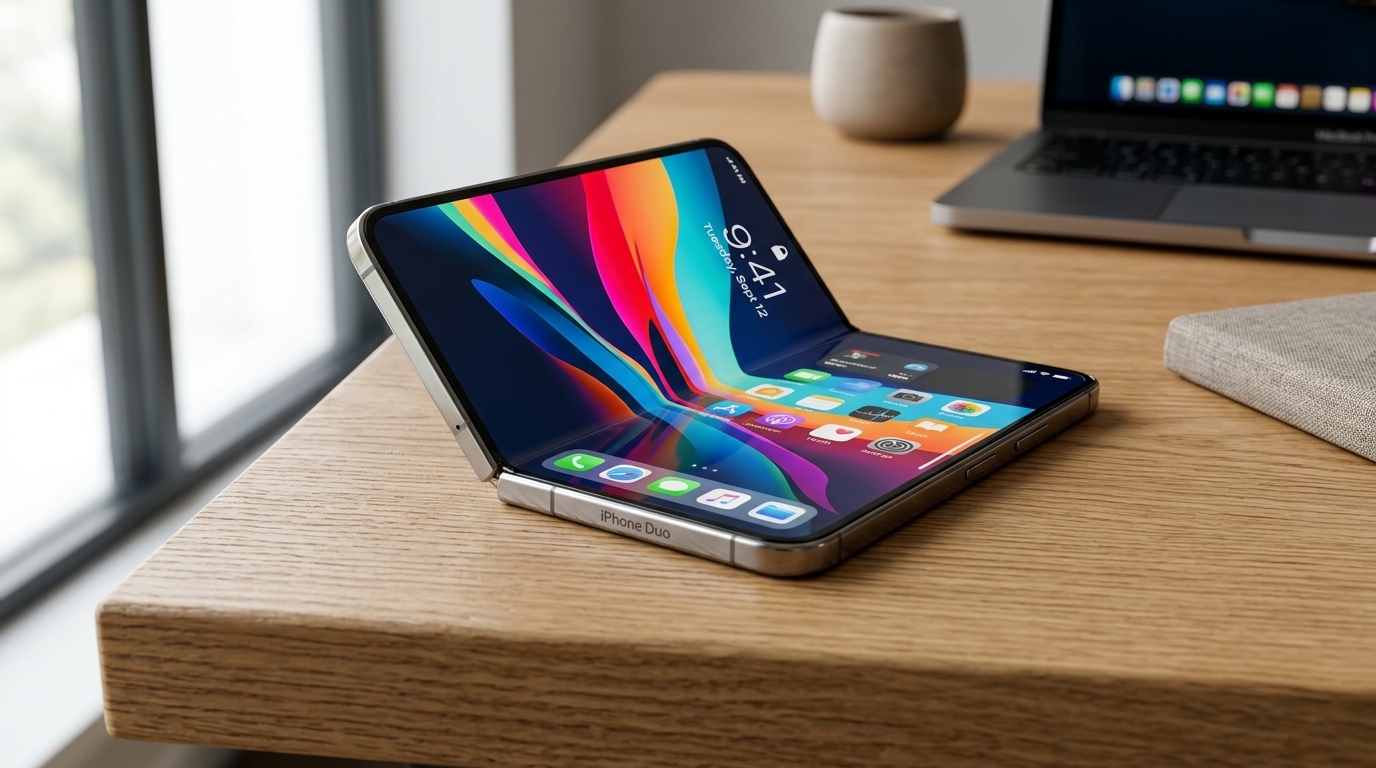
This launch unmistakably reflected the engineering-driven philosophy of new CEO John Ternus: taking bold, calculated risks with hardware form factors while systematically optimizing portfolio margins.
According to Apple's primary technical whitepapers and event presentations, this hardware generational shift centers around three transformative developments:
- The Inaugural Foldable iPhone Duo Debuts: Engineered around polished Grade 5 titanium chassis rails and an innovative split dual-battery architecture, the Duo unfolds into an expansive 7.6-inch interior panel while maintaining a 5.4-inch exterior cover display, setting an all-time record as the slimmest iPhone ever produced. Powered by a specialized edition of iOS 27 optimized for tablet multitasking, the device incorporates edge-docked split windows and floating stage controls at a $1,999 baseline (pre-orders open October 16, retail shipments begin October 23);
- iPhone 18 Pro Integrates Variable Aperture and 2nm Silicon: The rear 48MP Fusion primary camera debuts a mechanical physical aperture mechanism capable of toggling continuously between f/1.48 and f/4, providing optical depth-of-field manipulation reminiscent of dedicated mirrorless optics; underneath, it houses the A20 Pro chip fabricated on TSMC's 2nm node, paired with a custom vapor chamber thermal dissipation loop;
- Dynamic Island Compression and Portfolio Realignment: The Dynamic Island footprint decreases by 25 percent on Pro models while gaining concurrent rendering support for up to three simultaneous Live Activities. Far more disruptive commercially, Apple entirely eliminated the entry-level baseline iPhone 18, raising the floor of the mainline generation to $1,199 and compelling prospective upgraders to choose between older inventory or immediate pro-tier investments.
---
Why It Matters: From 2024 Ambitions to 2026 Delivery, Apple AI Encounters Fatigue
While mechanical craftsmanship and optical innovations received acclaim from hardware enthusiasts, software execution schedules have induced pervasive fatigue across enterprise analysts and everyday consumers alike.
Across keynote presentations over the preceding twenty-four months, Apple consistently highlighted Apple Intelligence as a transformational paradigm shift: deep semantic reasoning, proactive cross-application orchestration of flight and lodging reservations, and context-aware screen intelligence. Yet in late 2026, the tangible production reality remains profoundly constrained:
1. The 26-Month Slog: Fully Featured Siri Remains an English-Only Beta
The revamped Siri AI accompanying the public rollout of iOS 27 on September 14 is officially stamped with a persistent "Beta" moniker. - Initial availability is strictly confined to English, with secondary languages such as French, Japanese, Korean, Spanish, and Portuguese postponed until late October; - Multi-step cross-application agentic workflows repeatedly showcased during polished onstage demonstrations remain tightly barricaded within restricted sandboxed developer builds; - Consumers are effectively confronted with a flagship platform capability that has existed in a perpetual developmental holding pattern for more than two years.
2. Dual Regional Blockades: China and Europe Sidelined at Launch
Prospective purchasers across the European Union and Greater China remain unable to access foundational Apple Intelligence capabilities on day one. - China Mainland Trajectory: Although China's Cyberspace Administration (CAC) formally approved Apple Intelligence algorithm filings in mid-July 2026, and Apple secured localized infrastructure partnerships with Alibaba (deploying Qwen foundation models for generative text and image rendering) and Baidu (powering Visual Intelligence and regional semantic search), China is explicitly absent from the September 14 launch roster, leaving domestic activation schedules unannounced; - European Regulatory Impasse: Stringent compliance reviews under the European Union's Digital Markets Act (DMA) concerning interoperability and data residency protocols have led Apple to indefinitely withhold Siri AI across European iPhone, iPad, and Apple Watch deployments.
---
Commercial Reversal: Shattered Free-Tier Assumptions, Daily Limits, and Paywalls
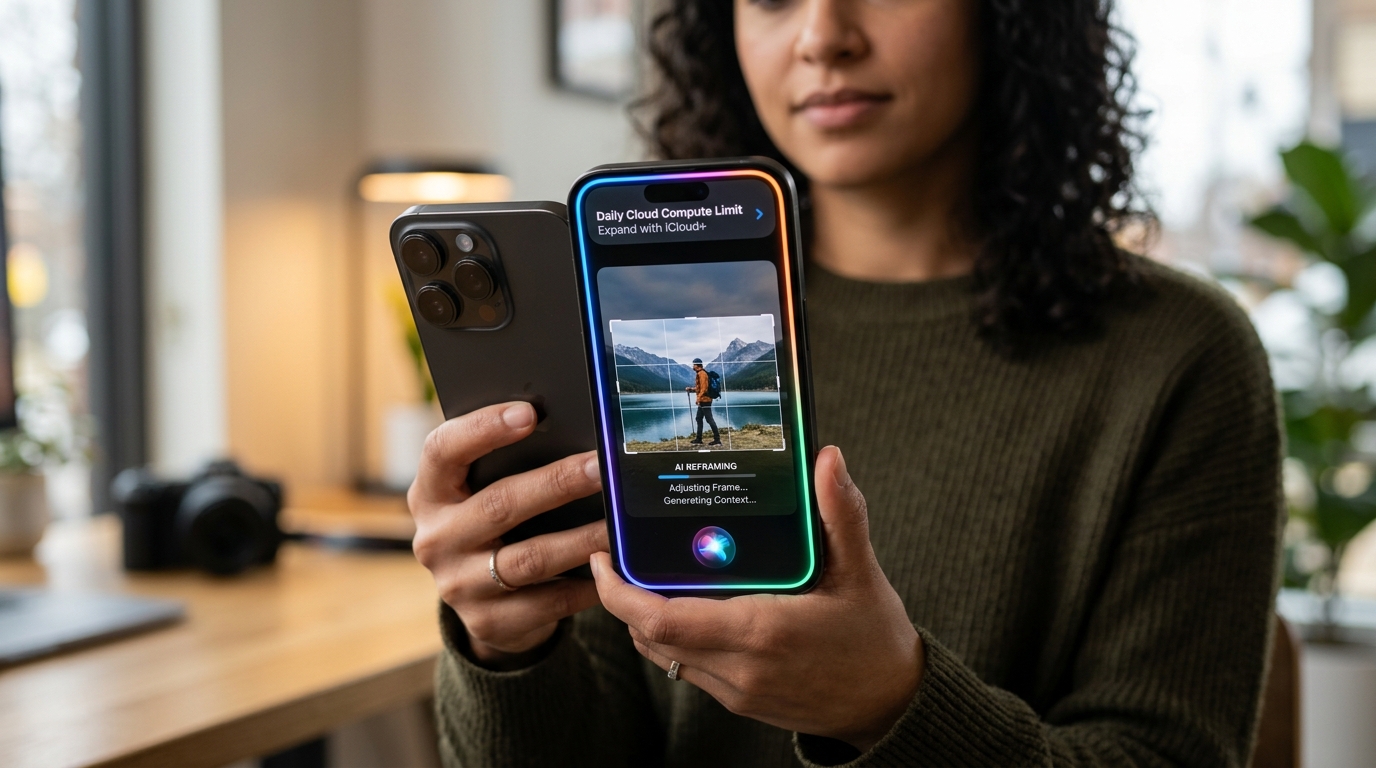
If procedural delays tested consumer patience, Apple's evolving monetization model sparked widespread indignation throughout developer forums and consumer advocacy groups.
Buried within regulatory footnotes and technical service briefs, Apple formally confirmed an unprecedented operational restriction: all computationally intensive requests routed through Private Cloud Compute clusters will be subjected to daily usage limits.
- Premier Functions Capped by Default: Strict daily thresholds govern multi-turn conversational reasoning in Siri AI, synthetic asset generation in Image Playground, generative object removal and spatial reframing in Photos, and complex automated routines powered by server-side AFM 3 weights;
- Dynamic Throttling Guided by Server Congestion: Consumption allowances will fluctuate dynamically based on real-time datacentre queue depth, prompt complexity, and global load distribution policies; once exhausted, designated workflows will either terminate temporarily or degrade into rudimentary on-device execution modes;
- Formal Verification of Future Subscription Fees: Apple explicitly noted in official releases that expanded access will be available for a recurring fee in the future. Wall Street consensus anticipates the introduction of a dedicated Apple Intelligence+ premium subscription tier or compulsory bundling with higher-capacity iCloud+ storage packages within upcoming fiscal quarters.
This economic maneuver upends two decades of consumer expectations: having committed up to $1,999 for an iPhone Duo under the assumption that flagship hardware amortizes premier system software, buyers are informed that frontier intelligence is leased rather than owned. Confronted by escalating datacentre operational expenditures, Apple has dismantled the illusion of complimentary server-grade foundation intelligence.
---
Our Verdict: Hardware Moats Hold, but AI Paywalls Threaten Consumer Loyalty
Evaluating Apple's ongoing technological transition and shifting revenue dependencies, we outline three high-conviction structural verdicts:
Verdict 1: Foldable Hardware Closes Defensive Gaps but Cannot Mask Software Stagnation
The arrival of the iPhone Duo establishes John Ternus's engineering authority, validating Apple's capability to deliver benchmark-setting titanium hinge tolerances and display thinness. However, in an international ecosystem where competitors including Samsung, Huawei, and Honor have iterated through six generations of commercial foldables, the Duo functions primarily as a defensive requirement rather than an offensive conquest; it cannot distract consumer attention from prolonged delays in operating system intelligence.
Verdict 2: Cloud Inference Costs Are Real, but Monetization Creates Severe Cognitive Dissonance
Datacentre inference across hundreds of millions of active terminals constitutes an unprecedented balance-sheet drain, meaning Apple cannot subsidize private server clusters indefinitely. Nevertheless, Apple's enduring brand equity was constructed upon an implicit covenant: premium hardware margins guarantee complete, lifetime operating software without feature gating. Segmenting core intelligence into throttled free tiers and premium paid tiers hands rival Android manufacturers significant marketing ammunition.
Verdict 3: Pragmatic Chinese Partnerships Are Sound, but Timing Determines Replacement Cycles
Partnering with Alibaba's Qwen architecture for core generative synthesis and Baidu for domestic search and visual parsing represents the most pragmatic and compliant trajectory for mainland China. However, domestic Android flagships—such as Huawei HarmonyOS, Xiaomi HyperOS, and vivo BlueLM—have already embedded native agents across transport booking, document parsing, and enterprise workflows. If localized Apple Intelligence slips into spring 2027 or beyond, market share migration across tier-one Chinese cities will accelerate irreversibly.
---
Actionable Guidance for Consumers: Upgrade Immediately or Exercise Restraint?
Navigating this contradictory generation of Apple hardware, we advise distinct user cohorts to adopt the following postures:
- Enthusiasts Targeting Foldable Form Factors: If your operational priorities center upon uncompromising titanium industrial craftsmanship, an expansive 7.6-inch interior productivity canvas, and cutting-edge 2nm A20 Pro processing, the iPhone Duo offers a compelling hardware experience, provided you anticipate initial third-party application scaling quirks and steep repair liabilities;
- Consumers Upgrading Specifically for Apple Intelligence: Exercise strict restraint and postpone purchasing! Launch-day Siri AI remains an experimental, English-constrained beta bounded by daily query caps; committing substantial capital for software capabilities showcased in conceptual presentations two years ago carries a high probability of buyer remorse;
- Owners of Existing iPhone 15, 16, or 17 Pro Hardware: Users operating recent pro-tier devices should install the baseline local features of iOS 27 on September 14 while withholding hardware expenditure until localized Alibaba and Baidu model integrations are deployed, benchmarked, and reviewed under real-world conditions.
---
What Remains to Be Observed
- Definitive Launch Timeline for Greater China: When will the deeply integrated adaptations of Alibaba Qwen and Baidu models complete rigorous domestic compliance evaluations and arrive via over-the-air firmware updates for Chinese consumers?
- Concrete Thresholds for Daily Limits and Subscription Pricing: What precise volumetric ceiling will Apple enforce for daily cloud queries, what will an unconstrained Apple Intelligence+ subscription cost on a monthly basis, and will this model provoke regulatory scrutiny?
- Consumer Elasticity Following the Elimination of the Base Model: Following the abrupt cancellation of the baseline iPhone 18, will broader consumer markets accept an elevated $1,199 entry price point, or will overall hardware unit volumes suffer structural contraction?
---
FAQ
Can users in mainland China access full Apple Intelligence upon purchasing an iPhone 18 Pro or Duo?
Not at initial launch. While foundational model registrations were cleared by the Cyberspace Administration of China in July 2026 through strategic partnerships with Alibaba and Baidu, mainland China is omitted from the September 14 release roster. Domestic consumers purchasing new hardware must await regional firmware updates; furthermore, altering system language settings to access international accounts yields degraded functionality and server latency.
Why is Apple implementing daily usage limits and preparing to charge subscription fees for cloud AI?
Because large-scale multimodal inference across server clusters demands massive capital expenditures in specialized compute infrastructure. To preserve user privacy, Apple routes complex workloads through dedicated Private Cloud Compute clusters; as hundreds of millions of users execute generative image editing, document summarization, and agentic workflows, compute costs cannot be absorbed indefinitely through hardware margins alone, compelling Apple to institute usage caps and adopt recurring software monetization.
Why did Apple eliminate the standard baseline iPhone 18 during this keynote?
CEO John Ternus introduced an aggressive portfolio rationalization: by terminating the standard base model, Apple repositioned mainline demand toward the $1,199 iPhone 18 Pro and the $1,999 iPhone Duo, elevating overall Average Selling Prices (ASP) to protect corporate margins while focusing constrained 2-nanometer wafer allocations upon premium tiers.