ChatGPT Ads hit $1B in 200 days, but advertiser reality is mixed: 9,000 impressions with zero buyers while B2B conversions emerge
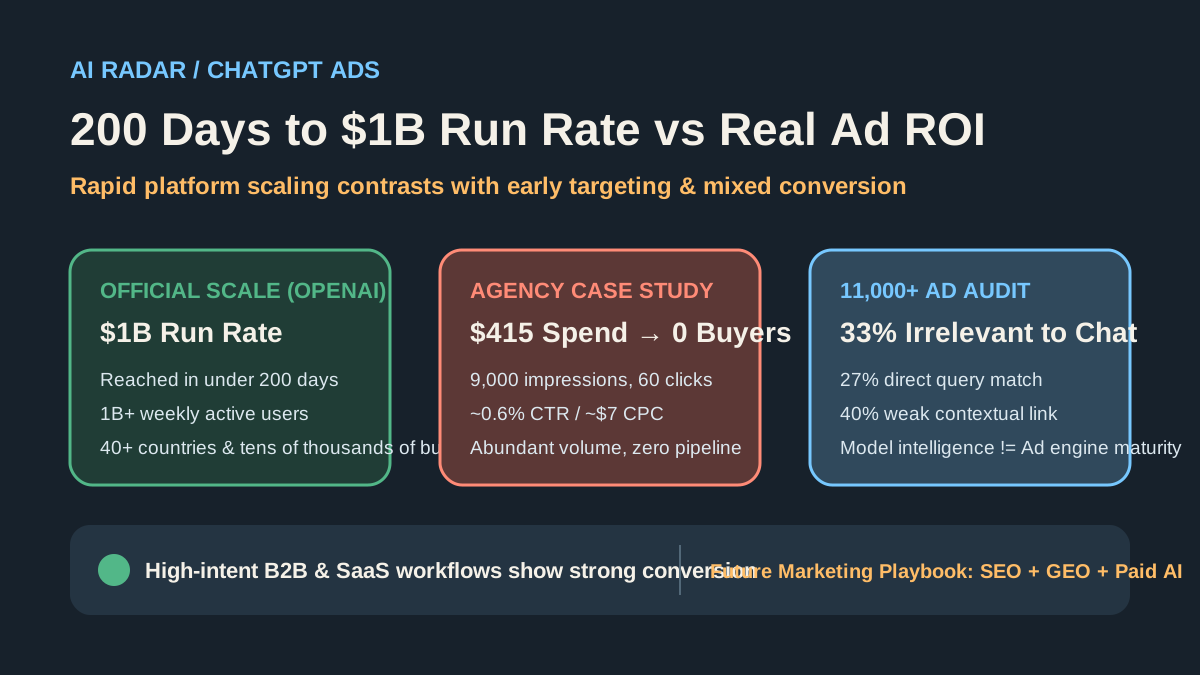
OpenAI announced on August 31, 2026 that ChatGPT Ads reached a $1 billion annualized revenue run rate in under 200 days, spanning 40+ countries and tens of thousands of advertisers with over 1 billion weekly active users. However, third-party audits show stark divergence: one agency test saw 9,000 impressions at 0.6% CTR with zero buyers for $415, and an analysis of 11,000+ ads found 33% appeared in irrelevant conversations; yet B2B and high-consideration workflows achieved 4.67% conversion. A massive AI ad inventory is forming, but targeting and marketing playbooks remain early.
Conclusion
OpenAI officially announced on August 31, 2026, that ChatGPT Ads has reached a $1 billion annualized revenue run rate in under 200 days since its initial pilot rollout, covering more than 40 countries, tens of thousands of advertisers, and expanding its self-serve Ads Manager across India, Europe, the Middle East, and North Africa.
Yet behind these headline platform figures, third-party benchmarks and real advertiser tests present a sharp contrast: - Canadian digital agency Choice OMG ran a live test campaign delivering nearly 9,000 impressions and 60 clicks at a 0.6% CTR, spending $415 without generating a single interested buyer; - Independent monitoring firm Searchable audited over 11,000 live ChatGPT ads and found that 33% appeared in conversations completely irrelevant to the product; - At the same time, specialized practitioners in high-consideration niches like real estate consulting achieved a 1.45% CTR and 7 confirmed appointments on a $500 budget (a 4.67% click-to-booking conversion rate).
A $1 billion annualized revenue run rate proves that the ad market is eager to buy access to ChatGPT's 1 billion weekly active users, but it does not yet prove that advertisers can consistently generate profitable returns. Model intelligence is not the same as ad distribution intelligence; ChatGPT Ads is reshaping the top of the funnel, but businesses must differentiate between indiscriminate impression spending and tailored AI decision marketing.
---
What happened: OpenAI's $1B milestone and real-world advertiser divergence
1. Reaching $1B in under 200 days: OpenAI's rapid commercial scaling
OpenAI's announcement cited verified operational figures rather than loose projections: - Timeline: Under 200 days from pilot launch to the $1B run rate; - Annualized run rate: Surpassing $1 billion in annualized revenue run rate; - User volume: Over 1 billion weekly active users (WAU); - Self-serve access: Advertisers in India, Europe, the Middle East, and North Africa can now register and purchase ads directly via Ads Manager without working through dedicated enterprise sales teams.
Reuters independently confirmed these metrics and noted that small and medium-sized businesses (SMBs) already represent a "material share" of ChatGPT ad spend, signaling a transition from exploratory brand budgets at multinational corporations to performance-oriented advertisers.
2. 9,000 impressions, zero buyers: agency test reality check
Days prior to OpenAI's announcement, MediaPost reported on real campaign data from Peter Jaffray, managing director at Canadian digital agency Choice OMG: - Budget and scope: Three campaigns across Ontario and Alberta running over roughly two weeks with a total spend of $415; - Impressions and clicks: Over 9,000 impressions delivered against an initial projection of 4,000, generating 60 clicks; - Core metrics: A click-through rate (CTR) of approximately 0.6% and an average cost-per-click (CPC) of around $7; - Final outcome: Zero qualified leads or interested buyers generated from the $415 budget.
Volume was readily available and exceeded expectations, but commercial intent and downstream conversion remained flat.
3. 11,000-ad audit: one third irrelevant to current conversation
AI visibility firm Searchable collected and analyzed more than 11,000 live ChatGPT ad placements between July 4 and August 4, pairing each sponsored unit with the active conversation text: - Irrelevant: 33% of ads had no discernible contextual connection to what the user was asking; - Direct match: Only 27% represented direct alignment where the ad directly fulfilled the user's explicit question; - Contextual match: The remaining 40% had weak associative links to prior discussion topics rather than the immediate query.
This disparity explains why deep conversational context has not yet automatically translated into surgical ad precision.
4. Not an across-the-board failure: high-intent decision workflows show traction
In contrast to commoditized consumer goods, performance marketer Austin St. Jean documented a distinct outcome in real estate consulting: - Budget and delivery: 10,372 impressions and 150 clicks across a 14-day flight on a $500 budget; - Performance: A 1.45% CTR at an average CPC of $3.33; - Downstream conversion: 7 confirmed client bookings, representing an acquisition cost of $71.43 per booking and a 4.67% click-to-booking conversion rate.
Data aggregated by third-party tracking platform ChatGPT Ad Library confirms this sectoral concentration: across 17,000+ ads audited through August, the top five verticals were Enterprise & Fintech, SaaS & Productivity, Email Marketing & CRM, Real Estate, and Cloud & DevOps, together accounting for 59.5% of tracked placements.
---
Why it matters: redefining rules from search ads to conversational decision portals
1. From search traffic to commercial gates: convergence of Google, SEO, and GEO
For over two decades, Google operated on a dual structure: sponsored ads at the top and organic search results below. ChatGPT is assembling a parallel architecture: - Embedded layer: Natural AI Answers; - Sponsored layer: Sponsored Placements beneath the prompt response.
With 1 billion weekly active users conducting discovery and evaluation inside chat windows, brands relying solely on traditional Google Ads risk becoming invisible at the earliest stages of decision-making.
2. Guardrails: advertising cannot alter organic answers
OpenAI explicitly reaffirmed two operational policies: 1. Ads do not influence ChatGPT's organic responses: Advertisers cannot pay to alter the model's generated editorial recommendations; 2. Advertisers do not receive access to private user chat histories.
Consequently, Generative Engine Optimization (GEO) has not been superseded by paid ads. Organic citations remain governed by website depth, authority, technical documentation, and structured data, while paid units operate alongside organic synthesis.
3. Future roadmap: transition from static cards to Commerce Agents
OpenAI's release noted upcoming explorations into "new ways for businesses to interact with consumers in more native ways in ChatGPT." This points toward dynamic agentic integrations: - Direct API and Model Context Protocol (MCP) connections between merchant backends and chat sessions; - Real-time quote generation, inventory lookups, and sample ordering executed directly within conversation flows.
---
Our verdict: evaluating the ChatGPT advertising wave
- $1B reflects platform scale, not proven advertiser ROI: Early ad platforms consistently attract land-grab experimentation. The true test of ChatGPT Ads will be second-year advertiser retention and repeat spend.
- High-consideration B2B workflows fit chat interfaces far better than impulse goods: Low-ticket impulse buys thrive on visual feeds like TikTok and Instagram; complex procurement, CRM software, and enterprise solutions benefit from the interactive, research-heavy chat environment.
- Landing pages must be re-engineered for AI-referred traffic: Unlike search users beginning their research journey, AI-referred visitors have already spent minutes comparing specifications. Landing pages must bypass generic marketing copy to deliver immediate pricing, minimum order quantities (MOQs), compliance credentials, and direct inquiry paths.
- Exporters should prioritize structured product data first: Rather than rushing uncalibrated ad spend, businesses should standardize technical specs, certifications, and Schema.org markup to capture both organic GEO citations and future agentic commerce integration.
---
What to watch next: key open questions
- Targeting precision and algorithm refinement: Whether OpenAI can substantially reduce the 33% irrelevant ad placement rate while maintaining user privacy boundaries.
- Academic and regulatory scrutiny: Early academic audits from arXiv (evaluating 91 persona accounts across 3,000+ ads) observed higher ad exposure on lower-income personas, making demographic targeting and ad equity ongoing compliance themes.
- Global payment and regional rollout: When Ads Manager will support additional Asian and international currencies for direct cross-border settlement.
- First-party attribution standards: How OpenAI will structure multi-touch attribution to quantify the true commercial value of conversational clicks.