Claude finally made computer use production-ready: AI can work in sites with no API
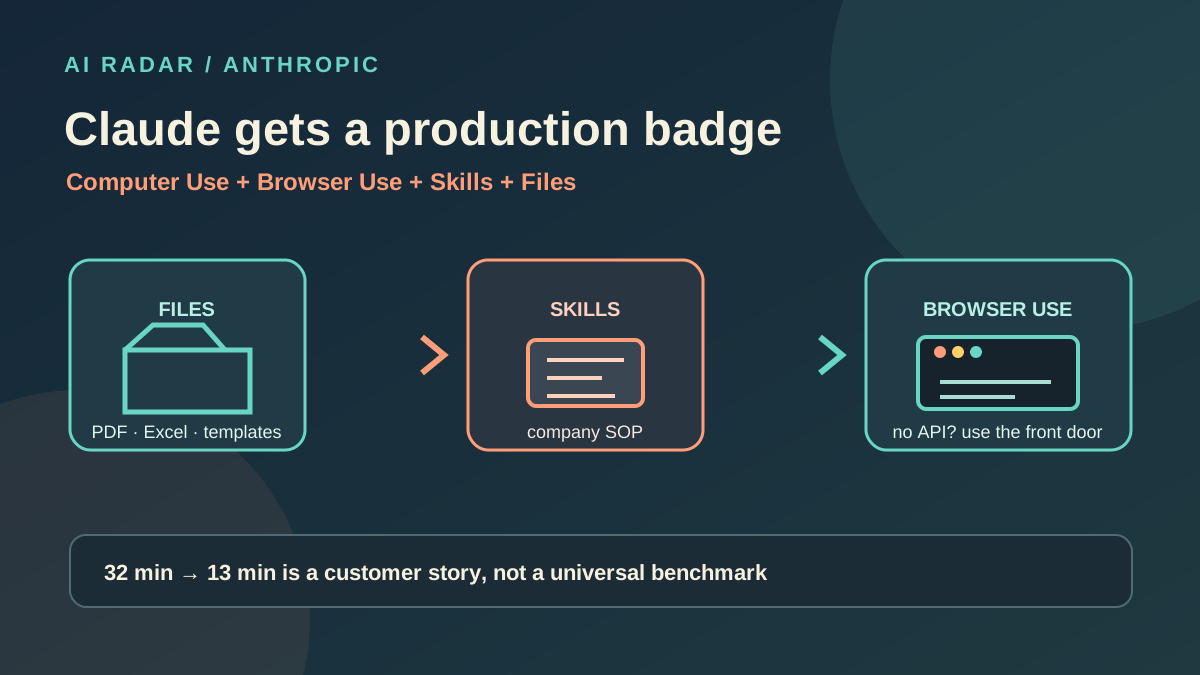
Anthropic has made Computer Use, the Skills API and the Files API generally available, adding Browser Use to combine screenshots with page structure. It is assembling files, procedures and no-API software into production agents, but the 32-to-13-minute workflow, roughly 30% cost reduction and 100% completion figure are customer claims published by Anthropic, not independent proof of reliability.
The bottom line
Claude has finally moved “using a computer” from the demo room into the product catalogue.
On August 20, 2026, Anthropic announced general availability for Computer Use, the Skills API and the Files API on the Claude Platform, and introduced Browser Use. Together they let an agent read documents, follow a company's operating procedure and operate a web back office that has no API at all.
Anthropic's early customer story is striking: a claims workflow fell from 32 minutes to 13, cost per task fell about 30%, and completion was reported at 100%. Those figures come from an Anthropic customer case, not an independent benchmark. The meaningful change is not that Claude has already replaced RPA. It is that “this system has no API” is losing its power as an excuse for not automating it.
AI used to explain the last step; now it tries to perform it
Give Claude a claims document in the past and it could read the PDF, extract fields and explain what to enter next. Opening an insurer's old back office, locating the Claim page, filling dozens of fields, submitting the form and downloading the receipt still required a person.
Computer Use is built for that manual layer: it sees the screen, clicks, types, scrolls and presses keys. Anthropic now lets one model call execute several actions in sequence instead of returning to the model after every click.
That sounds like an implementation detail, but it determines whether an agent can enter production. A workflow that completes only after dozens of round trips will be rejected by speed and cost before anyone argues about intelligence.
Browser Use matters because it no longer guesses only from pixels
Pure computer use is like giving a model a screenshot and asking it to guess that the submit button is somewhere near the lower right. Move the page and the coordinate can fail.
Browser Use also exposes page structure. Claude can identify an input field, an element named Submit or a dropdown, then combine that information with visual understanding to operate the specific element. Vision interprets the page; structure helps the action land accurately. That is closer to a maintainable browser agent than pixel clicking alone.
More reliable does not mean reliable enough for anything. Login state, CAPTCHAs, pop-ups, multiple tabs, network failures and redesigns remain real failure modes. Payments, deletions, outgoing mail, orders and customer-data edits still need human approval even when an API exists.
Skills and Files turn a veteran employee's SOP into modules
The Skills API answers the question: how does this company actually work? A skill can contain instructions, scripts and templates, and can be versioned. After an inquiry arrives, a skill might check the country, verify the product and MOQ, then apply an approved quotation format. When the rule changes, update the skill instead of rewriting a giant prompt.
The Files API answers a more mundane question: why keep moving the same material? Upload a PDF, spreadsheet or template once, reference it by ID later, and download the file the agent creates. Anthropic also lists automatic expiry, five-times-higher rate limits and 1 TB of storage per organization among the GA updates.
Put together, this resembles what an enterprise actually wants: Files provide the evidence, Skills provide the rules, Computer or Browser Use performs the work, and the output comes back as a file. These are parts of a digital worker's infrastructure, not merely another button in a chat window.
A 32-minute workflow became 13 minutes, but a customer story is not a law of nature
Anthropic cites a healthcare-insurance customer whose system had no API. Its longest claims workflow fell from 32 minutes to 13, task cost dropped about 30%, and completion was reported at 100%, without changing the prompt.
That story suggests the new multi-action design may solve a real round-trip bottleneck. The public material does not say how many tasks were tested, how retries were counted, how difficult the pages were or how often a human intervened. The accurate version is: the customer case shows potential; it does not prove Computer Use is 100% reliable.
Independent research is a useful cold shower. An ICLR 2026 web-agent paper used Claude Computer Use as a baseline. Its specialized WALT method averaged 52.9% on WebArena and VisualWebArena, clearly above that baseline. A general model is flexible, but a method designed specifically for web tasks can still beat it.
Our judgement: RPA's lunch is on the table, but no one has eaten it yet
The hardest automation targets are often old ERPs, supplier portals, insurance systems, government sites and internal forms. They have no API, and nobody wants to rebuild an interface for one agent. Computer Use takes the opposite route: if software will not open a machine door, the agent tries the front door that humans already use.
That is why this may matter more than another MCP demo. MCP and API agents require the software to open a door. Browser Use starts with a web page that already exists.
The best first tasks are repetitive, rules-based, easy to verify and low-risk: entering back-office data, downloading reports, extracting fields from a PDF and entering them into a legacy system. “Handle everything for me” is still a poor specification.
Three numbers deserve attention: real success over long trajectories, recovery after failure, and the cost of human approvals and retries. Agent benchmarks should stop asking only whether a model can click a button. The useful question is whether it can run a real job 100 times, how often it finishes, and whether it can recover without creating a mess.
Claude Computer Use reaching GA means agents are leaving the demo stand and entering the workshop. It is not a digital employee yet, but it has started wearing a badge.
What to watch
- Whether independent teams reproduce the 32-to-13-minute result, roughly 30% cost reduction and reported completion rate;
- Browser Use stability under redesigns, CAPTCHAs and long task chains;
- Approval boundaries for payments, mail, deletion and data edits;
- Whether price, latency and retries can beat established RPA systems.