Codex usage was not all in users' heads: OpenAI acknowledged bugs, even in title generation
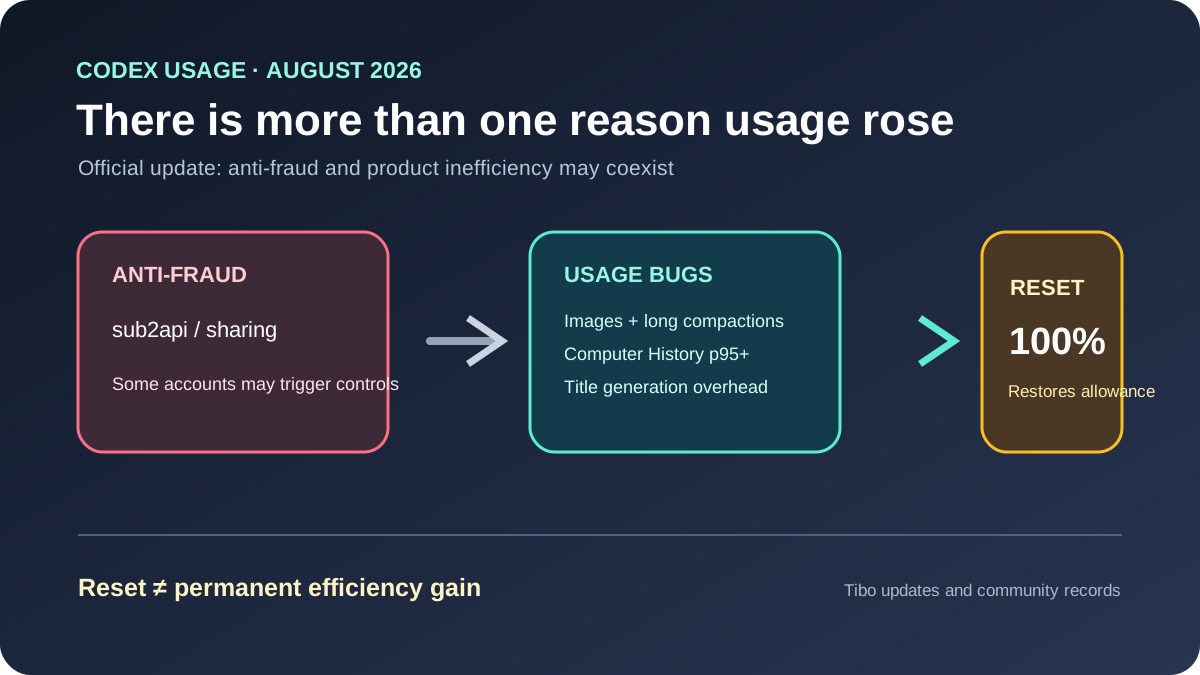
OpenAI Codex lead Tibo publicly acknowledged extra usage inefficiencies involving images in long sessions with repeated compactions, high-percentile Computer History usage and session-title generation, and said a reset was rolling out to paid accounts. This complements the earlier sub2api anti-fraud explanation: Codex anomalies may include both account controls and product inefficiency, while a reset does not prove a permanent doubling of efficiency.
Conclusion
On August 23, Tibo, an OpenAI Codex lead, said the team had found several issues that could make Codex usage drain faster than expected: inefficiencies when images appear in long sessions with repeated context compactions, unusually high Computer History usage among p95-plus users, and a feature intended to generate session titles consuming more usage than it should. He later said a reset would land and previewed more efficiency work.
This adds an important piece to the recent “Codex quota shrinkage” dispute, but it should not be simplified to “OpenAI admitted every limit was miscounted.” Tibo had also said that some accounts the team contacted were using sub2api-style subscription-to-API setups that can trigger anti-fraud systems. The careful reading is that anti-fraud effects and product-side usage inefficiency may coexist.
Three days ago, everyone was arguing about sub2api
Recent Codex complaints were not mainly about wrong answers. They were about usage disappearing too quickly. Some users said a workflow that lasted days now exhausted its allowance in one day. An OpenAI Community user said they used no MCP or similar tool, only the official Codex Desktop, with roughly the same workload, yet their weekly limit felt much tighter.
Tibo's investigation of some affected accounts pointed to sub2api: wrapping a ChatGPT/Codex subscription into an API through OAuth or an intermediary, sometimes for shared account pools, can trigger anti-fraud controls. That may explain some accounts, but it cannot automatically explain every normal user's experience.
The distinction matters because a security or abuse-control decision is not the same thing as a metering defect. An account can be restricted because of how access is being shared, while another account can see unusually fast usage because an internal feature is inefficient. The same outward symptom—an allowance falling quickly—can therefore have different causes.
OpenAI now admits Codex itself was wasting usage
Tibo's August 23 update names three classes of issue:
- inefficiency when images appear in long sessions with multiple compactions;
- high Computer History usage among p95-plus heavy users;
- a feature intended to generate session titles draining more usage than intended.
The third item is the most vivid. Users think their allowance is paying only for “fix login bug,” while an Agent product also runs title generation, history, caching, compaction, tools and review. If one background component wastes a little on every long session, the same percentage reflects all of it.
Tibo's wording is also narrower than the strongest community headlines. He described inefficiencies and usage draining “more than intended”; he did not publish a complete accounting of every token or claim that the entire rate-limit system was defective. The responsible conclusion is that these are confirmed areas to test, not a universal explanation for every user's weekly allowance.
Why long Agents amplify small inefficiencies
A normal chat is often one question and one answer. Codex may read a repository, search files, edit code, run tests, inspect screenshots, operate a computer, compact its context and continue.
If image processing costs a little extra each round, compaction carries redundant material, or history becomes unusually expensive for high-percentile users, a short session may not show it. A multi-hour Agent session will.
That explains why the community can show opposite experiences at once: one user runs out in half a day, another loses little after hours. Models, project size, images, cache hits, tools and compaction counts differ.
There is another source of noise: the visible percentage is a product-level meter, not a transparent invoice. A user may see the same 5% fall after a short task even when the underlying calls, cached input, image processing and background work are very different. Without a breakdown, users are forced to infer the cause from the timing of the drop.
A reset is compensation, not proof that efficiency has doubled
Tibo said the reset would reach paid accounts and replied to users about the timing. A full usage reset restores the current allowance. Fixing inefficiency is what would make the same work consume less in the future.
OpenAI also previewed an efficiency improvement unrelated to these three issues. If it reaches production, it could change Codex's long-term value. A full meter after a reset is not evidence that limits were permanently restored or multiplied.
The reset should therefore be treated as a clean starting point for measurement. It gives users a chance to compare a similar task after the fixes, but it does not by itself establish that the old usage was all caused by one bug. Nor does it prove that a future week will have the same behavior if the workload, model routing or cache state changes.
Some users feel an improvement, but the evidence is thin
One social-media user reported that after the fix, roughly half an hour of high-intensity model use consumed about 2% of their Plus weekly allowance, compared with 3–5% for a similar task before. This is worth recording, not treating as a benchmark.
Context, project size, cache, images, compaction and reasoning effort all change usage. For now it shows that some users noticed an improvement, not a fixed gain for every plan.
“OpenAI secretly cut everyone” is also too simple
There is no evidence here that OpenAI uniformly halved every paid user's limits. There is also no evidence that every anomaly came from sub2api.
The more defensible map is:
- Some accounts may trigger anti-fraud controls through subscription-to-API, sharing or similar behavior;
- Codex itself has usage inefficiencies publicly acknowledged by its lead;
- Different workflows hit different triggers, creating very different experiences;
- A reset may help immediately, while the durable result needs post-fix usage records.
This is not a complete defense of OpenAI. It is a way to keep two public strands of evidence in their proper places.
What Codex users can measure now
If your usage previously looked abnormal, a small before-and-after comparison is more useful than arguing from memory:
- record the starting and ending usage percentage;
- keep the model and reasoning effort constant;
- use projects and tasks of roughly similar size;
- mark images, Computer History, compactions and subagents;
- run for 30–60 minutes and record completed work and elapsed time.
That answers whether the fix helped your workflow, rather than mixing different plans, caches and tasks.
If possible, repeat the test twice and keep a short log. A single run can be distorted by a failed tool call, an unusually long prompt or a cache miss. Repeated observations will not produce an official benchmark, but they are much better evidence for an individual account than screenshots without task context.
Our judgement
The important change is not another reset. It is that OpenAI's explanation became more complete. Blaming every anomaly on sub2api could not explain users who never used it; blaming every anomaly on a secret limit cut is also unsupported.
Codex is becoming a long-running Agent system rather than a chat box. Users see one usage percentage, while the bill reflects models, caches, images, history, compaction, title generation and tools. Until the platform exposes these costs, any anomaly will first look like a hidden limit change.
What to watch next
- Whether the reset reaches every paid plan consistently;
- Whether image-heavy sessions and repeated compactions consume less after the fixes;
- Whether Computer History usage returns to a reasonable range;
- When the previewed efficiency improvement ships and whether users can reproduce it;
- Whether OpenAI adds a detailed usage breakdown.
Sources and evidence boundary
- Primary update: Tibo's August 23 public Codex rate-limit update
- Primary reply: Tibo's public reply about reset timing
- Community record: OpenAI Developer Community discussion of Codex limits and user reports
- User report: an individual post about post-fix usage, not official statistics
This article reports the inefficiencies and reset described publicly by an OpenAI lead. It does not treat them as the only cause of every anomaly, and it does not turn individual user feedback into a universal plan improvement.
The article also uses community reports only as evidence that the problem was experienced by real users, not as a substitute for OpenAI's own telemetry. The next useful update would be a public usage breakdown or a before-and-after measurement covering the same plans and workloads.