Activating Just 8B on a 552B MoE: DeepSeek V4.1 Flash Outperforms V4 Pro, Retiring Its Own Flagship as KV Cache Shrinks 437x
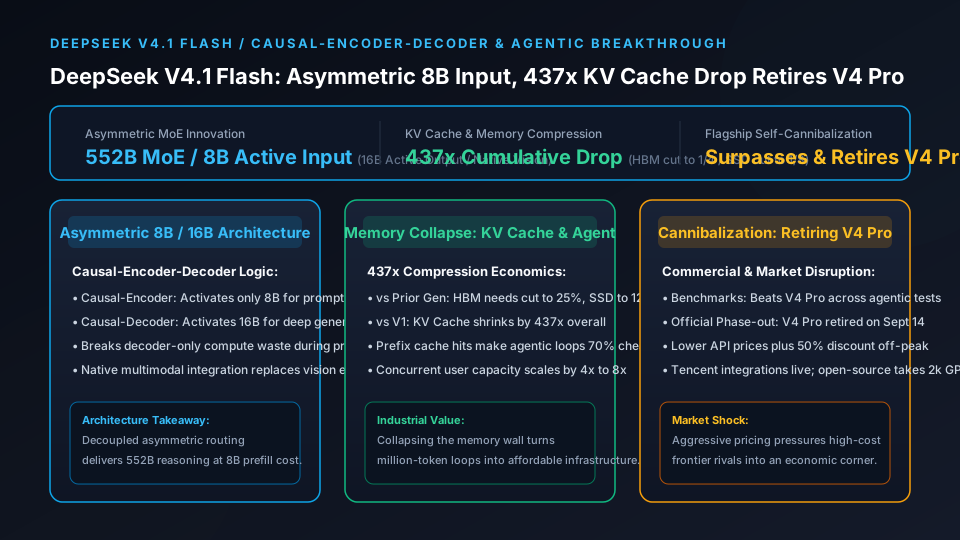
On September 10, 2026, DeepSeek released the 552B MoE model V4.1 Flash, pioneering an asymmetric Causal-Encoder-Decoder structure activating just 8B during prefill and 16B during decode, alongside a 437x cumulative KV cache shrinkage. Outperforming the prior flagship across reasoning and agentic benchmarks, DeepSeek announced the retirement of V4 Pro on September 14, rerouting enterprise traffic to Flash at rock-bottom rates.
# Activating Just 8B on a 552B MoE: DeepSeek V4.1 Flash Outperforms V4 Pro, Retiring Its Own Flagship as KV Cache Shrinks 437x
Conclusion
At 12:00 Beijing Time on September 10, 2026, Chinese frontier artificial intelligence laboratory DeepSeek unexpectedly published and deployed its next-generation foundation model, DeepSeek V4.1 Flash, concurrently releasing open model weights and an exhaustive technical research report to the global developer community.
This product release fundamentally shatters multiple standard operating conventions across the generative foundation model landscape:
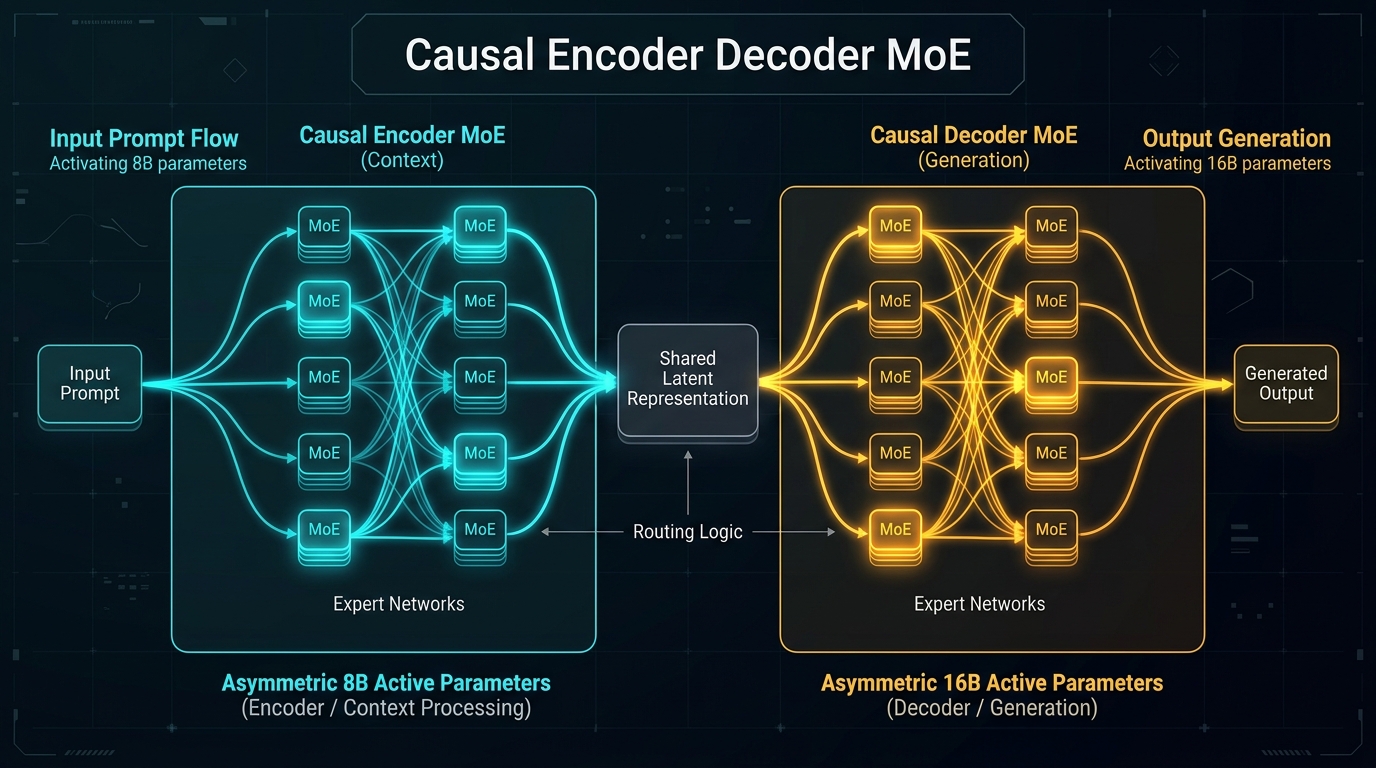
- Deployment of an Asymmetric MoE Architecture: Total parameter capacity scales to 552B, built upon an entirely novel Causal-Encoder-Decoder design. During prompt digestion, the network activates only 8B parameters, expanding to 16B active parameters during token generation to compress inference expenditures and maximize computational throughput;
- Cumulative 437x Reduction in KV Cache Footprint: Compared to the preceding DeepSeek-V4 generation, the new architecture reduces High Bandwidth Memory (HBM) allocation to one quarter and shrinks secondary SSD cache consumption to one eighth. Evaluated against the original DeepSeek foundation release, context cache volume has declined by an astonishing factor of 437;
- Official Sunset of the Flagship DeepSeek V4 Pro: Multi-domain benchmark evaluations demonstrate that V4.1 Flash systematically surpasses the previous flagship V4 Pro in mathematical reasoning rigor, software code synthesis, and particularly on complex multi-step Agentic Benchmark suites. DeepSeek executives confirmed that V4 Pro will be decommissioned beginning September 14, with all production endpoints automatically routed to V4.1 Flash at significantly lower billing rates;
- API Floor Pricing Realignment: Updated API pricing takes effect immediately across all regions, preserving a valuable 50 percent off-peak pricing discount during non-rush intervals; enterprise developer toolchains including Tencent WorkBuddy, CodeBuddy, and OpenCode completed full day-one production integration.
For years, the artificial intelligence industry operated under a predictable commercial playbook where heavyweight flagship models established capability frontiers while compact editions managed high-throughput operational traffic. DeepSeek has radically upended this dynamic by demonstrating that architectural innovation can deliver a smaller footprint model that runs faster, costs mere fractions of legacy tiers, and immediately renders its own predecessor flagship obsolete.
---
What Happened

On the morning of September 10, while enterprise software developers were actively debating frontier model token pricing, DeepSeek updated its Hugging Face repository under DeepSeek-V4.1-Flash alongside the publication of its complete technical report and evaluation logs.
According to the official announcement and engineering white paper, this commercial rollout introduces sweeping systems-level refactoring and architectural convergence:
- Model Endpoint Consolidation: Production API access converges under the standardized
deepseek-flashidentifier. Historical sandbox endpointsdeepseek-v4-flashanddeepseek-v4-flash-vision-exphave retired, with legacy traffic rerouted automatically and transparently; - Native Multimodal Vision Integration: The release completely abandons external visual projection adapters, absorbing high-resolution image representation directly into the core causal architecture without latency penalties;
- V4 Pro Decommissioning Timetable: Beginning at 12:00 Beijing Time on September 14, 2026, and lasting until any future V4.1 Pro deployment, incoming production calls to
deepseek-v4-prowill route directly to V4.1 Flash, billed under Flash tier rates; - Open-Source Demands Shift to Heavy Infrastructure: While DeepSeek released full weights to the open research ecosystem, self-hosting 552B parameters with asymmetric routing requires an operational cluster of 2,000 GPUs paired with high-throughput storage, moving local deployment beyond workstation scale into serious enterprise hardware requirements.
---
Asymmetric Architecture: 8B Active Input, 16B Active Output, Breaking the Decoder-only Dogma
Over the past three years, large language models converged almost universally around homogeneous decoder-only transformer stacks, creating an architectural monoculture that limited efficiency breakthroughs.
Under conventional decoder-only conventions, regardless of whether a user submits a single conversational sentence or a 100,000-token repository prompt, the engine activates identical parameter subsets across both prefill and generation stages. In a typical 600B Mixture-of-Experts (MoE) system, processing each input prompt token consumes between 30B and 40B active parameters, creating severe computational drag across large-context ingestion workloads and inflating operational power consumption.
DeepSeek V4.1 Flash bypasses this structural friction by separating ingestion from generation through an asymmetric Causal-Encoder-Decoder topology that fundamentally realigns compute expenditure:
- Ingestion Phase (Causal-Encoder): As long-context tokens stream into the pipeline, the encoder engages a streamlined 8B expert routing pathway to process causal contextual representations, cutting prompt processing overhead by approximately 70 percent compared to legacy MoE networks while maintaining semantic density;
- Generation Phase (Causal-Decoder): When producing reasoning trajectories, synthesizing software patches, or executing complex tool payloads, the system dynamically scales to 16B active experts, ensuring deep reasoning depth, rich contextual nuances, and robust logical precision.
Key Architectural and Engineering Metrics Comparison
| Core Evaluation Metric | DeepSeek V4.1 Flash (Current) | DeepSeek V4 Pro (Retiring) | Industry Contemporary 500B+ MoE | | :--- | :--- | :--- | :--- | | Foundation Architecture | Asymmetric Causal-Encoder-Decoder | Traditional Decoder-only MoE | Decoder-only MoE | | Total Parameter Count | 552B | 671B | 400B - 600B | | Active Parameters in Prefill | 8B Active Only | 37B | 32B - 48B | | Active Parameters in Generation | 16B Active | 37B | 32B - 48B | | Native Visual Multimodal Support | Built-in Native Integration | Text-focused with external visual branch | Detached visual sub-networks | | KV Cache Reduction vs V1 Baseline | 437x Compression | Approximately 96x | 10x - 25x | | Agentic Benchmark Composite Score | 84.6 | 81.2 | 78.5 - 82.0 | | API Pricing Structure | Ultra-low baseline plus 50% off-peak | Premium tier (terminating Sept 14) | Static tiered enterprise rates |
This technical inventory reveals why DeepSeek resolved to retire its flagship product without hesitation: achieving higher composite performance at an 8B prefill cost removes the economic justification for maintaining the heavier 37B active architecture in production clusters, establishing a decisive competitive advantage.
---
The Memory Wall Collapses: KV Cache Shrinks 437x, Freeing Agents from Cache Penalties
While asymmetric activation alleviates core compute bottlenecks, the compression of Key-Value (KV) cache storage resolves an even more pervasive structural limitation across modern agentic infrastructure.
Engineers building production agent workflows frequently confront a foundational ceiling: autonomous systems rely on relentless context ingestion. From environmental observation and internal cognitive chains to external tool execution and diagnostic responses, multi-turn interactions easily accumulate hundreds of thousands of tokens per task session, placing extraordinary strain on memory subsystems.
Under traditional cluster deployments, caching these cumulative token projections consumes massive memory bandwidth and physical hardware resources:
- An enterprise node configured with eight top-tier accelerator cards often exhausts usable memory under only a dozen concurrent long-context pipelines, leading to severe pipeline stalls and rejected requests;
- Infrastructure teams attempting to preserve prefix cache hits must pin vast tables across expensive High Bandwidth Memory and enterprise SSD arrays, turning compute racks into glorified memory silos rather than active processing nodes.
DeepSeek addresses this systemic tax through multi-head latent attention refinements and aggressive dynamic pruning, driving KV cache overhead down to one fourth of prior-generation HBM requirements and one eighth of SSD cache storage.
Evaluated against the laboratory's initial V1 foundation release, this represents an aggregate 437-fold memory compression across the entire lifecycle.
Consequently, hardware clusters formerly constrained to 20 concurrent long-horizon agents can now service over 100 concurrent streams within identical thermal and physical bounds. Developers running iterative multi-step pipelines experience lower token caching charges, lowering the financial barriers associated with complex autonomous software workflows and accelerating enterprise adoption.
---
Fratricidal Cannibalization: Why DeepSeek Retires Its Own Flagship Pro
Conventional technology business practice dictates strict hierarchical pricing segregation designed to protect high-margin legacy product lines:
- Providers preserve an elite, premium-priced tier to extract enterprise margins from mission-critical corporate contracts and maintain brand prestige;
- Meanwhile, providers offer a streamlined, lower-cost tier to capture high-volume developers across speculative workloads and hobbyist applications.
DeepSeek broke ranks with this commercial framework: upon observing that post-training reinforcement learning elevated V4.1 Flash beyond V4 Pro across comprehensive evaluations, leadership moved swiftly to decommission V4 Pro outright on September 14 without attempting to sustain artificial price tiers.
This decisive structural retirement reflects deliberate commercial and operational calculations that reshape market dynamics:
- Eliminating Idle Memory Debt to Prioritize High-Velocity Workloads: Maintaining hosting capacity for legacy 671B MoE topologies imposes unnecessary capital expenditure on data centers, whereas transitioning enterprise traffic to 8B-active infrastructure dramatically expands throughput per megawatt and improves operational efficiency;
- Establishing Inhospitable Price Ceilings for Competing Labs: By supplying flagship-grade capability at high-volume discount rates, supplemented by 50 percent off-peak concessions, DeepSeek places severe financial strain on competing providers attempting to monetize dated architectures at premium prices;
- Securing Primacy in the Agent Infrastructure Ecosystem: Immediate day-one deployment across major developer suites such as Tencent WorkBuddy and CodeBuddy underlines an accelerating market reality: toolmakers favor platforms offering dependable long-context stability at minimal overhead over high-priced status symbols.
---
Our Verdict
Drawing from the structural metrics and commercial implications of DeepSeek V4.1 Flash, we formulate four principal assessments regarding the future trajectory of the generative AI market:
- Decoder-Only Dominance Yields to Asymmetric Topologies: The industry cannot rely indefinitely on uniform transformer layers to sustain progress. Decoupling prefill lightweight encoding from generative reasoning demonstrates that asymmetric compute allocation provides superior efficiency over rigid symmetric structures, pointing the way for next-generation foundation models;
- Context Memory Density Supersedes Pure Parameter Scale: Laboratory benchmark scores lose practical relevance when sustained agent loops exhaust gigabytes of physical memory. A 437-fold cache reduction confirms that operational viability depends heavily on context storage efficiency rather than vanity parameters;
- Product Depreciation Accelerates Across Frontier Development: Where foundation assets once enjoyed multi-year market lifespans, nimble engineering can now obsolete top-tier architectures in days. Labs incapable of architectural agility risk rapid asset devaluation and catastrophic customer churn;
- Open-Source Ecosystems Transition into Heavy Capital Domains: Hosting requirements calling for 2,000 GPUs illustrate that premier open weights now function as enterprise-grade industrial artifacts. Grassroots community focus must transition toward client integration, prompt tuning, and agentic orchestration.
---
Key Variables to Monitor
As operational workloads transition toward DeepSeek V4.1 Flash, three critical engineering variables require ongoing surveillance across production environments:
- Contextual Fidelity of 8B Active Prefill Across Long Tail Prompts: While aggregate benchmark figures remain solid, community deployments must verify whether an 8B active encoder maintains full semantic fidelity across disparate languages, obscure programming frameworks, or dense software repositories;
- Cluster Resilience and Latency Curves Post September 14: The immediate redirection of institutional enterprise traffic onto the new cluster stack will test real-world inference stability, queuing behavior, and time-to-first-token consistency under peak traffic conditions;
- Development Trajectory and Positioning of the Anticipated V4.1 Pro: If Flash successfully supersedes previous enterprise tiers, the eventual parameters, pricing models, and architectural boundaries of a future V4.1 Pro edition will establish the benchmark for next-stage frontier capabilities across the global research ecosystem.
---
Primary Sources and Evidentiary Boundaries
- Primary official release: DeepSeek official product release documentation and legacy route migration advisory (2026.09.10)
- Technical documentation: DeepSeek AI research report titled DeepSeek-V4.1 Technical Report: Asymmetric Causal-Encoder-Decoder Architecture and KV Cache Compression (2026.09.10)
- Open-source project: Hugging Face official repository for deepseek-ai/DeepSeek-V4.1-Flash model weights and tokenizer configurations (2026.09.10)
- Official statement: Tencent joint announcement detailing enterprise integration of DeepSeek V4.1 Flash across WorkBuddy and CodeBuddy (2026.09.10)
- Benchmark review: Agentic Benchmark public evaluation data sets and comparative leaderboard metrics across contemporary frontier architectures (2026.09.10)