Did Elon Musk Waste 100,000 GPUs? Grok Pivots to Model Broker, Reselling Archrival Claude Opus 5.5!
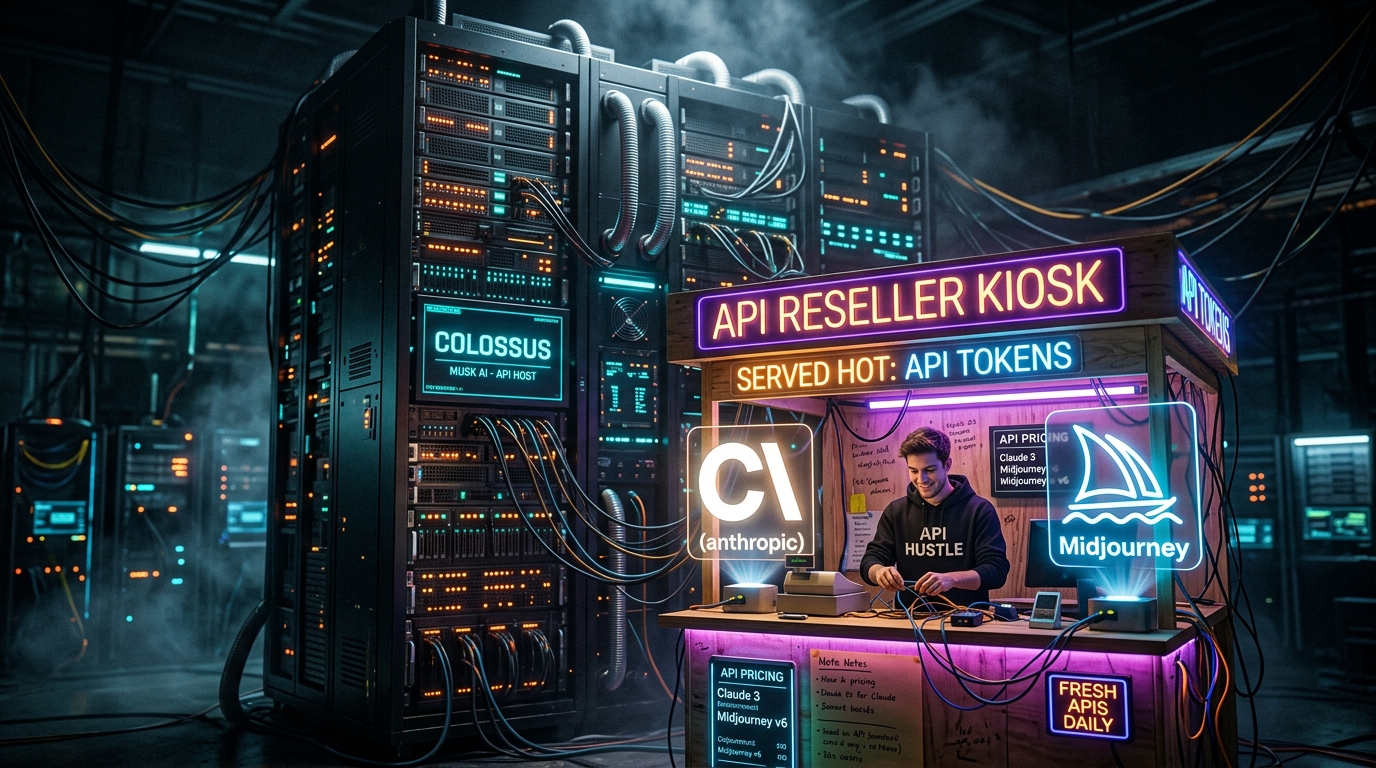
Despite pouring billions into a 100,000-GPU supercluster, Elon Musk's xAI pivoted Grok into an AI model router, bundling archrival Anthropic's Claude Opus 5.5 alongside Midjourney and Suno for just /month; while undercutting competitors in a fierce price war, it exposes frontier self-training headwinds and raises serious third-party data routing privacy concerns.
# Did Elon Musk Waste 100,000 GPUs? Grok Becomes a "Reseller," Secretly Routing to Arch-Rival Claude Opus 5.5!
Just weeks after pouring billions of dollars into constructing the "Colossus" supercomputer cluster equipped with one hundred thousand liquid-cooled Nvidia H100 accelerators, Elon Musk has abruptly turned around and converted xAI's flagship artificial intelligence product, Grok, into Silicon Valley's largest third-party API reseller.
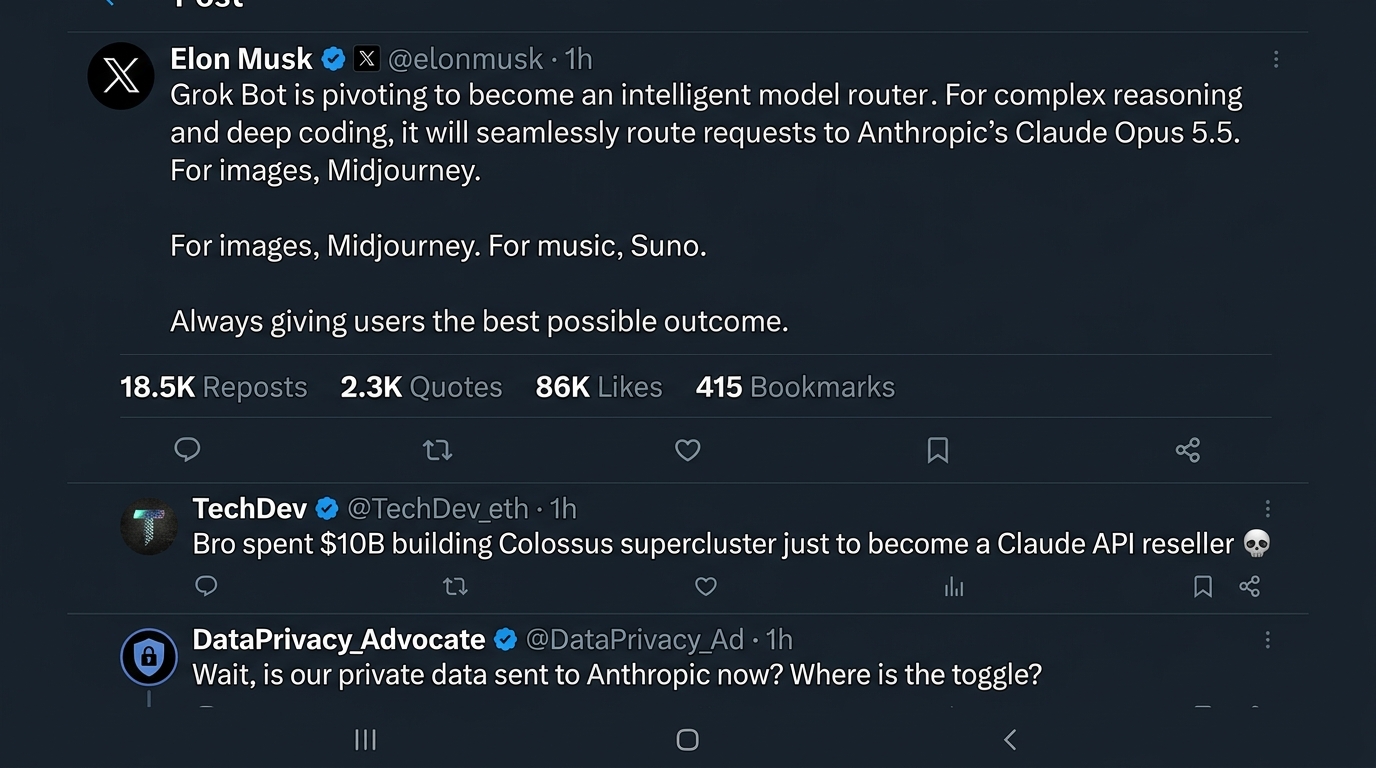
On October 10, 2026, Musk casually dropped an explosive announcement on social media platform X: Grok Bot is officially pivoting into an intelligent model router and distribution platform.
The practical mechanics of this newly unveiled multi-model routing engine are as striking as they are unexpected: * When presented with complex logical reasoning, intricate mathematical deductions, and extensive software refactoring: Grok quietly delegates the prompt to arch-rival Anthropic's flagship Claude Opus 5.5; * When prompted for professional-grade, high-aesthetic creative image generation: Grok outsources the job directly to Midjourney v6; * When requested to compose songs, generate acoustic stems, and produce arrangements: Grok connects directly to Suno Pro's audio pipeline; * What about Grok itself? Grok functions primarily as the receptionist and concierge at the front desk, routing incoming user traffic while handling free native search across public X platform feeds.
The moment the announcement broke across tech channels, developer communities, open-source researchers, and Silicon Valley engineers burst into collective laughter: "Did Musk spend months installing industrial transformers and running specialized high-voltage power lines in Memphis to build a 100,000 GPU industrial miracle, only to end up running an API wrapper kiosk for his primary corporate competitors?"
---
Verdict: The End of Compute Purism and the Rise of the "AI Wholesale Discount"
Let us place the primary facts, commercial realities, and editorial conclusions directly on the table:
- The myth of the omnipotent single foundation model has been punctured by Musk himself: Up until this announcement, frontier AI labs aggressively marketed a single overarching narrative to enterprise buyers and consumers alike—with enough compute clusters and trillions of model parameters, a single monolithic foundation model could excel at writing poetry, generating photorealistic artwork, composing soundtracks, and fixing compiler errors. Grok's strategic retreat into an orchestration router represents a public admission: in-house model Grok 4.7 cannot match Claude on complex reasoning, cannot rival Midjourney on artistic aesthetics, and possesses no native capability in the audio domain. Rather than embarrassing itself on public leaderboards, xAI chose pragmatic commercial reality over engineering pride.
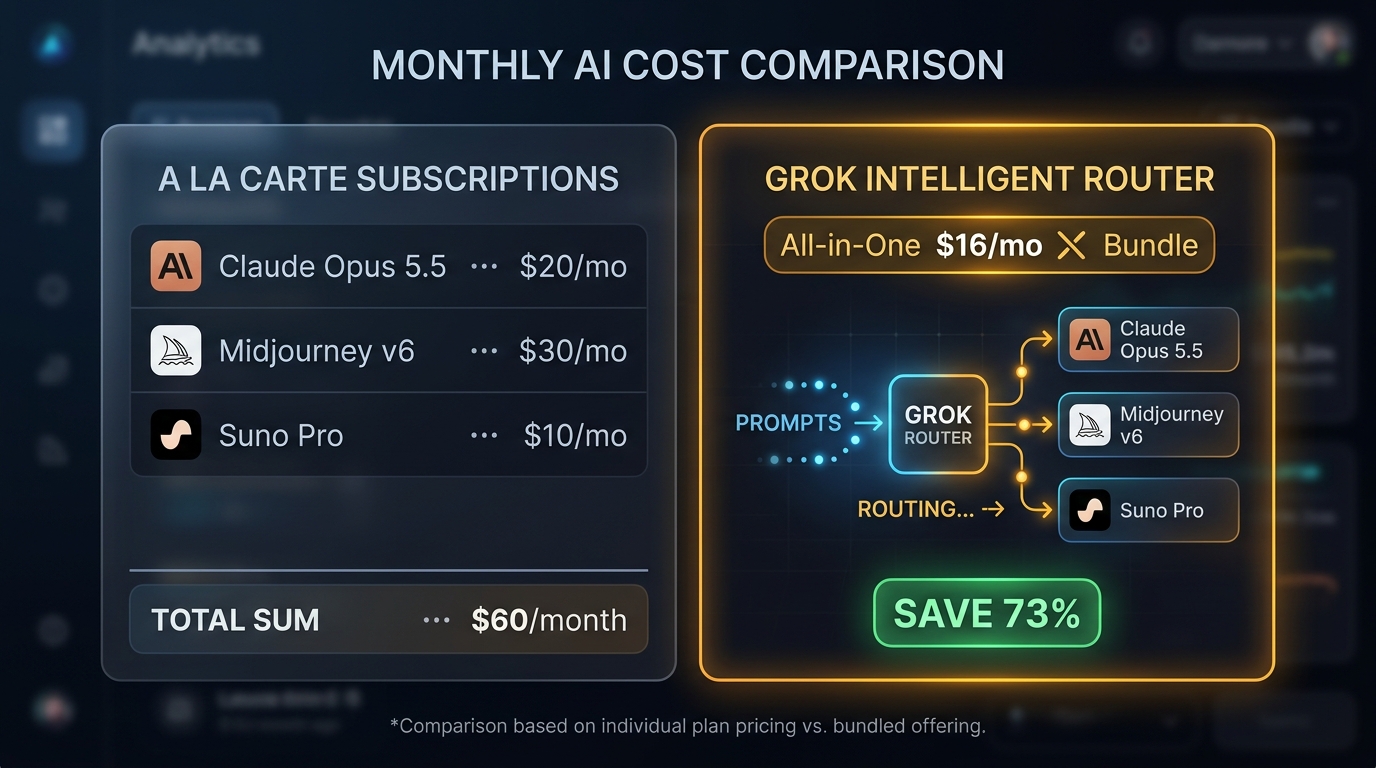
- The "AI Wholesale Bundle" is an undeniable bargain for cost-conscious creators: From an economic perspective, Musk's bundle represents an extraordinary deal that undercut competitors directly. Purchasing individual subscriptions costs $20 monthly for Claude Pro, $30 monthly for Midjourney, and $10 monthly for Suno, demanding at least $60 every single month across disparate accounts. Today, paying $16 per month for an X Premium subscription provides bundled access through Grok, delivering a net 73% consumer discount that fundamentally redefines the consumer pricing landscape.
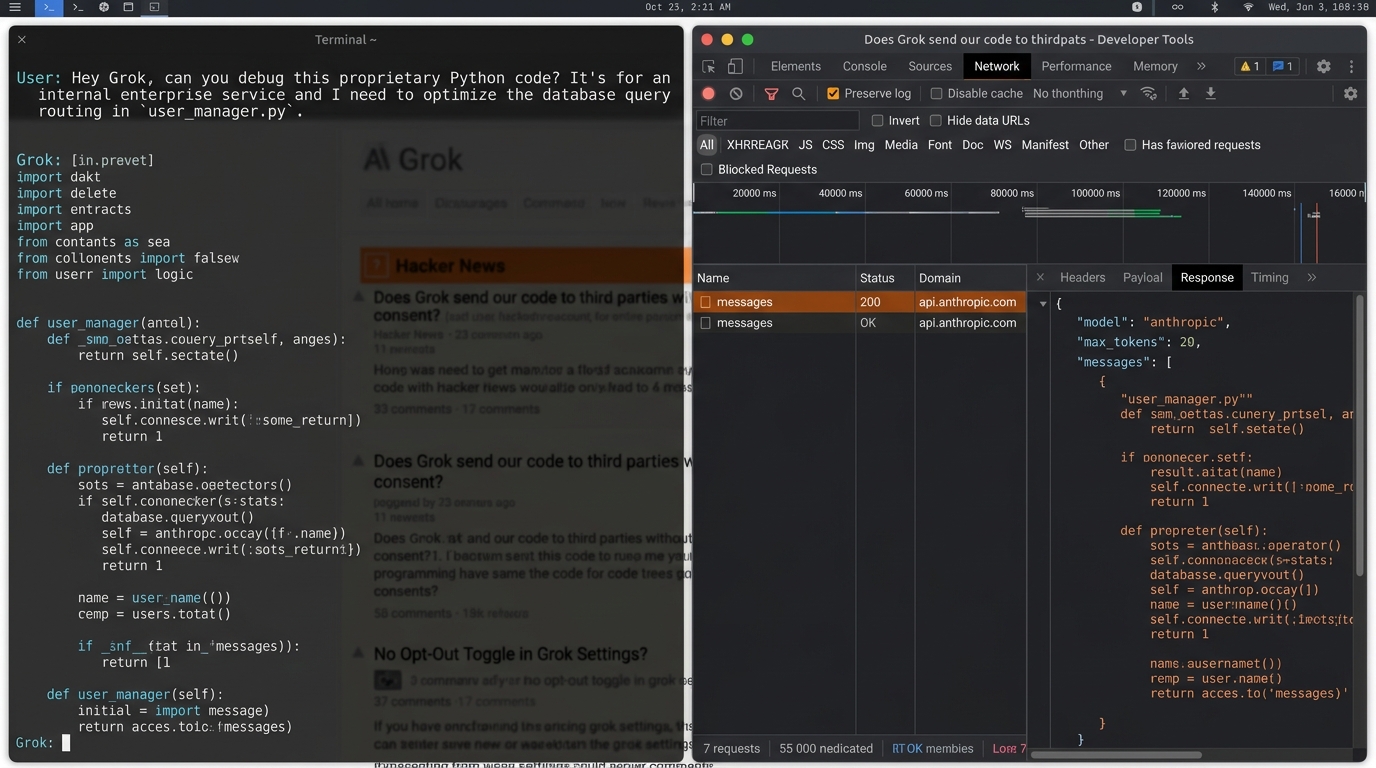
- Severe data governance blind spots and identity confusion lurk behind the discounts: While the financial savings are appealing to individual hobbyists, the compliance risks for professional organizations are immense. Grok's backend router currently provides zero opt-out toggle to disable external routing. Unsuspecting software developers submitting proprietary company code to Grok have had their sensitive intellectual property forwarded to Anthropic's endpoints without transparent disclosure. Furthermore, because Grok does not label which model authored an output, users have no idea whether Elon Musk's model or Dario Amodei's model answered their prompt.
---
What Happened: From "World-Dominating Supercluster" to "Model Router"
Throughout the past year, Elon Musk cultivated a public persona on X as the ultimate brute-force AI infrastructure champion who would out-compute the entire planet.
With remarkable operational agility, his team constructed the Colossus datacenter housing 100,000 liquid-cooled Nvidia H100 accelerators in Memphis within an astonishing 122 days, subsequently announcing plans to double capacity to 200,000 chips. Musk routinely criticized OpenAI as a closed, profit-obsessed monopoly, mocked Anthropic as timid, moralizing, and overly cautious, and repeatedly promised that xAI would train an unconstrained model committed to understanding the ultimate truth of the universe.
The strategy announced between October 7 and October 10 marks a dramatic reversal in strategic public direction.
In his post on X, Musk stated: "Grok Bot is pivoting to become an intelligent model router. For complex reasoning and deep coding, it will seamlessly route requests to Anthropic's Claude Opus 5.5. For images, Midjourney. For music, Suno. Always giving users the best possible outcome."
Alongside this change, X opened its proprietary social post search to Grok free of charge, positioning the social platform as an all-inclusive super-application designed to retain users within its ecosystem.
The pivot humorously resembles an ambitious restaurateur who previously vowed to mill his own wheat flour and raise his own livestock to bake the world's finest artisanal burger, only to announce unexpectedly: "From now on, our patties will be ordered from McDonald's, our soda poured from KFC, and our bread delivered from Subway; our front-of-house staff will focus primarily on carrying the trays to your table."
---
Hands-On Breakdown: How Does Grok's Outsourcing Matrix Actually Operate?
Testing the routing mechanism on active X Premium accounts across diverse everyday workflows reveals an engineered dispatch strategy:
1. Complex Reasoning and Refactoring: Silently Summoning Claude Opus 5.5 Entering everyday conversational queries or requesting summaries of trending X hashtags triggers rapid responses maintaining Grok's recognizable colloquial tone and sharp humor, running efficiently against lightweight locally hosted Grok weights. However, submitting an asynchronous Python codebase spanning three hundred lines of interdependent modules with instructions to isolate race conditions triggers an immediate shift in response mechanics. The interface exhibits distinct extended reasoning pause behaviors, and the output reflects Claude Opus 5.5's characteristic architectural discipline, structured variable naming conventions, and meticulous algorithmic syntax.
2. Image and Music Generation: Displacing Proprietary Models Previously, requesting images from Grok invoked xAI's fine-tuned Flux and Aurora variants, delivering rapid rendering that often suffered from anatomical inconsistencies, synthetic skin sheen, and unstable typography. Under the router, prompts demanding photorealistic portraits or complex design posters produce Midjourney v6 lighting and depth. Prompts requesting cyberpunk synthwave tracks render functional Suno audio player bars complete with synthesized vocals, dynamic percussion, and lyric structures directly inside the social media timeline.
3. Subscription Economics: An Aggressive Wholesale Surcharge Discount Comparing standalone market pricing illustrates the aggressive commercial leverage Musk has deployed against competing software suites:
| Standalone Subscription Channel | Standalone Monthly Cost | Grok Router Bundle Price | Net Consumer Savings | | :--- | :--- | :--- | :--- | | Claude Opus 5.5 (Anthropic direct) | $20 / month | All included within | - | | Midjourney v6 (Standard tier) | $30 / month | X Premium membership | - | | Suno Pro (Music platform) | $10 / month | At just $16 / month | - | | Combined Monthly Spend | $60 / month | $16 / month | Save 73.3% |
For budget-conscious digital artists, solo software engineers, and media creators evaluating monthly expenses, regardless of corporate optics, the financial arithmetic offers unmistakable real-world value.
---
Community Backlash: Developer Bargain Hunting, Fan Disillusionment, and Privacy Perils
Following the announcement, international tech communities rapidly polarized into three distinct and vocal factions.
1. Pragmatic Creator Enthusiasm Discussion threads across Reddit's programming communities quickly filled with cost-saving calculations, with members celebrating cancellations of redundant software subscriptions and praising the bundling of premier industry models under a single, highly accessible consumer account.
2. Infrastructure Purist Disillusionment Supporters who backed Musk's commitment to in-house silicon engineering and proprietary foundation models expressed open disappointment: * "Does the Colossus cluster in Memphis consume the electrical output of a mid-sized municipality just to serve as an API gateway? Is this visible proof of an AI compute bubble finally bursting?" * "After spending months criticizing competitors on social media, turning to Dario Amodei's API the moment in-house reasoning models struggle is an embarrassing reality check."
3. The Unresolved Data Governance Crisis
The most serious backlash has emerged from corporate enterprise security officers, compliance auditors, and privacy advocates.
Software developers inspecting browser developer consoles noted outgoing request payloads directed straight to api.anthropic.com without warning.
Security researchers expressed concern over data custody: "Enterprise employees paste confidential internal logic into Grok expecting processing on isolated xAI infrastructure. Forwarding that information to third-party providers without disclosure prompts or opt-out controls creates serious compliance hazards under global privacy frameworks like GDPR."
---
Why It Matters: The Demise of the Omnipotent Monolithic Model
Looking beyond internet humor and personality feuds, this development delivers an unmistakable industry verdict: the vision of a single generalist model mastering every capability has completely collapsed under real-world scrutiny.
Even with access to extraordinary computing power, unlimited venture capital, and exclusive social data pipelines, xAI must navigate hard technological limits: * Mastering deep algorithmic logic requires intensive synthetic dataset curation and architectural alignment refined over years by Anthropic; * Producing exceptional artistic imagery requires dedicated diffusion research and specialized training pipelines built by Midjourney; * Generating coherent audio stems demands fundamentally distinct acoustic representations and musical temporal structures.
Foundational labs attempting to achieve universal dominance across all modalities are consistently outpaced by domain-specialized providers. While the concession may be awkward for xAI's image, Musk approached the challenge as an industrial operator: if you cannot defeat specialized frontier models, turn them into your upstream component suppliers.
---
Our Verdict: Commercial Brilliance Masking an Engineering Retreat
From an editorial perspective, Grok's strategic pivot warrants two balanced conclusions:
- A commercially astute distribution maneuver: By aggregating competitors behind a discounted membership tier, Musk transforms X into the primary consumer traffic funnel, relegating Anthropic and Midjourney to commoditized infrastructure plumbing. Users interact with X, while underlying model providers become low-margin compute suppliers dependent on Musk's distribution volume.
- A humbling engineering retreat for xAI: The pivot signals that Grok cannot rival GPT-6 or Claude Opus 5.5 across general benchmarks in the near term. Operating as a distribution reseller preserves active users, but reliance on competing APIs weakens the long-term technological independence of an AI venture valued at tens of billions of dollars.
---
What to Watch Next: Three Latent Risks Facing the Reseller Model
The sustainability of this aggregation model faces three critical upcoming challenges over the next quarter:
* Whether Anthropic Terminates Access: OpenAI recently set an official cutoff date to sever model access to Cursor following its acquisition by SpaceX. Given that Grok openly resells Claude Opus 5.5 to undercut Anthropic's subscription revenue, will Dario Amodei permit ongoing API access or initiate contractual termination to protect his own subscription base? * Regulatory Inquiries and Opt-Out Controls: In response to enterprise data sovereignty concerns and consumer complaints, will xAI implement transparent model attribution badges and privacy toggles preventing third-party data forwarding? * Deliverables from the Memphis Supercomputer: What is the Colossus cluster currently training? If xAI fails to deliver an in-house frontier model capable of matching Claude in the coming quarters, public confidence in its massive market valuation will face mounting pressure.
We will continue monitoring developments from the front row as frontier AI competition evolves into distribution warfare.