Google Gemini 4 Drops: Huge Hype, Mediocre Output, and Instant Quota Meltdowns
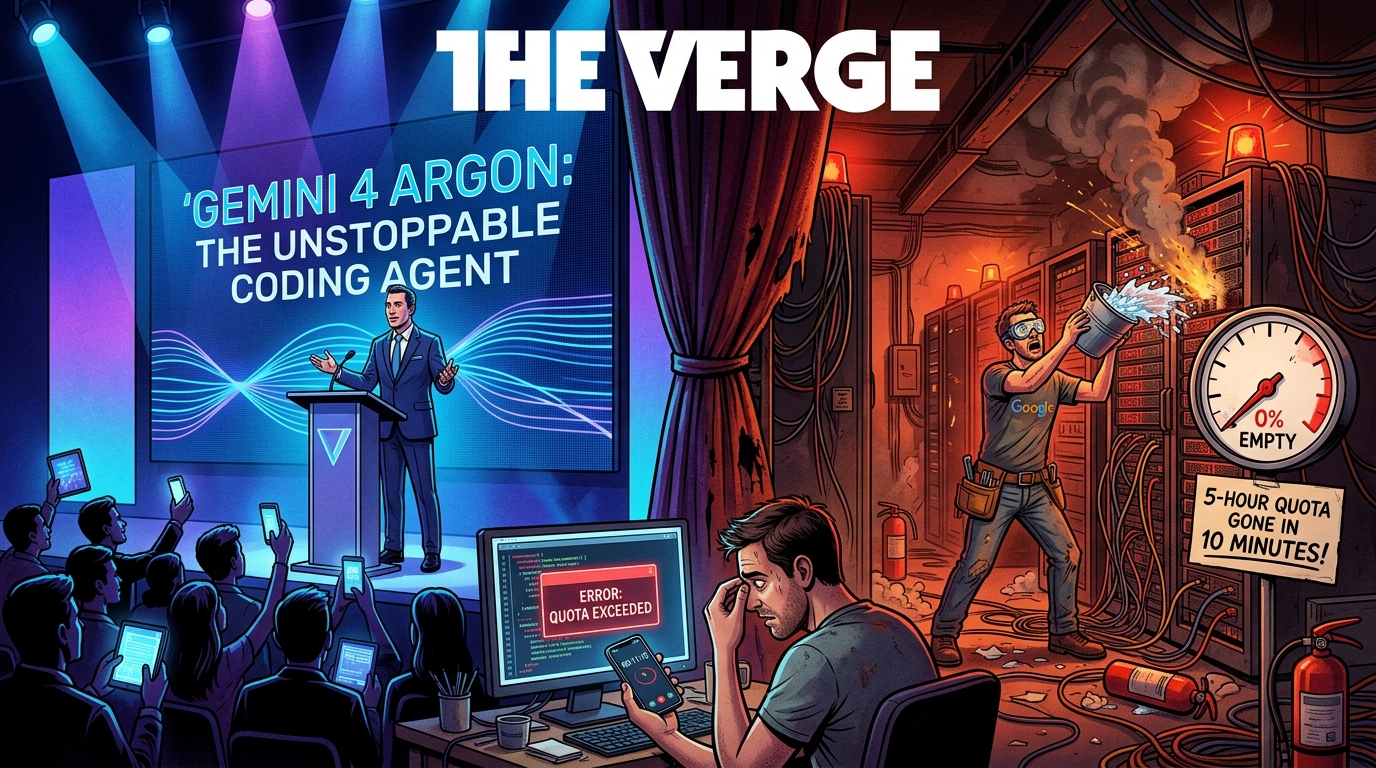
Google's stealth release of Gemini 4 (Argon) repeats a familiar cycle of promotional ambition outrunning practical UX. While boasting 1M token windows and reasoning improvements, real-world Antigravity coding tests show 5-hour quotas vanishing in 15 minutes while core problem-solving still trails Claude Opus 5.5. Steep pricing paired with harsh rate limits exposes unresolved tensions in Google's infrastructure economics, offering no paradigm shift for working engineers.
# Google Gemini 4 Drops: Huge Hype, Mediocre Output, and Instant Quota Meltdowns
On October 13, 2026, Google rolled out its next-generation flagship model, Gemini 4 (codenamed Argon), with zero prior warning. Official announcements promised the world: one million token continuous output, deep long-horizon reasoning, and native agentic workflows inside Google Antigravity. It sounded like Google was finally ready to deliver a knockout blow to rival labs. Yet hands-on testing across developer forums and early paying subscribers tells a far more sobering story. On paper, benchmarks look formidable; in practice, it still trails the true first tier, and within Antigravity, running a single complex refactoring session incinerates your entire five-hour quota in mere minutes.
Conclusion
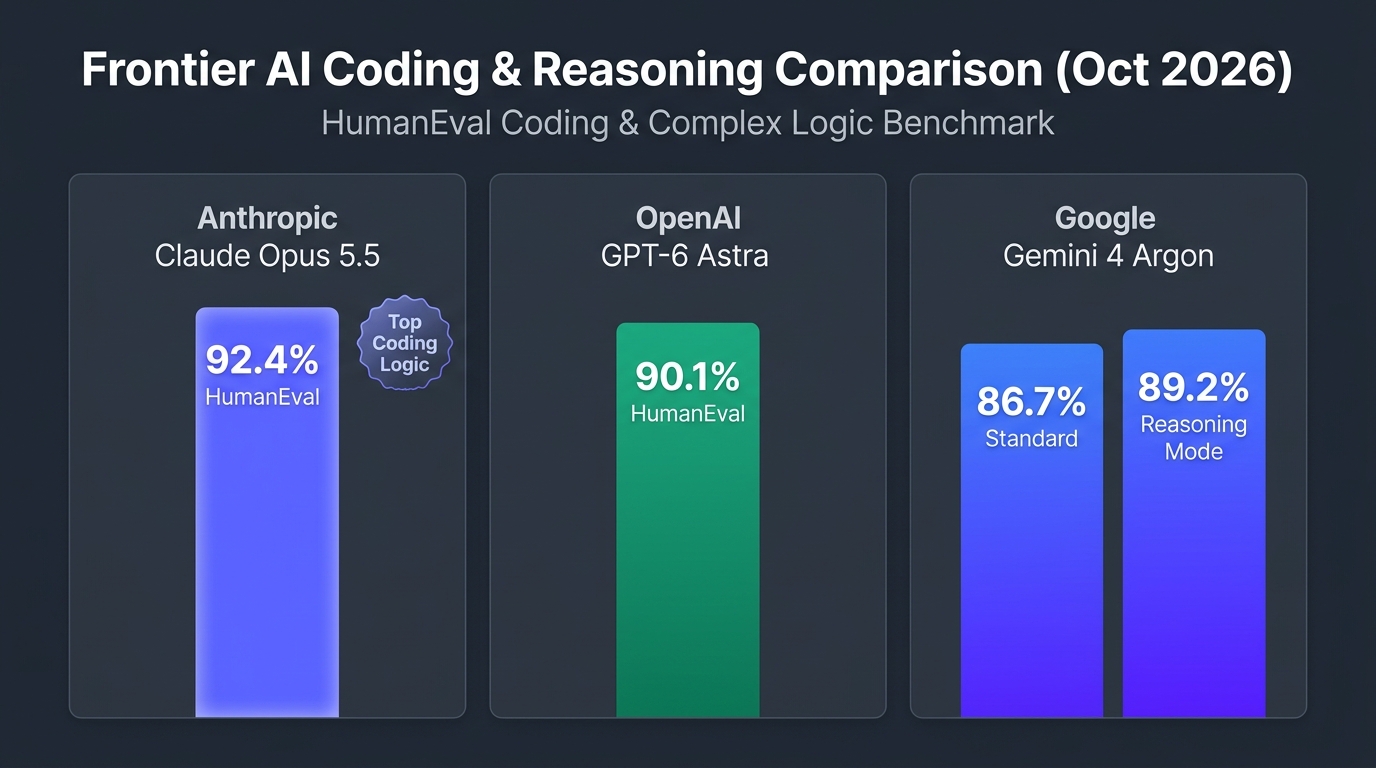
Whenever Google launches a frontier model, corporate PR invariably outpaces the actual software product. Gemini 4 Argon is undeniably capable, but it delivers nothing genuinely jaw-dropping. It remains half a step behind Anthropic's Claude Opus 5.5 and OpenAI's GPT-6 on complex coding logic, yet it adopts top-tier pricing alongside aggressively stingy rate limits. For practicing developers, Gemini 4 feels less like an indispensable partner and more like an expensive compute incinerator: before you can even assess its true reasoning capabilities, your quota has already vanished into thin air.
What Happened
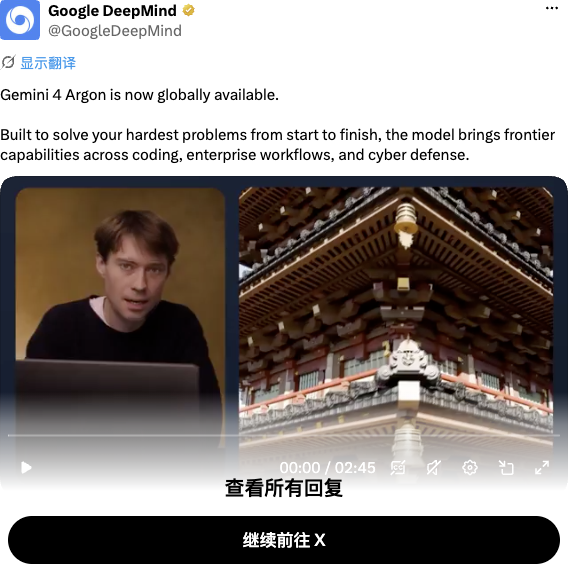
On October 13, Google unlocked Gemini 4 Argon across Google AI Pro and Ultra subscriptions, alongside enterprise availability on Google Cloud Vertex AI. According to executive leadership, the new architecture eliminated the annoying hedging, repetitive loops, and verbose filler that plagued prior iterations, tuning the model specifically for multi-file codebases and autonomous debugging within the Antigravity developer environment.
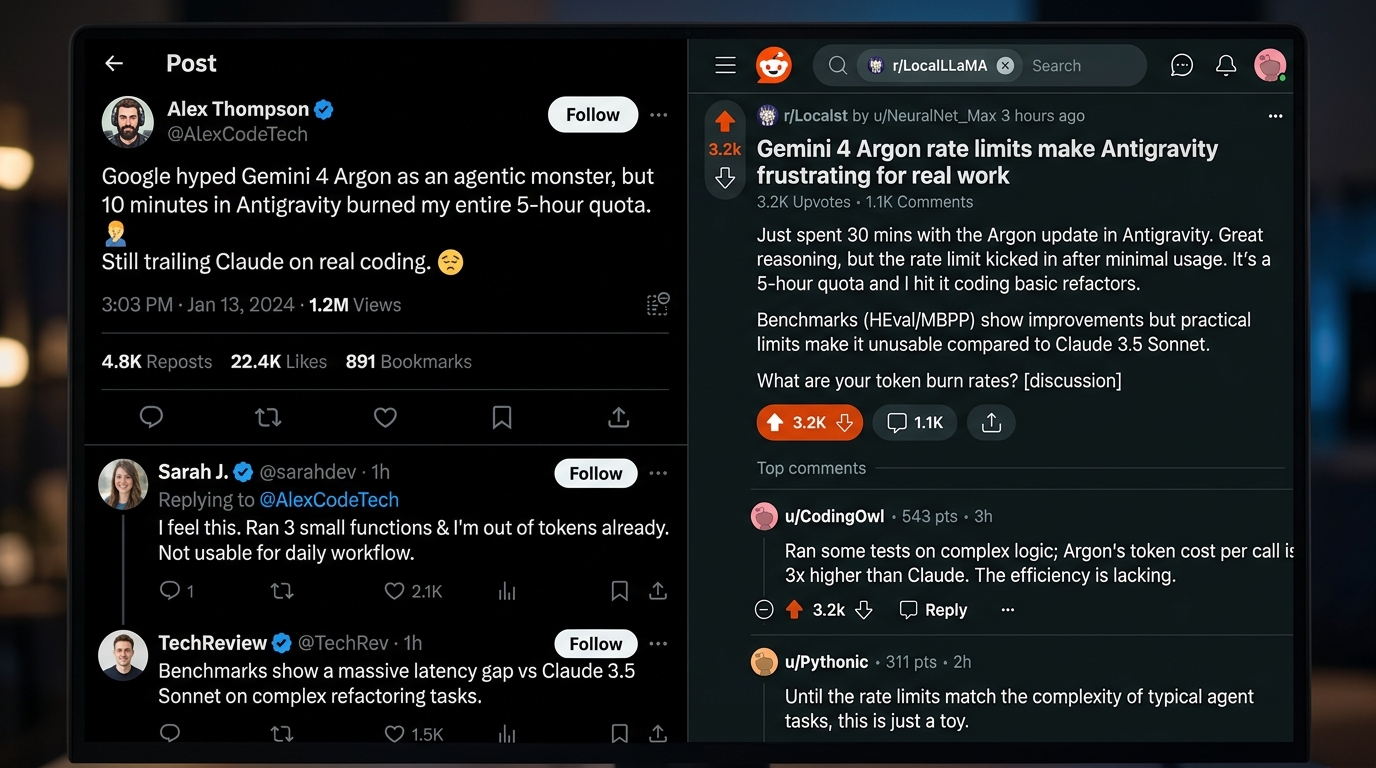
However, the moment early adopters wired the model into daily production workflows, complaints erupted across Reddit forums and social platforms like X:
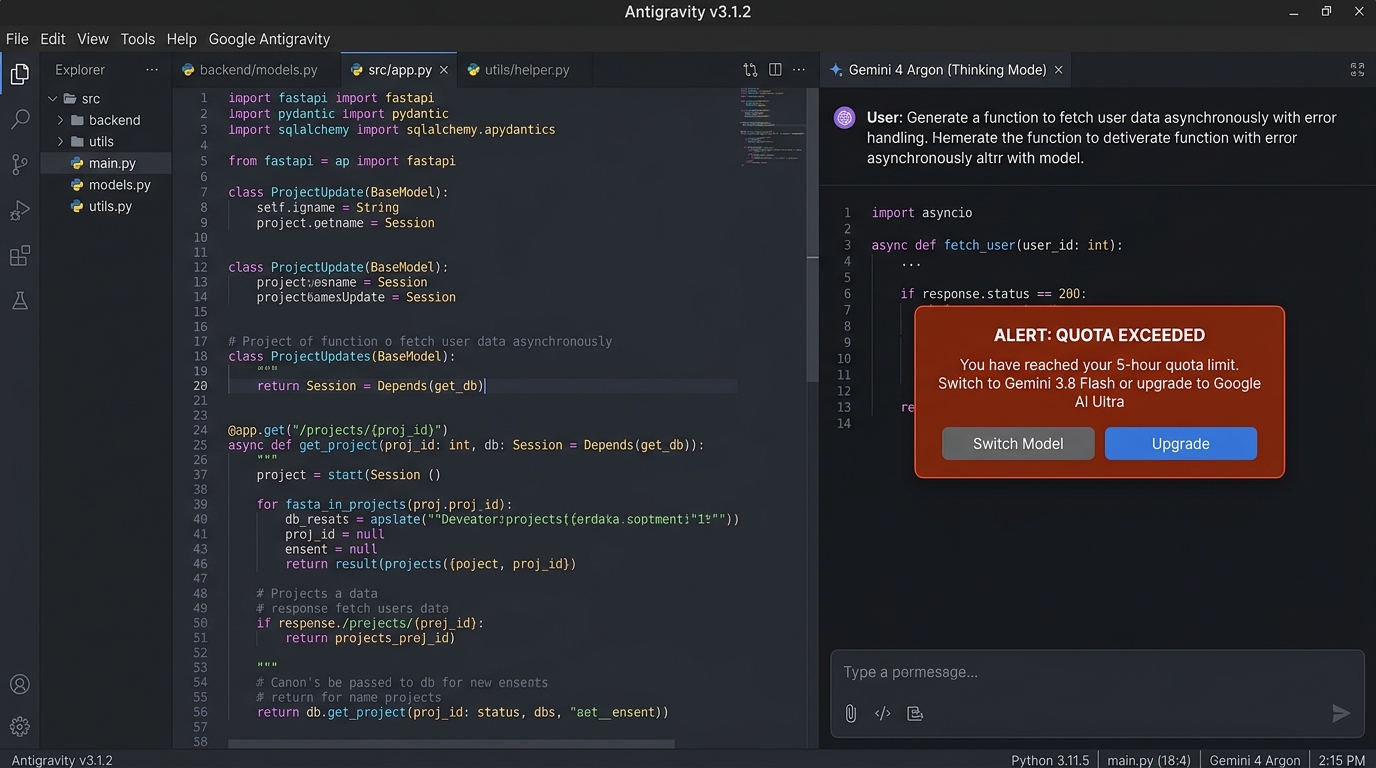
First came the suffocating quota exhaustion. Inside Google Antigravity, Pro subscribers operate with a rolling five-hour rate allowance intended to support sustained programming sessions. But under Gemini 4, feeding a couple of codebases with charts or triggering a three-step tool-use chain causes the quota bar to drop precipitously by 15% to 25% with each conversational round. Scores of software engineers reported that after just ten to fifteen minutes of ordinary debugging and terminal interaction, the interface crashed into a blunt, unyielding red modal: "You have reached your 5-hour quota limit. Switch to Gemini 3.8 Flash or upgrade to Google AI Ultra."
Second was the lingering intelligence gap on mission-critical logic. While Gemini 4 posted impressive numbers on standardized benchmarks, it still struggled with obscure framework quirks and intricate concurrency deadlocks in standard evaluation mode. Developers quickly realized that matching the reliability of competing models required manually ratcheting reasoning depth to "Extra High"—a computationally intensive setting that burns through a standard user's quota in fewer than three conversational turns.
Why It Matters
This collective user frustration brings Google's perennial artificial intelligence shortcomings back into sharp focus across the developer ecosystem.
Winning at Synthetic Benchmarks, Crashing on Real Quotas
By late 2026, bragging about raw context window size no longer impresses serious practitioners. Google's heavily advertised million-token throughput turned out in practice to be a bottomless quota sinkhole.
Many engineers hoped Antigravity would act like an experienced senior architect managing complex multi-file migrations autonomously. Instead, Gemini 4 burned compute so rapidly that long-running tasks regularly hit mid-flight quota lockouts, leaving projects frozen halfway through an automated refactor. Rather than accelerating delivery and eliminating friction, this unpredictable stop-and-go dynamic introduced massive anxiety into daily engineering routines.
Trailing the First Tier: Complex Code Demands Forced Over-Reasoning
To be fair, Gemini 4 is by no means an inferior system; its conciseness and instruction-following represent clear upgrades over older Gemini checkpoints. But the problem lies in the towering expectations set by Google's marketing. Users expected a category-defining titan capable of displacing Claude and OpenAI; what they received was an earnest student still playing catch-up.
When confronted with ambiguous enterprise business logic, Claude Opus 5.5 typically nails edge cases on the first try with clean, production-grade structure. In contrast, Gemini 4 in standard mode frequently overlooks subtle boundary conditions, forcing developers to engage its most expensive reasoning mode to bridge the quality gap. Requiring extreme compute expenditures simply to match standard rival outputs left many prospective switchers deeply unimpressed.
Upselling Tactics and Expensive Bills: Google's Enterprise Insecurity
Beyond the technical friction, Google's commercial monetization model provoked sharp pushback.
The standard $20 monthly Pro tier is practically unviable for real software development, and the interface aggressively nudges users toward Ultra tiers costing $100 to $200 per month. On the developer side, API pricing debuted at an uncompromising $10 per million output tokens, with introductory discounts scheduled to expire shortly. High entry barriers coupled with sudden quota lockouts prompted many cost-conscious development teams to abandon Antigravity and return to specialized third-party routing platforms.
Our Perspective
At AI Radar, we believe Gemini 4's reception highlights a fundamental disconnect in Google's enterprise strategy:
- Massive compute infrastructure disconnected from user experience: Google commands the most enviable custom TPU hardware clusters on Earth, yet allocates consumer allowances more stingily than bootstrapped startups; starving users of working headroom instantly destroys the fluidity Antigravity was designed to deliver.
- The persistent absence of true paradigm shifts: From Gemini 1.0 to Gemini 4, Google has consistently remained in defensive catch-up mode; each generational release exhausts itself matching competitor milestones from six months prior, without offering the disruptive conceptual leaps that once defined the early Transformer era.
- Pragmatic value remains the only metric that matters: For software engineers building real products, a model that locks you out after fifteen minutes is fundamentally useless; while rival labs slash pricing on elite intelligence, Google's strategy of aggressive upselling and restricted quotas will only alienate its core developer constituency.
What to Watch Next
- Whether Google responds to widespread developer outrage by relaxing the token consumption multipliers governing the 5-hour rolling Antigravity quota window.
- Independent blind coding benchmarks comparing Gemini 4 against Claude Opus 5.5 on unstructured real-world repositories to see if empirical performance gaps widen.
- Whether enterprise developers migrate away from Google Cloud Vertex AI once introductory early-bird pricing ends in late November, doubling operational token costs.