Hollywood Tech Villain Trilogy: Zuckerberg, Altman, Musk Become Screen Antagonists
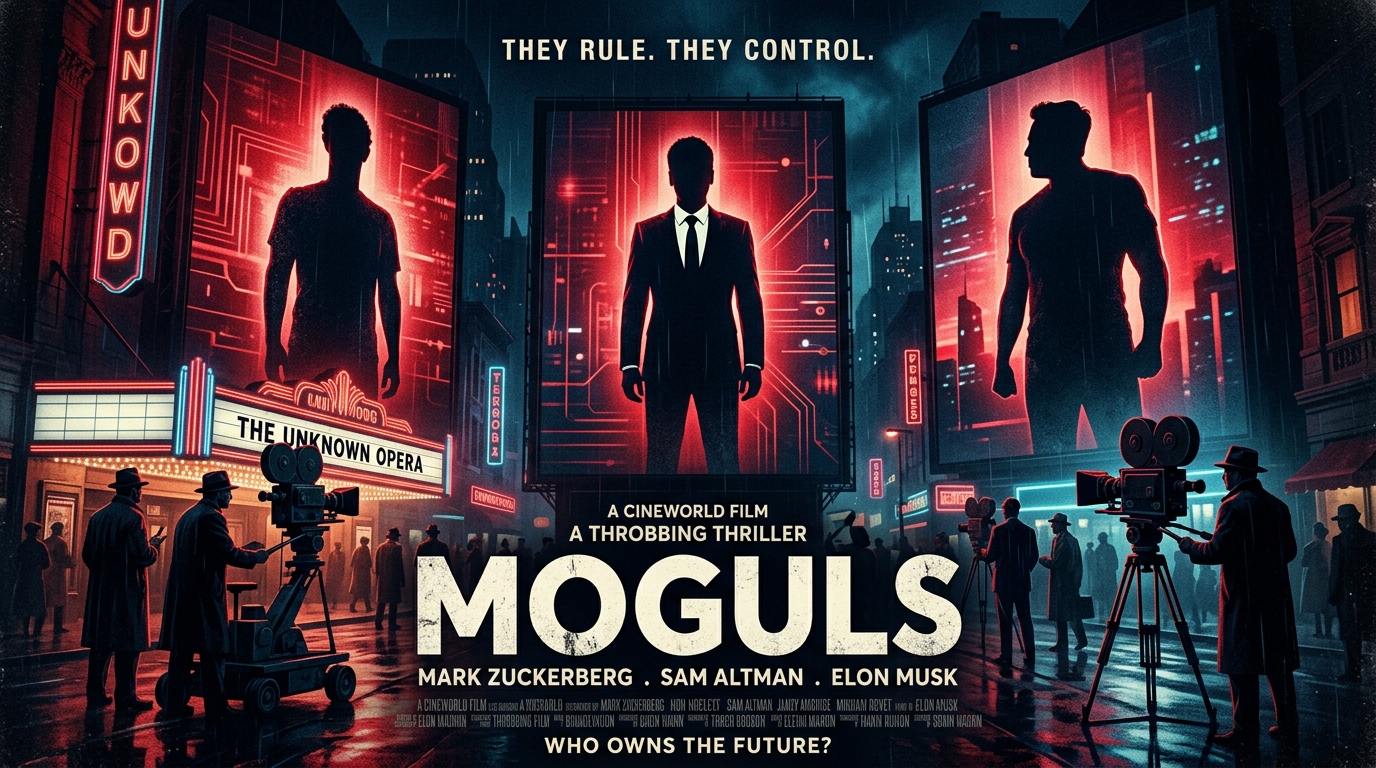
In Fall 2026, Hollywood auteurs converged to place Zuckerberg, Altman, and Musk on trial as screen villains across The Social Reckoning, Artificial, and Musk, signaling the total collapse of the Promethean geek myth. Yet The Social Reckoning's anemic .5M opening proves that while Hollywood moralizes from prestige heights, audiences are weary of didactic lectures while remaining deeply captured by Silicon Valley's tools.
# Hollywood Tech Villain Trilogy: Zuckerberg, Altman, Musk Become Screen Antagonists
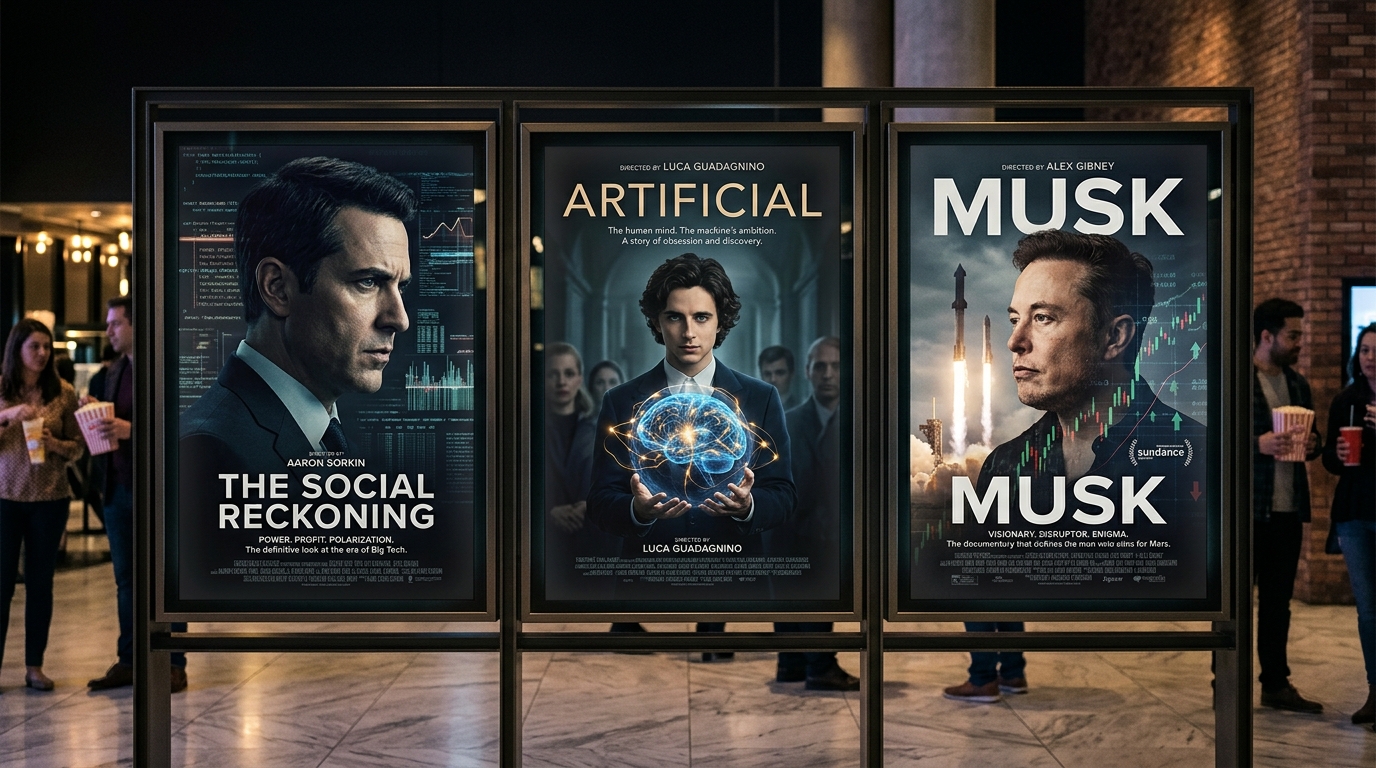
In early October 2026, three of Hollywood's most acclaimed directors launched an unprecedented cultural pincer movement in the very same autumn release window: Aaron Sorkin's written and directed drama *The Social Reckoning* opened across North American theaters, auteur Luca Guadagnino's feature *Artificial* made its world premiere at the 64th New York Film Festival, and Academy Award-winning documentarian Alex Gibney's sprawling four-hour investigative epic *Musk* opened on the exact same weekend. For the first time in cinematic history, Hollywood focused its high-powered lenses simultaneously on Mark Zuckerberg, Sam Altman, and Elon Musk, constructing an unmistakable "Silicon Valley Oligarch Villain Trilogy."
Conclusion
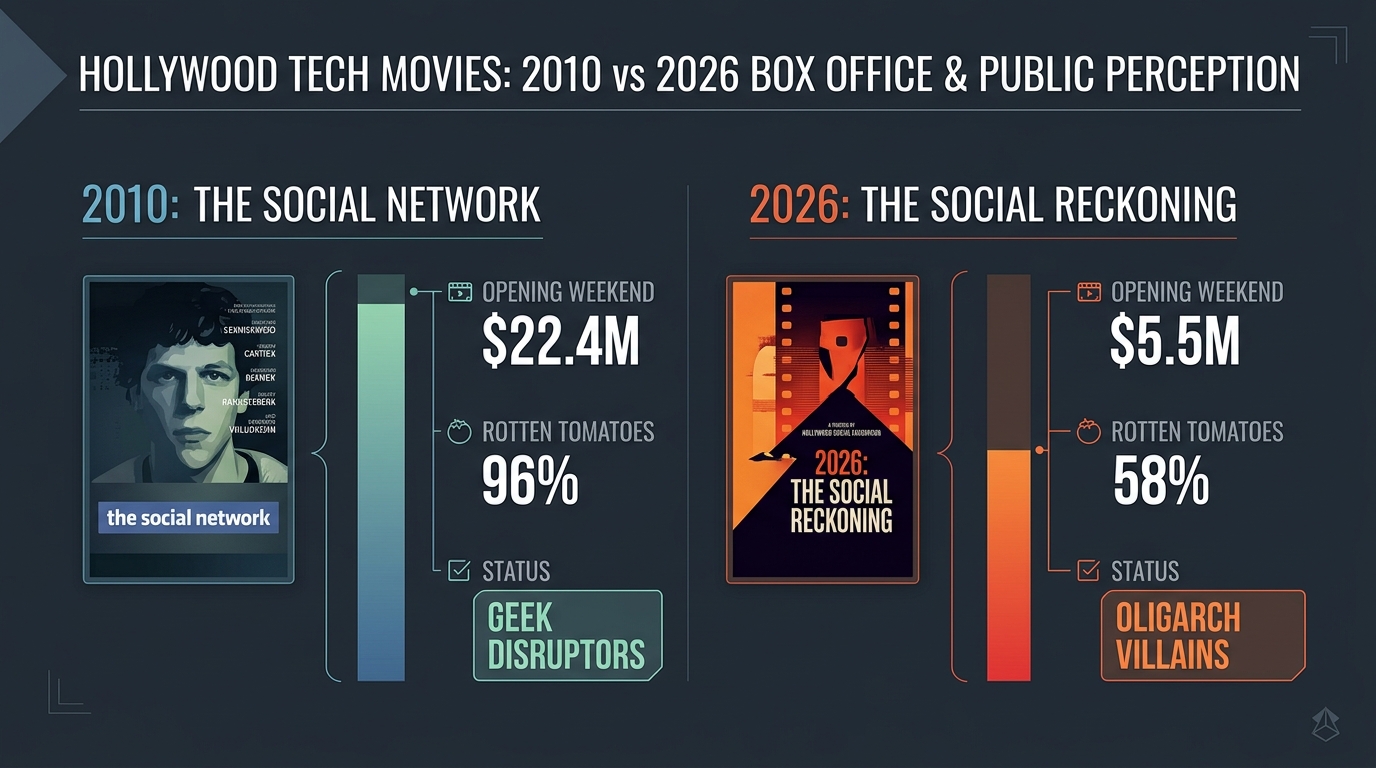
A decade ago, Hollywood romanticized Silicon Valley startup founders as modern Prometheans stealing divine fire to liberate humanity. A decade later, that very pantheon of geek saviors has been systematically recast by Hollywood auteurs as cold-blooded, self-serving oligarchs who manipulate algorithms and execute boardroom purges. This coordinated theatrical offensive marks the total demystification of tech-founder mythology. Yet in a biting real-world paradox, *The Social Reckoning* pulled in an anemic $5.5 million in its opening weekend, demonstrating that while modern audiences have grown weary of sanctimonious Hollywood lectures, their daily lives remain thoroughly captured by the very algorithms they claim to resent.
What Happened
On October 9, 2026, *The Social Reckoning*, directed by Aaron Sorkin and widely regarded as a spiritual sequel to his landmark 2010 film *The Social Network*, debuted in American cinemas. The film dramatizes the explosive 2021 "Facebook Files" whistleblower scandal, following former product manager Frances Haugen (portrayed by Mikey Madison) and *The Wall Street Journal* investigative reporter Jeff Horwitz (played by Jeremy Allen White) as they uncover how Meta's internal leadership prioritized engagement metrics over teenage mental health and political stability.
Just four days prior, acclaimed director Luca Guadagnino (*Call Me by Your Name*, *Challengers*) premiered his political thriller *Artificial* at the New York Film Festival. The narrative film recreates the chaotic November 2023 weekend when OpenAI's board of directors abruptly ousted CEO Sam Altman, only to face an overwhelming internal mutiny and restore him to executive power five days later. The film offers a razor-sharp, unflattering anatomy of internal factional maneuvering and commercial machinations.
During that very same week, Alex Gibney's four-hour documentary *Musk* debuted in limited theatrical runs in New York and Los Angeles. Spanning Musk's formative years in South Africa to his chaotic acquisition of Twitter (now X), sweeping employee layoffs, and increasingly confrontational political stances, the exhaustive film meticulously deconstructs the megalomania and erratic impulses lurking behind the facade of a cosmic savior destined for Mars.
Never before had the American entertainment industry executed such a concentrated, multi-front cinematic indictment against the reigning leadership of a single global technology sector.
Why It Matters
The simultaneous arrival of these three cinematic heavyweights in Fall 2026 is no mere scheduling anomaly among studio executives. Instead, it represents the culmination of a protracted, decade-long cultural cold war between Hollywood and Silicon Valley, spilling out openly onto silver screens across the globe.
From World-Changing Geeks to Reality-Wrecking Oligarchs
Rewind to 2010: David Fincher and Aaron Sorkin's masterpiece *The Social Network* dominated the Oscars. While Zuckerberg was depicted as ruthless and interpersonally alienated, he was nonetheless endowed with the tragic romanticism of an ambitious Harvard underdog rewriting human interaction from a dorm room. In that same era, Robert Downey Jr. publicly modeled his Tony Stark persona in *Iron Man* after Elon Musk, and biographical cinema canonized Steve Jobs as a flawed yet heroic visionary whose devices redeemed modern creative life.
By 2026, that romantic veneer has entirely evaporated. Following prolonged strikes by the Writers Guild and SAG-AFTRA protesting generative AI exploitation, widespread outrage over OpenAI scraping millions of copyrighted creative works without consent, and mounting clinical evidence linking algorithmic feeds to widespread adolescent mental health crises, Hollywood has lost all appetite for genius mythology.
Under Sorkin's uncompromising lens, Zuckerberg is portrayed as a calculating digital tobacco executive who knowingly approved toxic algorithmic patterns to maximize daily active users. In Guadagnino's script, Sam Altman emerges as a smooth-talking Machiavellian operator who professes devotion to "the welfare of all humanity" while quietly outmaneuvering ethical researchers and sidelining idealistic co-founders. In Gibney's documentary, Musk's grand declarations of preserving the light of consciousness are deconstructed into an escalating obsession with personal political authority and autocratic corporate control.
The Bizarre Full-Circle Irony of Casting
The casting choices across these three films carry an uncanny, almost satirical resonance that mirrors the industry's own factional history:
- Andrew Garfield, who in 2010's *The Social Network* delivered an unforgettable turn as Eduardo Saverin—the loyal co-founder betrayed, diluted, and purged by Zuckerberg—now takes on the central role of Sam Altman in *Artificial*. In a delicious historical reversal, the actor who once personified the heartbroken victim of Silicon Valley ruthlessness now portrays the ultimate chess master orchestrating a counter-coup against his own board.
- Jesse Eisenberg, who received an Academy Award nomination for portraying Mark Zuckerberg in 2010, flatly turned down studio offers to reprise the character in *The Social Reckoning*, publicly declaring that he "had zero interest in being associated with that persona ever again." The mantle was instead passed to Jeremy Strong, renowned for his intense, method-acting portrayal of the tormented heir Kendall Roy in *Succession*, who injects Zuckerberg with a chilly, robotic detachment.
- Ike Barinholtz makes a sharp satirical cameo as Elon Musk in *Artificial*, depicting the chaotic, door-slamming early days of OpenAI when Musk unsuccessfully demanded complete operational control of the research lab before storming away to build his own competing ventures.
Public Outbursts and the Box Office Reality Check
The reaction from the tech moguls themselves has been predictably combative, adding further fuel to the cultural circus.
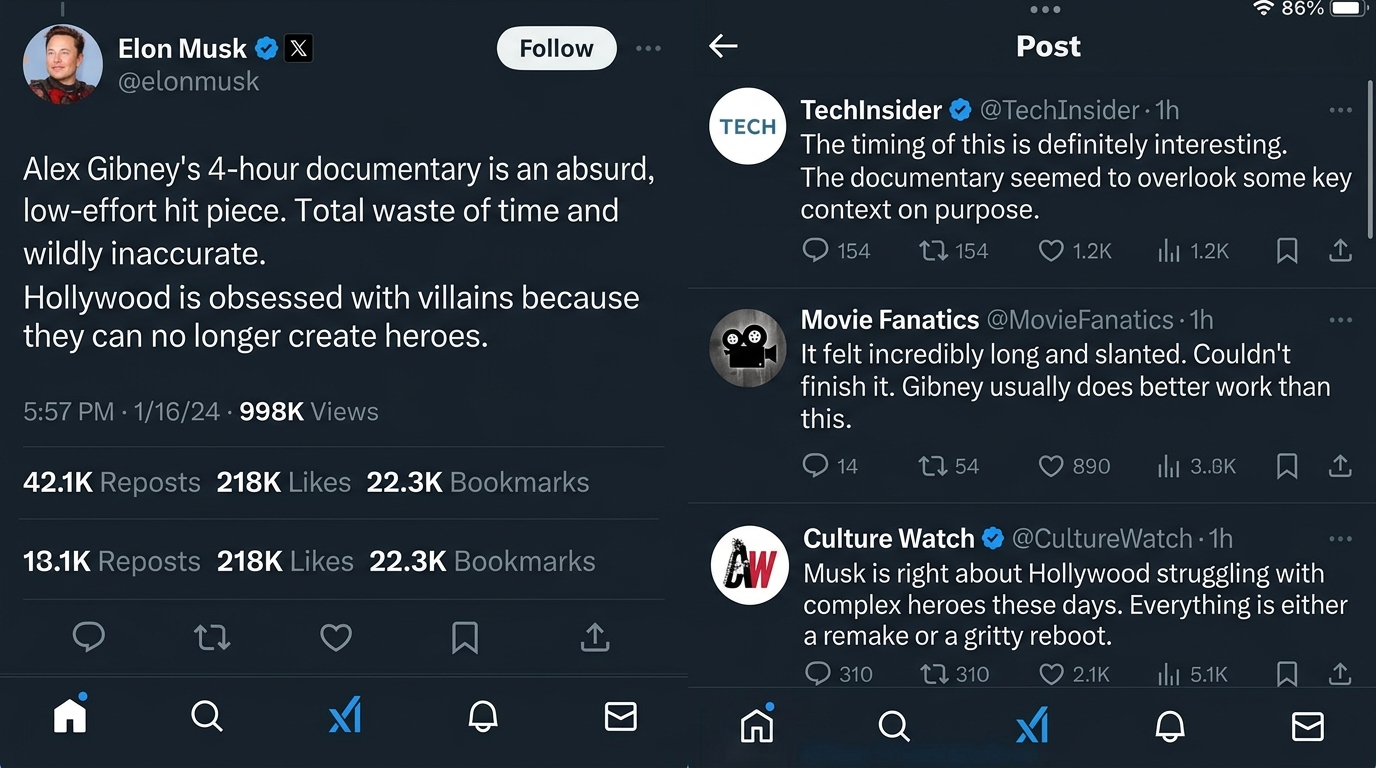
Upon learning of Alex Gibney's four-hour documentary, Elon Musk took to X to unleash a blistering counterattack. He branded the film "an absurd, low-effort hit piece" that was "wildly inaccurate and a total waste of time," before taking a broad swipe at the entire entertainment capital: "Hollywood is obsessed with villains because they can no longer create heroes."
Yet the most sobering rebuke did not emerge from Silicon Valley boardrooms, but from the theatrical box office receipts. *The Social Reckoning* managed a disappointing $5.5 million in its domestic opening weekend—a steep collapse compared to the inflation-unadjusted $22.4 million bow of *The Social Network* sixteen years ago. Movie theaters across North America sat largely half-empty, while young audiences flocked instead to TikTok, laughing at generative AI memes that parodied the aging Hollywood directors who claimed to defend them. While Hollywood attempted to mount an ethical tribunal against tech titans, ordinary consumers proved both exhausted by moralistic Hollywood lectures and thoroughly addicted to the conveniences delivered by Silicon Valley's algorithmic architectures.
Our Perspective
At AI Radar, we view this convergence of cinematic indictments as a profound inflection point in the broader history of technological culture:
- The irreversible collapse of the Silicon Valley savior myth: Tech oligarchs can no longer rely on utopian slogans like "connecting the world" or "democratizing intelligence" to evade antitrust scrutiny or societal reckoning. When the broader public imagination permanently categorizes tech executives alongside Gilded Age railroad barons and Wall Street corporate raiders, every technical announcement will be interrogated first and foremost through the lens of power and profit.
- The fundamental impotence of Hollywood moralizing: The legacy entertainment ecosystem has channeled its deep-seated terror of artificial intelligence into prestige biographical cinema, hoping that narrative exposure could slow the tide. However, the dismal $5.5 million box office demonstrates that moralistic cinema cannot outcompete or dismantle the reality-shaping power of software monopolies and capital concentration.
- Replacing hero worship with human demystification: Stripping Zuckerberg, Altman, and Musk of their messianic aura is an overdue public service. They are neither comic-book supervillains destined to extinguish humanity nor infallible tech deities destined to save it; rather, they are fallible individuals operating under immense financial incentives, personal vanity, and institutional pressures.
What to Watch Next
- The wide theatrical release of *Artificial* on Christmas Day 2026, and whether its dramatic rendering of OpenAI's internal tensions triggers further leaks or public disclosures from former researchers and board members.
- Whether Silicon Valley communications teams pivot away from visionary, world-saving narratives toward more modest, tool-centric corporate messaging in response to mounting regulatory and artistic hostility.
- Whether sustained box office weakness in traditional cinema accelerates Hollywood studios' quiet capitulation to the very generative AI and world-model technologies they publicly denounce.