A robot ran 100 meters in 9.32 seconds, and Musk reportedly reposted it. But Honor's robot was not even the champion
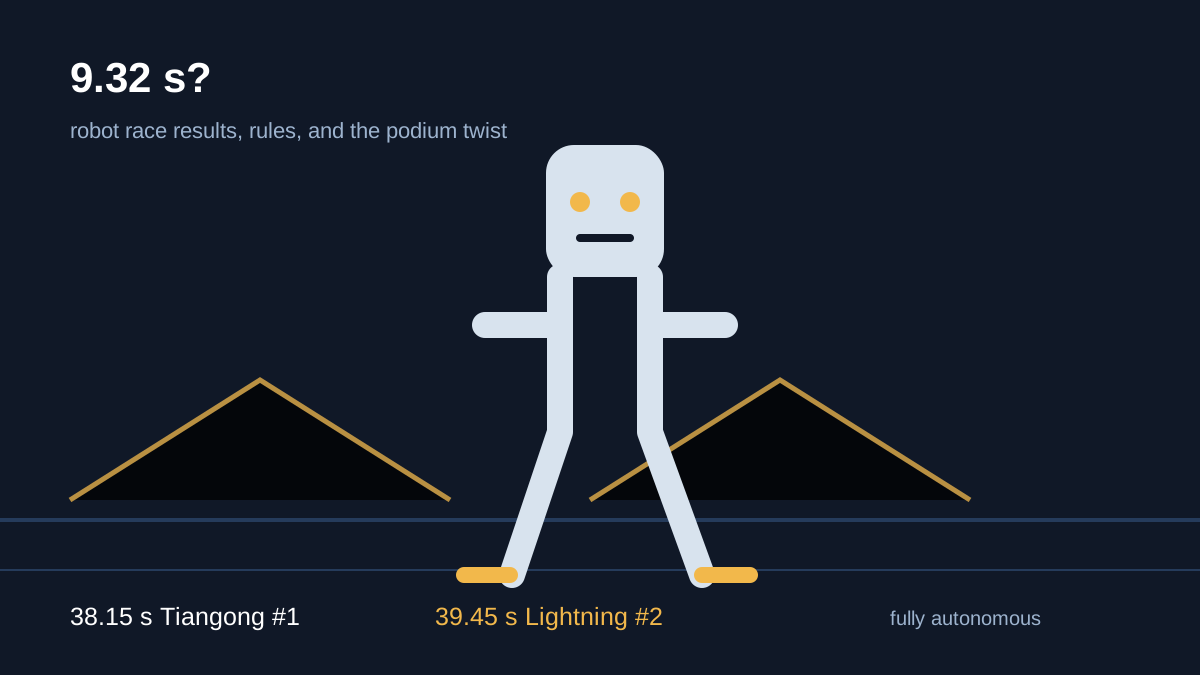
Honor's Lightning has supported 9.32-second 100-meter and 39.45-second 400-meter times, but “breaking the human world record” is a cross-system comparison under robot-event rules, not a World Athletics certification. The official large 400-meter table shows Tiangong won in 38.15 seconds; Musk's repost is presented as reported by multiple outlets because the original X post still needs public verification.
Conclusion
Honor's Lightning robot pushed a 9.32-second 100-meter run and a 39.45-second 400-meter run into the headlines. Several outlets also said Elon Musk reposted the video. The times are supported by Honor's page and the event's official results, but “officially breaking the human world record” needs a qualifier: these are robot-game results under the event's own rules, not new World Athletics records.
The better twist is that Lightning did not sweep the podium. The official results show Tiangong winning the large 400-meter final in 38.15 seconds, with Lightning second in 39.45 seconds. In the 1500-meter final, Tianzhuo won in 2:21.64 while Honor's robot finished second in 2:30.00. The gap between the viral headline and the official table is the story.
The 9.32 seconds are real, but who was it racing
Honor lists 9.32 seconds for 100 meters, 39.45 seconds for 400 meters and 2:30 for 1500 meters. It also cites a 50:26 half-marathon. These are not all from one event: the first three belong to this humanoid-robot games, while the half-marathon came from an earlier Beijing Yizhuang humanoid-robot race.
The event rules matter more than the slogan. The 100-meter, 400-meter and 1500-meter races are autonomous events. An operator may send a start command before the race; after the gun, the robot must complete the run itself, without live remote control. Robots start standing, cannot use starting blocks, and are timed by the torso crossing the finish plane.
So this was not a remote operator driving a robot down the track. It tested autonomous control, balance, power and high-speed gait together.
That distinction matters because high-speed autonomy is harder than playing back a fixed motion. The controller must keep the body inside a wide but bounded lane, absorb small disturbances, regulate stride timing and preserve enough stability to finish. The rules also penalize lane violations and interference, so a fast time cannot be separated completely from navigation and control. It is still a specialized track task, but it is a real systems result rather than a motor-speed demonstration on a test stand.
But “breaking the human record” remains a cross-system comparison. Human records belong to World Athletics rules and certification; the robot event has its own track, divisions and timing rules. The careful wording is: in fully autonomous events at this robot games, some robots recorded times faster than the corresponding human records.
Second twist: Honor got the attention, not the fastest time
The official large-group 400-meter table lists:
| Place | Robot | Team | Time | | --- | --- | --- | ---: | | 1 | Tiangong | Beijing Humanoid Robot Innovation Center | 38.15 s | | 2 | Zhui Feng Zi | Honor Terminal | 39.45 s | | 3 | Jinghong Power Team | Beijing Yaosheng Terminal | 39.66 s |
The 1500-meter result tells a similar story: Tianzhuo won in 2:21.64 and Honor's Fei Leishen finished second in 2:30.00. Honor's page uses “Lightning,” while the official result tables use team and entry names such as Zhui Feng Zi and Fei Leishen. We keep those labels separate instead of turning a marketing name into an official entry name.
That makes the news more interesting. Honor owns the loudest narrative, while another team owns the fastest official time. Robot competition is beginning to acquire the same drama as human sport: star names, brand storytelling and the podium do not always line up.
Does Musk's repost count as certification
Several outlets said Musk reposted a video about Honor's 9.32-second run on August 22. X currently requires login, so I could not independently verify the original post in a public page. This article treats it as a reported amplification event, not as technical certification by Musk, and certainly not as proof that he was “stunned” by Chinese robotics.
The repost explains the reach. It does not time the race or certify a record. The hard evidence remains the event rules, official result PDFs and replayable footage.
What the race actually measured
Short sprint times travel well because everyone understands 9.32 seconds. But a humanoid robot also has to hold its lane on a bend, brake after a fast run, stand up after a fall, and manage power and heat over longer distances.
The rules include obstacle races, wet surfaces, braking slopes, narrow turns and moving tires. Those tests are closer to a robot's future work than peak speed on a straight line. Speed is easy to cut into a viral clip; recovery and stability will decide whether a machine belongs in a factory, warehouse or home.
Our judgement
This is worth publishing, but the headline should keep a question mark. It is fair to say that Chinese humanoid robots recorded fully autonomous times faster than corresponding human records, and that Musk's reported repost helped the story travel. It is not fair to turn a robot-event result into a World Athletics record, or to assume that Lightning was the fastest robot simply because Honor marketed it best.
The event may be most valuable as public communication. Robotics finally has a number everyone can understand. The next test is less glamorous: can the fast robot stop, turn, recover from a fall and complete complex work without live human control?
What to watch next
- Whether a complete, continuous and reviewable video confirms the 9.32-second timing;
- How Honor's “Lightning” label maps to the official entry names;
- Whether other teams can repeatedly run under 10 seconds;
- Whether autonomous speed transfers to obstacles, wet surfaces, braking and real-world tasks;
- Whether World Athletics or another independent body develops a separate certification standard for robot records.
Sources and evidence boundary
- Primary sources: the World Humanoid Robot Games athletics rules; official large-group 400-meter and 1500-meter result notices; Honor's robot-games page.
- Media reports: outlets covering Musk's reported repost and Honor's results.
- Boundary: Musk's original X post could not be checked on a public page without login; “breaking the human record” is a cross-system comparison, not a World Athletics certification.