"AGI Has Arrived" vs. Rate Limit Slashing: Jensen Huang's 100k-GPU Proclamation Clashes with OpenAI's Compute Reality
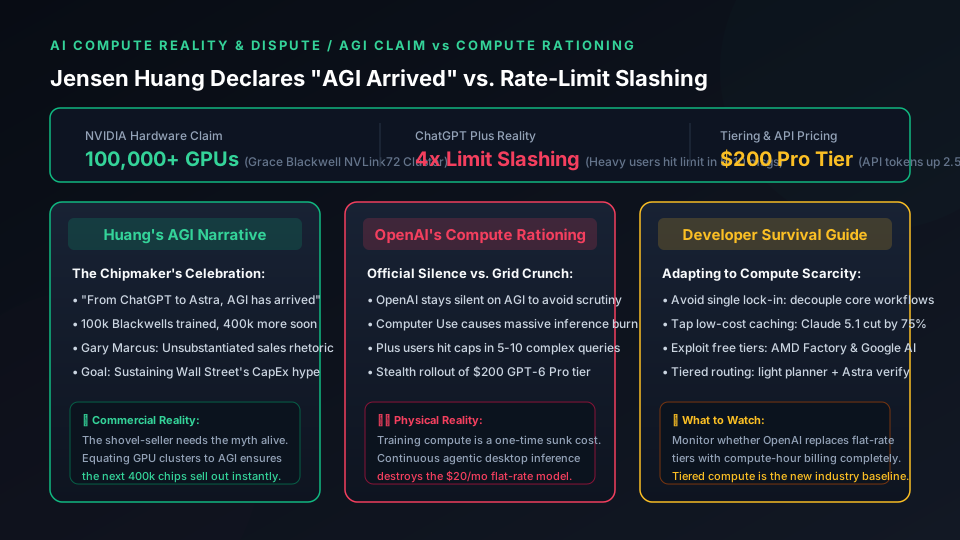
On September 6, 2026, NVIDIA CEO Jensen Huang declared that "AGI has arrived", stating GPT-6 Astra was trained across 100,000+ Grace Blackwell NVLink72 GPUs with 400,000 more deploying. While researchers led by Gary Marcus rebuked the claim as unscientific marketing, OpenAI remained silent on AGI to avoid triggering Microsoft licensing terms and regulatory scrutiny. Concurrently, millions of /month ChatGPT Plus users were hit by severe rate limits—facing 4-hour cooldowns after as few as 5 to 10 agentic queries, accompanied by the quiet appearance of a /month "GPT-6 Pro" tier. This structural shift signals the collapse of flat-rate compute subsidies, inaugurating an era of tiered compute rationing and compute-hour metering.
# "AGI Has Arrived" vs. Rate Limit Slashing: Jensen Huang's 100k-GPU Proclamation Clashes with OpenAI's Compute Reality
On the evening of September 6, 2026, NVIDIA Founder and Chief Executive Officer Jensen Huang took to X (formerly Twitter) to send public congratulations to the OpenAI engineering team, delivering a sweeping declaration that sent immediate shockwaves across Silicon Valley and the global technology sector: "From ChatGPT to o1 to Astra. AGI has arrived." In his widely circulated post, Huang disclosed that GPT-6 Astra had been trained upon an unprecedented hardware footprint comprising more than 100,000 NVIDIA Grace Blackwell NVLink72 superchips, adding that an additional 400,000 GPUs were actively queued to come online in the company's next deployment wave.
Yet, this triumphant proclamation of artificial general intelligence from the world's preeminent semiconductor merchant collided head-on with an uncompromising engineering reality experienced by frontline users within less than twenty-four hours. Over the weekend of September 6 and 7, hundreds of thousands of ChatGPT Plus subscribers paying twenty dollars per month discovered that their operational message caps for GPT-6 Astra had been drastically and abruptly curtailed. Interacting with the newly released flagship model for as few as five to ten complex coding or reasoning turns repeatedly triggered bright red "Usage limit reached" warning dialogues, with independent developers measuring effective operational quota contractions of roughly four-fold. Simultaneously, client interfaces quietly began surfacing a distinct, segregated "GPT-6 Pro" selector reserved exclusively for professional and business accounts paying between one hundred and two hundred dollars per month.
While the primary architect of the modern computing boom celebrated the arrival of AGI to anchor Wall Street's multi-hundred-billion-dollar infrastructure spending cycle, paying practitioners were confronted by an unavoidable truth: frontier artificial intelligence has not unlocked widespread computational abundance, but has instead inaugurated the most restrictive and expensive era of compute rationing in modern technology history.
---
What Happened: Huang Declares "AGI Arrived", Academic Backlash, and OpenAI's Silence
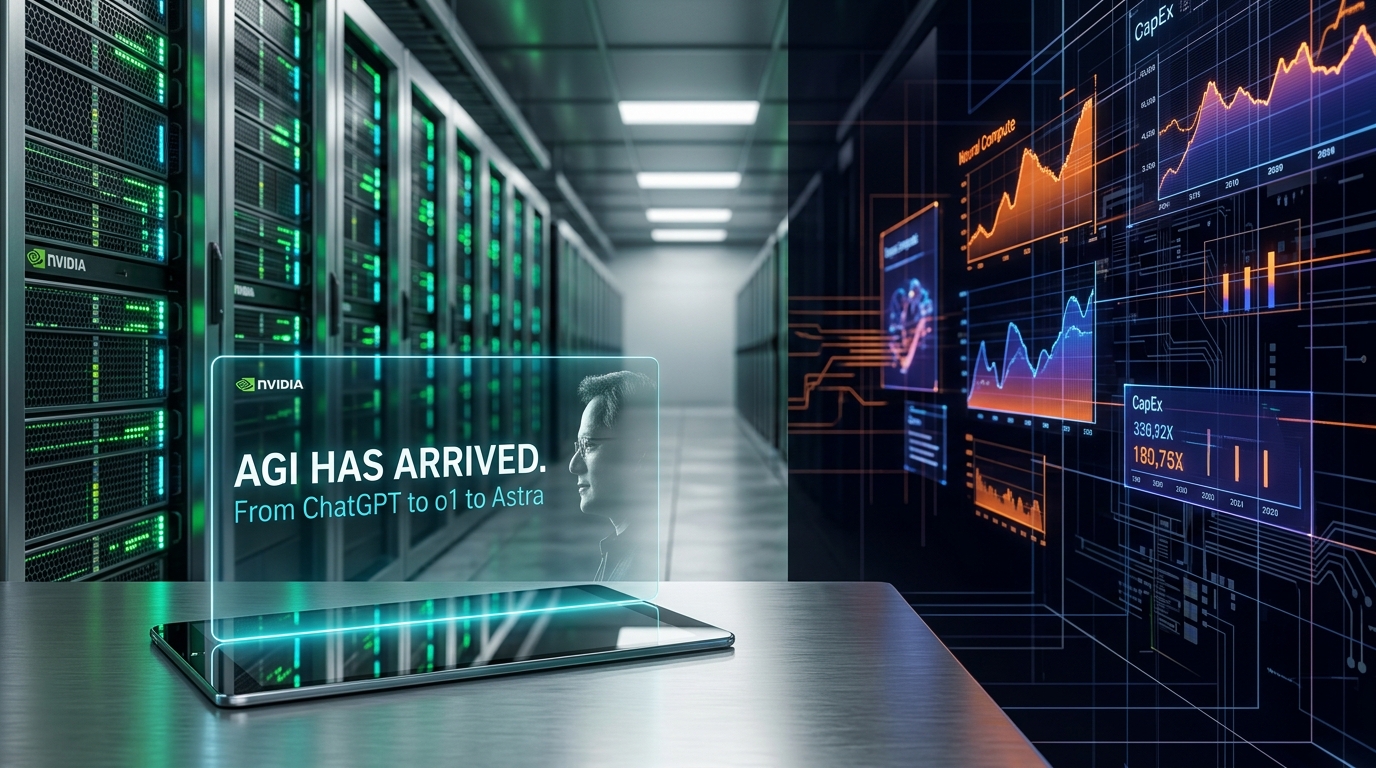
This intervention was certainly not the first time Jensen Huang had offered audacious statements regarding the technological horizon, but this specific declaration breached the longstanding protocol separating hardware vendor marketing from established computer science definitions.
Throughout his public statement and subsequent technical remarks, Huang structured the preceding four years of foundational model development as an inexorable, unbroken evolutionary ladder: ChatGPT in November 2022 democratized conversational synthesis, OpenAI o1 in the autumn of 2024 established test-time compute expansion and reinforcement learning reasoning, and GPT-6 Astra in September 2026 unified software engineering autonomy, scientific theorem proving, and cross-application visual Computer Use. On this empirical basis, Huang proclaimed that Artificial General Intelligence had officially materialized, citing the monumental computational throughput of NVIDIA's Grace Blackwell NVLink72 supercomputing cluster as the definitive physical engine behind the breakthrough.
However, the chipmaker's unilateral victory declaration provoked immediate, sharp resistance and debate across researchers, enterprise customers, and legal observers:
- Academic and Scientific Denunciations: Prominent cognitive scientist, author, and frequent industry critic Gary Marcus immediately published an extensive refutation, castigating Huang for coopting the academic definition of AGI for corporate promotional objectives. Marcus emphasized that GPT-6 Astra, despite its exceptional scores on mathematical competitions and programming benchmarks, still demonstrates acute structural fragilities in physical-world causal reasoning, persistent goal maintenance across multi-day horizons, and vulnerability to adversarial jailbreaks. Marcus argued that conflating sheer supercomputing scale with artificial general intelligence remains an unvalidated marketing maneuver rather than a peer-reviewed scientific consensus;
- OpenAI's Deliberate and Complete Silence: Despite Huang's glowing praise, OpenAI's corporate communications, official technical reports, and video demonstrations pointedly and systematically omitted the three-letter acronym "AGI." While President Greg Brockman offered poetic allusions to entering "the AGI era," the organization refrained from formal classification. This cautious discipline is grounded in existential commercial and regulatory necessities: under the foundational governance framework established between OpenAI and Microsoft, an official executive determination of AGI would trigger contractual clauses potentially rescinding Microsoft's commercial exclusivity over foundational weights. Furthermore, claiming verified AGI status would immediately invite stringent statutory reviews from antitrust regulators and national security oversight boards;
- The Weekend Compute Crunch: Almost simultaneously with Huang's viral declaration, millions of global ChatGPT Plus subscribers slammed against severe systemic ceilings. Operational allowances designed for long-form agentic workflows were dynamically suppressed by OpenAI's load balancers. Software engineers attempting iterative repository refactoring reported sudden platform lockouts after merely five consecutive exchanges, greeted by rigid cooldown timers lasting anywhere between four and five full hours.
---
Why It Matters: Why a Model Trained on 100k GPUs Cannot Sustain Daily Inference
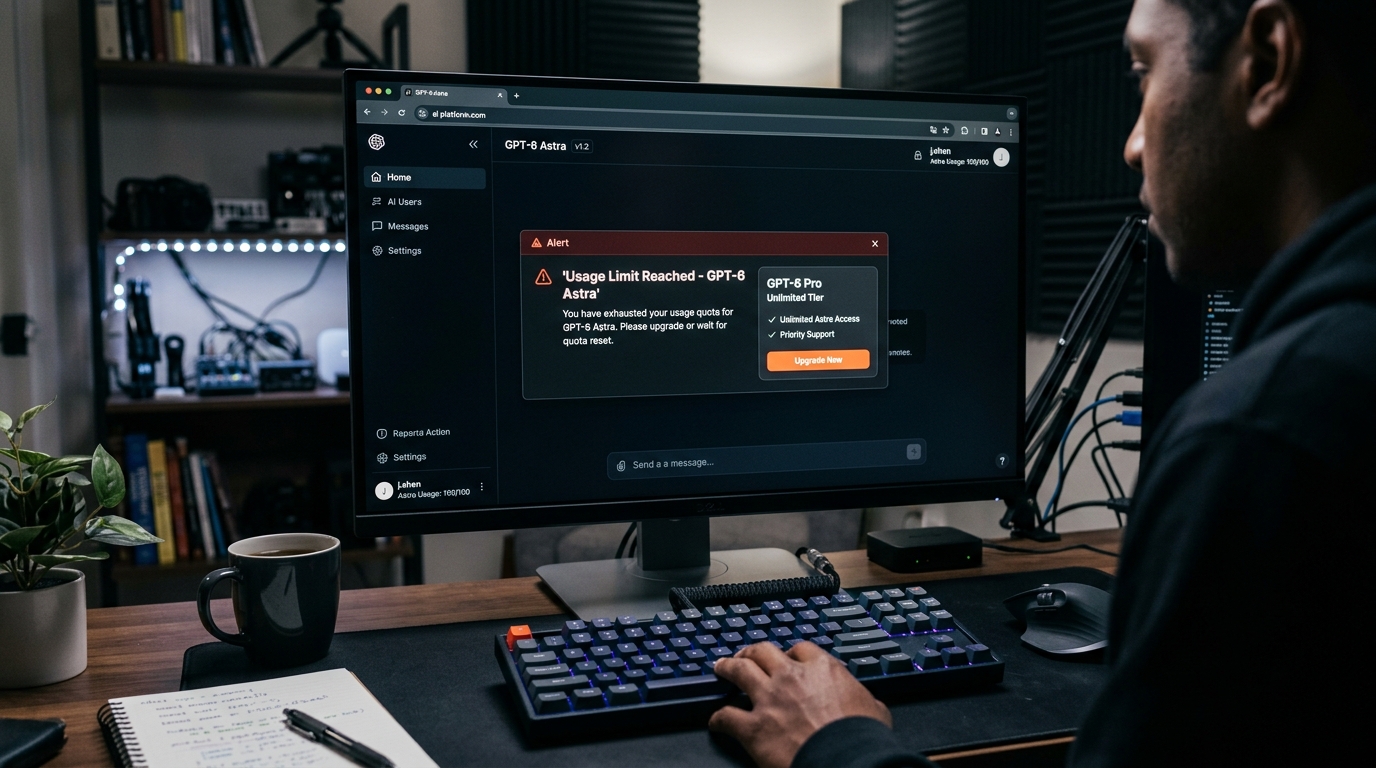
Many industry observers and everyday users found themselves grappling with an apparent technological paradox: if OpenAI commands an unprecedented supercomputing armada exceeding one hundred thousand Grace Blackwell GPUs, why can the platform not comfortably sustain the routine interactive inquiries of its paid subscriber base without resorting to draconian throttling?
The resolution of this mystery resides in the profound, often misunderstood economic and physical chasm separating training compute from inference compute.
1. Training Is a Sunk Capital Cost; Inference Is an Ongoing Cash Drain
A dedicated cluster of one hundred thousand Grace Blackwell NVLink72 systems represents a massive, capitalized asset deployed to execute foundational pre-training runs and large-scale reinforcement learning with verifiable rewards (RLVR). Once those foundational weights converge after months of uninterrupted execution, that multi-billion-dollar capital expenditure is essentially locked in and completed.
However, GPT-6 Astra represents a categorical departure from traditional autoregressive transformers such as GPT-4. It functions as an autonomous, multi-modal operating agent designed for native Computer Use and adaptive multi-path deduction. When a software architect instructs the model to inspect an asynchronous deadlock across microservices and patch the codebase, the backend computational demand does not resemble a traditional text prompt:
- The system cannot simply generate five hundred tokens of straightforward prose and conclude the exchange;
- It must initialize virtual desktop environments, run localized containerized test harnesses, parse high-resolution UI screen buffers, interpret stack traces, and execute between twenty and fifty self-correcting iterative loops;
- A single user turn frequently triggers hundreds of thousands, or even millions, of latent reasoning, scratchpad, and vision tokens across distributed inference nodes.
2. The $20 Flat-Rate Subscription Model Has Broken Down
When examined against OpenAI's official API rate card for GPT-6 Astra—priced at ten dollars per million prompt tokens and fifty dollars per million generated reasoning tokens—the financial arithmetic becomes untenable for flat-rate plans.
A single comprehensive agentic coding session or visual desktop automation run can effortlessly incur between two and five dollars in direct wholesale API compute costs. If OpenAI were to grant its vast base of twenty-dollar-per-month Plus subscribers unfettered access to Astra, an active developer running just four or five demanding workflows would completely exhaust their monthly contribution. A user executing twenty complex sessions within thirty days would generate hundreds of dollars in negative unit economics, easily overwhelming electricity margins and hardware depreciation allowances. Rate-limit slashing is neither a trivial infrastructure bug nor a temporary network outage; it represents an urgent corporate firewall erected to prevent catastrophic operational cash burn.
---
Commercial Agendas and Tiered Rationing: From $20 Flat-Rate to $200 "VIP Compute"
Under the intensifying strain of operational inference expenditures, OpenAI has begun fundamentally revamping its public product packaging and user segmentation:
- Free-Tier Consumers: Have been almost entirely severed from direct access to uncompressed Astra weights, redirected instead toward aggressively quantized, distilled utility models;
- $20/Month Plus Subscribers: Have been practically transformed into a restricted evaluation tier, governed by strict five-hour message quotas and immediate down-throttling during server peak load;
- $100 to $200 Pro and Business Accounts: Are systematically routed toward dedicated, high-priority "GPT-6 Pro" compute clusters with unconstrained context windows and zero synthetic latency penalties;
- Enterprise and Pay-As-You-Go API Clients: Are billed strictly according to metered token consumption and execution seconds, paying premium spot prices for sustained autonomous problem solving.
This structural divergence marks the definitive conclusion of the subsidized "all-you-can-eat" era that defined the introductory years of consumer generative AI. The artificial intelligence sector is rapidly adopting the economic model of public utilities and industrial electrical grids, where premium power quality demands steep, multi-tiered tariff structures.
From Jensen Huang's vantage point, the timing of his AGI declaration constitutes a meticulously calculated commercial defense. Coming immediately on the heels of NVIDIA's 12.93 billion dollar definitive acquisition of Hugging Face, the semiconductor giant must continuously reassure institutional investors that hyperscaler capital expenditures exceeding hundreds of billions annually are not merely sustainable, but fundamentally insufficient. By framing one hundred thousand superchips as the bare threshold required to reach rudimentary AGI, Huang establishes a powerful commercial narrative dictating that the subsequent tranches of four hundred thousand and one million GPUs must be procured at all costs.
---
Our Verdict: Compute Rationing Becomes the New Normal as the "Affordable AI Utopia" Ends
Synthesizing underlying semiconductor thermal boundaries, memory bandwidth economics, and software business models, we present three clear strategic verdicts for the artificial intelligence landscape:
Verdict 1: Flat-Rate Subscriptions Give Way to Compute-Hour Metering
Fixed monthly consumer pricing cannot withstand the open-ended inference overhead of autonomous agentic workflows. By the close of 2026, leading model developers including OpenAI and Anthropic will transition their flagship autonomous tools toward hybrid monetization models: a baseline nominal platform fee combined with metered compute-hour credits or consumption token wallets.
Verdict 2: Cascade Routing Becomes an Architectural Requirement
Directing every routine programmatic inquiry to top-tier frontier models like GPT-6 Astra is a financially reckless engineering posture. Enterprise software architectures must universally adopt three-tier cascade routing pipelines: 1. Tier 1: Local lightweight instances or sub-dollar commodity APIs (such as Gemini 3.8 Flash or open-source edge weights) execute preliminary intent extraction, semantic parsing, and routine filtering; 2. Tier 2: Cost-efficient long-context workhorses perform intermediate boilerplate generation, document search, and regular tool operations; 3. Tier 3: Context packets are dispatched to premium frontier models like Astra or Claude Fable 5.1 exclusively for critical algorithmic deadlocks, multi-file architectural refactoring, and formal mathematical proofs.
Verdict 3: Cloud Providers and Open-Source Ecosystems Accelerate Competitive Counter-Attacks
OpenAI's capacity crunch and consumer throttling are providing a major strategic opening for agile competitors across the landscape:
- Anthropic's Targeted Economic Offensive: Anthropic's Claude Fable 5.1 release on September 1 dramatically slashed prompt caching read expenses by seventy-five percent to twenty-five cents per million tokens, directly catering to enterprise teams handling repetitive codebase contexts;
- Alternative Free Quotas and Subsidized Hubs: Initiatives such as Google AI Studio's fifteen hundred daily free Gemini API requests and AMD Token Factory's continuous free allocations are becoming crucial operational sanctuaries for developers priced out by OpenAI's rate restrictions.
---
Actionable Advice for Developers and Enterprises: What to Do Now
To safeguard continuous operational agility in an environment characterized by systemic compute rationing and rising inference expenditures, technical leadership should implement the following defensive actions:
- Implement Intelligent Circuit Breakers in Agent Pipelines: Never permit autonomous terminal agents or continuous test runners to enter unmitigated retry loops against HTTP 429 rate limit responses. Implement exponential backoff algorithms with jitter across client runtimes, and automate graceful degradation to secondary model backends whenever quota throttling is detected;
- Restructure Workflows Around Aggressive Prompt Caching: If your operational workloads depend upon extensive static documentation, multi-thousand-line coding style guides, or large repository maps, immediately refactor codebases around caching-optimized architectures such as Anthropic's seventy-five percent caching discount to avoid re-paying redundant prompt ingestion costs on every successive turn;
- Establish Unified Multi-Provider Routing Abstraction Layers: Eliminate direct code coupling to proprietary single-vendor client SDKs. Utilize open-source abstraction proxies such as LiteLLM or internal routing gateways to dynamically balance query loads across Google Gemini Flash, DeepSeek, and Meta open-weight infrastructure, reserving high-cost frontier models strictly as high-leverage escalations.
---
What Remains to Be Observed
- Timeline for Actual Compute Relief: When the four hundred thousand additional Blackwell units currently undergoing deployment become fully energized, will inference throttling genuinely abate for consumer subscribers, or will enterprise contracts absorb the entirety of the new capacity?
- Subscriber Churn and Platform Migration: Will disillusioned Plus users subjected to five-message operational caps initiate widespread subscription cancellations over the next thirty days, triggering substantial platform migrations toward Claude or self-hosted alternatives?
- Potential Regulatory Inquiries into AGI Claims: Could unilateral social media declarations of achieving AGI from major semiconductor executives draw formal scrutiny from securities regulators and consumer protection agencies regarding market disclosures and truth in advertising?
---
FAQ
Has AGI truly arrived with GPT-6 Astra?
No. Huang's statement represents corporate framing designed to support capital expenditure cycles and hardware demand. True Artificial General Intelligence requires broad autonomous generalization and robust physical world adaptability that remains unproven. While Astra excels at mathematical deduction and programmatic agency, it continues to face fundamental constraints around context retention, energy consumption, and adversarial robustness.
Why are paying ChatGPT Plus subscribers being throttled?
Because deep reasoning and agentic Computer Use workflows consume tens of times more tokens than standard conversational queries. Under current API rates, heavy agent usage incurs actual compute costs far exceeding the $20 monthly fee. OpenAI enforces dynamic rate limits to protect server availability and prevent unsustainable operational losses.
Can independent developers still afford top-tier frontier models going forward?
Yes, provided they shift from conversational prompting to targeted execution. Frontier reasoning models are increasingly priced as high-value strategic resources. Developers must leverage lightweight models for preliminary processing and invoke flagship models selectively for critical execution milestones, while taking advantage of provider free tiers and prompt caching discounts.