The Free Double-Dip Is Over: OpenAI Merges ChatGPT and Codex Into a Single Quota Pool
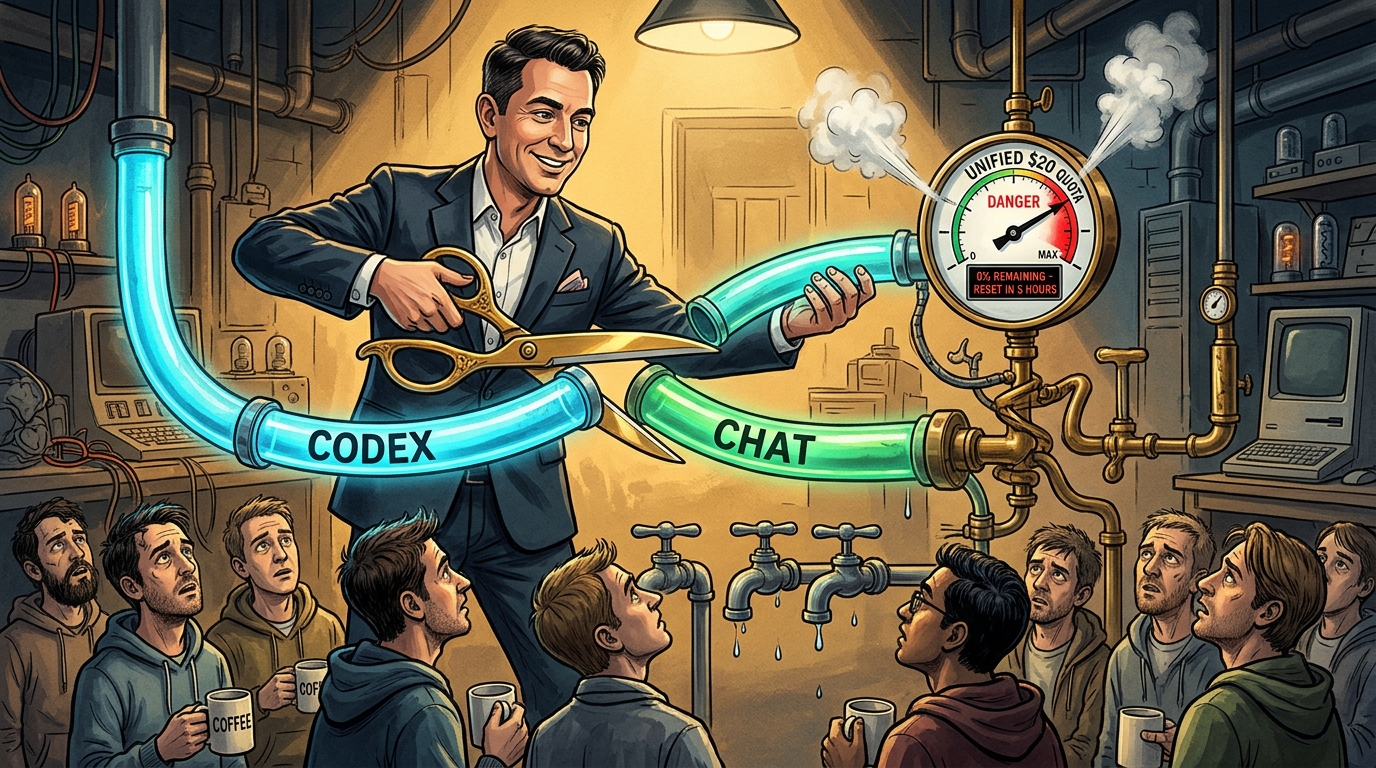
OpenAI's consolidation of ChatGPT and Codex quotas marks the definitive end of venture-subsidized, all-you-can-eat compute. By funneling high-context agentic operations, multi-step coding, and everyday dialogues into a single token-weighted pool, the platform executed a stealth price hike to offload soaring inferential deficits onto heavy power users. To navigate this compute crunch, developers must immediately abandon single-vendor dependency: reserve flagship allocations strictly for core architectural dilemmas, offload expansive codebase migrations to decoupled platforms like Claude or metered APIs, and anchor foundational tooling on sovereign local open models where productivity cannot be shut off by an external spigot.
Late on a Sunday night in Shenzhen's Nanshan tech corridor, an independent full-stack engineer slammed headfirst into the single most suffocating experience of his engineering year. His high-resolution display was neatly partitioned down the center: the left half hosted a terminal window running Codex, which was methodically refactoring three backend microservice endpoints and compiling fresh unit test suites; the right half displayed the ChatGPT web client, churning through dense distributed tracing logs to hunt down a Byzantine database lock contention.
Just as the Codex progress bar smoothly climbed to 98% and prepared to commit seven modified configuration files to disk, the terminal window violently stuttered, spewing out an ominous crimson diagnostic banner: "Shared quota depleted: Rate limit reached". The engineer froze, gripping the cold remnants of an Americano, and instinctively dragged his cursor across the screen to the ChatGPT dialog to ask for immediate troubleshooting assistance. Yet beneath the prompt input box, the once-reliable green send button had faded into an inert slab of dull gray, pinned beneath an unyielding amber countdown: "Your unified quota is exhausted. Please try again in 4 hours and 38 minutes."
His ceramic mug nearly rattled against the mechanical switches of his keyboard. For the past several years, virtually every budget-conscious developer and small engineering outfit operated under an unspoken, deeply comfortable optimization loop: write and refactor code within the isolated boundary of your Codex allotment, while conducting high-level research, customer correspondence, and architectural ideation within your separate ChatGPT web allocation. Two separate spigots, each flowing from its own independent reservoir, allowing a single determined builder to orchestrate an entire production pipeline for twenty dollars a month.
With OpenAI's sudden, unvarnished official decree, that cherished era of computational double-dipping has been unceremoniously smashed to pieces. Beginning this December, subscription tiers across Plus, Pro, and Business plans will undergo radical structural surgery: ChatGPT and Codex will formally share a single, unified token-based quota pool. The beloved free ride that subsidized a generation of solo founders is officially entering the graveyard.
Midnight Hackers Choked by a Single Shared Compute Spigot
The international developer community has learned through hard experience to treat OpenAI's product announcements with immense skepticism. Predictably, the official briefing document opened with smooth corporate pleasantries about "seamless cross-workflow synergy" and "reducing cognitive friction for multifaceted teams." But once an engineer strips away the marketing glaze and inspects the raw mechanics of the underlying billing logic, it becomes immediately apparent that this is not an interface upgrade. It is an aggressive, calculated rationing of compute.
Under this newly minted "unified quota pool" regime, OpenAI has welded together two previously distinct digital assets. In the past, if an aggressive coding session in the terminal drained your Codex limits to zero, you could casually switch back to your browser tab and prompt ChatGPT to polish an executive summary for your board of directors. Conversely, if you spent an entire afternoon using advanced reasoning models to debate esoteric system designs in the web interface, your evening terminal coding sessions remained entirely pristine and unaffected.
That functional firewall is gone. When two formerly independent dams are breached and routed through a single, constrictive valve, an oversized spike in usage on one front instantly cannibalizes the water supply of the other.
Software development, by its very nature, represents the single most token-hungry discipline in modern applied intelligence. An automated codebase migration across multiple dependencies routinely digests tens of thousands of contextual tokens through iterative tool invocations, linting passes, and automated test loops. A developer might trigger a seemingly routine integration test through Codex, only to pivot back to the web console and find themselves completely locked out from translating a three-line documentation snippet because the terminal agent drank the entire well dry.
Five Lethal Details: Cramming a Cash-Guzzling Beast Into a Teacup
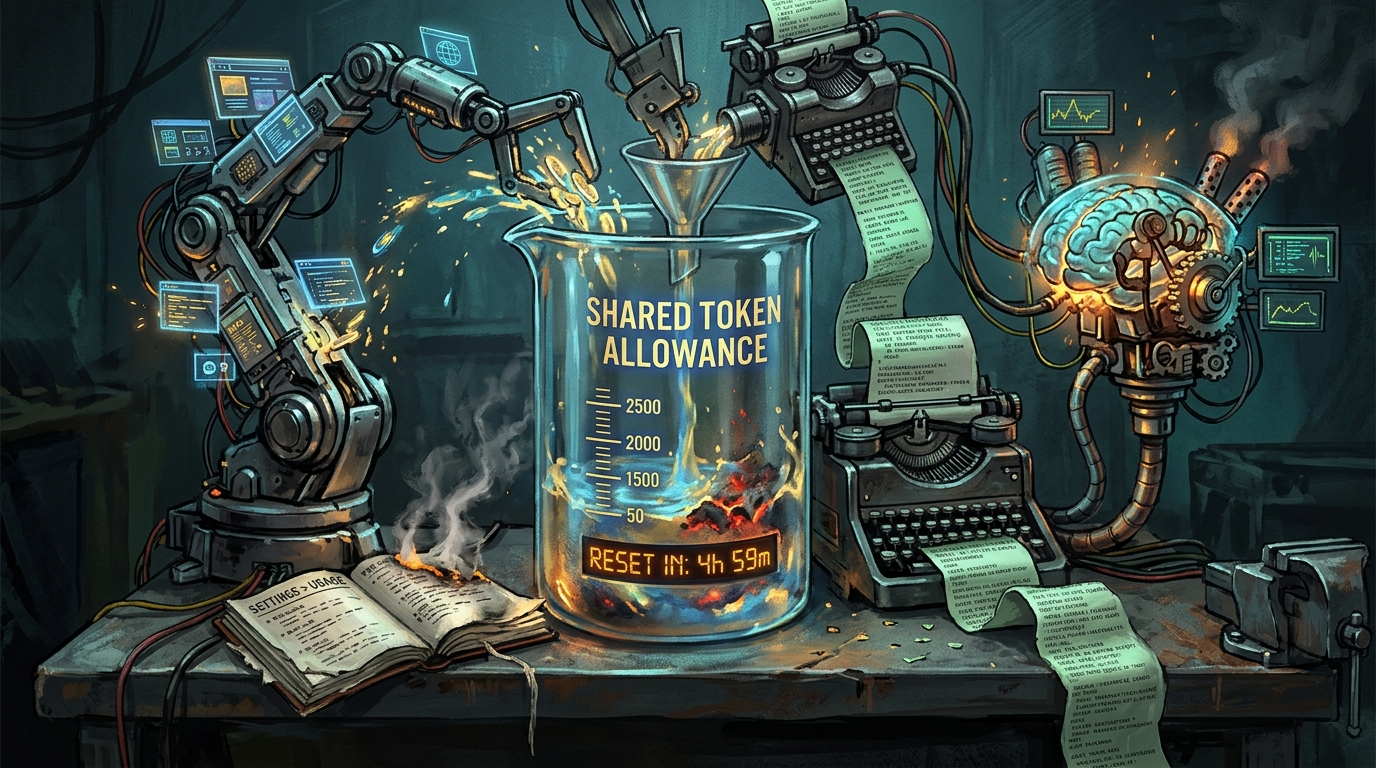
Deconstructing the granular provisions of OpenAI's announced framework reveals that every single adjustment strikes with surgical precision at the everyday workflows of heavy productivity power users:
- Absolute Quota Consolidation: ChatGPT conversational dialogues and Codex terminal or plugin invocations will no longer maintain distinct rate ceilings. Both now draw directly from an identical pool of computational credits. Every query asked in a web browser during the day now actively borrows against the reasoning runway available during late-night debugging marathons.
- Dynamic Token-Based Depletion: Allowances are no longer metered by static conversational turns or uniform message tallies. Consumption is calculated dynamically through comprehensive token arithmetic, factoring in base model weights, input-output token volume, expanded context windows, and extended reasoning effort. Firing up a frontier reasoning engine or launching a recursive agentic loop will deplete the shared reserve exponentially faster than standard text generation.
- Instant Chat as the Lone Exemption: OpenAI explicitly confirmed that "Unlimited Instant" remains bundled across paid tiers without draining the shared allowance. However, experienced builders recognize this as an empty concession. The Instant tier operates predominantly on pruned, lightweight models stripped of deep deductive chains, making it suitable for superficial conversational trivia but utterly inadequate for nontrivial software architecture or rigorous bug triaging.
- Work Mode Absorbed Into the Core Dialogue: The formerly isolated "Work" paradigm is being folded directly into the primary ChatGPT conversational stream. Users can now natively delegate tasks such as dynamic website construction, multi-slide slide deck compilation, and active web navigation without toggling dedicated tabs. While aesthetically impressive, this change effectively introduces an autonomous agent capable of burning hundreds of thousands of tokens per task directly into an already strained personal quota.
- Unified Telemetry Dashboard: Subscribers will monitor remaining computational balances and upcoming reset clocks via a consolidated "Usage" ledger nestled inside the application settings. While framed as an exercise in radical transparency, in practice it functions as an anxiety-inducing visual countdown, forcing developers to watch their professional productivity meters evaporate in real time.
These five structural pillars lock together like industrial gears, collapsing a once-flexible operating environment into a punishing, zero-sum game of personal compute budgeting.
Behind the "Unified Experience" Slogan: Shifting Compute Deficits to Users
OpenAI's stated justification for this overhaul relies on classic Silicon Valley doublespeak: "to enable frictionless transitions across diverse tasks without requiring users to perform mental gymnastics across disconnected usage meters."
Experienced industry observers see right through the rhetorical paint. This is structurally identical to an airline trimming four inches of legroom from economy seating and enthusiastically declaring that closer quarters foster richer neighborly connections. The underlying imperative driving OpenAI has nothing to do with ergonomic interface harmony. It is an urgent, balance-sheet-driven campaign to stem the hemorrhaging inference costs threatening its bottom line.
As the industry pivots away from simple next-token prediction toward prolonged chains of thought and agentic multi-tool execution, synthesizing a high-quality technical solution is no longer a matter of momentary GPU burst capacity. It demands extensive background computation spanning tens of thousands of hidden reasoning tokens across multiple asynchronous subagents. In scenarios involving Codex and automated web tooling, a single high-level command can trigger dozens of consecutive, compute-heavy API rounds.
Under the outgoing split-meter model, millions of clever software engineers effectively weaponized a twenty-dollar Plus subscription as an all-you-can-eat compute buffet: utilizing the web interface as an infinite senior technical sounding board while deploying Codex as a cost-free junior engineering apprentice. This ubiquitous double-dip habit left OpenAI underwriting astronomical volumes of unbilled inferential overhead behind closed datacenter doors.
Merging the quota pools resolves this corporate vulnerability with remarkable elegance. Without raising base subscription prices by a single headline dollar, OpenAI has restructured the consumption denominator, effectively cutting the usable high-tier compute allocation of power users by more than half. It is a quiet, impeccably engineered stealth price hike.
The Compute Economics Audit: The Twenty-Dollar Double-Dip Myth Collapses

Examining this policy shift against the broader macroeconomic landscape of Silicon Valley reveals that OpenAI's move was an economic inevitability. Throughout late October, the technology sector endured a brutal market reckoning over soaring artificial intelligence capital expenditures.
Alphabet revealed quarterly infrastructure spending climbing to an astonishing $51.4 billion, driving its free cash flow into a negative $9.1 billion abyss. Meta engineered a historic $95 billion equity issuance anchored by chip suppliers to sustain its hardware acquisition binge. Microsoft went so far as to orchestrate the revival of decommissioned nuclear reactors simply to ensure baseline electrical grids can sustain its upcoming datacenter clusters. The entire hyperscale ecosystem is buckling under the weight of historic infrastructure invoices.
Against this unforgiving backdrop, OpenAI consumes tens of billions of dollars annually merely to keep its active inference clusters spinning. While aggressive deficit-subsidized pricing successfully captured hundreds of millions of enthusiastic global users, Wall Street's patience for open-ended compute subsidies has officially run dry. Institutional investors are demanding defensible margins and strict return on invested capital.
The twenty-dollar Plus membership was always an artificial economic bubble financed by venture capital subsidies. The moment that speculative bubble collided with the real-world operational costs of autonomous coding agents and deep iterative reasoning, its collapse became mathematically predetermined. OpenAI's unspoken ultimatum to its user base is impossible to misinterpret: twenty dollars a month will no longer simultaneously underwrite your daily writing, strategic brainstorming, and automated full-stack coding. If you require seamless continuity across both realms, you must either upgrade to the two-hundred-dollar Pro tier or purchase enterprise seats at full commercial freight.
Survival Guide Before December: How to Keep Working When Quotas Run Dry
Voicing frustration across online forums will not ship the production pull requests sitting on your sprint board. Confronting the imminent December compute contraction requires high-frequency builders and independent software practitioners to radically restructure their daily engineering toolchains:
- Guard Against Silent Token Vampires in Work and Reasoning Modes: Break the careless habit of delegating trivial tasks to flagship reasoning models within the primary chat thread. Route documentation queries, boilerplate syntax lookups, and basic data munging strictly to the Instant tier, which remains outside the shared meter; reserve the consolidated token pool strictly for mission-critical architectural design and intractable bugs.
- Decouple Large-Scale Refactoring From the Primary Quota: Cease routing end-to-end multi-file test generation and broad repository migrations through your personal Codex allowance. Offload massive codebase refactoring to alternative platforms with dedicated allocations, such as Claude Code, or route heavy scripting directly through meter-based third-party API gateways where payment scales purely with actual operational volume.
- Cultivate Sovereign Private Compute via Local Open Models: With the arrival of robust open-weight giants like the 1-trillion parameter Mistral Large 4 and specialized coding fine-tunes from the DeepSeek ecosystem, transition routine code completion, style linting, and local unit test validation onto private workstations and internal bare-metal servers. True operational resilience is achieved only when foundational engineering throughput no longer depends upon an external API valve.
- Audit Team Subscription Economics Against Real Delivery Output: Engineering leads and solo operators must begin tracking weekly consumption trends directly within the newly deployed Settings > Usage ledger. If empirical tracking demonstrates that the unified allocation regularly runs dry before midweek milestones are met, calculate the hard business return of seat upgrades against the costly productivity halts caused by artificial quota freezes.
Corporate tech promises are inherently transient, and OpenAI's quota consolidation will certainly not be the final subtraction made by a hyperscaler under margin pressure. But for engineers who deliberately diversify their workflows and refuse to anchor their livelihoods to a single proprietary spigot, no degree of compute rationing can permanently shut down their momentum.