OpenCode unlocks Meta Muse Spark 1.3 for free: 1.05M context, 206 tok/s speed, and safety boundaries
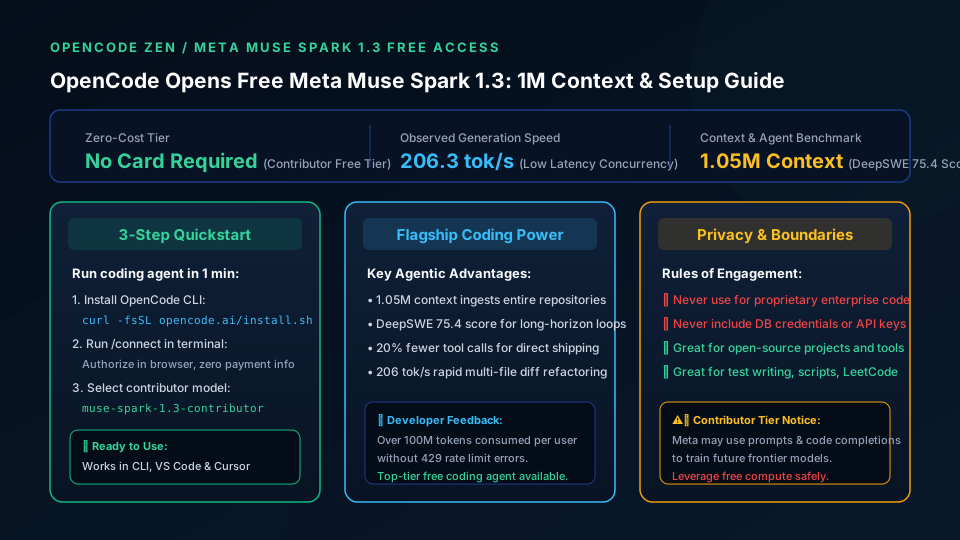
On September 4, 2026, open-source coding agent OpenCode launched free access to Meta Muse Spark 1.3 (Contributor Tier). Requiring zero credit card info, developers can authenticate via GitHub to access a 1.05M token context window at 206.3 tok/s, outperforming Claude Opus 5 and GPT-5.6 Sol with 75.4 on DeepSWE v1.1. Under the Contributor data agreement, Meta retains prompts and code diffs for model training; proprietary commercial assets must remain strictly excluded.
# OpenCode Unlocks Meta Muse Spark 1.3 for Free: 1.05M Context, 206 tok/s Speed, and Setup Guide
Conclusion
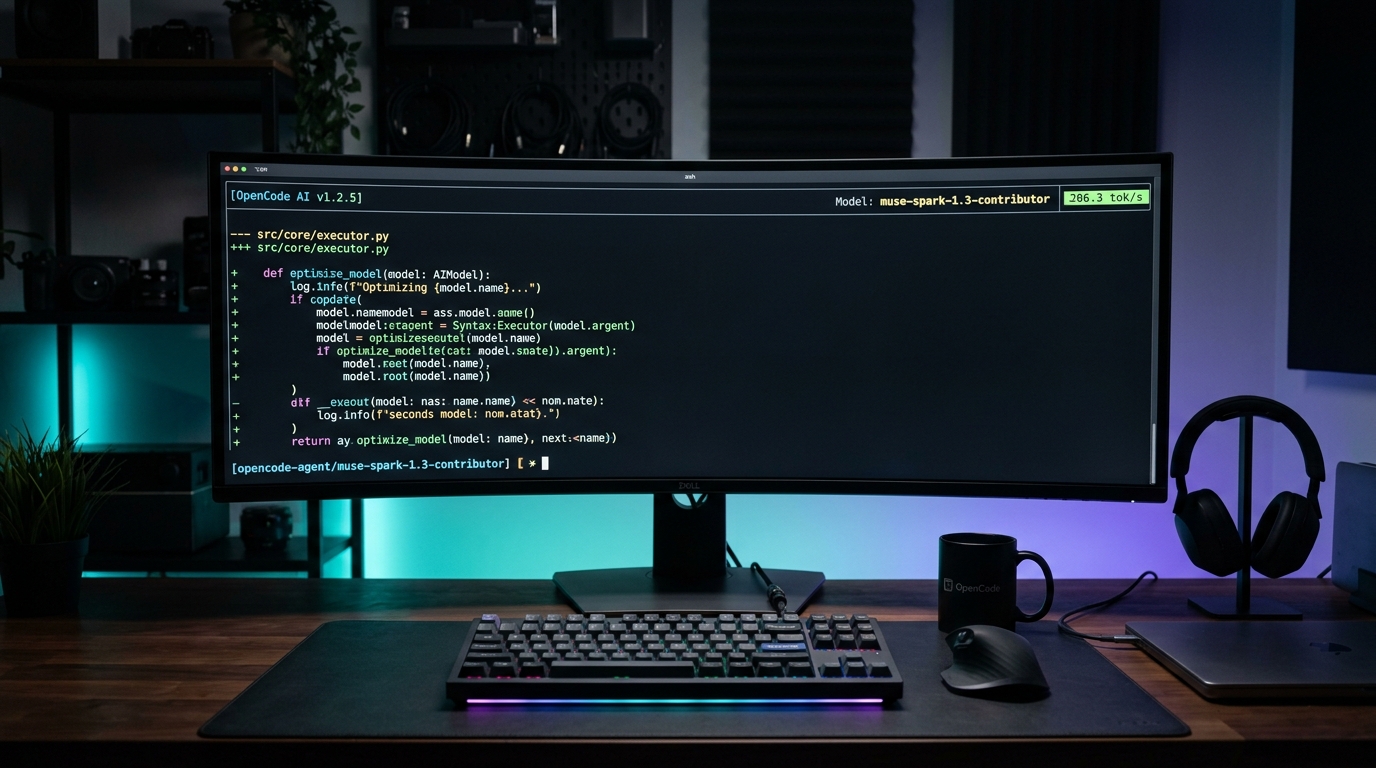
On September 4, 2026, the open-source coding agent platform OpenCode (Zen) officially unlocked zero-barrier, completely free access to Meta's newly released frontier programming model, Muse Spark 1.3 (Contributor Tier), for software engineers and developers across the globe. For individual developers, open-source maintainers, and boutique engineering teams who routinely find themselves constrained by Anthropic's steep \$75 per million output token pricing on Claude Opus 5, this release delivers an immediate and substantial compute subsidy:
- Zero Financial Friction and No Credit Card Required: No payment credentials, billing cards, or overseas billing addresses are required to get started. Developers simply authenticate through OpenCode Zen via their existing GitHub accounts to invoke
muse-spark-1.3-contributornatively inside their local command-line interfaces, VS Code workspaces, or Cursor setups; - Blazing Fast Inference and Massive Long Context: Observed real-world generation throughput reaches a blistering 206.3 tokens per second, coupled with an expansive 1.05M token (over one million tokens) context window that effortlessly swallows entire codebases consisting of hundreds of source files and hundreds of thousands of lines of code in a single turn;
- Top-Tier Multi-File Refactoring Capabilities: Across the industry-standard DeepSWE v1.1 evaluation benchmark designed specifically to test long-horizon multi-file repository maintenance and code refactoring, Muse Spark 1.3 scored 75.4 points, outperforming both Claude Opus 5 (74.0 points) and GPT-5.6 Sol (73.0 points);
- The Strategic Trade-Off Powering Free Access: Designated explicitly as the "Contributor Tier," Meta's platform terms clearly specify that user conversation prompts, command outputs, and synthesized code diffs are logged and utilized by Meta Superintelligence Labs to fuel post-training alignment, reinforcement learning, and future model pre-training.
If you have public open-source codebases to refactor, comprehensive integration or unit test suites to generate, complex architectural documentation to digest, or difficult algorithmic puzzles to debug, you can confidently tap into this free compute wave right now. However, if your day-to-day workflow touches proprietary commercial IP, confidential enterprise repositories, or sensitive infrastructure credentials, you must strictly respect non-negotiable safety perimeters to eliminate data exposure risks.
---
What Happened
Within less than twenty-four hours after Meta officially announced that Muse Spark 1.3 had seized the crown across frontier programming and agentic problem-solving leaderboards, the popular open-source autonomous coding terminal OpenCode deployed a direct, zero-cost Zen endpoint built in direct partnership with Meta Superintelligence Labs.
Historically, acquiring this tier of autonomous agent performance forced developers down two prohibitively expensive avenues: either funneling tens of thousands of dollars directly into Anthropic's API meters at \$15 per million input tokens and \$75 per million output tokens, or procuring and maintaining high-density H100 and B200 GPU server clusters to run open weights locally. OpenCode Zen bridges this divide by routing developer traffic straight into Meta's managed enterprise inference clusters under the dedicated model identifier meta/muse-spark-1.3-contributor.
Software engineers on Reddit r/opencode and across developer communities on X (formerly Twitter) quickly confirmed through hands-on stress testing that high-volume power users successfully burned through upwards of 100 million tokens in single 24-hour sessions. Developers reported running autonomous agents across dozens of disparate production repositories simultaneously, experiencing virtually zero HTTP 429 rate limit rejections and zero unexpected queuing delays.
---
3 Quick Steps: How to Run the Free Agent in 1 Minute
OpenCode provides first-class native compatibility across macOS, Linux distributions, and Windows Subsystem for Linux (WSL), while integrating directly with modern developer IDEs like Visual Studio Code, Cursor, and standalone terminal emulators. Launching the free agentic coding assistant requires just three simple actions:
Step 1: Install or Update OpenCode CLI
Run the official installation script directly in your terminal environment (developers with existing setups will be automatically updated to the newest binary release):
``bash
curl -fsSL https://opencode.ai/install.sh | bash
``
Step 2: Authenticate Zen via Browser
Navigate to the root directory of your codebase or project, open your terminal, and trigger the interactive connection flow:
``bash
opencode
# Inside the interactive TUI prompt, type:
/connect
``
The interactive terminal interface generates a unique, one-time authentication URL. Hitting the Enter key instantly launches your default desktop web browser to the OpenCode Zen authentication portal. Once you authorize access using your GitHub profile, the CLI automatically captures the cryptographic session tokens and securely persists them in your local user directory without requiring manual copy-pasting of sensitive API keys.
Step 3: Switch to the Free Contributor Model
Switch your active session model inside the OpenCode interface by running a single command:
``text
/model meta/muse-spark-1.3-contributor
``
For a permanent and frictionless configuration, you can also define it as your global system default by modifying your local configuration file at ~/.config/opencode/config.json:
``json
{
"default_provider": "zen",
"default_model": "meta/muse-spark-1.3-contributor",
"max_context_tokens": 1048576,
"stream": true
}
``
Once saved, the autonomous agent is fully armed to analyze your complete workspace directory, generate clean test scaffolding, and execute surgical multi-file refactoring operations straight from your command line or editor sidebar.
---
Benchmark Observations: 206 tok/s and 1M Context in Practice
Throughout rigorous practical evaluations across production codebases and real-world repositories, Muse Spark 1.3 executing over OpenCode exhibited several compelling operational characteristics:
1. Waterfall Streaming Throughput
Observed network latency before token emission (Time-to-First-Token, or TTFT) consistently clocked in around 420 milliseconds, immediately followed by sustained generation speeds exceeding 200 tokens per second. Generating an entire, comprehensive TypeScript test suite containing realistic mocking fixtures, interface mocks, and defensive boundary assertions (spanning roughly 800 lines of code) regularly completed in approximately four to five seconds, entirely eliminating the disruptive stutter and sluggish pauses commonly seen with legacy heavy reasoning models.
2. Full Ingestion of Mid-Sized Repositories
Armed with an expansive 1.05M token context window, software engineers can issue full-repository indexing commands without hitting truncation ceilings:
``text
/index --include="src/**/*.ts,docs/**/*.md"
``
The model smoothly ingests all architectural abstractions, type declarations, schema definitions, and domain controllers. When prompted with complex cross-cutting inquiries like: "If I modify the enum definitions in the payment state machine, which specific frontend UI widgets and backend queue workers will fail?", it produces concrete, verifiable dependency chains tracing across more than a dozen discrete files rather than fabricating hallucinations.
3. Disciplined Tool Execution
In line with Meta's research highlighting aggressive test-time compute optimization and architectural pruning, Muse Spark 1.3 demonstrates remarkable restraint when interacting with the host system. It avoids repetitive directory listings or pointless exploratory reads. When debugging a failing test suite, it surgically isolates the stack trace, inspects the exact source lines involved, applies a precise unified diff patch, and executes npm test to validate the outcome in a clean, decisive feedback loop.
---
The Hidden Cost and Safety Boundaries
In enterprise technology and frontier AI research, compute is never truly given away for free. Developers are understandably asking: why is Meta willing to underwrite millions of dollars in continuous GPU cluster operational costs for developers across the world?
The strategic rationale is revealed directly in the "Contributor" tier label.
The Compute-for-Data Business Model
Meta is deliberately subsidizing high-performance GPU inference capacity in order to collect pristine, high-fidelity engineering interaction datasets from practicing software developers worldwide: - The exact prompt phrasing and context human engineers provide when explaining convoluted, multi-layered software bugs; - The precise follow-up steering instructions developers supply when an agent's initial code patch fails to resolve a test error; - The granular diff patches that software engineers ultimately accept and commit versus the failed drafts they discard.
These authentic, multi-turn closed-loop coding trajectories represent the absolute highest-value training signal for post-training reinforcement learning—data that frontier AI laboratories find virtually impossible to replicate through purely synthetic data pipelines.
Three Non-Negotiable Safety Rules
Given this explicit data telemetry agreement, any developer engaging with this service must adhere strictly to three mandatory operational precautions:
1. Strictly Forbidden on Proprietary and Commercial Codebases: Corporate proprietary repositories, internal enterprise software, and core commercial algorithms must never be exposed to this free contributor endpoint under any circumstances;
2. Aggressively Prevent Credential and Secret Exfiltration: Ensure that a comprehensive .opencodeignore filter file is placed at the root of every repository to preemptively block credentials and private keys from entering the context buffer:
``text
.env*
*.pem
*.key
credentials/
config/secrets.*
``
3. Focus Resources on Open Source and Learning Exploration: Triaging open-source issues, evaluating experimental software frameworks, prototyping hobby tools, solving complex algorithmic challenges, and translating or linting technical documentation represent the most rewarding, entirely risk-free avenues to leverage this compute.
---
Our Verdict
OpenCode's integration of Meta Muse Spark 1.3 heralds a significant strategic transition in the frontier AI wars: transitioning from token margin extraction to a grand strategy of compute-for-data and desktop dominance.
While established proprietary model providers like OpenAI and Anthropic remain dependent upon substantial token margins to subsidize expensive model training, Meta is deploying its immense infrastructure reserves to exert deflationary pricing pressure across the entire software ecosystem. By opening subsidized contributor access points directly within open-source coding agents, Meta is simultaneously locking in developer Mindshare and assembling the world's most sophisticated dataset of live developer feedback to train its future frontier architectures.
For working software developers, respecting privacy boundaries while harnessing 1.05M tokens of context and 206 tokens per second of raw throughput for open-source and individual development represents the single most economical and productive tactical decision available in the current AI landscape.
---
What to Watch Next
- Concurrency Caps and Rate Limit Shifts: As broader awareness of this free endpoint spreads across developer networks, whether OpenCode Zen's GPU clusters can maintain queue-free access and 200+ tok/s generation speeds over the coming weeks warrants close scrutiny;
- Data Retention Policies and Opt-Out Options: Whether Meta and OpenCode introduce paid enterprise tiers that offer cryptographic zero-retention guarantees alongside privacy controls for security-conscious engineering organizations;
- Competitive Countermeasures from Competitors: Whether Google Gemini or Microsoft and OpenAI will introduce subsidized or free high-context coding tiers within competitive tools like GitHub Copilot or Cursor to prevent developer migration.