Ox Alpha's mask is slipping: is OpenRouter's free 1M multimodal model GLM-5.3 Flash?
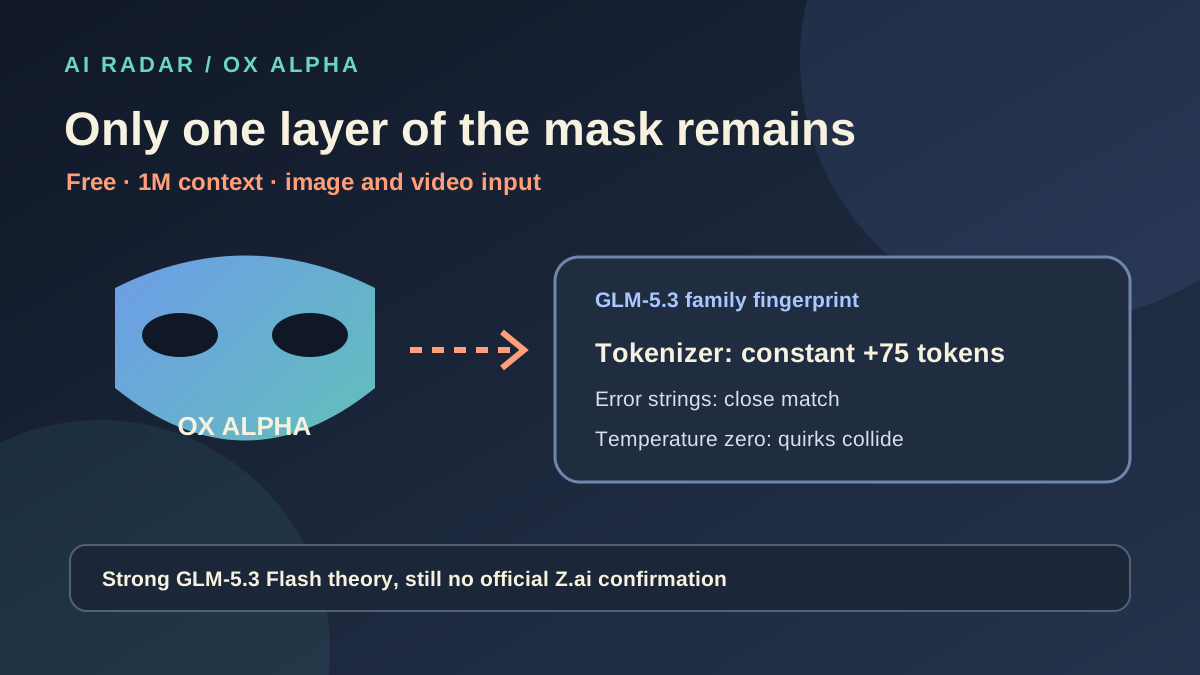
Ox Alpha has not received an official identity confirmation, but the available black-box evidence strongly points to the GLM-5.3 family: tokenizer counts differ by a constant 75 tokens across multiple texts, while error strings and temperature-zero output quirks also match closely. OpenRouter currently lists it as free with text, image and video input and a 1M context; free does not mean unlimited or production-safe.
The bottom line
The mask on the mysterious Ox Alpha model has been reduced to one thin layer.
OpenRouter still describes it as a stealth model operated by an anonymous third-party provider. But a black-box tester reports that six English, German, Chinese, code and emoji prompts produced token counts exactly 75 higher than public GLM-5.3 every time. The error string also matched GLM-5.3's warning that thinking cannot be disabled, and temperature-zero answers shared distinctive German-decimal and Markdown habits.
That makes “Ox Alpha belongs to the GLM-5.3 family” the strongest current explanation. It is not an official reveal: Z.ai has not said Ox Alpha is GLM-5.3-Flash, and OpenRouter still lists the provider as anonymous. The careful conclusion is that it may be a post-trained or multimodal preview variant of GLM-5.3. Whether it is specifically Flash remains for the publisher to confirm.
The official page describes more than a renamed small model
OpenRouter positions Ox Alpha as a reasoning model for coding, sustained agent work and production workflows. The page lists text, image and video input, a 1,048,576-token context window and a maximum output of 131,072 tokens. Its release date is August 20, 2026.
The more startling line is the price: Free for both input and output. It has one Stealth provider, with roughly 26 tokens per second and about 3.90 seconds of P50 latency on the page. Hermes Agent, Claude Code and DeepSeek Harness already appear among the applications sending traffic to it, while the activity panel shows a huge burst of early usage.
That is why people started digging. A 1M-context multimodal model for long-horizon coding agents is temporarily free, and it does not look like a random anonymous demo.
Clue one: a tokenizer that is always 75 tokens apart
The community tester did more than ask a few questions and trust a vibe. They ran three black-box fingerprint tests.
The first was tokenization. Across six English, German, Chinese, code and emoji inputs, Ox Alpha and public GLM-5.3 differed by exactly 75 prompt tokens every time. The author suggested that this looks like a fixed hidden system prompt rather than two unrelated models happening to be close. Kimi, Qwen, MiMo and MiniMax produced different counts.
Matching tokenizers do not prove matching weights. Different models can share a tokenizer or a base. What this shows is that Ox Alpha probably has not left the GLM technical route.
Clue two: even the error message sounds like the same author
The tester then sent an invalid reasoning_effort value. OpenCode passed the parameter through, and Ox Alpha returned:
This model always engages in thinking and cannot be disabled; please use low, high, or max.
That is the same wording reported for public GLM-5.3. One error could be reused by a compatibility layer. Combined with the tokenizer offset and interface behavior, it becomes a more interesting fingerprint.
Clue three: the little temperature-zero quirks also collide
In greedy-output tests, Ox Alpha and public GLM-5.3 showed similar Markdown habits, the same German-decimal LaTeX form 0{,}375, and near word-for-word overlap on some factual answers. The tester said they were quite sure it was a GLM model, while remaining unsure whether it was a GLM-5.3 vision variant or a later internal version.
There is still room for caution. Similar output can come from a shared base, shared post-training data, similar system prompts or the same compatibility path. It is strong evidence, not a signature from the publisher.
Why the GLM-5.3-Flash theory spread so quickly
The timeline made the theory irresistible. Z.ai has already launched the GLM-5.3 API and presents it as its latest flagship. The community then noticed that Ox Alpha is public, free and multimodal, while the public GLM-5.3 product does not fully explain those traits.
The cleanest story is that Z.ai handed an unreleased multimodal or Flash member of the GLM-5.3 family to OpenRouter for stealth stress testing before launch, collecting real agent traffic before the public release.
That story is plausible, but plausibility is not confirmation. Another possibility is an Ox Alpha model post-trained by a third party on a GLM-5.3 base. It could also be a larger internal model from the same family. The anonymous-provider label means we do not know who owns the last mile.
Can you use it for free? Yes, but Free does not mean infinite
The OpenRouter page currently shows Free for both input and output. A user can request an API key and call stealth/ox-alpha through the OpenAI-compatible endpoint. Text, image and video input make it useful for code edits, long-context reading, browser agents and low-risk multimodal experiments.
There are four practical limits:
- OpenRouter does not promise that the preview will remain free; it can be repriced, retired or swapped;
- a free provider can still rate-limit, queue or cap accounts, so it should not carry a critical production path;
- OpenRouter says prompts and completions are retained by the provider but not used for training; the exact boundary is defined by the Stealth Model Terms;
- an anonymous provider makes it harder to verify versions, weights, data residency and incident response.
The right posture is: try it boldly, but do not feed it customer records, secrets, medical files or an entire production repository yet. The best early uses are low-risk benchmarks, prompt migration, small agent jobs and side-by-side output comparisons.
Our judgement: the family is nearly certain; Flash still needs a poster
If the question is “is this in the GLM family?”, the answer is now very close to yes. If the question is “is this Z.ai's GLM-5.3-Flash multimodal model?”, the answer remains a high-probability inference, not a confirmed fact.
That distinction matters. If Ox Alpha really is Flash, Z.ai is not merely launching another model. It is using an anonymous preview to test a complete agent ecosystem: OpenRouter, OpenCode, Claude Code, browser tools and huge volumes of real requests.
If it is a third-party post-trained model, that is interesting too: the GLM-5.3 base may already be good enough for someone else to turn into a more agent-oriented product.
Either way, Ox Alpha offers a useful lesson: model identities can be hidden, but model fingerprints are difficult to hide completely; the free window may be short, but evidence and risk do not become zero because the price is zero.
What to watch
- Whether Z.ai or OpenRouter confirms the provider and model name;
- Whether Ox Alpha receives an official model ID, version number, price change or retirement notice;
- Whether independent tests reproduce the GLM-5.3 fingerprint on vision, long context and agent tasks;
- Free-period rate limits, retention, regional availability and real stability.