Qwen3.8-27B nearly caught GPT-5.6 Luna in a browser agent — then stumbled on complex code
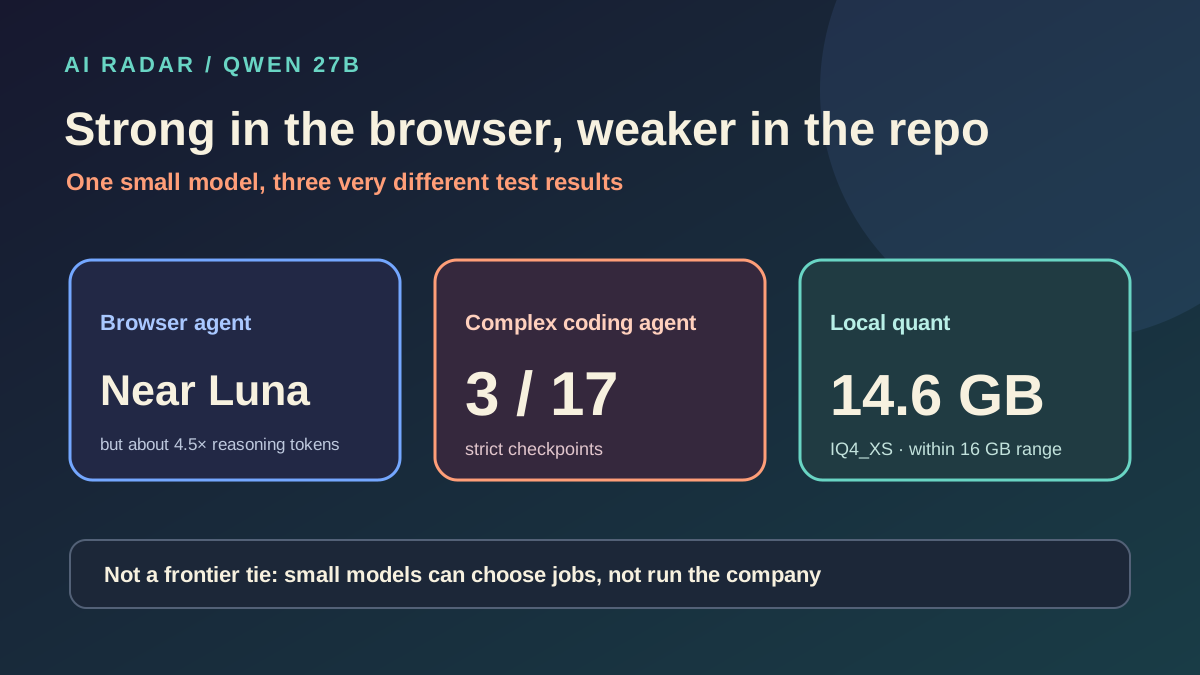
Community tests of Qwen3.8-27B show a sharp split: one browser-agent run placed it near GPT-5.6 Luna while using roughly 4.5 times as many output and reasoning tokens, whereas a complex coding-agent test produced only 3 of 17 strict checkpoints. It deserves serious local-agent testing, but there is no evidence that its overall ability matches proprietary frontier models.
The bottom line
The interesting thing about Qwen3.8-27B is not whom it “beat.” It is how it seems to have three different personalities at work.
In recent community tests, the model was placed inside a browser agent, local coding evaluations and 16 GB GPU quantization experiments. One BU Bench v1 tester described it as close to GPT-5.6 Luna xhigh. In a separate complex coding-agent test, it passed only 3 of 17 strict checkpoints. On mechanical math and code tests it reached 96.7% on GSM8K and 95.5% on HumanEval.
This is not one unified leaderboard. It is a very human contradiction: the model can write a new feature, then break an old one when the second requirement arrives. A small 27B model can approach a closed model on some agent tasks, but a strong score still does not mean it can run an entire codebase alone.
It is small enough to matter, but not small in the usual sense
Qwen describes the model as a 27B dense multimodal model with 262K native context, an expandable 1M context, thinking controls, adjustable reasoning effort and agent execution. The full weights are about 55.6 GB, so this is not a toy that simply runs on any laptop.
Local users quantize it. One community comparison measured a Q4_K_M file at about 17.1 GB and IQ4_XS at about 14.6 GB; the latter retained roughly 99.2% of the Q8 reference on a perplexity-based quality proxy. That does not mean 99.2% of agent ability survives. It does show that a 27B model is approaching the edge of a single 16 GB consumer GPU.
Act one: a browser agent nearly reached GPT-5.6 Luna
On August 19, a tester ran Qwen3.8-27B with BU Bench v1 and an open-source Browser Agent harness. The tester said it beat every other affordable or open model they had tried and was broadly close to GPT-5.6 Luna xhigh.
That is a loud result: an open-weight, locally deployable 27B model apparently narrowed the gap in real browser tasks to the level of a closed model with a very different product position.
Then the bill arrived. The same test estimated about 1.5 million output and reasoning tokens for Luna against roughly 6.8 million for Qwen at xhigh, more than four times as many, with a longer runtime. The accurate conclusion is not “Qwen equals Luna.” It is: Qwen can spend much more inference to push some browser-task outcomes close to a closed model.
For someone with spare GPUs, extra tokens may not hurt like an API invoice. In a shared server, latency-sensitive product or high-concurrency service, the difference becomes money again.
Act two: beautiful basic scores, then a crack in complex code
Another test used Qwen3.8-27B Instruct in Q8_0 on two RTX 3090s and 2,483 mechanically scored samples. It reported 96.7% on GSM8K, 86.4% on MATH-500, 95.5% on HumanEval and 80.0% on MBPP. Code was checked by unit tests; math was checked with SymPy equivalence rather than an LLM judge.
That suggests the model's basic ability is not just a few hand-picked demos.
The task then changed to a HumanLayer Opus 5 subset in SlopCodeBench. Instead of writing one function, the model had to understand an unfamiliar project, change several files and avoid damaging old behavior. Qwen passed only 3 of 17 strict checkpoints, or 17.6%. In the same comparison, Claude Opus 5 plus Claude Code passed 4 of 17, while one DeepSeek V4 Flash setup passed 5 of 17.
The tester's recommendation was restrained: Qwen is useful as a guided copilot, but not ready to manage a complex codebase over time. A commenter put the weakness more plainly: it was good at adding new things but repeatedly broke old things.
Why can HumanEval be 95% while project maintenance is 17.6%?
Because the tests ask different questions.
HumanEval is an exam question: can you implement this function? A complex agent benchmark asks whether an unfamiliar company project can be planned, edited across files, tested, kept coherent when requirements change and stopped at the right moment.
The first needs code generation. The second also needs long-horizon memory, boundary awareness, regression control and the ability not to keep editing. Someone can be excellent at LeetCode and still create technical debt in a five-million-line codebase. Models are no different.
What this means for local deployment
Qwen3.8-27B deserves a serious A/B test if your work consists of browser forms, fixed procedures, internal PDFs, local knowledge bases or tool calls with clear acceptance checks. Teams that must keep data inside their network, lack a dependable overseas API or own a 16 GB-plus GPU have especially good reasons to try it.
For long-term maintenance of a large codebase, open-ended architecture or dozens of consecutive decisions, do not hand over permissions because of one browser score. Start with small diffs, run tests automatically, preserve every change and keep payments, deletion and production deployment behind human approval.
Our judgement: small models are learning to choose their jobs
Qwen3.8-27B does not mean “I am now the strongest model in the world.” It represents another route: compressing useful agent ability into a model that is increasingly practical to run locally.
That changes the question we should ask. Instead of starting with the model at the top of a general leaderboard, start with the job. Browser navigation and fixed workflows may already be enough. Long-term maintenance and architecture still require a larger model, stronger tooling and human oversight.
The memorable result is not “Alibaba beat OpenAI.” It is this: the gap between frontier closed models and local small models is no longer the same on every task. On some jobs Qwen gets close; on others it immediately exposes its limits.
If a 16 GB card can finish your actual work, a flagship model that is 30% stronger may not matter much. If one regression is unacceptable, a beautiful 95.5% score still cannot sign the release for you.
What to watch
- Whether the browser-agent result reproduces across more tasks, harnesses and lower reasoning budgets;
- Whether the 3-of-17 coding result improves with better tools, prompts and model revisions;
- Real vision, long-context and tool-use behavior after quantization, not just perplexity;
- Local speed, VRAM use, driver compatibility and enterprise maintenance costs.