DeepSeek raises peak prices while OpenAI cuts Luna to 20%: the AI pricing war is changing
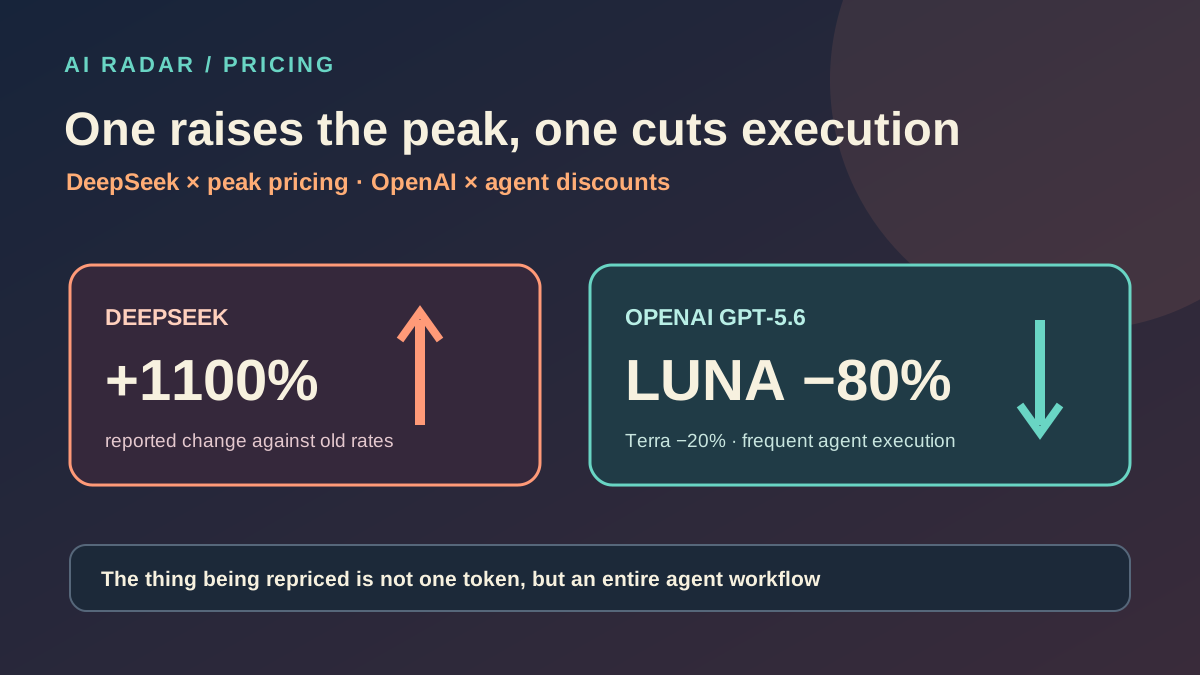
Shenzhen media and other reports describe up to an 1,100% increase for some DeepSeek API prices alongside peak/off-peak billing, while OpenAI cut GPT-5.6 Luna by 80% and Terra by 20%. Current official pricing shows that real cost still depends on cache hits, peak hours, context length and how often a model is called inside an agent workflow.
The bottom line
The AI API pricing war has suddenly split into two very different shows.
Shenzhen media and other reports say some DeepSeek API prices rose by as much as 1,100%, with peak and off-peak periods billed separately. At the same time, OpenAI moved in the opposite direction: GPT-5.6 Luna was cut by 80% and Terra by 20%.
It looks like one former price cutter is raising prices while a market leader is cutting them. Current official pricing tells a more useful story: DeepSeek is pricing scarce compute at busy hours, while OpenAI is discounting the execution layer for agents. What is being repriced is not one token but an entire workflow.
DeepSeek is not raising every hour; it is raising the hours you most want
DeepSeek's current official price page is explicit. Peak hours are 01:00–04:00 and 06:00–10:00 UTC; all other hours are off-peak, and off-peak rates are half the peak rates.
For V4 Pro, cached input is about $0.022 per million tokens off-peak and $0.044 at peak. Output is about $1.98/$3.96. That is not the same table as the media's 1,100% increase: 1,100% describes the change against an older price, while the current official page shows the new peak relationship.
The impact is practical for agent teams. Overnight batches, cache hits and off-peak warmups may remain cheap. Weekday peaks, cache misses and repeated long trajectories can push the bill up through several switches at once.
OpenAI's cut targets the high-frequency execution layer
OpenAI's current GPT-5.6 table separates the models clearly. At the standard short-context rate, Luna costs $0.20 for input, $0.02 for cached input and $1.20 for output per million tokens. Terra costs $2/$0.20/$12; Sol remains at $4/$0.40/$20.
That is the product signal behind the reported 80% and 20% cuts. The flagship Sol remains expensive while Luna and Terra move into tiers suited to frequent execution. OpenAI has not turned every model into a commodity; it is telling developers to use a larger model for difficult planning and a cheaper one for repeated steps and tool calls.
When an agent calls a model dozens of times per task, saving a little on every step matters more than saving dollars on one answer. Pricing is beginning to follow workflow layers rather than a single intelligence ranking.
This is not a simple China-versus-US price fight
Putting DeepSeek and OpenAI into one “price per million tokens” table invites a wrong conclusion. Currencies differ. Cache rules differ. Peak hours differ. Model roles differ. Context tiers differ too.
The useful comparison asks three questions:
- Do your calls happen at peak or off-peak?
- Can the same prefix reliably hit the cache?
- How many calls does a task need, and how large must each model be?
DeepSeek is testing whether customers will schedule around off-peak supply. OpenAI is testing whether more agent steps can be delegated to a cheaper execution model. One optimizes the supply curve; the other optimizes task layers.
For developers: reshape the bill before switching providers
If you build agents on APIs, the immediate move is not necessarily changing vendors. Split the bill first: planning tokens, tool-call tokens, repeated context, failed retries, cache-hit rate and peak-hour share.
The same workflow can then change shape. Use a strong model for the plan and a cheaper model for fixed execution. Cache stable system instructions and tool schemas. Move batch work off-peak. Set maximum loop steps and a failure circuit breaker. Reserve the expensive model for branches that truly require judgement.
That is closer to real cost than watching a single price headline. In the agent era, the expensive part is often not one answer but forty answers in the wrong direction.
For everyday users: a cheap model does not make the whole task cheap
One question in a web chat may not reveal the change. Enterprise back offices, coding agents, batch documents and automated support will. A model with a low token price may need more turns, retries or context, leaving the final bill higher.
The reverse can also be true. A more expensive model that completes a task in one pass may be cheaper overall. Model choice now needs task cost, seconds and human interventions, not just the price per million tokens.
Our judgement: the war is moving from cheap tokens to task ownership
DeepSeek's increase does not automatically mean it has abandoned its price-cutter role. It may be selling scarce peak compute to urgent users while preserving elasticity off-peak. OpenAI's cut is not merely defensive either; it places Luna and Terra on more agent execution paths.
The next important object is not another price table. It is the router, coding agent, cloud platform or app store that chooses the default model. Whoever controls the task entry point can decide which model runs every step, and therefore where the pricing war's profit finally lands.
What to watch
- Whether DeepSeek extends peak/off-peak pricing to more models and regions;
- Whether low-priced Luna and Terra carry rate, context or feature limits;
- Whether cache-hit rates, retries and agent steps offset the headline cuts;
- Whether third-party routers automatically orchestrate peak pricing, caching and task tiers across models.