AMD opens free AI model APIs on Radeon Cloud: 1M-token DeepSeek, $10 daily credits, and zero-proxy access
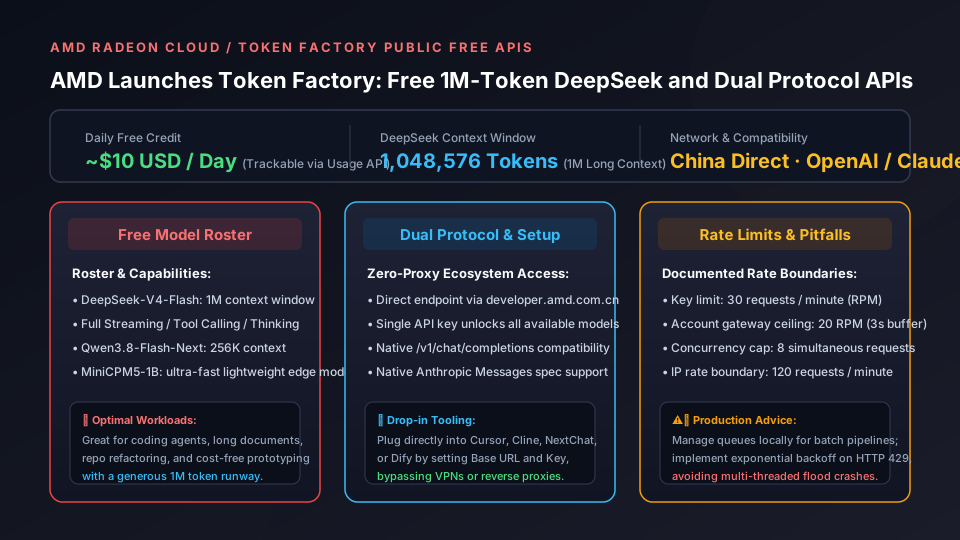
In late August and early September 2026, AMD launched Token Factory on Radeon Cloud, distributing Public Free Model APIs to registered developers. The launch lineup features DeepSeek-V4-Flash with a massive 1,048,576-token context window (1M tokens), Qwen3.8-Flash-Next (256K), and MiniCPM. AMD established dedicated China routing at developer.amd.com.cn (zero-proxy access), dual OpenAI/Anthropic protocol compatibility, and default daily allowances of approximately $10 USD per account (governed by a 30 RPM key limit and 20 RPM gateway). This represents an aggressive play by AMD to capture software developer mindshare with subsidized compute.
# AMD opens free AI model APIs on Radeon Cloud: 1M-token DeepSeek, $10 daily credits, and zero-proxy access
Bottom line
In late August and early September 2026, semiconductor giant AMD quietly launched Token Factory within its official Radeon Cloud developer platform, opening Public Free Model APIs directly to registered software engineers and technical teams. The service features open-source frontier powerhouses including DeepSeek-V4-Flash (delivering an extraordinary 1,048,576 tokens, or a full 1-million-token context window) alongside Qwen3.8-Flash-Next (256K context). Crucially, AMD engineered three major architectural and networking advantages for developers:
- Direct China-regional routing: A dedicated domestic access endpoint hosted at
developer.amd.com.cnallows local software engineers to query models directly without overseas VPN tunnels or international reverse proxies; - Dual-protocol compatibility: Native support for both standard OpenAI formats (
/v1/chat/completions) and Anthropic Claude message protocols allows immediate drop-in replacement across everyday coding clients; - Substantial daily allowances: The official Usage telemetry endpoint reveals default daily allotments of approximately $10 USD per day per account, governed by a 30 RPM key rate limit and a 20 RPM gateway ceiling—providing ample compute for programming workflows, local agent automation, and large-scale document retrieval testing.
While industry peers and public cloud providers aggressively monetize foundational inference tokens, AMD is distributing enterprise compute free of charge. This calculated move serves simultaneously as an aggressive offensive to capture developer mindshare in the hardware ecosystem and as an exceptional resource for independent engineers seeking high-specification model infrastructure without commercial overhead.
---
What happened
Over the past twelve months, despite consecutive waves of price reductions across commercial API vendors, international engineering teams frequently encountered friction from unstable proxy routing, foreign credit card billing barriers, and abrupt account suspensions triggered by automated fraud heuristics.
AMD's Radeon Cloud Token Factory takes an aggressive competitive angle: it packages the open-weight community's highest-performing, most capable production models into managed, instantly accessible public endpoints with zero financial friction.
Launch model roster and core technical specifications
According to official developer documentation and live endpoint introspection as of August 31, 2026, the Token Factory currently provisions the following model matrix:
| Model Identifier | Context Window | Capabilities & Tooling | Optimal Workload | | :--- | :--- | :--- | :--- | | DeepSeek-V4-Flash | 1,048,576 Tokens (1M) | Streaming, Tool Calling, Thinking Reasoning | Multi-file codebase refactoring, long technical manuals, autonomous agents | | DeepSeek-V4-Flash-Vision-Exp | 128,000 Tokens (128K) | Multimodal visual reasoning, document QA | Screenshot error debugging, chart parsing | | Qwen3.8-Flash-Next | 262,144 Tokens (256K) | Rapid first-token latency, robust bilingual syntax | High-frequency chat, multilingual translation, general drafting | | MiniCPM5-1B | 32,768 Tokens (32K) | Edge-optimized low-latency inference | Classification, tag extraction, deterministic intent routing |
Crucially, AMD did not truncate or artificially downscale DeepSeek-V4-Flash's context boundary to preserve server memory. By exposing the complete 1-million-token capability to every developer, engineers can stream dozens of full repository source files, complex dependency graphs, or entire architectural handbooks in a single prompt for comprehensive indexing and semantic verification.
---
Step-by-step setup and operational guide
AMD streamlined developer onboarding by unifying model authorization under a single universal API key, completely eliminating the cumbersome requirement to provision distinct credentials for individual models.
Step 1: Claim your universal API key
1. Navigate directly to AMD's regional developer portal: https://developer.amd.com.cn/radeon/tokenfactory;
2. Register a new profile or log into your existing AMD developer account;
3. Locate Public Free Model APIs in the left-hand navigation panel;
4. Select any available model to inspect its endpoint documentation and reveal:
- Base URL: https://developer.amd.com.cn/radeon/api/v1
- Universal API Key (formatted with prefix amd_tf_...)
5. Copy this universal key to your clipboard. A single token authorizes all models currently hosted in the Token Factory catalog; toggling between different model architectures simply requires updating the model parameter inside your payload.
Step 2: Terminal validation (OpenAI-compatible format)
Execute the following curl command in your terminal to query DeepSeek-V4-Flash with its full 1M context configuration:
```bash export AMD_API_KEY="YOUR_AMD_API_KEY"
curl https://developer.amd.com.cn/radeon/api/v1/chat/completions \ -H "Authorization: Bearer $AMD_API_KEY" \ -H "Content-Type: application/json" \ -d '{ "model": "DeepSeek-V4-Flash", "messages": [ { "role": "user", "content": "Write a concurrent thread-safe LRU Cache in Go with complete unit tests." } ], "stream": false }' ```
Receiving a clean, structured JSON completion validates that your account authorization, regional network routes, and header formatting are fully operational.
Step 3: Audit remaining balance via Usage API
Developers concerned about token depletion or hidden cost ceilings can query real-time consumption and remaining daily allowances directly through AMD's dedicated telemetry endpoint:
``bash
curl "https://radeon-global.anruicloud.com/api/profile/model-usage?include_recent=true" \
-H "Authorization: Bearer $AMD_API_KEY"
``
A representative response payload contains:
``json
{
"rpm_limit": 30,
"daily_cost_limit_usd": 10.0,
"daily_cost_used_usd": 1.8412,
"daily_cost_remaining_usd": 8.1588
}
``
daily_cost_limit_usd: 10.0: Confirms that the target developer account maintains a default daily allotment of $10.00 USD;daily_cost_remaining_usd: 8.1588: Indicates the precise dollar balance remaining for inference during the active 24-hour cycle.- Note: AMD's service documentation explicitly highlights that baseline account allotments may adjust dynamically based on global compute cluster load, making routine telemetry checks advisable for persistent pipelines.
---
Operational boundaries: Documented rate limits
Free public compute tiers inevitably require structural guardrails to prevent noisy-neighbor exhaustion. AMD has openly published its rate-limiting criteria, requiring developers to architect their client scripts accordingly:
| Restriction Dimension | Hard Limit | Systems Engineering Advice | | :--- | :--- | :--- | | Per-Key Rate | 30 Requests / Minute (RPM) | Equivalent to 1 query every 2 seconds | | Account Gateway Cap | 20 Requests / Minute (RPM) | Primary bottleneck: limit cadence to 1 request every 3 seconds | | Maximum Concurrency | 8 Concurrent Requests | Avoid unbounded parallel threads; exceeding 8 triggers HTTP 429 | | IP Address Limit | 120 Requests / Minute (RPM) | Accommodates small team sharing while safeguarding infrastructure |
Client integration patterns (Cursor / NextChat / Cline)
- Cursor / Windsurf: Access your custom model preferences, enable OpenAI-compatible mode, specify Base URL
https://developer.amd.com.cn/radeon/api/v1, enter your universal Key, and define the model identifier asDeepSeek-V4-Flash; - NextChat / LobeChat: Configure as a standard custom OpenAI endpoint without enabling auxiliary proxy daemons or URL rewriting middleware;
- Python / Node.js Agents: Given the 20 RPM gateway cap and 8 concurrent request limit, wrap calls in a local token-bucket queue and implement exponential backoff with randomized jitter to mitigate temporary rate-limiting spikes.
---
Why it matters
This generous compute offering reflects significant underlying shifts in semiconductor competition and enterprise platform economics:
1. Transitioning from chip fabricator to platform ecosystem
In enterprise AI hardware, Nvidia's proprietary CUDA software moat continues to maintain an iron grip on global infrastructure. While AMD's accelerator silicon (including the Instinct MI300X and MI325X platforms) demonstrates compelling raw performance benchmarks on paper, ROCm developer adoption has historically faced friction.
By subsidizing frictionless public inference within Radeon Cloud, AMD establishes an accessible international demonstration showroom. Tens of thousands of software engineers run mission-critical workloads on AMD hardware clusters daily. As operational reliability and low-latency execution are proven in practice, enterprise hardware procurement cycles naturally develop greater confidence in AMD's hardware ecosystem.
2. Eliminating third-party API relay arbitrage
Numerous developers across mainland Asia access frontier models through unregulated third-party relay brokers. These intermediaries introduce serious data privacy liabilities, significant financial markups, and unpredictable network latency spikes. By deploying dedicated domestic routing through developer.amd.com.cn, AMD supplies direct, reliable infrastructure, effectively undercutting gray-market API brokers.
---
Our take
We offer three practical engineering recommendations for developers intending to leverage this infrastructure:
- Deploy for copilot tooling and lightweight agents: While a $10 daily budget is modest for massive web-scale dataset ingestion, it serves as an abundant, renewable compute reservoir for IDE code completions, technical translation, and multi-step agent debugging;
- Do not route mission-critical SLA pipelines solely through public free pools: AMD explicitly designates these endpoints as "Public Free Model APIs" lacking commercial uptime guarantees. Under heavy traffic surges, rate gates may throttle unpredictably. Production systems should deploy this endpoint as a primary low-cost path with a commercial fallback;
- Respect the 8-concurrency ceiling: Do not execute multi-threaded batch scripts without local rate governors. Maintaining disciplined request cadences ensures sustainable, uninterrupted long-term access for everyone.
---
What to watch
Over the coming quarters, three critical performance and operational variables will determine the platform's trajectory:
- Latency stability under heavy regional load: As developer adoption expands exponentially, will queue times degrade across Radeon Cloud compute nodes?
- Duration of the $10 daily allowance: Will this generous allocation remain a permanent platform feature or convert into a time-limited promotional window?
- Catalog expansion: Will AMD introduce larger Llama 3 parameters or custom operator-tuned variants optimized specifically for ROCm?
---
Sources and Evidence:
- Primary Platform Console: AMD Radeon Cloud Token Factory Portal (https://developer.amd.com.cn/radeon/tokenfactory, 2026.08–09)
- Primary Technical Documentation: AMD Radeon Cloud Public Free Model APIs Specifications & Usage Endpoints (https://developer.amd.com.cn/radeon/api/v1, 2026.08.31)
- Telemetry Infrastructure: AMD AnruiCloud Model-Usage Quota and Rate Matrix (2026.08.31)
- Independent Field Validation: Direct API invocation of DeepSeek-V4-Flash (1,048,576 tokens) and Qwen3.8-Flash-Next across long-context streams (2026.09.03)