Anthropic may seek a $2T valuation while preparing to list anti-AI backlash as an IPO risk
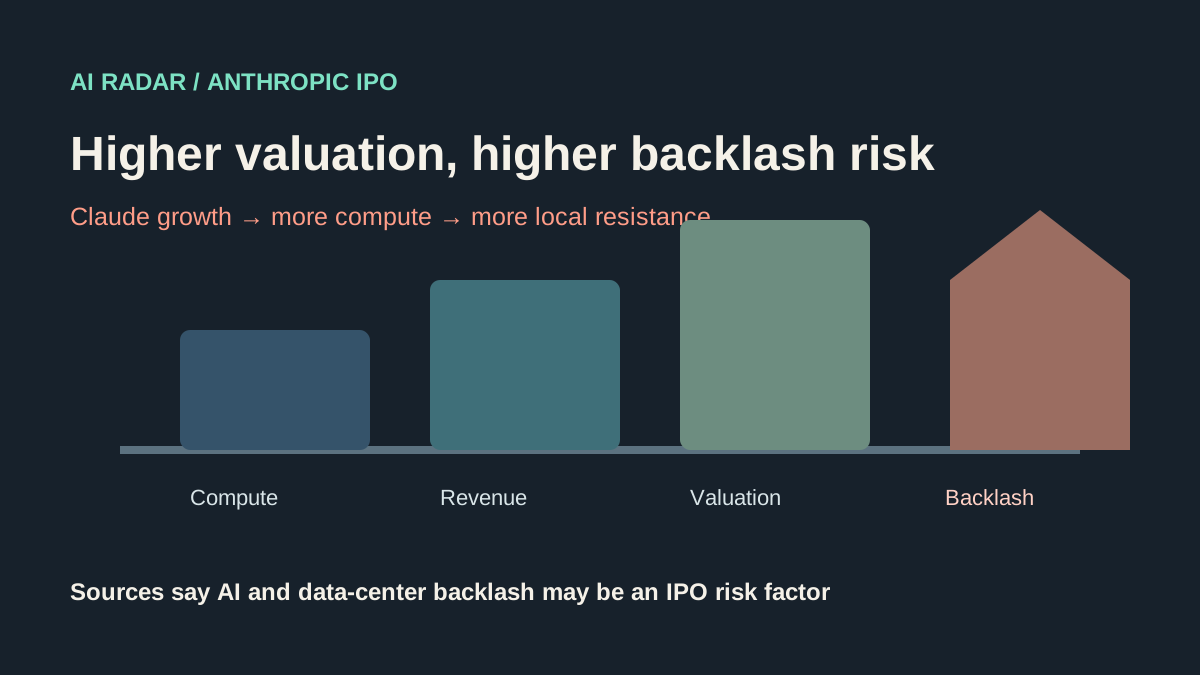
Anthropic confidentially submitted a draft S-1, and CNBC reports that sources expect its public prospectus to list public backlash toward AI and data centers as a risk factor. The company is valued near $1 trillion privately, while market talk points to a possible $2 trillion IPO valuation. The public filing is not available, so neither the valuation nor the final risk language is confirmed.
The bottom line
Anthropic may seek an IPO valuation as high as $2 trillion, yet its prospectus could acknowledge a sharp reversal: the more successful Claude becomes, the more data centers it needs, and the more likely communities and politicians are to resist its expansion.
Anthropic confidentially submitted a draft S-1 in June. CNBC reported on August 21, citing people familiar with the matter, that the prospectus expected in coming weeks will list negative sentiment toward AI and data centers as a risk factor. The public filing is not available yet, so this is credible reporting, not Anthropic's final published language.
Its biggest obstacle may not be OpenAI
Anthropic has held pre-IPO “test-the-water” meetings with bankers and investors. Questions extend beyond model competition to margin pressure from open models and what happens if data-center construction slows.
The reason is straightforward. Compute capacity is tied to revenue growth at AI labs. CNBC previously reported an annual revenue run rate above $65 billion for Anthropic and a private-market valuation close to $1 trillion. Investors cited by the outlet expect a possible public valuation around $2 trillion and an offering that could challenge SpaceX's record.
That valuation assumes continued rapid growth in Claude usage, enterprise customers and compute supply. Delays involving electricity, land, permits or construction threaten that assumption.
Seven in ten Americans do not want an AI data center nearby
CNBC cited a May Gallup survey in which seven in ten Americans opposed AI data-center construction in their area. Nearly half strongly opposed it, while roughly one quarter were in favor.
Critics point to electricity prices, water use, noise, tax incentives and limited local employment. In August, restrictions became an issue in Florida's Republican gubernatorial primary, while Pennsylvania issued an executive order imposing tougher development standards.
Compute used to appear mainly as a technology investment. In an IPO document it is becoming a political and community risk.
Why the backlash can reach Claude users
Anthropic can rent cloud capacity, but it cannot outsource the underlying infrastructure risk. Cloud providers still buy GPUs, build campuses and connect them to power grids. Those costs eventually affect model prices and margins.
If projects are delayed, Anthropic can restrict capacity, raise prices or compete more aggressively for existing compute. Claude users may experience that as rate limits, pricing changes or slower product releases.
That is why data-center opposition is more than a communications problem. It can affect revenue, margins and service reliability.
Our judgement: the AI bottleneck is moving from chips to ballots
For two years, investors asked whether laboratories could obtain enough GPUs. The next questions are where the electricity comes from, whether communities consent and how quickly state governments allow construction.
Listing public backlash as a risk would not mean Anthropic expects the AI market to collapse. Public companies routinely disclose scenarios that could damage their business. The notable fact is that opposition may now be material enough for the first document presented to public investors.
What to watch
- Whether the public S-1 lists AI and data-center backlash, and how prominently it describes the risk;
- Whether the reported $2 trillion valuation and offering size enter a formal plan;
- Whether local restrictions delay projects rather than remaining campaign language;
- How Anthropic explains compute spending, margin pressure and dependence on cloud providers.
Claude's next contest may happen not only on benchmarks, but on power grids, at hearings and inside ballot boxes.