Can't Keep Pretending: Claude Officially Surrenders to Third Parties and Pays Developers $200 to Stay
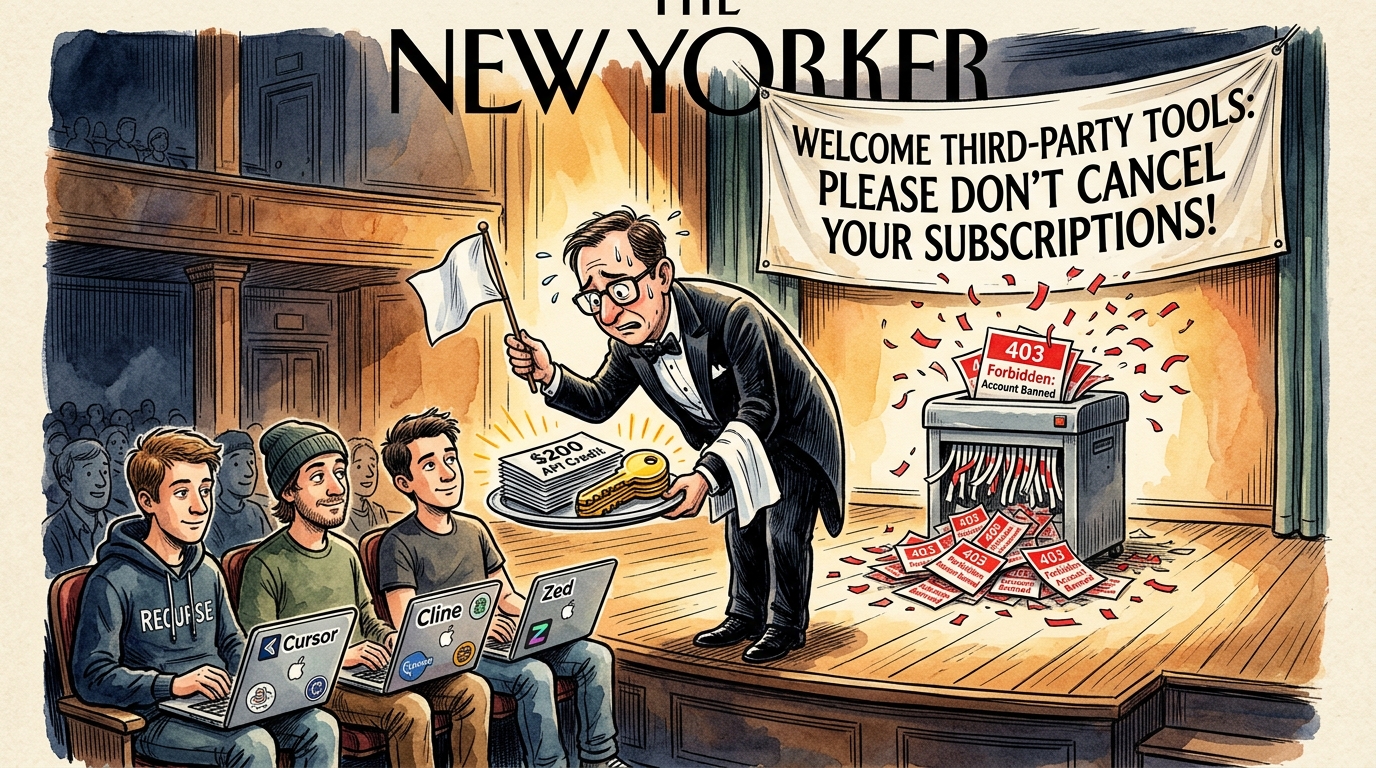
Anthropic's 180-degree reversal and bundled API subsidies represent the most ironic power shift in recent AI history. The move shatters the illusion that foundation model providers can lock power users inside rudimentary browser portals, proving that authentic developer loyalty belongs to native workflow canvases like Cursor, IDEs, and terminal environments. Foundational labs must rapidly embrace their destiny as embedded utility foundries to survive the coming compute wars.
# Can't Keep Pretending: Claude Officially Surrenders to Third Parties and Pays Developers $200 to Stay
After spending over half a year pretending to be an aloof, untouchable digital landlord, Anthropic finally ripped off the facade and waved the white flag.
Just recently, Anthropic bowed to reality: the company not only conceded that developers can legally tap into their Claude subscriptions via standard OAuth inside third-party environments like Cursor, Cline, and Zed, but to placate an infuriated developer community, it started handing out free cash. Max 5x subscribers now receive one hundred dollars per month, while Max 20x subscribers receive two hundred dollars per month in standalone Console API credits.
The haughty posture of treating paying users like thieves, issuing ban warnings, and threatening legal action against reverse-proxy creators has officially collapsed into the biggest industry comedy of the year.
After Six Months of Playing Hard to Get, Anthropic Finally Waved the White Flag
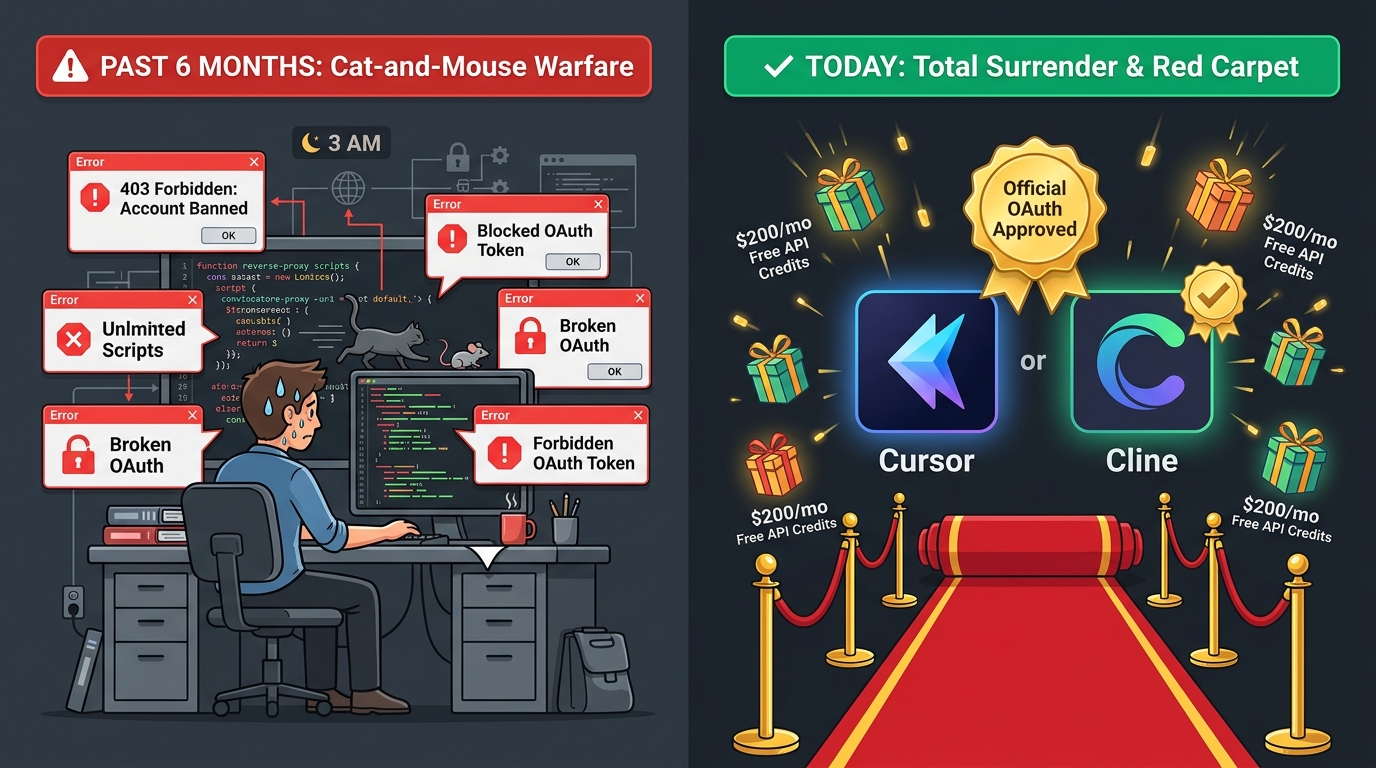
The grand ambition of frontier model labs to build proprietary walled-garden portals officially unraveled in late 2026.
Put simply, developers and power users demand the seamless integration of top-tier model intelligence directly into their existing daily toolchains—code editors, terminal shells, and local automated scripts. Nobody wants to clock in every morning inside a bare-bones web chat window that looks like a high schooler's weekend hackathon project.
Anthropic's sudden reversal paired with bundled API subsidies may masquerade as benevolence toward developers, but it represents an act of emergency self-preservation after being hijacked by Cursor and autonomous local agent harnesses: when the entire industry values your raw weights but actively despises your proprietary wrapper, clinging to an isolated walled garden simply means starving to death behind walls of your own making.
Bans, Reverse Proxies, and Lawsuits: An Absurd Cat-and-Mouse Game
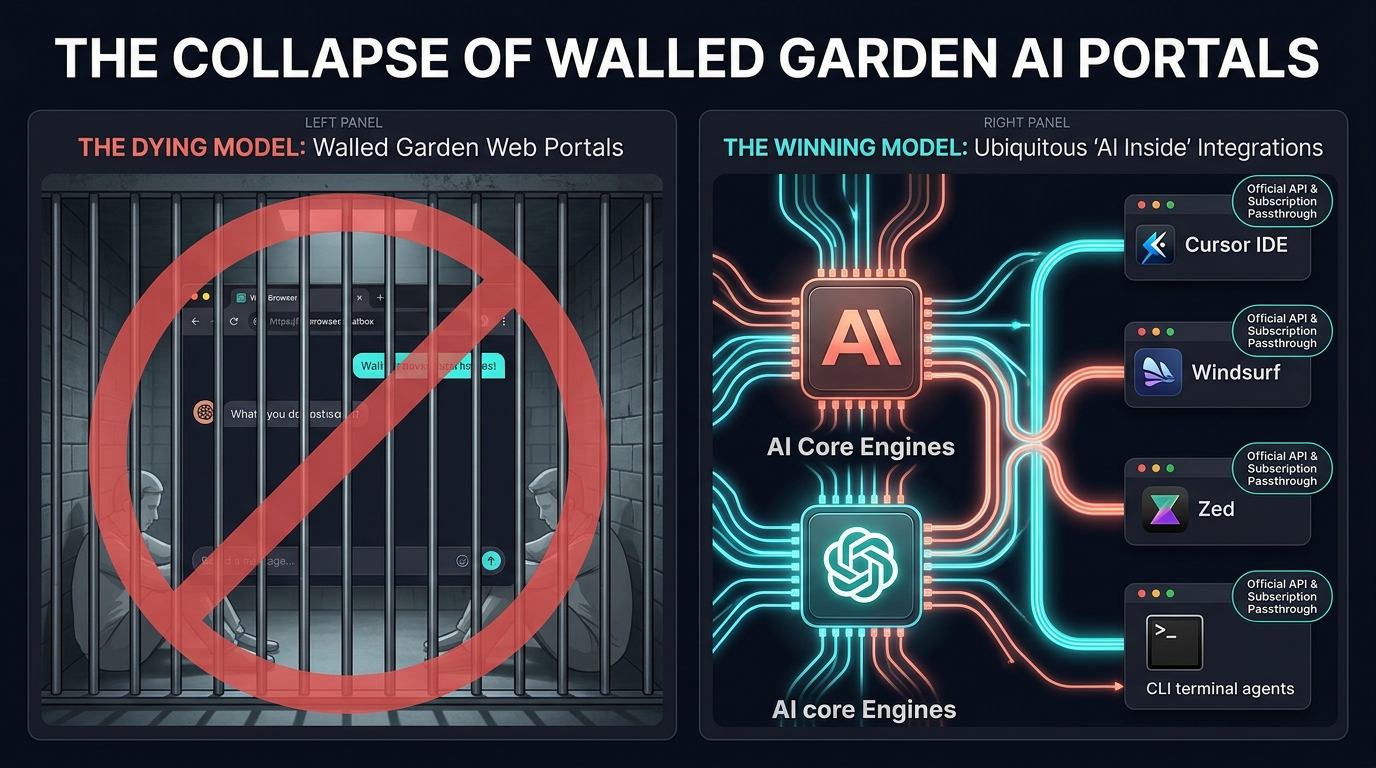
Reviewing this corporate comedy of errors reveals a drama three times more entertaining than a daytime soap opera.
Act One: The Snooty Landlord Chasing Suspects. Over the past eight months, developers paid between twenty and two hundred dollars every month for Claude Pro and Max tiers. Yet engineers quickly discovered that the moment they attempted to write code inside Cursor or Cline, Anthropic stepped in aggressively: subscriptions were strictly restricted to official web interfaces, while external tools were forced into expensive pay-as-you-go API metering.
Pushed into a corner, the developer community mobilized. Hackers extracted session cookies, built local reverse proxies, and daisy-chained the official claude -p command-line tool into custom IDE wrappers. Anthropic retaliated with ban waves, anti-bot frontend patches, and an update to its terms of service explicitly forbidding "cruel or abusive behavior" toward Claude models—a move that sparked merciless meme ridicule across Reddit and Hacker News.
Act Two: Mutiny in the Ranks and Mass Cancellations. By autumn 2026, the strategy began unraveling. High-paying Max subscribers discovered that marketed usage multipliers were narrowly confined to rolling five-hour session windows rather than weekly allotments, culminating in prospective false-advertising class-action lawsuits. Simultaneously, rivals Google and OpenAI courted external developer ecosystems aggressively. Engineers voted with their feet by canceling subscriptions en masse, causing engagement times on Anthropic's official web domain to tumble.
Act Three: Total Surrender and Paying Retainers. Seeing their walled garden emptied out, Anthropic executed a complete reversal in early October: the company affirmed that third-party OAuth integrations are fully authorized and began depositing up to two hundred dollars per month in genuine API credits into Max subscriber balances. The subtext was impossible to miss: please do not leave, take two hundred dollars in free compute, and connect Claude wherever you work.
Wake Up: A Web Chat Box Was Never a Moat
This shift represents far more than an operational pricing tweak; it signals an irreversible transfer of power across the artificial intelligence value chain.
The Wrapper Myth Crumbles: Control Lies with the Workflow
Frontier AI labs once believed they could emulate Apple by monopolizing the entire stack, from foundational compute weights up to the end-user operating canvas.
Market reality delivered a sharp rebuke: for engineers and analytical specialists, the gravity of modern work resides inside Cursor, VS Code, and terminal workflows, not within a generic web browser tab. Whoever owns the practitioner's primary canvas controls long-term user retention. Even the most capable model becomes an interchangeable plumbing utility once detached from its execution environment. Anthropic learned that proprietary isolation cannot compete against native developer ergonomics.
Token Arbitrage and Grey Markets Obliterated Overnight
Because Anthropic maintained artificial billing walls between web subscriptions and programmatic access, an extensive grey market of intermediary tools flourished.
Middlemen generated substantial revenue reselling scraped session tokens, pooling accounts, and maintaining reverse-proxy gateways tailored to bypass Claude frontend safeguards. By legalizing third-party OAuth and bundling hundreds of dollars in official API credits, Anthropic bypassed the grey market entirely, rendering unofficial proxy arbitrage obsolete overnight.
Double-Billing Extortion Forced into Extinction
The foundational business plan for model providers relied on charging the same customer twice: a recurring monthly subscription fee for daylight chat interactions, followed by steep per-token API bills for evening automated workflows.
Anthropic's hybrid model—pairing flat subscriptions with substantial bundled API allowances—shatters this predatory structure. The move puts immediate competitive pressure on OpenAI's ChatGPT Plus and Google's Gemini Advanced subscriptions. If competing providers bundle hundreds of dollars in portable API tokens for third-party tools, captive isolated chatbots will struggle to justify premium pricing.
Three Hard Truths: Power in the AI Supply Chain Is Flipping
This ridiculous corporate about-face delivers a sharp lesson to the broader artificial intelligence industry:
- Frontier models are transforming into utility foundries: foundational labs are increasingly occupying the role of semiconductor fabricators rather than consumer platform empires; accepting the reality of becoming an embedded utility is essential for surviving hyper-competitive compute wars.
- Developers wield absolute pricing leverage: casual users may tolerate walled gardens for polished aesthetics, but engineers evaluate tools strictly on throughput and economic friction; when providers attempt rent-seeking bottlenecks, open-source workarounds force eventual corporate surrender.
- The enduring winners of software engineering remain workflow controllers: harnesses like Cursor, Cline, and Zed demonstrate the immense strategic value of owning task context; channeling intelligence into established developer environments will always outcompete forcing users into disconnected new silos.
How to Grab the Free Credits, and What to Watch Next
- Whether Anthropic quietly introduces aggressive rate limits or throttling on developer API endpoints once users start maxing out bundled credits within high-frequency coding harnesses;
- Whether OpenAI responds during upcoming release cycles by bundling OpenAI Platform API allowances directly into ChatGPT Pro and Team tiers to stem developer churn;
- How early-stage AI startups previously reliant on wrapping unofficial Claude proxy connections pivot now that Anthropic has legitimized direct third-party access.