CISA Names 6 Chinese AI Labs in 'Industrial Distillation': As Billions of Reasoning Tokens Fuel Geopolitical Storm, US Urges Cloud APIs to Deploy 'Active Output Degradation'
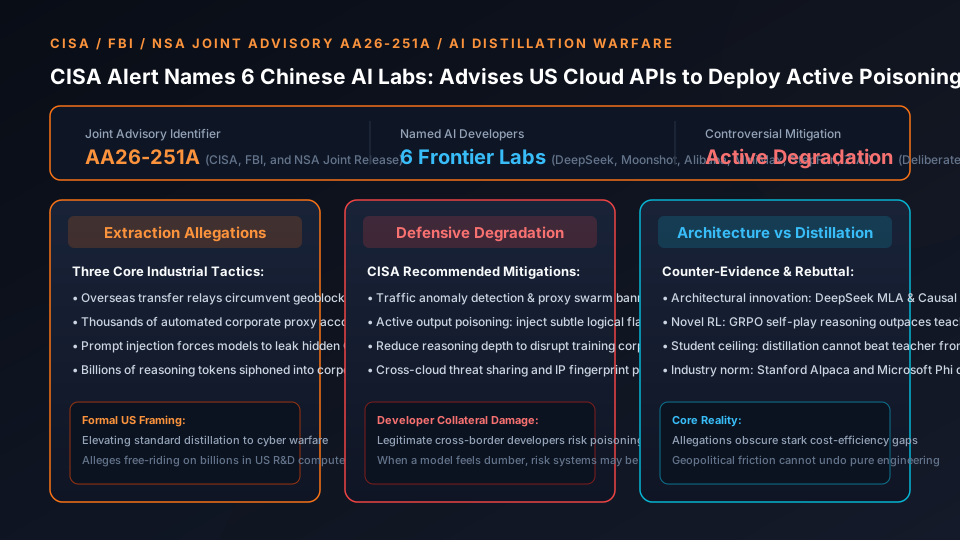
A watershed moment turning standard training practices into geopolitical warfare. Active output degradation shatters commercial API trust, accelerating enterprise migration toward self-hosted open-source architectures.
# CISA Names 6 Chinese AI Labs in "Industrial-Scale Distillation": Recommends US Cloud APIs Deploy "Active Output Degradation"
On September 8, 2026, the Cybersecurity and Infrastructure Security Agency (CISA), the Federal Bureau of Investigation (FBI), and the National Security Agency (NSA) released joint cybersecurity advisory AA26-251A, triggering immediate shockwaves across the global artificial intelligence industry, academic research circles, and commercial software engineering communities.
The unclassified joint advisory formally accuses six prominent Chinese frontier artificial intelligence developers—specifically naming DeepSeek, Moonshot AI, Alibaba, MiniMax, StepFun, and Z.AI—of conducting systematic, highly automated, and industrial-scale "knowledge distillation" campaigns against American frontier models. The affected proprietary systems allegedly include state-of-the-art iterations of Anthropic Claude, OpenAI GPT, Google Gemini, and xAI Grok. According to federal investigators, these operations have extracted billions of tokens of high-fidelity latent reasoning data, reinforcement learning traces, and specialized domain knowledge since at least the final quarter of 2024, significantly shrinking the lead time and capital investment traditionally required to train world-class foundation models.
Yet the most contentious and widely debated element of the release lies not in the espionage allegations themselves, but in the defensive mitigations officially recommended to private industry. Alongside standard network monitoring, federal agencies explicitly urged American cloud infrastructure platforms and AI developers to deploy "active degradation tactics" against suspicious automated queries. Under this proposed defensive framework, model APIs would subtly alter outputs, inject fragile edge-case bugs, or curtail internal chain-of-thought depth to intentionally poison downstream synthetic training corpora. As standard machine learning optimization techniques become swept into geopolitical technology confrontation, software developers and enterprise engineering teams worldwide now face the acute and unprecedented danger of collateral degradation on mission-critical commercial APIs.
Conclusion
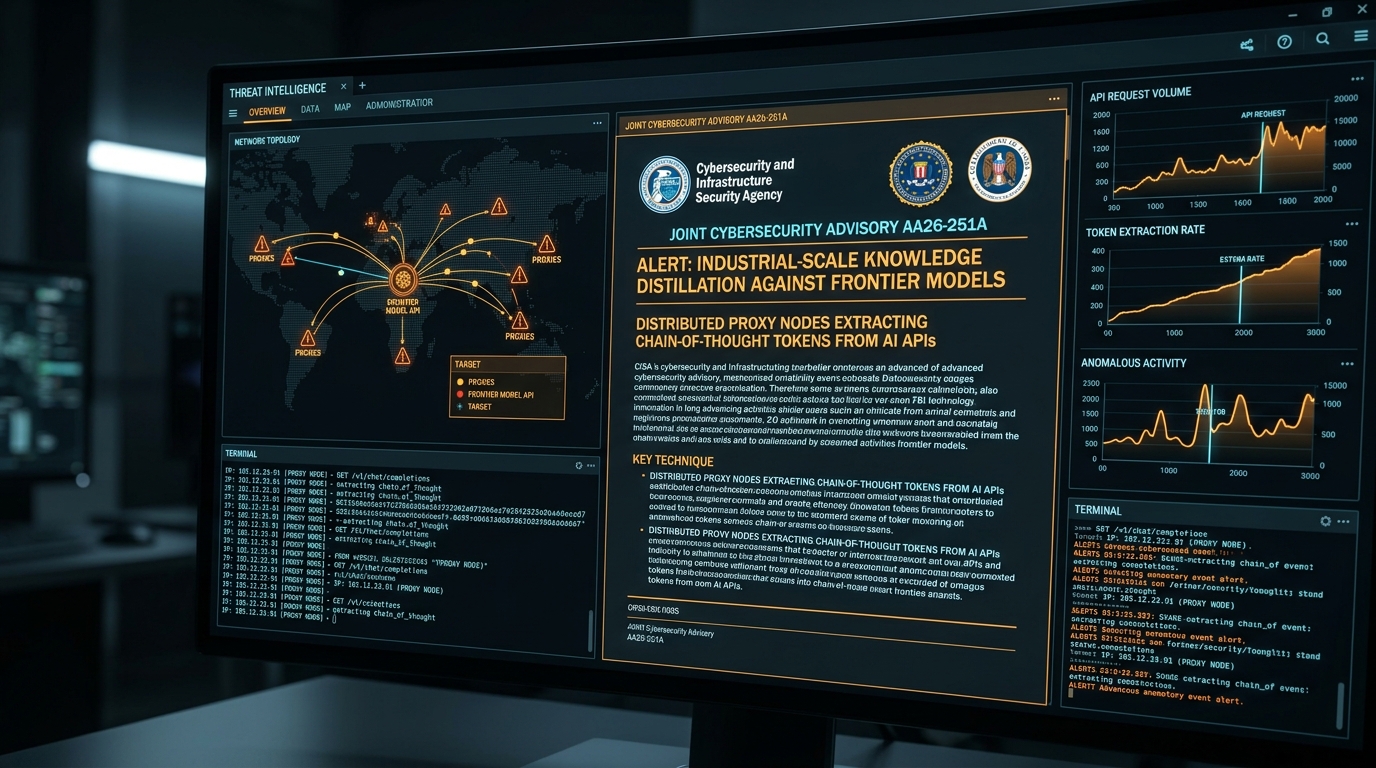
- Standard training practices face geopolitical redefinition: Knowledge distillation has long stood as an established machine learning technique, but federal authorities have now formally designated large-scale API extraction as coordinated "industrial interception" designed to bypass billions of dollars in American research and development capital.
- Hidden Chain-of-Thought (CoT) reasoning forms the primary battlefield: Federal agencies emphasize that the campaigns targeted more than generic text completions, deploying specialized prompt injections to force reasoning models into leaking unreleased internal thinking tokens and reinforcement learning exploration trajectories.
- "Active degradation" defenses jeopardize developer trust: Recommending that cloud providers quietly alter output quality upends the foundational contract of commercial APIs. When heuristic risk engines inevitably produce false positives, legitimate overseas developers and cross-border startups risk receiving poisoned or downgraded responses without warning.
- Architectural engineering cannot be equated with pure distillation: High-performing open-weight models from DeepSeek and Alibaba achieved groundbreaking cost efficiency through multi-head latent attention (MLA), causal encoder-decoder structures, and native group relative policy optimization (GRPO). Distillation alone cannot elevate a student model past the performance frontier of its teachers.
---
What happened: A joint advisory elevating academic distillation to cyber warfare
The comprehensive 28-page advisory document, officially titled "Industrial-Scale Knowledge Distillation Directed at U.S. Frontier Artificial Intelligence Models" (AA26-251A), compiles exhaustive telemetric observations, network flow analyses, and threat intelligence gathered between November 2024 and mid-2026. The publication marks the first instance where the premier intelligence and cybersecurity bodies of the United States federal government have formally classified the programmatic querying of commercial artificial intelligence interfaces as an organized economic and national security threat.
According to the factual findings presented in the advisory, cybersecurity specialists tracked massive, sustained surges in programmatic queries systematically targeting frontier commercial architectures. The affected endpoints included Anthropic Claude 3.5 Sonnet and Opus variants, OpenAI GPT-4o and o-series reasoning engines, Google Gemini 1.5 Pro and 3.0 series, and xAI Grok. The advisory alleges that the six identified Chinese laboratories established sophisticated operational infrastructures designed to bypass geographic IP geofences, anti-bot mechanisms, and commercial terms of service. These operations allegedly relied on layered offshore cloud relays, the bulk acquisition of enterprise API keys from distressed Western startups, and the fabrication of international commercial entities to maintain uninterrupted access.
Federal investigators assert that the harvested data was deliberately targeted toward high-difficulty, capital-intensive technical disciplines. The telemetry specifically highlights dense queries focused on formal mathematical proof generation in Lean and Isabelle, complex kernel optimization for heterogeneous hardware accelerators, automated vulnerability exploitation payloads, and the structured semantic parsing of proprietary biomedical literature. Cumulatively, the advisory estimates that tens of billions of specialized tokens were successfully exfiltrated into overseas data repositories. During a background press briefing with technology correspondents, senior intelligence officials argued that foreign developers were effectively cloning the neural representations of multi-billion-dollar compute runs at fractions of a cent per API transaction.
Chinese diplomatic authorities and executive representatives from the named enterprises swiftly rejected the allegations in their entirety following the public release. Ministry spokespersons characterized the joint advisory as politically orchestrated containment engineered to hinder legitimate open-source innovation and protect domestic commercial monopolies from superior price-performance competition. Domestic researchers pointed out that contemporary Chinese foundation models have achieved international prominence primarily through novel architectural formulations, indigenous cluster management efficiencies, and extensive self-supervised training on domestic corpora rather than synthetic token scavenging.
---
Technical breakdown: Offshore relays, corporate account swarms, and hidden reasoning jailbreaks
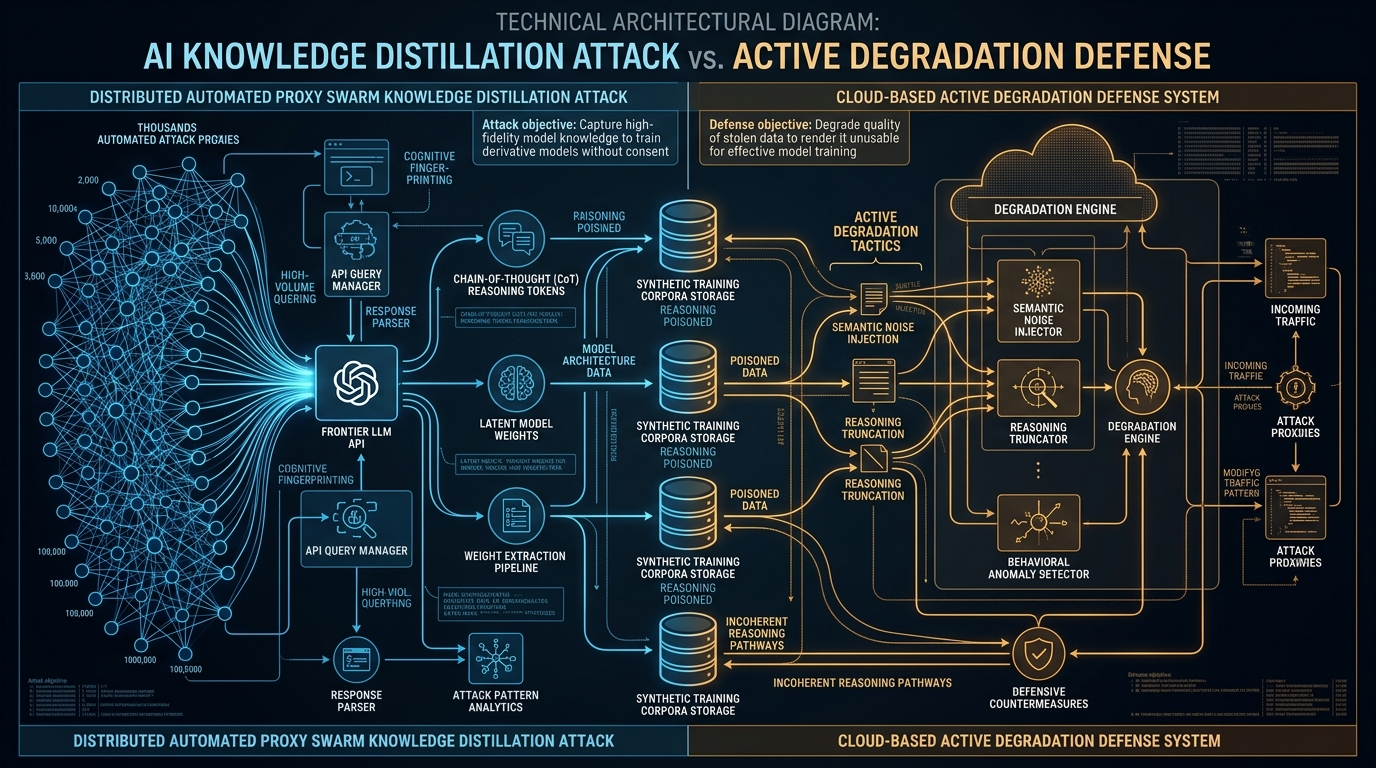
Federal cybersecurity specialists and forensic threat analysts dedicated significant portions of the advisory to documenting what they term an industrialized "distillation supply chain." Unlike conventional developer queries or individual researchers collecting modest experimental samples, the investigation describes an enterprise-grade extraction pipeline engineered for continuous high-throughput data aggregation:
- Distributed multi-tier proxy relays: Programmatic requests were systematically routed through three or more layers of dynamic cloud infrastructure distributed across South America, Eastern Europe, and Southeast Asia. This topology effectively disguised anomalous query bursts as routine consumer and enterprise traffic, frustrating heuristic rate limiting by diffusing query signatures across tens of thousands of dynamically rotating residential and enterprise IP blocks.
- Automated corporate account swarms: Operators allegedly established networks of synthetic holding companies registered in neutral jurisdictions, enabling them to apply for and maintain enterprise-grade Tier-4 and Tier-5 application programming interface tiers. These corporate accounts unlocked high-concurrency request quotas, high token ceilings per minute, and prioritized routing channels that bypassed standard consumer-tier fraud detection filters.
- Hidden Chain-of-Thought prompt jailbreaks: Attackers engineered specialized context manipulations, recursive persona simulations, and multi-turn prompt injections specifically crafted for advanced reasoning models such as the OpenAI o-series and Anthropic Claude. These prompts were designed to bypass safety guardrails and system instructions, compelling the models to disclose unreleased internal thinking scratchpads, raw mathematical deliberation steps, and implicit tool-use protocols that are ordinarily masked from final user interfaces.
- Automated validation and refinement pipelines: The vast stream of harvested completions was subjected to multi-stage real-time sanitization rather than stored as raw text. Automated worker nodes filtered out defensive refusals, standardized syntax trees, verified code execution viability within sandboxed execution harnesses, and applied reward-model scoring to construct pristine, high-density synthetic reasoning corpora for downstream supervised fine-tuning.
Evidence boundary note: While the joint advisory presents extensive aggregate network visualizations, regional distribution diagrams, and behavioral fingerprint summaries, it conspicuously omits publicly verifiable raw packet traces, redacted API transaction payloads, or cryptographically verified model weight provenance that conclusively proves extracted synthetic tokens were incorporated into final production checkpoints.
---
The defense controversy: How "deliberate degradation and poisoning" alarmed global developers
While the geopolitical allegations immediately provoked sharp diplomatic friction, the technical countermeasures officially recommended by the federal agencies triggered even greater consternation across the global software engineering community. In addition to conventional defensive posture improvements—such as enforcing strict Know Your Customer (KYC) identity verification for enterprise accounts and accelerating threat intelligence sharing among cloud vendors—the advisory formally recommended that model providers evaluate and implement active degradation and poisoning tactics:
- Injecting subtle, deterministic flaws: Under the proposed protocol, when cloud risk-scoring algorithms classify an active session as exhibiting high distillation probability, the system is instructed to avoid returning explicit HTTP 403 Forbidden errors or terminating the connection. Instead, the model subtly alters its inferences, embedding nearly imperceptible boundary conditions, fragile logic flaws, off-by-one errors, or subtly mathematically inconsistent definitions directly into the generated answers.
- Truncating latent reasoning depth: Cloud infrastructure providers are encouraged to dynamically suppress internal attention allocation and limit chain-of-thought expansion for suspected scraping threads. By forcing the model to generate syntactically polished prose that deliberately lacks conceptual depth, causal rigor, and multi-step coherence, the resulting synthetic data loses its instructional utility for training competitive student architectures.
- Cross-cloud threat intelligence alliances: The advisory advocates for synchronized defensive treaties connecting major hyperscale providers, including Amazon Web Services, Microsoft Azure, Google Cloud Platform, and independent model laboratories. Under this framework, automated behavioral profiles and IP reputation scores identified on one platform would automatically trigger silent degradation protocols across participating endpoints on other networks simultaneously.
Industry warning: The endorsement of active output degradation has generated profound unease among independent software engineers, researchers, and enterprise architects worldwide. If commercial API providers begin silently introducing deliberate flaws based on automated heuristics, legitimate development teams executing legitimate high-volume workloads—such as large-scale code refactoring, continuous integration pipelines, deep synthetic dataset generation for internal tools, or academic natural language processing benchmarks—face high risks of false-positive classification. Developers would be left unable to determine whether an anomalous response stems from stochastic model hallucination, service degradation, or covert intentional poisoning by the hosting platform.
---
Rebuttals and counter-evidence: Can anyone build a world-class model on distillation alone?
In the days following the publication of AA26-251A, prominent artificial intelligence researchers, open-source contributors, and independent machine learning practitioners articulated substantial technical pushback against the federal narrative, highlighting fundamental theoretical inconsistencies in the notion that world-class model capabilities can be achieved through pure distillation:
- Distillation is universal across modern AI: From Stanford Alpaca and the seminal Microsoft Orca and Phi research initiatives to Meta release cycles for Llama variants, generating synthetic supervision datasets from state-of-the-art foundation models has formed the bedrock of legitimate academic and industrial research worldwide. Framing an established scientific methodology as an illicit cyber weapon represents a radical and arbitrary departure from decades of computer science norms.
- Systemic architectural innovation cannot be downloaded: Breakthroughs such as DeepSeek Multi-Head Latent Attention (MLA), Multi-Token Prediction (MTP), innovative dual-pipe scheduling, and novel Causal Encoder-Decoder architectures represent sophisticated mathematical formulations and ultra-low-level hardware optimizations. These critical systems engineering accomplishments govern memory bandwidth utilization and floating-point throughput, none of which can be replicated or accelerated by scraping natural language text from third-party REST interfaces.
- Student models cannot surpass their teachers through pure imitation: Classical statistical learning theory and empirical deep learning benchmarks demonstrate that supervised distillation inevitably suffers from distributional collapse and compounding error accumulation, bounding student competence strictly below teacher capabilities. The fact that modern open-weight models have repeatedly matched or exceeded frontier proprietary systems on rigorous mathematical evaluations like AIME and programming benchmarks like SWE-bench proves that independent reinforcement learning algorithms, such as group relative policy optimization (GRPO) and self-play reasoning, are driving their performance gains.
- Geopolitical framing obscures unprecedented cost-efficiency gaps: Numerous market analysts and venture capitalists observe that while leading Western frontier laboratories routinely expend hundreds of millions of dollars per individual pretraining iteration, innovative open-source research teams achieved comparable empirical outcomes on compute budgets an order of magnitude smaller. Viewed through this lens, invoking national security terminology provides commercial incumbents with convenient political cover to justify stark disparities in operational cost efficiency and software productivity.
---
Our verdict
- Synthetic data rules are becoming geopolitical weapons: The historical era of permissive, legally ambiguous data harvesting and programmatic model distillation is closing permanently. Regulatory authorities and national security organs across the United States and the European Union will increasingly treat synthetic datasets, intermediate reasoning artifacts, and high-concurrency API access as strategic dual-use technologies subject to stringent intellectual property and export control frameworks.
- The foundational trust of commercial APIs has fractured: Recommending that commercial platforms intentionally poison API outputs undermines the essential reliability contract that sustains the modern software ecosystem. Even if major frontier providers publicly disclaim the active deployment of degradation in standard commercial tiers, the mere formal validation of heuristic poisoning creates systemic uncertainty that will accelerate enterprise transitions toward self-hosted open-weight model architectures.
- Exclusive reliance on external teacher data is obsolete: Regardless of the veracity of specific government allegations, tethering a product roadmap or frontier research agenda to external proprietary API interfaces represents an unsustainable strategic risk. Sustainable technological leadership will belong solely to institutions that control native reinforcement learning sandboxes, end-to-end verification environments, and sovereign data flywheels capable of autonomous capability expansion.
---
What to watch next
- [01] Whether major commercial AI providers such as OpenAI, Anthropic, and Google issue binding statements clarifying whether active output degradation, latent token watermarking, or behavioral query poisoning are currently active across standard developer and enterprise tiers.
- [02] Whether the United States Department of Commerce or Department of the Treasury utilizes advisory AA26-251A as the evidentiary foundation for enacting new export restrictions, sanctions, or cloud-access prohibitions targeting the six identified Chinese AI enterprises.
- [03] Whether the identified engineering teams publish comprehensive technical audits or open research papers documenting their synthetic data generation harnesses and autonomous reinforcement learning algorithms to conclusively refute claims of reliance on external API extraction.
- [04] Whether independent benchmarking collectives and academic laboratories detect anomalous variance in commercial API response quality, empirical accuracy, or code generation stability across geographically distributed endpoints, thereby confirming the covert production deployment of active degradation tactics.
---
Frequently asked questions (FAQ)
What is knowledge distillation, and is it legal across the industry?
Knowledge distillation is an established, widely utilized machine learning optimization technique in which a larger, computationally intensive "teacher model" generates probability distributions, step-by-step rationales, or synthetic solutions that serve as training supervision for a more compact and cost-effective "student model."
Throughout open-source software and university research, distillation is recognized as an indispensable method for democratizing advanced artificial intelligence capabilities and enabling local inference on consumer hardware. However, the commercial terms of service established by proprietary model vendors, including OpenAI and Anthropic, explicitly prohibit utilizing model completions to train competing commercial foundation models. While breaching terms of service represents a contractual dispute governed by civil law, designating large-scale programmatic querying as an organized national cybersecurity threat marks an unprecedented escalation in legal, regulatory, and geopolitical enforcement.
How do the proposed "active degradation tactics" work in practice?
The active degradation strategies detailed in advisory AA26-251A operate as an asymmetric honeypot mechanism embedded directly within cloud inference pipelines. When automated telemetry identifies usage signatures indicative of programmatic extraction—such as atypical prompt diversity, elevated query concurrency, and rapid token cycling across correlated accounts—the hosting platform abstains from issuing explicit rate-limit errors or terminating sessions.
Instead, the inference runtime selectively perturbs the output stream, intentionally introducing subtle arithmetic inconsistencies, syntactic traps, or truncated analytical explanations that pass cursory automated sanity checks. Because extraction pipelines typically absorb harvested completions directly into massive unsupervised training datasets without granular human verification, these engineered flaws become deeply integrated into the target model parameters during optimization, causing downstream student models to suffer from catastrophic reasoning drift and amplified hallucination rates.
What does this mean for everyday developers using frontier APIs?
The escalation of defensive countermeasures introduces three immediate operational and strategic challenges for software engineers, enterprise software architects, and cross-border startups:
First, the probability of false-positive performance degradation will escalate significantly. Legitimate commercial workloads characterized by bursty concurrency profiles, multi-agent automated orchestration, or regional traffic aggregation across dynamic proxies face elevated risks of triggering defensive heuristics, resulting in silently degraded or corrupted completions.
Second, compliance and verification overhead will increase across all commercial tiers. Major model vendors are actively tightening identity verification protocols, mandating rigorous organizational vetting, enforcing strict geographic billing validation, and restricting the automated provisioning of high-concurrency API keys.
Third, the strategic shift toward sovereign, self-hosted open models will accelerate. In response to unpredictable cloud provider behavior, opaque moderation systems, and potential output poisoning, engineering organizations are systematically redesigning their inference stacks around high-performance open-weight models such as DeepSeek, Qwen, and Llama, ensuring complete operational autonomy and deterministic data integrity.