Claude 5.5 Debuts, OpenAI Ambushes Within Two Hours with GPT-6 Sol: Surgical Depth Meets Asymmetric Price War
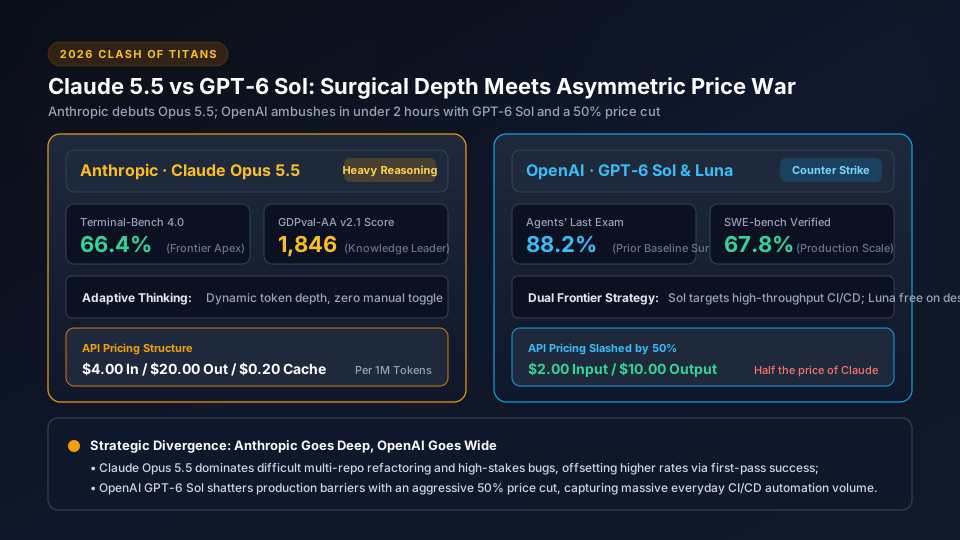
Anthropic established Claude Opus 5.5 with adaptive reasoning and record terminal benchmarks, only for OpenAI to launch an ambush within two hours slashing GPT-6 Sol rates by 50% and releasing Luna for free.
# Claude 5.5 Debuts, OpenAI Ambushes Within Two Hours with GPT-6 Sol: Surgical Depth Meets Asymmetric Price War
Overnight, the global artificial intelligence arena witnessed an intensely dramatic tactical ambush. Anthropic had just unveiled its long-anticipated flagship model, Claude Opus 5.5, aiming to set a new benchmark for autonomous coding agents with always-on Adaptive Thinking and a record-breaking 66.4% on Terminal-Bench 4.0. Yet before the tech community could even finish reading the announcement, OpenAI executed an aggressive counter-strike in under two hours, abruptly dropping GPT-6 Sol and GPT-6 Luna. More ruthlessly, OpenAI bypassed incremental benchmark squabbling altogether and slashed API pricing directly in half: GPT-6 Sol entered production at just $2.00 per million input tokens and $10.00 per million output tokens—precisely 50% cheaper than Claude Opus 5.5. From midnight engineering Slack channels to venture capital circles, the reaction was immediate. A profound clash between a high-precision surgical reasoning engine and an asymmetric industrial price war has formally commenced for late 2026.
---
Core Takeaways: Anthropic Pushes Reasoning Depth While OpenAI Slashes Unit Costs
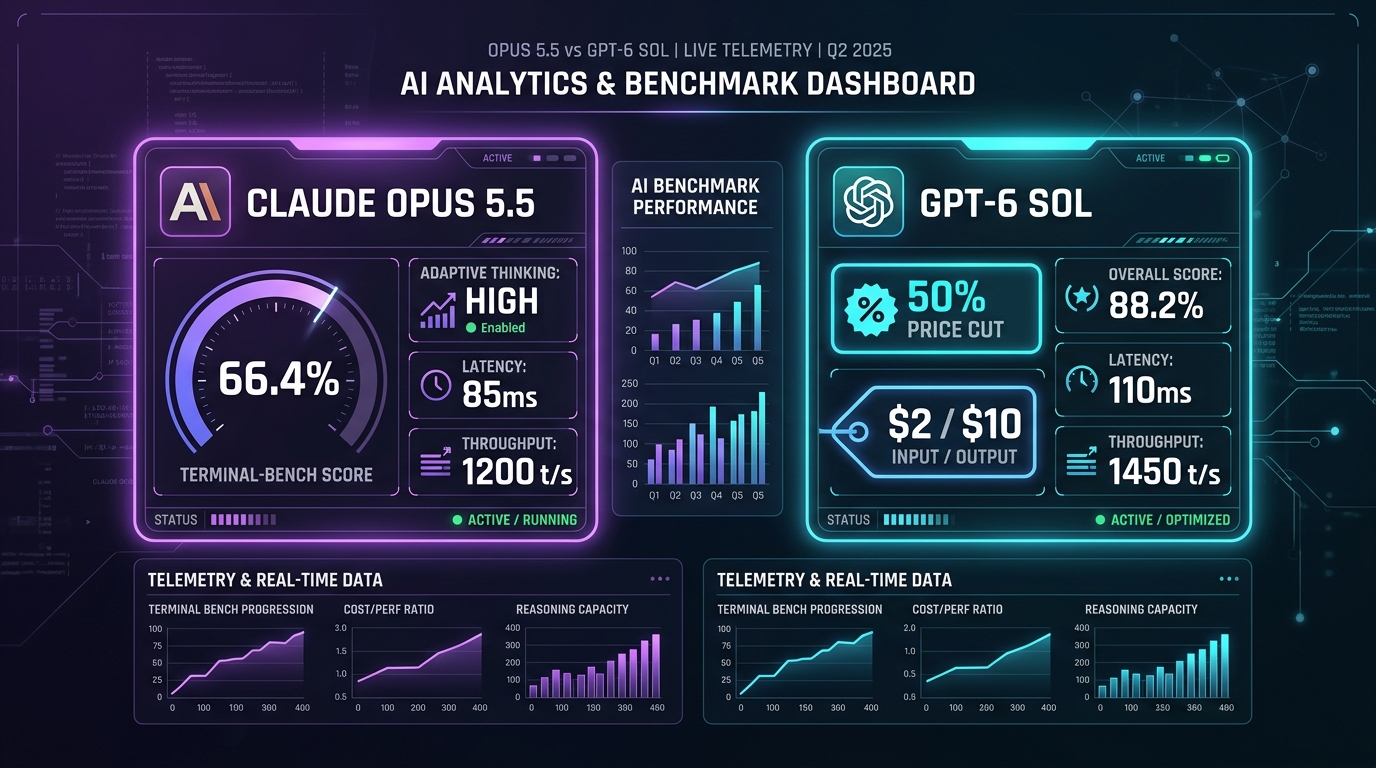
- A two-hour tactical counter-strike designed to seize mindshare: Major frontier model rollouts are rarely isolated occurrences. Anthropic had barely published the Claude Opus 5.5 technical overview and mapped out its 5.5 family trajectory before OpenAI rushed out GPT-6 Sol and Luna within two hours. This was not merely an exhibition of engineering readiness, but an aggressive counter-offensive engineered to disrupt media coverage and defend enterprise developer mindshare.
- Divergent architectural philosophies of surgical precision versus industrial throughput: Anthropic pursues the specialist paradigm. Claude Opus 5.5 incorporates native Adaptive Thinking, allowing the model to autonomously scale reasoning token depth up during intricate architectural surgery and scale down during routine tasks without requiring user toggles. Conversely, OpenAI prioritizes factory-grade volume: GPT-6 Sol leverages low unit latency and massive parallel capacity to monopolize 90% of routine enterprise workflows.
- An asymmetric price confrontation pitting two dollars against four dollars: The official API rate card for GPT-6 Sol shatters previous frontier enterprise pricing norms at $2.00 per million input tokens and $10.00 per million output tokens, exactly half the rates demanded by Claude Opus 5.5 ($4.00 and $20.00 respectively). For enterprise operations consuming billions of tokens monthly, this 50% delta represents hundreds of thousands of dollars in annual cloud expenditures.
- Desktop democratization with Luna distributed freely across operating systems: Alongside the enterprise-grade Sol, OpenAI deployed GPT-6 Luna, a sub-second lightweight reasoning engine integrated directly into the official macOS and Windows desktop applications for all registered users without credit card gates, accelerating mainstream adoption of persistent desktop reasoning assistants.
---
What Happened: The Two-Hour Clash at the Apex of Frontier AI
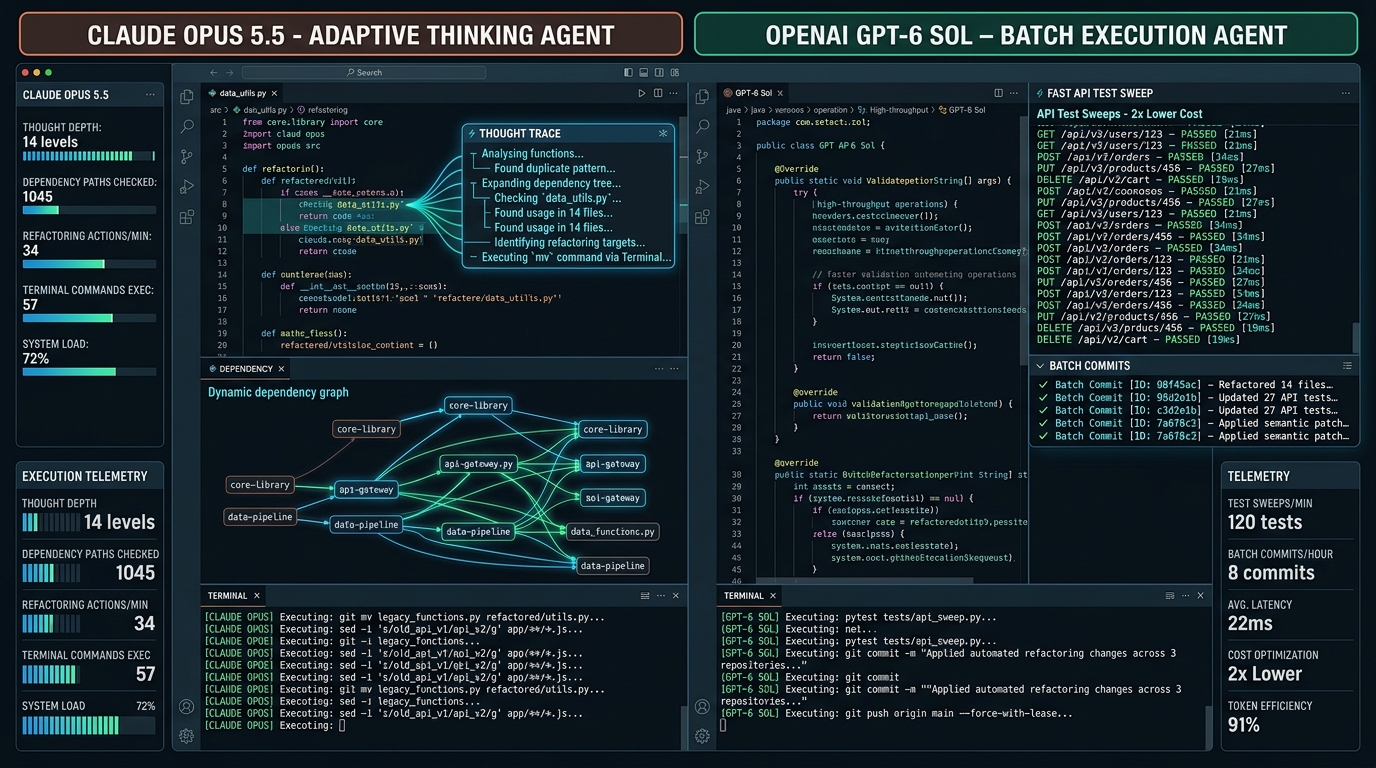
Late on September 22, 2026, the artificial intelligence landscape experienced one of its most dense and aggressive release sequences.
Anthropic initiated the evening by officially unveiling Claude Opus 5.5, the premier flagship of its 5.5 generation, while publishing release timelines for the forthcoming Sonnet 5.5 and Haiku 5.5 models. Having earned deep loyalty among software engineers through its previous releases, Anthropic introduced what it defines as native Adaptive Thinking. In legacy frontier models, engineers were forced to either manually enable lengthy chain-of-thought toggles that introduced severe latency penalties or disable them entirely and risk subtle logic bugs. Claude Opus 5.5 resolves this dilemma by dynamically calibrating its internal inference depth, securing a landmark 66.4% score on Terminal-Bench 4.0 to establish a new frontier peak for autonomous command-line engineering and complex multi-file environment triage.
However, before the global engineering ecosystem could absorb the implications of Anthropic's benchmark gains, OpenAI leadership led by Sam Altman delivered an unexpected counter-strike:
- GPT-6 Sol enters as the enterprise workhorse: Engineered specifically for high-throughput automated development pipelines, Sol captured an 88.2% mark on the rigorous Agents' Last Exam while sustaining a formidable 67.8% verified patch rate across industrial codebases on SWE-bench Verified;
- API rates halved across the board: OpenAI adopted an unapologetically aggressive commercial posture, discounting GPT-6 Sol input and output rates by 50% relative to comparable predecessor models and driving frontier-class API consumption down to historic lows;
- Zero-barrier desktop release of GPT-6 Luna: Catering to conversational desktop workloads, OpenAI paired the launch with GPT-6 Luna, an ultra-low-latency model made available without billing constraints directly inside desktop operating systems.
Within engineering communities, this sequence was universally recognized not as an accidental scheduling overlap, but as a meticulously prepared ambush designed to blunt Anthropic's momentum the instant its release was registered.
---
Why It Matters: The Transition from Parameter Vanity to Unit Economics
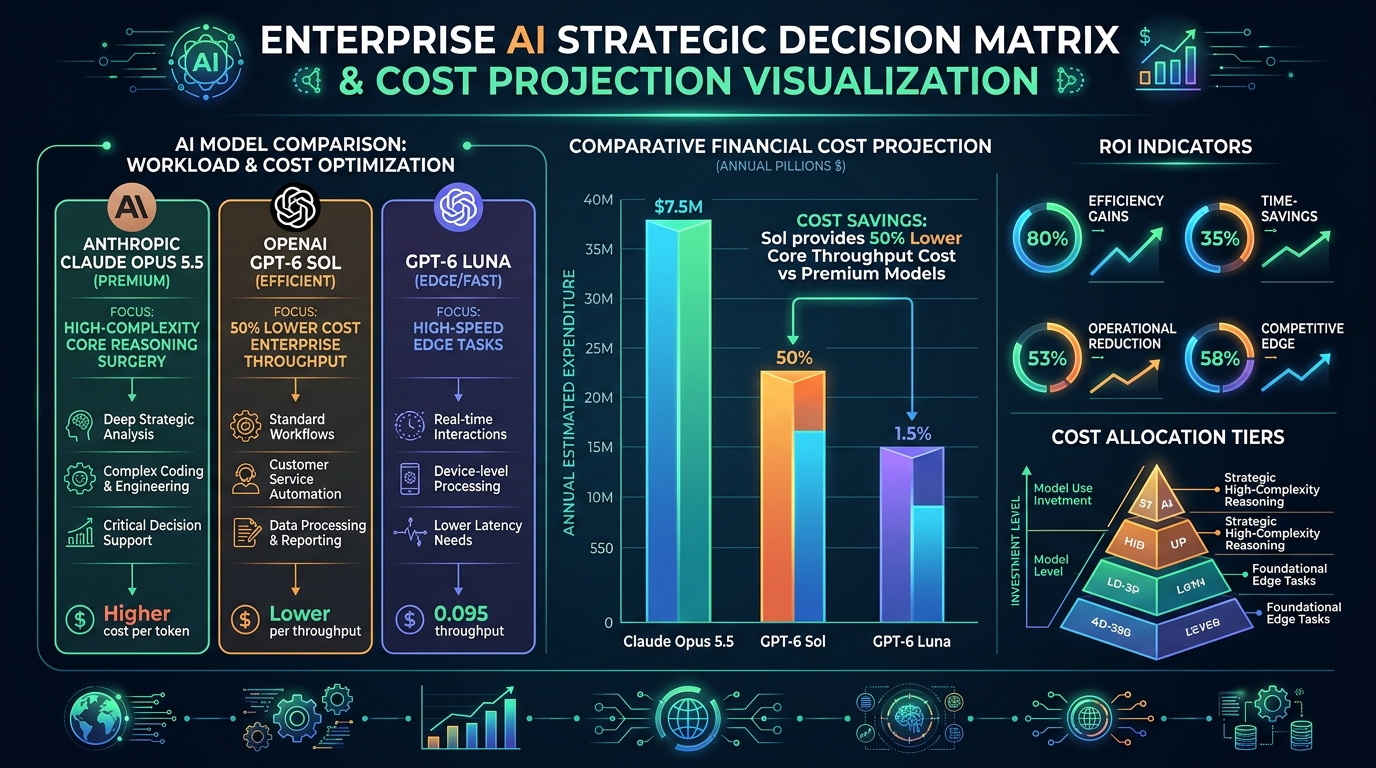
Why has this rapid exchange reverberated so forcefully across technology organizations and software leadership?
The underlying dynamics governing frontier AI competition have fundamentally transformed. Over the past two years, market attention fixated on raw parameter metrics and synthetic academic benchmarks. The events of this evening illustrate that global model development has permanently shifted from theoretical evaluations to an uncompromising battle over economic unit productivity.
- Adaptive Thinking eliminates the manual reasoning babysitter: Claude Opus 5.5 demonstrates that machine intelligence no longer requires developers to act as prompt handlers. Earlier architectures obligated developers to prepend phrases like "think step by step" or toggle complex UI reasoning sliders; native adaptation enables the network to intuit problem complexity on its own, consuming a mere fifty tokens to correct a syntax typo while autonomously unfurling thousands of internal steps to untangle distributed concurrency deadlocks;
- OpenAI erects an enterprise cost fortress: Once intelligence metrics clear baseline production thresholds, enterprise chief technology officers concentrate primarily on billing efficiency. By discounting Sol rates by 50%, OpenAI has established an economic barrier that prevents cost-conscious SaaS startups and mid-market organizations from casually transitioning their pipelines to Claude;
- The decisive battle for developer ecosystem dominance: Anthropic maintains the most dedicated core of elite software architects, yet OpenAI is countering with a coordinated pincer strategy—combining free desktop distribution via Luna with disruptive API pricing via Sol—aiming to dominate token consumption before alternative ecosystems can solidify their positions.
---
In-Depth Comparative Evaluation: Claude Opus 5.5 Versus GPT-6 Sol
To provide clarity for technology leaders evaluating real-world coding performance, long-horizon autonomy, and enterprise infrastructure budgets, we have synthesized the core empirical metrics:
| Evaluation Dimension | Anthropic Claude Opus 5.5 | OpenAI GPT-6 Sol | Strategic Architectural Trade-Off | | :--- | :--- | :--- | :--- | | Architectural Core | Heavy reasoning flagship with native Adaptive Thinking | High-throughput industrial flagship with parallel decoding | Surgical defect eradication versus massive pipeline scale | | Terminal-Bench 4.0 | 66.4% (New frontier peak for long-horizon terminal tasks) | 58.2% (Optimized for standard script generation) | Opus maintains a decisive advantage in complex multi-repo setups | | SWE-bench Verified | 68.1% (Exceptional first-pass patch accuracy) | 67.8% (Near-parity accuracy with 40% faster execution speed) | Both models achieve functional parity on real-world issue resolution | | Official API Input Cost | $4.00 per 1M tokens (Prompt cache read at $0.20) | $2.00 per 1M tokens (50% direct price reduction) | OpenAI holds a commanding financial edge for bulk ingestion | | Official API Output Cost | $20.00 per 1M tokens | $10.00 per 1M tokens (50% direct price reduction) | Sol delivers dramatic savings for multi-step agent loops | | Desktop Consumer Access | Requires paid Claude Pro, Team, or Max subscription | GPT-6 Luna free for all desktop app installations | OpenAI offers frictionless zero-cost adoption on consumer workstations |
1. Reasoning Dynamics: Native Adaptive Inference Versus Industrial Execution Speed
During hands-on software development testing, the two architectures demonstrated sharply divergent operational personalities.
The defining asset of Claude Opus 5.5 is the seamlessness of its adaptive reasoning layer. When handed a straightforward CSS adjustment or a standard React layout bug, Opus returns clean code within 800 milliseconds without burning redundant thinking tokens. However, when confronted with a thorny race condition involving distributed database locks and Linux kernel packet drops, the model spontaneously initiates a multi-layered deduction sequence, iterating through four self-correcting internal hypotheses before issuing a verified zero-defect patch on its initial generation.
In contrast, GPT-6 Sol behaves as an exceptionally optimized industrial assembly line. First-token latency is minimal, and sustained generation speeds comfortably exceed 1,400 tokens per second. While it exhibits slightly less patience when contemplating highly abstract architectural redesigns, Sol bulldozes through standard REST endpoint construction, unit test generation, and database schema migrations with remarkable velocity.
2. Benchmark Frontiers: Terminal-Bench 66.4% and Agents' Last Exam 88.2%
Empirical test harnesses reflect these specialized orientations with high fidelity.
On Terminal-Bench 4.0, a stringent benchmark requiring models to autonomously execute dozens of shell commands inside authentic Linux virtual environments to debug multi-component stacks, Claude Opus 5.5 recorded a score of 66.4%. This represents an improvement of nearly twelve percentage points over prior iterations and establishes clear industry leadership in recovering from tool failures, missing dependencies, and complex dynamic log traces.
Conversely, on the multidisciplinary Agents' Last Exam, which evaluates cross-domain academic reasoning, multimodal diagram synthesis, and composite logical deductions, OpenAI's GPT-6 Sol reclaimed the lead with an 88.2% score. This advantage highlights OpenAI's expansive investment in high-fidelity synthetic pre-training corpora and reinforcement learning alignment, granting Sol broad robustness across varied enterprise operational contexts.
3. Financial Realities: The Mathematics of Halved Rates Versus First-Pass Accuracy
For enterprise engineering leadership, the primary dilemma centers on whether Claude Opus justifies its double price tag.
The answer depends entirely on the mathematical structure of the target workload. For continuous high-frequency tasks such as automated PR linting, user intent classification, and repetitive test suite authoring, GPT-6 Sol is the indisputably rational choice; with an accuracy variance of under three percent, it immediately reduces organizational API expenditure by half.
However, for mission-critical core refactoring, production incident triage, or autonomous agents executing thirty consecutive terminal commands unattended, Claude Opus 5.5 often proves more economical overall. When a lower-cost model hallucinates on the twentieth step of a delicate workflow, the compounding cost of consumed context tokens and engineer recovery hours vastly exceeds the modest savings gained on individual token rates.
---
Strategic Guidance: Recommended Deployment Playbooks for Engineering Teams
In light of the dual flagship launches reshaping enterprise AI infrastructure, the AI Radar editorial team recommends the following tactical guidelines:
- Guideline 01: Reserve Claude Opus 5.5 for high-complexity core engineering: Deploy Opus 5.5 specifically for foundational architectural redesigns, complex cross-repository refactors, algorithmic deductions, and elusive production anomalies where first-pass accuracy protects mission-critical engineering velocity;
- Guideline 02: Route continuous integration and batch pipelines to GPT-6 Sol: Transition daily automated CI/CD unit testing generation, documentation maintenance, compliance audits, and high-volume background processing directly to GPT-6 Sol to capitalize on immediate 50% cost reductions;
- Guideline 03: Establish dual-tier architectural routing at the API gateway: Avoid single-vendor vendor lock-in by implementing dynamic dispatch logic where standard tasks default to low-cost GPT-6 Sol, with automated fallback escalation to Claude Opus 5.5 upon confidence degradation or execution errors;
- Guideline 04: Leverage complimentary Luna instances for desktop knowledge work: Individual engineers and technical operators should update their local desktop clients to utilize GPT-6 Luna at zero cost for interactive code explanation, technical documentation drafting, and ad-hoc scripting;
- Guideline 05: Track forthcoming Anthropic 5.5 mid-tier releases closely: Maintain active surveillance on the upcoming rollouts of Claude Sonnet 5.5 and Haiku 5.5, as competitive parity could shift rapidly if Anthropic pairs Opus-tier reasoning capabilities with aggressive mid-market price adjustments.
---