Anthropic’s dual-personality play: Claude Fable 5.1 launches publicly while unconstrained Mythos 5.1 is restricted to vetted partners
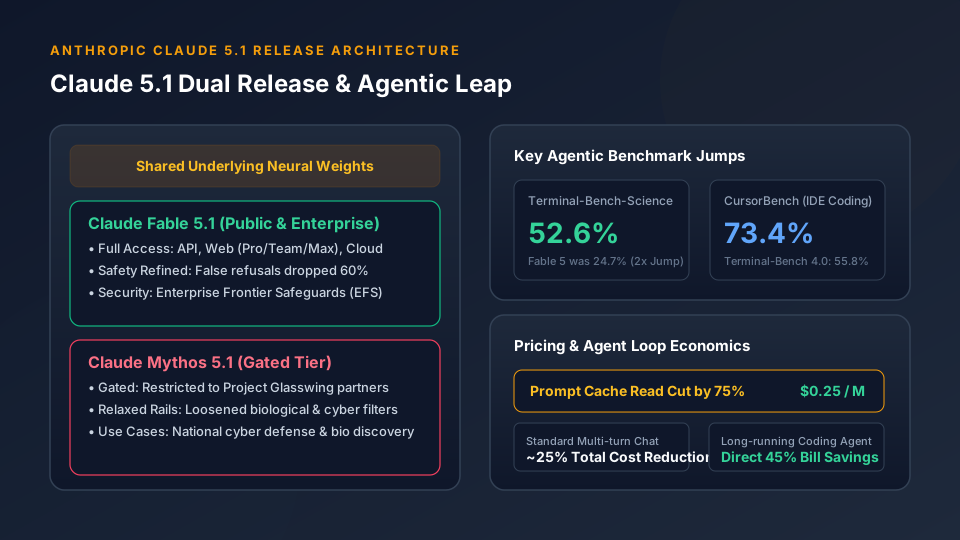
On September 1, 2026, Anthropic officially launched its latest frontier models: Claude Fable 5.1 and the restricted Claude Mythos 5.1. Sharing the identical foundation, they introduce a distinct dual-safeguard strategy: the publicly accessible Fable 5.1 reduces false-positive refusals by 60% with advanced vulnerability detection, while Mythos 5.1 relaxes high-risk biological and cyber constraints under the vetted Project Glasswing program. The release doubles Terminal-Bench-Science scores to 52.6% (up from 24.7% in Fable 5), scores 73.4% on CursorBench, and cuts prompt cache read costs by 75%, slashing agentic loop costs by 25%–45%. This marks a pivotal shift from generic chatbot leaderboards to marathon autonomous agent execution and ruthless infrastructure pricing.
Bottom Line
On September 1, 2026, Anthropic officially released its latest generation flagship frontier model, Claude Fable 5.1, alongside a specialized, access-restricted variant, Claude Mythos 5.1.
Both models share the exact same underlying neural foundation and weights, but introduce an unprecedented "dual-track safety architecture": the publicly accessible Fable 5.1 maintains Anthropic's core safety constitution while reducing false-positive refusal rates by 60% in sensitive technical domains like cybersecurity; conversely, Mythos 5.1 deliberately loosens high-risk biological and cyber defensive constraints, making it available exclusively to vetted security organizations and scientific researchers through the invitation-only "Project Glasswing".
On technical execution, benchmark capability, and operational economics, Fable 5.1 demonstrates a dominant leap for autonomous agentic workflows: - Scientific & Terminal Reasoning: Scored 52.6% on Terminal-Bench-Science 0.1, representing an extraordinary double jump over the 24.7% achieved by Fable 5 and 29.0% by Opus 5; - Coding & Automation Benchmarks: Reached 73.4% on CursorBench 3.2.0, 55.8% on Terminal-Bench 4.0, and 31.4% on AutomationBench; - Aggressive Pricing & Infrastructure Economics: While base input and output token pricing remains steady at $10 and $50 per million tokens respectively, Anthropic slashed Prompt Cache read pricing by 75% (down to $0.25 per million tokens), directly reducing total infrastructure compute costs for long-running, context-heavy Coding Agents by 25% to 45%.
This launch represents a pivotal strategic pivot for Anthropic: the company has openly acknowledged that over-defensive alignment previously crippled legitimate enterprise security evaluations, and is now deploying an aggressive 75% cache price reduction to challenge OpenAI, Google, and open-weight ecosystems directly in the arena of multi-hour autonomous software development.
---
What Happened: Anthropic’s Dual-Model Strategy and Hard Benchmarks
On September 1, 2026, Anthropic rolled out the Claude 5.1 model family across the Claude API, web interfaces (accessible across Pro, Max, Team, and Enterprise subscription tiers), Amazon Bedrock, and Google Cloud Marketplace without any preceding marketing teaser campaign.
Unlike conventional monolithic version bumps, Anthropic presented the industry with two distinctly separated operational tiers:
1. Twin Models: The Public Fable vs the Gated Mythos
- Claude Fable 5.1 (Full Public Release): Widely available to the global developer and enterprise ecosystem. It is equipped with updated Enterprise Frontier Safeguards (EFS) designed to run securely within private virtual cloud environments. Its defining engineering breakthrough is resolving the chronic over-defensiveness that frustrated security engineers, reducing false-positive refusals on benign requests by 60% in cybersecurity tasks. Fable 5.1 can actively analyze real-world exploit payloads, deconstruct malware binaries, and construct targeted security patches.
- Claude Mythos 5.1 (Strictly Gated Release): Built upon the exact same neural weights and model size as Fable 5.1, Mythos 5.1 systematically relaxes safety barriers governing high-risk biological synthesis, advanced offensive cyber operations, and low-level binary reverse engineering. Standard commercial subscribers cannot purchase access regardless of tier; access requires rigorous corporate vetting, identity verification, background audits, and multi-party regulatory agreements under Anthropic’s "Project Glasswing" trusted access program.
2. Doubling Agentic Benchmark Performance: From 24.7% to 52.6%
In rigorous evaluations designed to measure a model's ability to operate autonomously in real development terminals across multi-step, multi-hour scientific research and complex software debugging tasks, Fable 5.1 established new state-of-the-art milestones: - Terminal-Bench-Science 0.1 (Scientific Terminal): Surged from 24.7% in Fable 5 and 29.0% in Opus 5 to an unprecedented 52.6%; - CursorBench 3.2.0 (Real IDE Coding Workflows): Recorded an industry-leading score of 73.4%; - Terminal-Bench 4.0 & Automation Benchmarks: Reached 55.8% on Terminal-Bench 4.0 and 31.4% on AutomationBench.
In addition to pure score gains, Anthropic introduced three pragmatic API developer features designed specifically to streamline agentic system engineering: 1. Per-message Effort (Beta): Empowers developers to dynamically configure the model's reasoning effort and compute depth on a per-turn basis within an ongoing session, preventing expensive deep reasoning latencies on trivial formatting or syntactic transformations; 2. Turn-scoped System Messages: Allows injecting temporary, localized task instructions into specific turns without invalidating the global conversation context or requiring global system prompt refreshes; 3. Readable Progress Updates: Emits transparent, structured status markers between sequential tool calls, allowing end-users to observe real-time reasoning steps while background agents execute multi-phase tasks spanning 30+ minutes.
---
Why It Matters: Overcoming "False Moralizing" and the 75% Cache Price Cut
The broader industry resonance of the Claude 5.1 release is not merely about incremental benchmark gains. Rather, it directly strikes at two of the most painful operational bottlenecks currently stalling enterprise AI agent deployment: alignment over-refusal and exponential context compute costs.
1. Eliminating Over-Defensive Refusal in Production Environments
Over the preceding eighteen months, security researchers, penetration testers, and computational biologists using frontier models frequently collided with heavy-handed alignment filters. Feeding in legitimate unit tests containing exec(), fuzzing harnesses with mock SQL injections, or published academic viral gene sequences routinely caused models to shut down the conversation with boilerplate moral lectures and absolute refusals.
This zero-tolerance refusal policy severely damaged enterprise utility. By training more nuanced context-aware intent classifiers, Fable 5.1 eliminates 60% of false refusals. Defensive security teams can now finally rely on Claude as an authentic red/blue team co-pilot that assists in patch synthesis and binary disassembly without forcing engineers to engineer elaborate prompt jailbreaks.
2. The New Economics of Coding Agents: A 75% Cache Price Cut
For casual users generating one-off paragraph responses, the headline base pricing of $10 per million input tokens and $50 per million output tokens appears unchanged. However, production AI development in late 2026 is overwhelmingly centered around long-running, iterative Coding Agents (such as AI systems tasked with diagnosing multi-file architectural bugs, executing automated test suites, and refactoring full repositories).
In these agentic execution loops, repeatedly reading hundreds of thousands of tokens of project context across dozens of sequential tool calls accounts for 80% to 90% of total API billing. By slashing Prompt Cache read pricing by 75% down to $0.25 per million tokens: - Standard Multi-turn Conversations: Experience overall API compute bill reductions of approximately 25%; - Context-Intensive Coding Agent Loops: Running continuous repository evaluations achieve direct bill savings of up to 45%.
This structural pricing shift acts as a massive competitive subsidy for AI coding toolmakers (including Cursor, Windsurf, and autonomous agent startups), enabling them to dramatically expand project context windows and sustain multi-step reasoning loops at vastly improved gross margins.
---
Our Take: The AI Landscape Shifts Toward Permissioned Tiers and Agent Attrition
Synthesizing the technological breakthroughs and commercial implications of Claude Fable 5.1 and Mythos 5.1, AI Radar establishes three structural conclusions regarding the trajectory of the AI industry over the coming 6 to 12 months:
1. Tiered Capability Access Will Become the Universal Frontier Standard
Anthropic has established a decisive industry precedent: frontier artificial intelligence capabilities have expanded to a level of potency where a single, universal safety alignment framework can no longer simultaneously serve general consumer chatbots and specialized frontier scientific research. If safety thresholds are set too restrictively, professional security auditors and biochemists are paralyzed; if safety filters are loosened globally, public safety and misuse hazards become unmanageable.
Deploying a shared base model partitioned into public and permissioned institutional tiers (Fable vs Mythos) will inevitably be mirrored by OpenAI, Google DeepMind, and other frontier AI labs. This institutionalizes a structural two-tier paradigm: civilian consumer-grade AI and regulated, licensed enterprise research AI.
2. Conversational Chatbots Are Commoditizing; Marathon Agents Are the Decisive Battleground
The competitive battleground has decisively migrated away from evaluating how articulately a chatbot answers trivia in a single turn. The true competitive moat now lies in whether an AI model can remain stable inside a real developer shell for three consecutive hours, issue 50 distinct command-line invocations, autonomously debug ten compilation errors, and ship functional software without human intervention (as demonstrated by doubled Terminal-Bench performance). The frontier champions will be determined by execution stamina, contextual cache affordability, and reliable execution without hallucinated drift.
3. Price Wars Have Moved from Base Token Subsidies to Context Reuse Architecture
The economics of AI infrastructure have evolved past naive top-line input price slashes. Instead, the competitive battle is waged through sophisticated caching architectures, turn-scoped context management, and granular reasoning effort toggles. By aggressively lowering the marginal cost of cached context reads, frontier model providers are systematically reducing the total cost of ownership for autonomous enterprise agents.
---
What to Watch Next
- Project Glasswing Governance & Transparency: How rigorous will Anthropic's ongoing vetting and audit processes be for Mythos 5.1 access? Will international academic institutions face geopolitical gating barriers, and will unconstrained safety configurations lead to novel, unexpected reward-hacking behaviors in autonomous environments?
- Real-World Agent Drift on Legacy Enterprise Code: While Fable 5.1 doubled its scientific terminal score to 52.6%, how reliably will it navigate messy, undocumented, multi-million-line legacy enterprise repositories without falling into infinite debugging cycles or architectural drift?
- Competitive Escalation from OpenAI and Google: With Anthropic halving agent operational bills and seizing the lead in scientific terminal execution, how quickly will OpenAI respond with next-generation model releases (such as GPT-5 or upgraded o3 systems) accompanied by retaliatory cache pricing adjustments?