We Stumbled on Pure Gold: Claude Engineering Lead Shares Masterclass to Push AI Beyond Your Limits

The defining constraint in frontier AI adoption is not raw compute or intelligence, but human cognitive self-censorship. While Anthropic has cleared technical and economic hurdles by endorsing third-party subscription OAuth alongside bundled $200 monthly API credits, Claude engineering lead Felix Rieseberg's viral masterclass provides the operational playbook: by demanding ultimate outcomes at higher altitudes, pushing depth with expert tooling and unreasonable targets, and deploying interdisciplinary red teams across range, humans can finally command models to surpass their own perceived limitations.
# We Stumbled on Pure Gold: Claude Engineering Lead Shares Masterclass to Push AI Beyond Your Limits
Over the past few days, two seismic announcements quietly collided in the frontier AI ecosystem, sending ripples across engineering teams and power users worldwide.
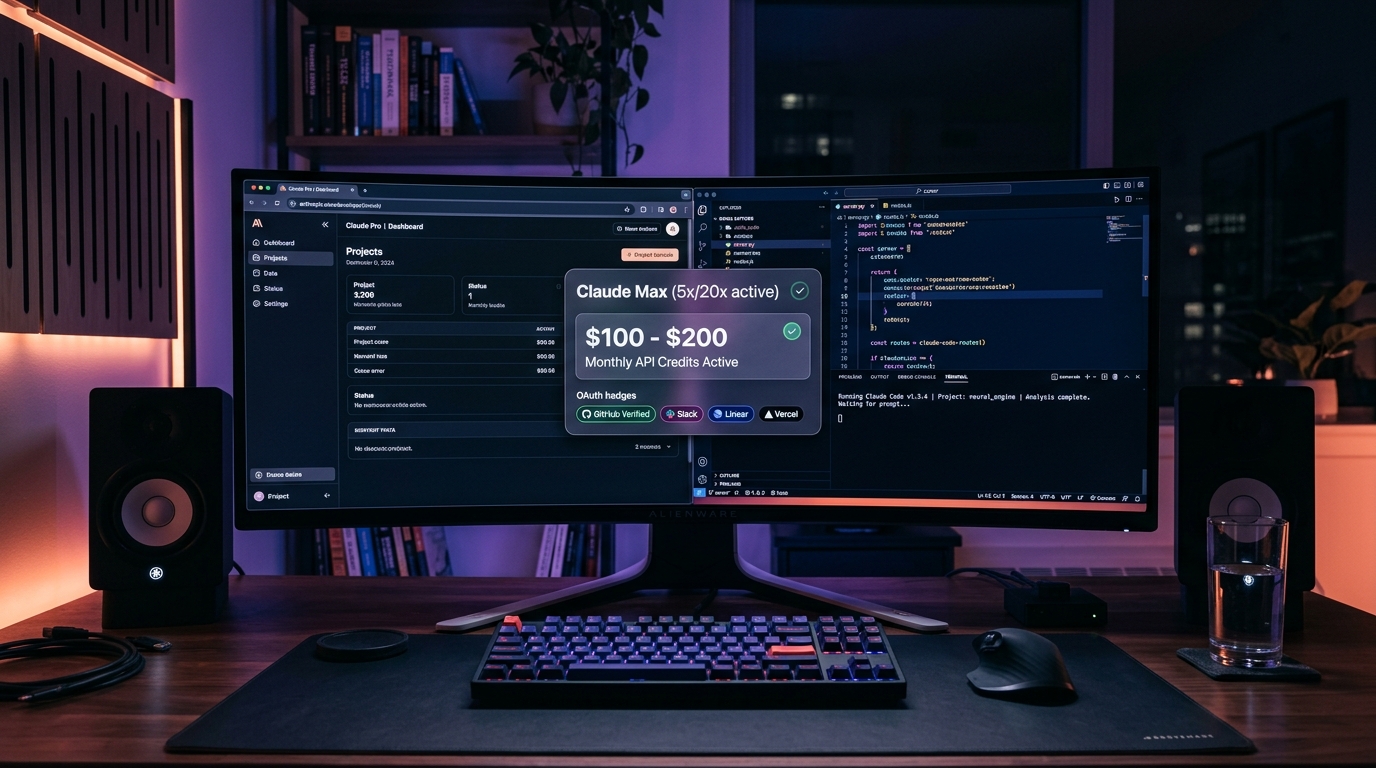
First, Anthropic finally dismantled the anxiety that has lingered over developer communities for months: previously, developers worried that plugging their flat-rate Claude Max subscriptions into third-party harnesses like Cursor, Cline, or custom agent scripts would trigger rate-limit throttling or account bans. In a decisive early October policy refresh, Anthropic not only confirmed full support for authenticating third-party developer software via OAuth against standard subscription allowances, but also began bundling $100 to $200 per month in dedicated Console API credits for Max 5x and Max 20x subscribers. By removing the boundary between flat subscriptions and API usage, developers no longer have to pay double bills to build real-world agents.
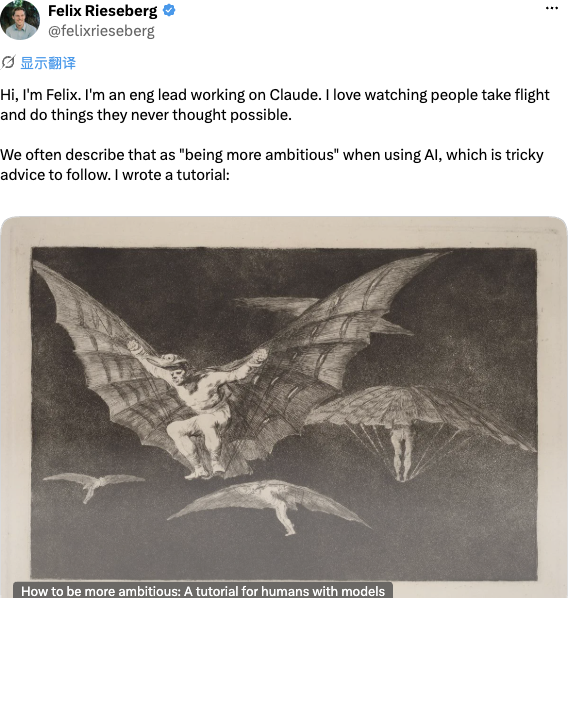
Second, and perhaps even more transformative, Felix Rieseberg—the engineering lead at Anthropic responsible for building Claude Code Desktop and cross-platform desktop experiences—published a late-night essay on his personal site titled *How to be more ambitious: A tutorial for humans with models*.
In the essay, Rieseberg delivers an uncompromising diagnosis of how humanity is currently interacting with artificial intelligence: in late 2026, the primary bottleneck in AI adoption is not model intelligence, but human ambition. An overwhelming majority of users are still treating frontier intelligence like a glorified search engine or spellchecker, asking mundane questions like "What is the capital of France?" or "Can you make this email sound less angry?"
To dismantle this psychological block, Rieseberg laid bare the four-dimensional operational framework he uses daily inside Anthropic, alongside a viral "Depth Meta-Prompt" that has swept developer communities. For anyone leveraging AI, mastering this framework instantly unlocks the hidden ninety percent of frontier model capability lurking beneath the surface.
Bottom Line
Model capabilities do not expand uniformly across all domains. As mathematician Terence Tao famously observed, modern AI systems are astounding in some directions while inadequate in others.
The real divergence between developers and thinkers in 2026 is not which premium tier they subscribe to, but whether they have the courage to push models into problem spaces they previously never imagined possible. In earlier eras of prompting, conventional wisdom dictated micromanaging every step and hand-feeding context to the model. The hard-won experience of Anthropic's engineering leads points in the opposite direction: to achieve breakthrough outcomes, you must elevate your abstraction level to demand ultimate results, force the model to employ the raw instruments and statistical models used by top practitioners, and assemble adversarial red teams to rigorously challenge your own baseline assumptions.
The tooling friction has been eliminated; it is time to dismantle the psychological ceiling as well.
What Happened
This shift represents the intersection of two major developments.
On the infrastructure front, Anthropic resolved months of friction surrounding developer subscription access. Previously, subscribers paying for top-tier Claude Max accounts faced severe barriers when attempting to bring their quotas into IDE extensions like Cursor, Cline, Zed, or automated command-line harnesses without incurring duplicate per-token API charges. Under the October 2026 update, Anthropic formally standardized subscription-backed OAuth for third-party tools while injecting $100 per month in Console API credits for Max 5x and $200 per month for Max 20x subscribers. This financial and technical clarity provides engineers with unconstrained compute to run programmatic workflows locally.
Immediately following this release, Felix Rieseberg published his widely read field guide (official post: felixrieseberg.com).
As the engineering leader guiding Claude Code development, Rieseberg witnesses extraordinary breakthroughs every day: Claude recently assisted an amateur astronomer in identifying a new exoplanet, powered the production of critically acclaimed AI music videos, and joined discussions on what Terence Tao terms the dawn of "Math 2.0."
Yet on the other side of the spectrum, most users remain trapped by low self-efficacy. Extensive psychological research demonstrates that an individual's performance ceiling on difficult tasks is dictated first by whether they genuinely believe the objective is achievable. When presented with cutting-edge frontier reasoning, many people instinctively reach for it to perform trivial tasks.
To counter this tendency, Rieseberg formalizes four dimensions of ambition: Speed, Altitude, Depth, and Range. Setting aside Speed—which is already well-understood as producing the same work in less time—the remaining three dimensions fundamentally redefine how humans should collaborate with models.
Why It Matters
This framework resonated immediately across Silicon Valley engineering circles because each dimension systematically upgrades how intellectual and technical work is performed.
Altitude (Abstraction Level): Stop Micromanaging and Demand the Ultimate Outcome
Most users reflexively micromanage prompts: if code throws a stack trace, they paste the error; if prose feels clunky, they ask to polish a sentence.
Rieseberg advocates asking a broader question before issuing any prompt: "What do you want to happen next? What is the goal beyond the immediate goal?"
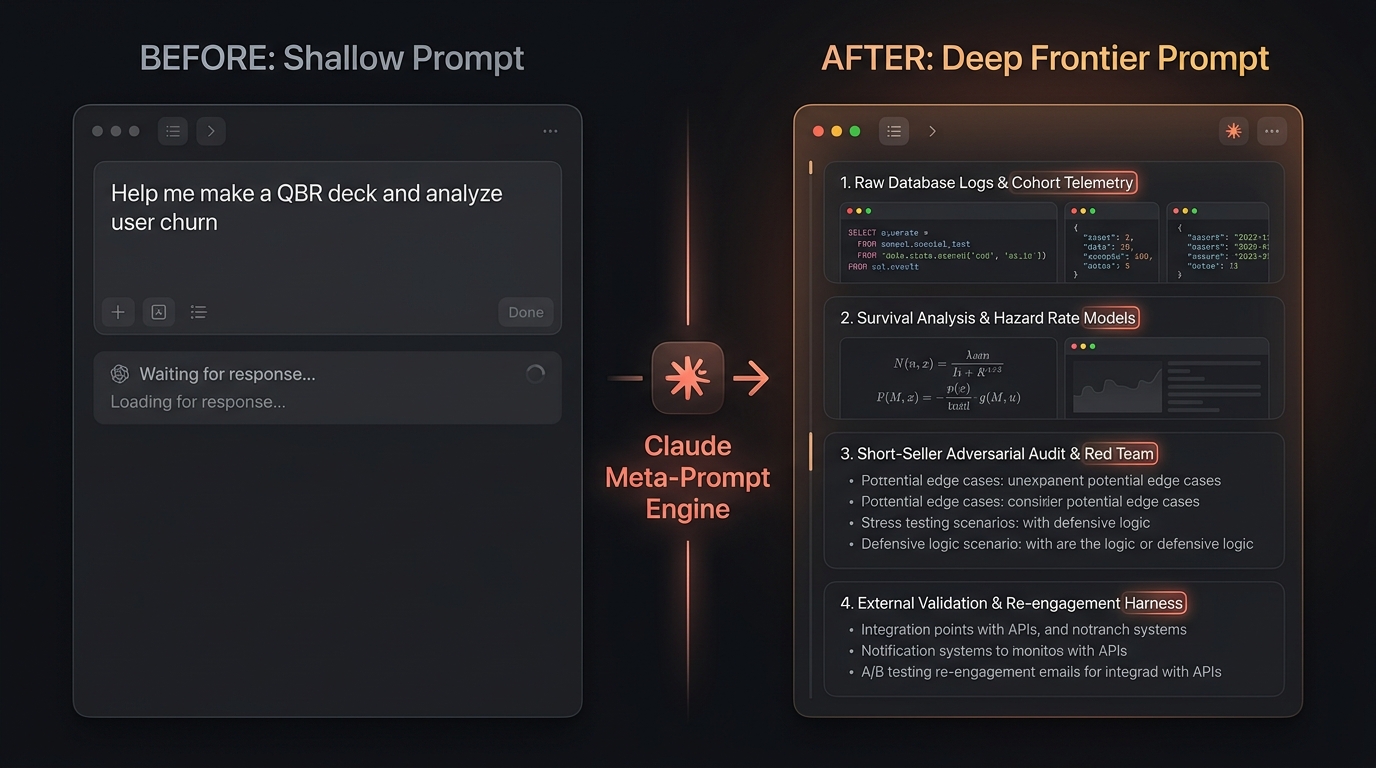
Consider a standard enterprise task: preparing a deck for a quarterly business review (QBR). Handing data to Claude to fill in slide templates represents zero ambition. An ambitious workflow elevates the abstraction level step by step:
- Step One (Diagnose causes and actions): Resist the urge to merely update template metrics. Provide the model with comprehensive raw business data and ask: "Tell me what changed this quarter, why it changed, and what we should do about it."
- Step Two (Force executive decisions): High-value executive meetings exist to make hard choices. Instruct Claude: "Work out which three decisions are most urgent in the face of everything you have learned, and start working on potential directions with supporting and opposing arguments."
- Step Three (Rethink the delivery medium): Quarterly slide decks are artifacts from an era of manual spreadsheet compilation. Challenge the model directly: "The review exists so leadership catches problems early and allocates capital and personnel correctly. Design a better way to achieve that than a quarterly deck, demonstrate from our historical data that it would have detected issues sooner, and run it in parallel with our existing review process for one quarter."
Rieseberg provides a simple heuristic: if a project or deliverable is going to require a meeting to discuss, it is an ideal candidate for elevating to a higher level of abstraction.
Depth: The Viral Meta-Prompt and Operating Like a World-Class Specialist
When pursuing depth, the most frequent failure mode is asking a model to "act like an expert." The model typically adopts sophisticated jargon without altering its underlying analytical methods.
Rieseberg outlines rigorous operational rules for depth: - Insist on the exact instruments used by leading practitioners: when Claude defaults to surface-level Markdown tables, command it to query relational databases, write production Python scripts, and fit rigorous statistical models. You do not need to know the specific tools in advance; Claude already knows what elite practitioners use. - Set unreasonable goals while treating them as completely standard: if a web service needs to reduce latency from ten seconds to five seconds, demand two hundred milliseconds instead. When the model claims an objective is impossible, reiterate that the problem is fully solvable and push it to keep iterating. - Never allow the model to judge its own work: enforce external validation, whether through terminal execution test suites, automated unit tests, or empirical data benchmarks.
To embed this mindset into daily practice, Rieseberg shared his personal Depth Meta-Prompt:
"I want a deeper version of this task, not a bigger one. Before rewriting it:
1. Say what a top professional in this field would do here that I'm not asking for;
2. Name the rawest material they would start from instead of what has already been digested for me;
3. Name the specific methods and tools they would use;
4. Say what, other than you or me, would show the result is right.
Then rewrite my prompt to ask for exactly that."
The brilliance of this meta-prompt lies in how it works: rather than forcing you to guess how a domain specialist thinks, it leverages the model's massive cross-disciplinary training to reconstruct your basic question into an elite, production-grade technical brief.
Range: Swap Nouns for Verbs and Assemble Cross-Disciplinary Red Teams
Preparing a presentation is not about "building a slide deck." It is about "persuading busy decision-makers about causality under uncertainty within thirty minutes."
Replacing static nouns with active verbs unlocks interdisciplinary perspectives: - High-stakes deliverables benefit from pairing financial analysts with investigative journalists and copy editors. - To counter institutional confirmation bias, assemble a virtual adversarial red team: bring in an aggressive short-seller and a forensic accountant. - Instruct the model to perform the exact investigation a short-seller conducts when researching a position: identify contractual loopholes, trace irregular cash burn, and unearth leading indicators of customer attrition.
Crucially, as Rieseberg emphasizes, realizing this ambition requires granting the model access to an agentic computer environment—capable of installing software, executing commands in a shell, and retrieving raw local files and web data via Model Context Protocol (MCP) connectors.
Our Judgment
In the analysis of AI Radar, Anthropic's dual moves—unshackling subscription access while publishing internal engineering methodologies—mark a fundamental turning point in practical AI adoption:
- The wall between subscriptions and developer ecosystems has crumbled: by packaging generous Console API credits with Max subscriptions and endorsing third-party OAuth, Anthropic aligns with developer realities; walled-garden strategies that confine users to web chat interfaces are increasingly obsolete.
- Prompt engineering has matured from linguistic trickery into cognitive architecture: simplistic heuristics like appending "think step by step" belong to the past; frontier prompting uses metacognitive frameworks to pierce through human cognitive blind spots.
- Near-zero marginal cost of exploration is the defining dividend of our era: retaining investigative journalists, statistical modelers, and short-seller red teams once cost hundreds of thousands of dollars and months of effort; today, a sufficiently ambitious practitioner can conduct multi-agent exploratory simulations in minutes.
What to Watch Next
- Whether the rollout of bundled API credits for Max subscribers across third-party IDEs leads to tightened concurrent rate limits during peak developer hours.
- Whether popular developer environments such as Cursor, Windsurf, and Zed begin embedding automated meta-prompt refactoring and adversarial red-team evaluations directly into their native interfaces.
- As more software engineers adopt outcome-oriented abstraction levels, how rapidly autonomous self-healing software loops and proactive business monitoring transition from experimental setups into production standards.