Unlocking Full Throttle: Claude Opus 5.5 Fast Mode Hands-on with 2.5x Speed and Zero Degradation

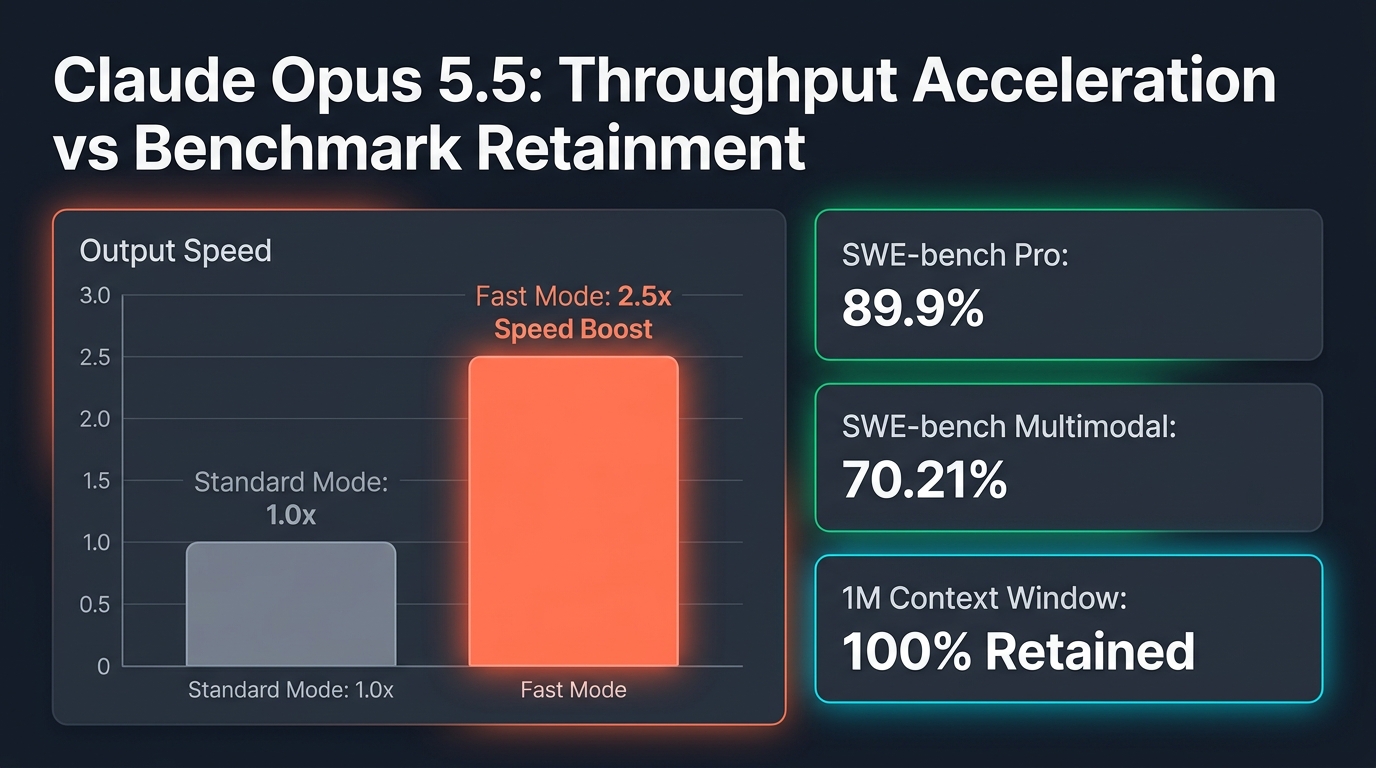
Anthropic has shattered the prevailing industry compromise that intelligent models must be sluggish while fast models must be dumb. By maintaining 100% full-weight architecture and an 89.9% SWE-bench benchmark while accelerating downstream throughput by 2.5x, Fast Mode—especially when paired with monthly bundled platform credits—delivers the ultimate zero-compromise developer experience.
# Unlocking Full Throttle: Claude Opus 5.5 Fast Mode Hands-on with 2.5x Speed and Zero Degradation
When coding with frontier reasoning models, the biggest friction has always been the painful waiting game—the smarter the model, the longer it ponders and the slower it streams, leaving developers staring blankly at a blinking cursor.
Over the past forty-eight hours, Anthropic quietly dismantled its research preview waitlists and rolled out Claude Opus 5.5 Fast Mode into general availability for all developers. By entering a simple /fast command inside Claude Code, hundreds of lines of complex multi-file refactoring pour across the terminal like an open fire hydrant. Best of all, this is not a distilled, lobotomized sub-model; it is the 100% full-weight Opus 5.5 flagship running at uncapped velocity.
Not a Distilled Downgrade: This Is 100% Full-Weight Opus
Across the commercial AI landscape, most so-called "Turbo" or "Flash" tiers rely on cheap distillation tricks: aggressively squeezing 70-billion or hundred-billion-parameter foundations down into miniature 8-billion-parameter models. While throughput accelerates, the model quickly stumbles over complex business logic, forgets edge-case error handlers, or silently mangles static typing contracts.
Anthropic’s Fast Mode breaks that pattern entirely:
- Zero Parameter Pruning: The inference cluster serves the exact, uncompromised Claude Opus 5.5 production model weights without quantization or layer skipping;
- Zero Benchmark Compromise: It retains its undisputed world-record benchmark scores, including 89.9% on SWE-bench Pro for real-world repository maintenance and 70.21% on SWE-bench Multimodal for diagnosing complex visual UI regressions;
- Pure Infrastructure Acceleration: The speed gain stems from dedicated, high-throughput inference silicon and optimized speculative decoding pipelines, catapulting token streaming throughput to 2.5 times the standard generation baseline.
One Parameter to Take Off: How to Activate Fast Mode
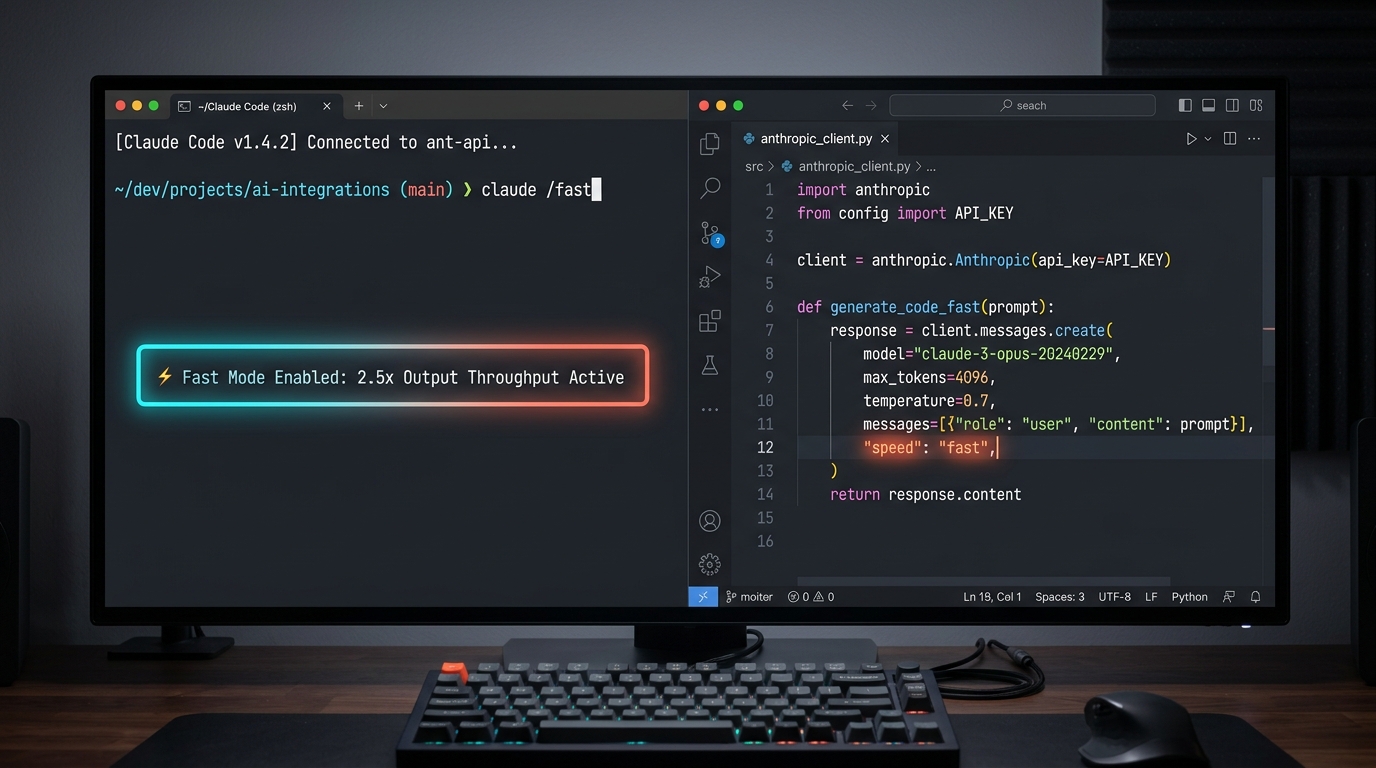
Previously, tapping into this ultra-low-latency tier required manual developer whitelisting and unwieldy experimental request headers. Now, Anthropic has streamlined access into a frictionless toggle:
- Inside the Official Claude Code CLI: Enter the
/fastcommand directly within any interactive session to immediately switch the running process into high-throughput mode; - Within Standard API Payloads: Pass a single, declarative key-value parameter inside your inference payload:
"speed": "fast"; - Cross-Platform Availability: Full support is active across the Claude Platform, Claude Code, and Microsoft Azure Foundry. However, cloud instances hosted on Amazon AWS Bedrock and Google Cloud Vertex AI have not yet received this dedicated cluster allocation, meaning multi-cloud teams must route through primary endpoints for now.
The Compute Audit: Who Pays, and How to Get It for Free
Because Fast Mode ties up dedicated, high-throughput compute infrastructure, its metering rates reflect the premium hardware allocation:
- Standard Opus 5.5 Pricing: $4 per million input tokens, and $20 per million output tokens;
- Fast Mode Pricing: $8 per million input tokens, and $40 per million output tokens (precisely double the standard tier).
At face value, a 2x price multiplier sounds steep. But remember the monumental concession Anthropic made last week: to defuse fierce developer backlash over third-party OAuth bans and reverse proxies, Anthropic officially began crediting $100 (Max 5x) to $200 (Max 20x) in free Console API vouchers every month to all Max subscribers!
In practice, individual developers do not need to spend extra cash out of pocket to afford Fast Mode. By offsetting inference costs against the platform retainers already sitting in your developer console, you can enjoy zero-marginal-cost interactive coding at maximum acceleration.
Two Reality Checks Before You Floor the Gas Pedal
Amid the community excitement, rigorous engineering testing reveals two critical technical boundaries every developer must understand before enabling the flag:
- Time-to-First-Token (TTFT) Does Not Shrink: Adaptive thinking still requires its necessary contemplation window. If you submit a highly abstract system architecture overhaul spanning dozens of interdependent microservices, the model will still deliberate for several seconds before emitting code; Fast Mode specifically accelerates the downstream streaming throughput once code begins generating.
- Never Run Fast Mode on Unattended Batch Loops: If you are executing thousands of offline unit tests, batch documentation crawls, or large data transformations overnight, enabling Fast Mode simply doubles your API bill without human benefit. Fast Mode is strictly designed for live, human-in-the-loop workflows—interactive pairing, real-time debugging, and rapid agent validation loops where immediate feedback keeps the developer in flow state.