OpenAI blamed some Codex limit complaints on sub2api — users who never used it got even angrier
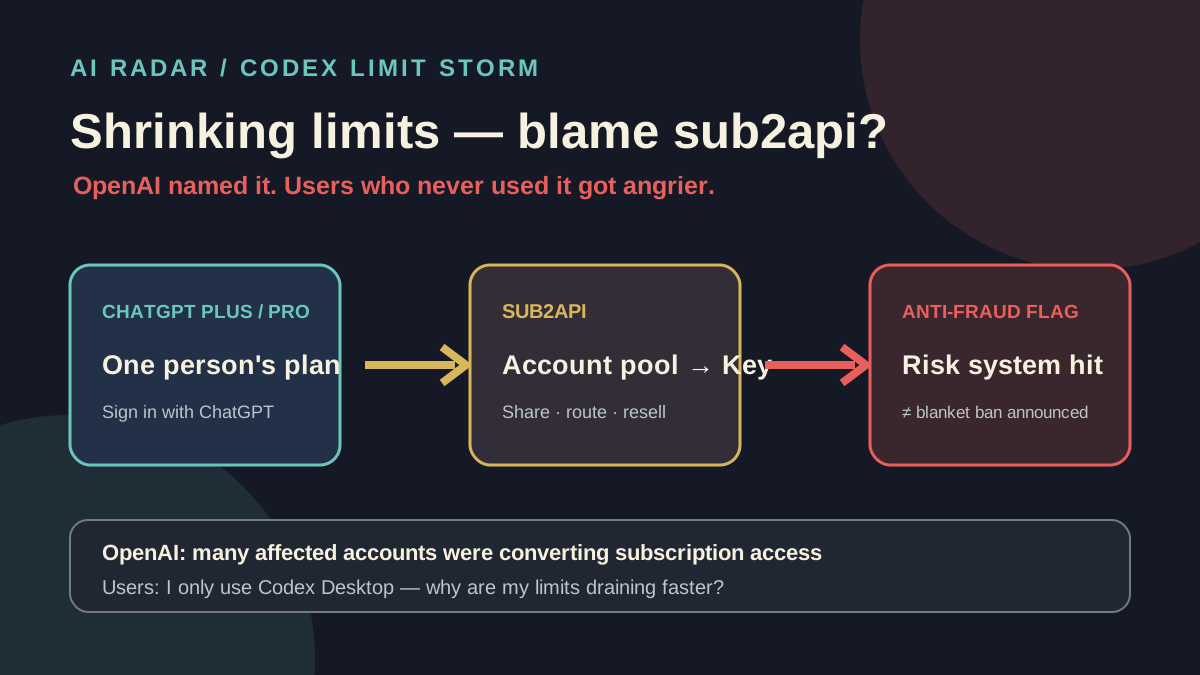
Codex lead Tibo said some users reporting limit problems were using sub2api to convert subscriptions into API keys for sharing, which triggers anti-fraud flags. He did not announce blanket permanent bans or explain complaints from users who say they only use official clients.
The short answer
OpenAI has not announced that third-party Codex clients are banned, nor that every sub2api user will be permanently suspended.
Codex lead Thibault “Tibo” Sottiaux said on August 21 that OpenAI found many people reporting limit problems were using sub2api to turn ChatGPT or Codex subscriptions into API keys and share them. He said this unsupported pattern is flagged by anti-fraud systems.
Then the Reddit replies landed:
“I have never even heard of sub2api. Why are my limits draining faster too?”
That leaves two stories at once: subscription-to-API pools have clearly entered a high-risk zone, but OpenAI's explanation does not yet account for every complaint from ordinary users.
OpenAI drew a line between two different uses
Tibo's response can be reduced to two points.
- Using your own ChatGPT account through a client that supports “Sign in with ChatGPT” is allowed.
- Turning subscription access into API keys for pooling, sharing, resale or redistribution is unsupported and may trigger anti-fraud controls.
That distinction matters. A third-party agent harness is not the same thing as a subscription-resale gateway.
Pi and OpenCode change the interface and agent shell an individual uses. A sub2api account pool combines subscriptions behind its own API keys and distributes calls to more people. Both may sit outside the official interface, but their commercial and fraud implications are completely different.
What line does sub2api cross?
The public sub2api repository describes subscription aggregation with OAuth accounts, API keys, concurrency, account routing and shared access.
A typical setup looks like this:
- Connect one or more ChatGPT or Codex subscription accounts to a gateway.
- Let the gateway issue its own API keys.
- Route requests across the connected subscription accounts.
- Give those keys to multiple clients, people or paying customers.
For the operator, this turns a fixed-price personal plan into a self-hosted API. For OpenAI, it can turn individual access into wholesale capacity while obscuring who is using the account, how many people are making concurrent requests and whether limits are being bypassed.
OpenAI's consumer terms prohibit sharing credentials, making an account available to another person and circumventing rate limits or protective measures. The terms do not name sub2api, but risk rises sharply when pooling, sharing, resale or limit evasion is involved.
“Flagged” does not mean “blanket permanent ban”
This is the boundary most headlines are likely to distort.
Tibo wrote “flagged by our anti-fraud systems.” He did not say that:
- detecting sub2api automatically causes a permanent ban;
- every third-party client is punishable;
- every account reporting a limit problem was confirmed to be violating the rules;
- OpenAI has published one universal enforcement schedule.
A flag may lead to verification, reauthentication, throttling, token invalidation or restricted access. OpenAI may suspend or terminate an account if it determines that the terms were violated. But calling this a completed blanket ban would turn a risk signal into a fact that has not been announced.
The reversal: people who never used sub2api got angrier
Tibo's explanation was meant to calm the limit controversy. On Reddit, it did the opposite.
Many r/codex users said they had never used or heard of sub2api and only worked through the official Codex Desktop app or CLI, yet still felt their weekly limits were draining faster. One user said a comparable task that previously consumed about 3% was now often taking more than 10%. Another estimated consumption was at least 1.5 times faster that week.
These are user reports, not an independent audit. They do not prove that OpenAI quietly cut plan limits. Model choice, context size, reasoning effort, tools and task length can all change consumption. OpenAI's current help documentation also warns that long-running tasks may consume far more capacity than short requests.
But the reports do show that sub2api explains only one category of affected accounts. They do not prove the rest of the complaints are imaginary.
The same split had already appeared in the Chinese community
On August 15, LINUX DO users were already discussing whether sub2api's Codex fingerprint configuration could trigger risk controls. Some said their limits recovered after changing configuration; others said they did not use sub2api and still saw lower limits.
Community posts cannot provide site-wide statistics, but they reveal the same unresolved divide:
sub2api may explain some anomalies. There is no evidence yet that it explains all of them.
To settle the dispute, OpenAI would need to publish verifiable details: which behaviors trigger a flag, how false positives can be appealed and why the same task may show different consumption.
What should you do now?
Lower risk: your subscription, your login
- Use ChatGPT Plus or Pro through official Codex Desktop, CLI, IDE or web experiences.
- Use a clearly supported “Sign in with ChatGPT” flow.
- Keep the account personal and do not give tokens or credentials to other people.
Clearly higher risk: turning a subscription into a shared API
- Sending OAuth tokens through a relay gateway.
- Automatically routing calls across an account pool.
- Issuing API keys for several people.
- Renting, reselling or group-buying a supposed “Codex API.”
- Spoofing devices or trying to evade limits and anti-fraud controls.
If you buy a shared “Pro API key,” the risk is not limited to the seller losing an account. Your code, client data, prompts and secrets may also pass through infrastructure you do not control.
Our view: not a ban announcement, but a dividing line for subscription arbitrage
Some operators have treated ChatGPT subscriptions as cheaper compute pools than the official API. A gateway that emulates clients, rotates accounts and distributes keys can package personal plans as a resold service.
Tibo's response publicly connected that pattern with Codex limit complaints and anti-fraud flags. Even without a blanket-ban announcement, the direction is clear: OpenAI is separating an open client ecosystem from wholesale redistribution of subscription capacity.
OpenAI is opening the Codex harness so developers can embed agents in more software. That does not mean a personal subscription can become a back-end API pool.
The harness is open. Unlimited resale of subscription capacity is not.
What remains unknown
- Whether OpenAI will publish a formal policy for sub2api, account pools and third-party clients.
- What exact restrictions an anti-fraud flag triggers and how quickly false positives can be appealed.
- Whether official-client complaints come from billing changes, model changes, long-task consumption or a system fault.
- Whether OpenAI will expose transparent per-task usage records.
- Whether Pi, OpenCode and other ChatGPT-login clients will receive a formal compatibility list.
The real target of Tibo's response was not “third-party clients.” It was turning one person's subscription into an API business for many people. But that sentence alone does not explain the entire limit storm.
FAQ
Will OpenCode or Pi get my account banned?
Tibo distinguished personal use through clients that support “Sign in with ChatGPT” from converting subscriptions into redistributed APIs. The main risk is pooling, sharing, resale and limit evasion—not simply using a non-OpenAI interface.
Will every sub2api user be permanently banned?
No such blanket outcome has been announced. OpenAI has said the pattern may be flagged by anti-fraud systems. Verification, throttling, suspension or termination depends on the behavior and subsequent review.
Why are my limits draining quickly if I only use official Codex?
Long tasks, model choice, context, reasoning effort and tools all affect consumption. If usage appears abnormal, record the time, client, model, screenshots and reproduction steps before contacting OpenAI Support. Community reports do not yet prove a universal limit reduction.
What is risky about buying shared Codex API access?
Besides account restrictions, the relay provider may process your requests. Source code, secrets, client information and internal files could pass through servers you do not control.