DeepSeek is no longer selling only a model: it is coming for the shell around Claude Code
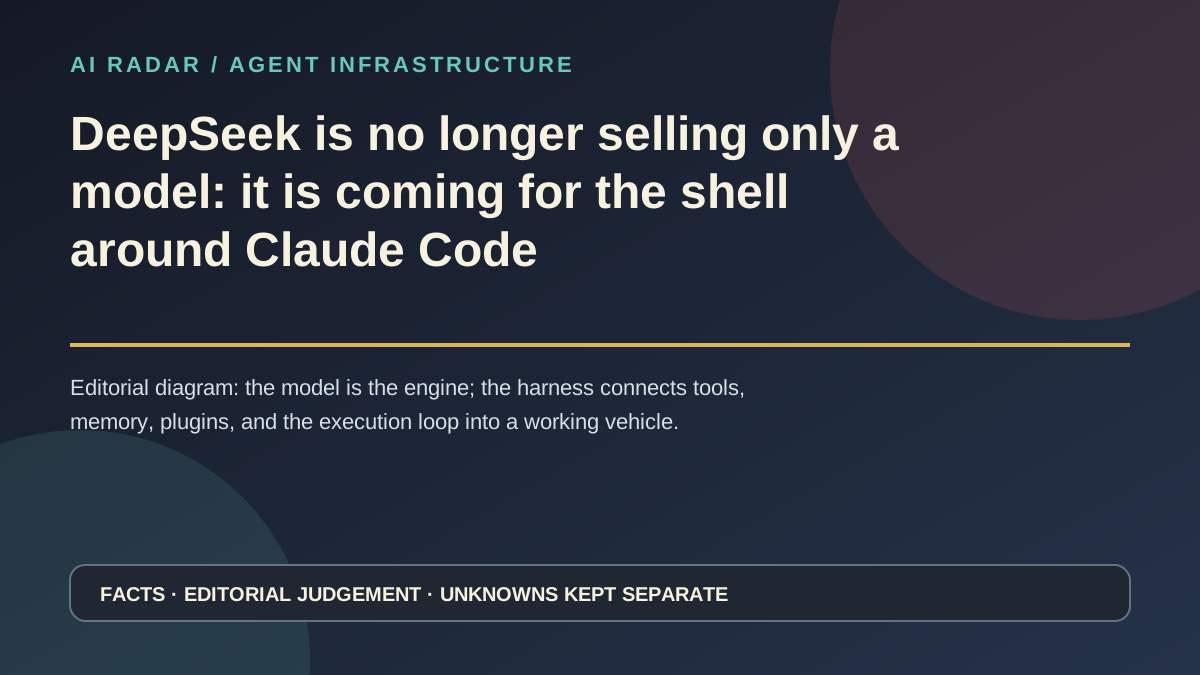
DeepSeek Harness is an open-source agent harness from DeepSeek AI with roughly 167k GitHub stars; it remains a developer preview, but shifts competition from what a model can think to whether an agent can finish work.
The bottom line
DeepSeek finally doesn’t just sell “brains”: it starts making its own Agent “shell”.
DeepSeek Harness (dsh) is DeepSeek AI's open-source agent harness. The GitHub page currently shows about 167,000 stars and 17,900 forks. Its core slogan is not “train a larger model,” but Everything is a Plugin.
The project is still in Developer Preview, and the official directly reminds that there will be changes that will destroy compatibility. But this just shows that DeepSeek is moving from a model supplier to a complete Agent workbench.
Why are model companies suddenly making "shells"?
Claude can become a developer portal not only because the Claude model can write code, but also because Claude Code can read projects, modify files, run commands, and call tools.
OpenAI's Codex is not just a model API, but a workflow that includes terminal, IDE, session, MCP and permissions. Cursor even ties together models, editors, Agent loops, and corporate accounts.
Today’s real competitive formula looks more and more like:
Model × Harness × Tools × Memory × MCP × Agent Loop.
The model determines "whether you can think about it", and Harness determines "whether you can continue to complete it."
Everything is a Plugin, sounds like a slogan, but is actually an architectural choice
DeepSeek Harness takes plug-in as its core, and the warehouse includes Web UI, native running components, plug-in packages, Agent Teams and documentation system. Users can run npx @deepseek-ai/dsh web from npm or build from source.
The benefit of this route is extensibility: model adapters, tools, interfaces, and runtimes can be iterated upon separately. The disadvantages are also clear: Developer Preview means that upgrades may break existing plug-ins, and the documentation and ecosystem have not yet reached the level of stability of Claude Code or Codex.
167,000 GitHub stars do not mean 167,000 production users
GitHub stars are a signal of attention, not active users, enterprise customers, or actual delivery volume. It shows that developers are willing to watch and participate, but it cannot directly prove that DSH can replace mature Agent tools.
This is also the inversion that should be retained in the article: the more popular the project, the more important it is to distinguish between "everyone wants to see it" and "everyone uses it to work on every day."
Our judgment: DeepSeek may not be trying to grab model orders
If DeepSeek only sells APIs, it will always be dependent on other companies’ entry points; if it owns Harness, it can put models, tools, plug-ins, memory and usage data into the same cycle.
This is not a regular GitHub tool release, but DeepSeek’s answer to the next phase of the AI race: The model is just the engine, the Agent harness is the entire car.
Ordinary users don’t have to rush to migrate now. Developer Preview is more suitable for developers and ecological observers; to use it for production, first lock the version, isolate the key, and prepare a rollback path.
What to watch
- Whether DSH has formed a stable plug-in ecosystem and third-party model adaptation.
- When will the Developer Preview enter a more stable phase of compatibility.
- Can it close the loop on real long tasks, rather than just launching a nice web UI.