DeepSeek Stealthily Updated Again: It Is Genuinely, Refreshingly Good

DeepSeek low-key update delivers an unpretentious triumph of real-world utility. By training out chronic code truncation via self-feedback RL, it democratizes zero-to-one interactive 3D and arcade game creation for non-coders; simultaneously, pruning conversational fluff lowers compute waste, while opening proprietary search APIs at pennies per thousand queries—with two weeks free—proves once again that true frontier progress is measured in human workflow velocity.
DeepSeek just rolled out another stealth update behind everyone's backs.
If you open the official web interface or mobile app right now, the underlying engine has quietly switched across the board to the new V4.1-Flash-1017 build. DeepSeek's official announcement was written with extreme academic restraint, overflowing with snooze-inducing buzzwords like "Pareto efficiency improvements," "self-feedback reinforcement learning," and "Mini-SWE-v2 evaluation harnesses."
But after spending an afternoon putting it through its paces in the terminal and browser, there's only one honest conclusion to draw: this update is genuinely, refreshingly good—especially for non-technical creators and hobbyists who don't want to mess with fragile engineering environments.
What Makes It So Good? It Finally Stopped Abandoning Jobs Halfway
Historically, whenever you asked an AI model to write software—whether Claude or previous DeepSeek builds—the most infuriating quirk was its habit of doing half the job and running away.
You would ask: "Build me a browser-based arcade obstacle racing game." The model would cheerfully spit out 30 lines of basic scaffolding. But right when it reached the critical collision detection, physical inertia, and game loop logic, it would drop a cold, insulting comment:
// 200 lines omitted for brevity. Please integrate your own physics engine and rendering pipeline.
Staring at that half-baked stub felt like ordering kung pao chicken at a restaurant, only for the chef to hand you raw chicken cubes and a bag of peanuts while telling you to "figure out the wok heat at home."
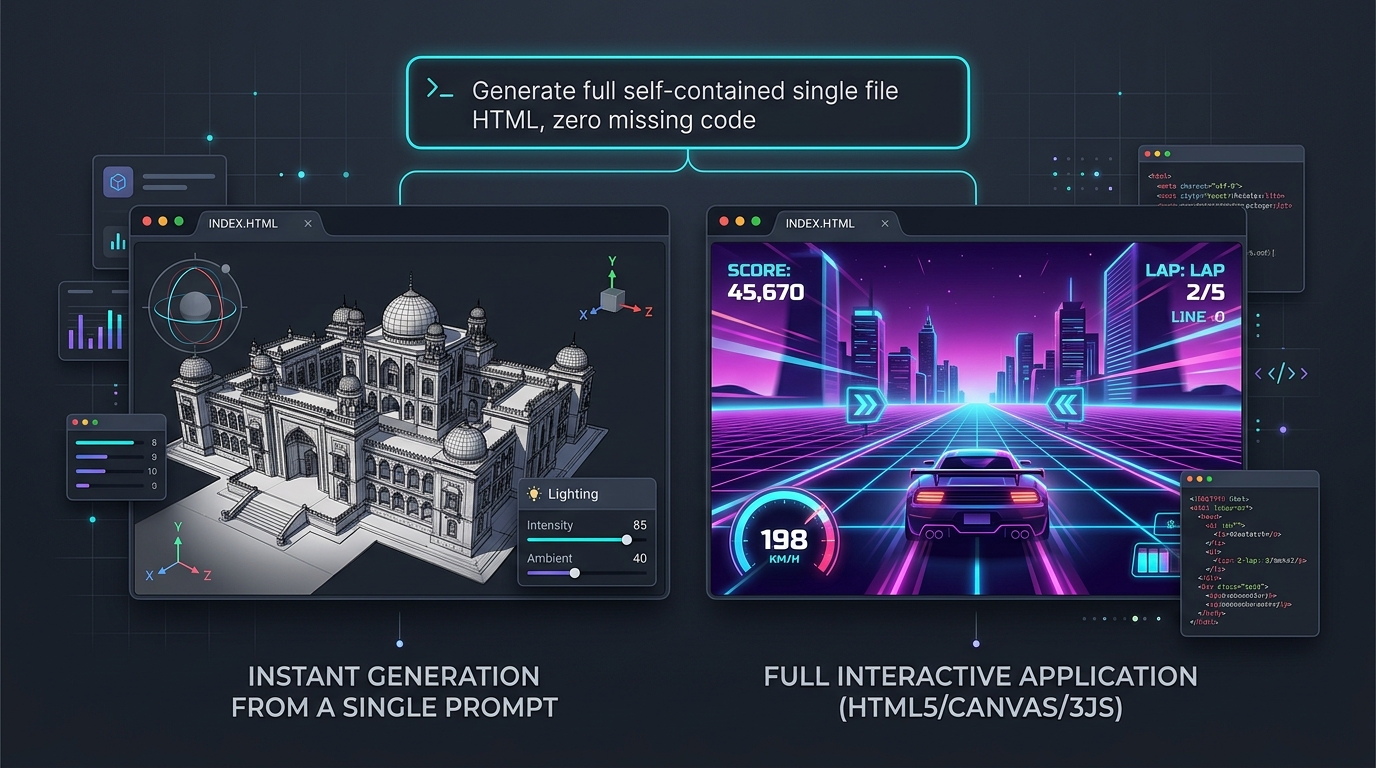
The defining breakthrough of the 1017 release is that it cures this chronic evasion. Through self-feedback reinforcement learning (RL), DeepSeek specifically trained the model to build complete, zero-to-one projects from scratch. You don't need Python, Node.js, or complex toolchains. Type a single concise prompt in the web chat, and it delivers fully self-contained, un-truncated, double-click-to-run code.
3 Copy-and-Paste "Wishful Coding" Prompts for Beginners
You don't need to know a single line of esoteric programming syntax. Open DeepSeek on the web (or in the mobile app), paste any of these three prompt recipes, copy the output into a plain text file, rename the extension to .html, and double-click to run it instantly in your browser:
1. Instant 3D Interactive Showroom in Your Browser > Copy this exact prompt: > "Please write a single-file HTML + Three.js application from scratch that opens directly in any browser upon double-clicking. Requirements: A rotating center pedestal, realistic studio lighting, and smooth camera orbit controls (click and drag to rotate 360 degrees). In the upper right corner, add a semi-transparent floating control panel that toggles between three ambient lighting modes (Warm Gold, Cool Cyan, and Cyberpunk Neon Purple). All visual elements must be rendered entirely via code with zero TODOs or truncated stubs. Return only working code."
2. The Ultimate Break Time Toy: A Complete Arcade Racing Game > Copy this exact prompt: > "Write a standalone, single-file HTML5 Canvas arcade racing game. Requirements: Use arrow keys to steer the car, animated road lane markers to simulate high-speed motion, randomly spawning road hazards and score coins. Display current speed and score in the top-left corner. When crashing into an obstacle, show an elegant frosted-glass game over modal and allow pressing spacebar to restart immediately. All graphics and collision logic must be drawn dynamically with native Canvas APIs without external assets."
3. A Minimalist Habit Tracking Dashboard > Copy this exact prompt: > "Build a sleek, dark-mode personal habit tracker inside a single HTML file. Requirements: Allow adding new habits, clicking checkboxes to mark them done, auto-saving data in browser LocalStorage so nothing is lost on refresh, and rendering a real-time Canvas bar chart showing completion trends over the past 7 days. Deliver a fully self-contained HTML file that runs locally with zero build tools."
Previously, frontier models would choke, crash halfway, or hallucinate missing libraries. With the 1017 update, a single conversational turn routinely produces a polished, playable prototype.
Less Fluff, Faster Generation, Lower Compute Bills
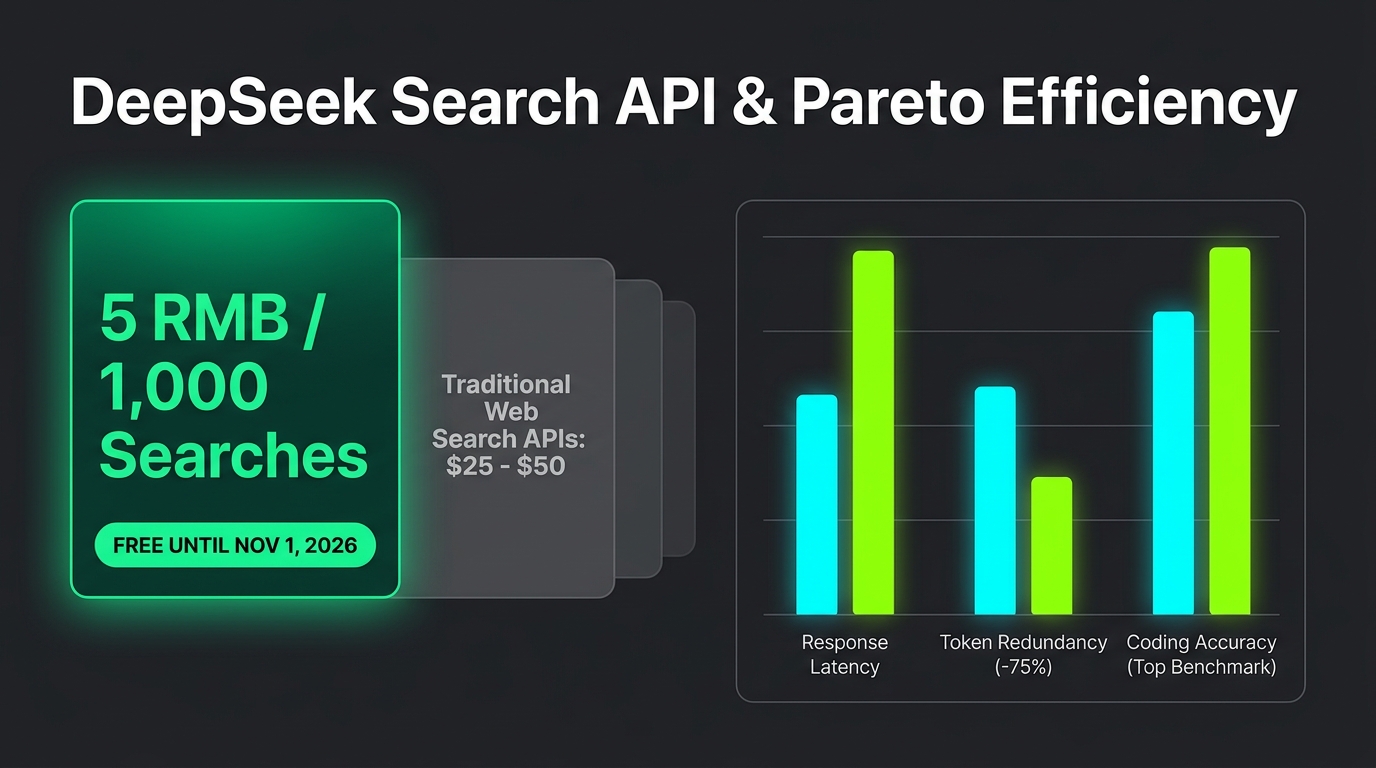
The official bulletin touted a "Pareto improvement in performance and cost." In plain terms, that means two concrete benefits:
1. Drastically Less Fluff: Older models loved opening every response with generic, sycophantic pleasantries ("Certainly! That is a brilliant and imaginative concept. As an AI assistant, I would be delighted to..."). That didn't just waste your time; in API environments billed per token, it was quietly burning your money. The 1017 release ruthlessly trims the filler, getting straight to execution with shorter outputs and noticeably faster token streaming. 2. Cheaper Compute Cycles: Task execution time and redundant context length are squeezed simultaneously. In automated agent environments like DeepSeek Harness or Tencent CodeBuddy, complex multi-file tasks that previously required five trial-and-error reasoning loops now converge in one or two iterations, cutting developer wait time in half.
The Overlooked Treasure: Open Search API, Free for Two Weeks!
Tucked away at the bottom of the release notice was a move with massive industry implications: DeepSeek has officially opened its proprietary, multi-billion-page search engine as a public API (the /search and /fetch endpoints).
Historically, connecting an LLM to live web data using commercial search APIs like Google Custom Search, SerpAPI, or Tavily cost anywhere from $5 to $15 per thousand queries—making automated web scraping painfully expensive for indie builders.
DeepSeek's new search API slashes that cost to 5 RMB per 1,000 queries (roughly $0.70 USD per thousand, or less than a tenth of a cent per search). Even better, their crawler explicitly filters out SEO spam farms and low-quality AI-generated content mills, returning significantly cleaner grounding data.
And here is the immediate bonus: If you use DeepSeek through coding agents or the DeepSeek Harness environment, the Search and Fetch endpoints are completely free and unbilled until November 1, 2026. Anyone looking to conduct market research, scrape technical documentation, or assemble automated intelligence workflows should exploit this two-week free window immediately.
Takeaways
Don't let the dense academic terminology mislead you. This DeepSeek release is about making frontier AI tangibly, immediately useful: * For everyday users: No environments to configure. Take these prompts to the web interface and build 3D toys and games in seconds; * For working developers: Less filler talk, faster inference, and no more half-implemented code stubs; * For tool builders: A clean 5 RMB/1k search API with two weeks of free unlimited testing.
Before wrapping up work today, open the DeepSeek chat, paste the arcade racing game prompt, and watch what happens. You'll quickly see that the model has turned a genuine corner.