Google AI Studio Gemini Free API Guide: 1,500 RPD, 1M Context, and Setup Guide
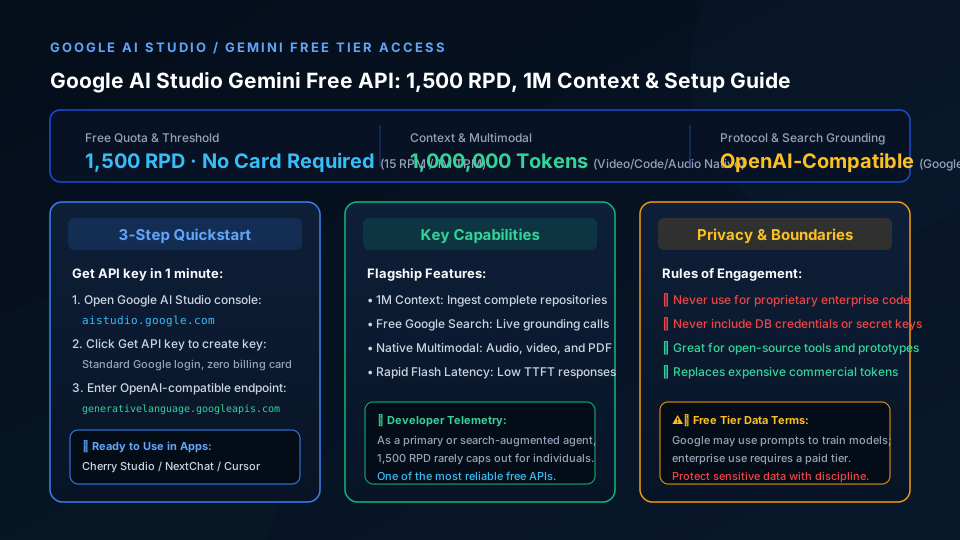
In September 2026, Google AI Studio continues to offer the industry's most generous zero-card free tier: 1,500 daily requests (RPD), 15 RPM, 1M TPM, and a 1M token context window for Gemini 2.5/1.5 Flash with native Search Grounding. The official OpenAI-compatible endpoint drops into any third-party client. However, free tier interaction data is logged for Google model training; proprietary commercial assets must remain strictly excluded.
# Google AI Studio Gemini Free API Guide: 1,500 RPD, 1M Context, and Setup Guide
Conclusion
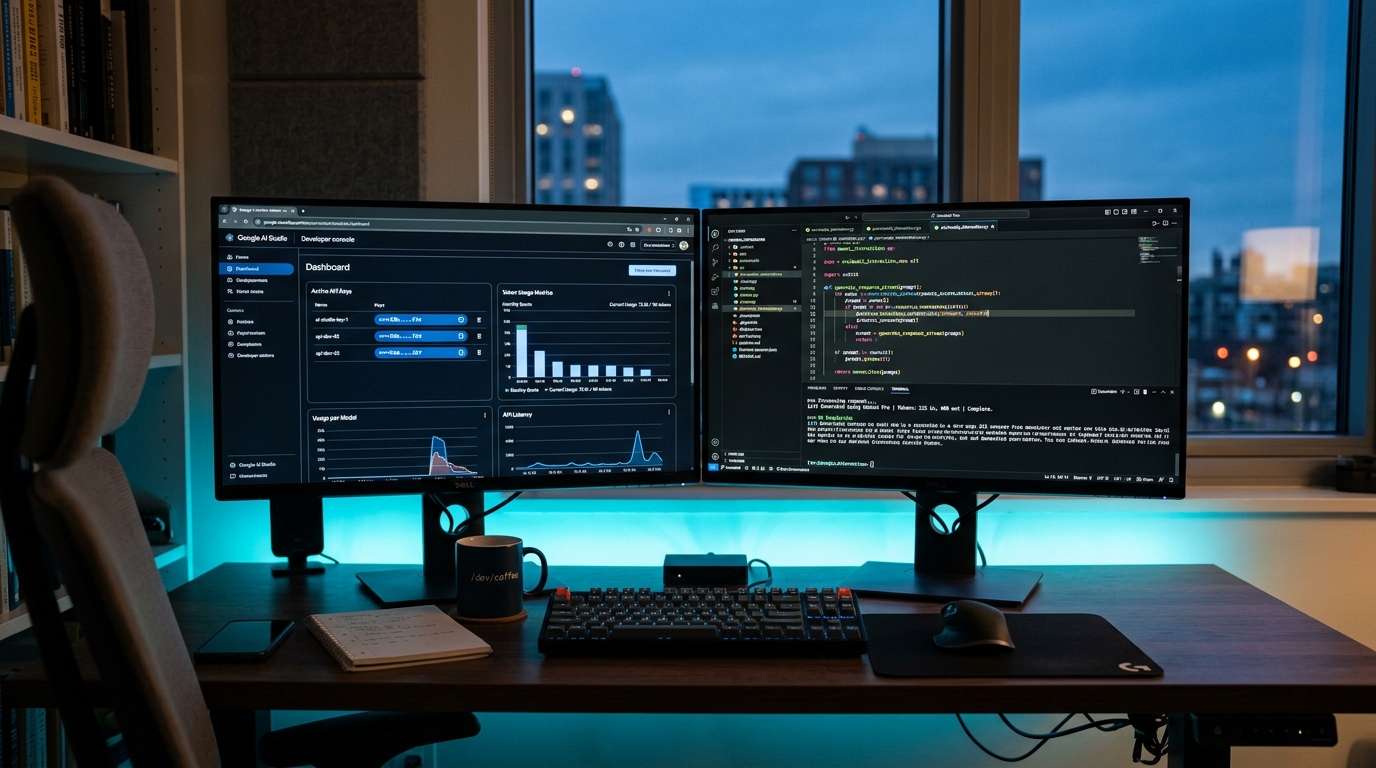
In September 2026, against a backdrop of escalating enterprise billing meters across commercial frontier model providers, Google's developer portal, Google AI Studio (Gemini API Free Tier), stands out as one of the largest, most dependable, and genuinely zero-card official compute pipelines available globally:
- Zero Financial Barriers and No Credit Card Required: No overseas credit cards, foreign billing addresses, or pre-authorization deposits are required. Developers simply log in with a standard Google account to generate a production API key;
- Abundant Daily and Minute-Level Quotas: The official free tier supplies an impressive 1,500 requests per day (RPD), a rate limit of 15 requests per minute (RPM), and an expansive throughput limit of 1,000,000 tokens per minute (TPM);
- Million-Token Context Window and Native Multimodality: Free access extends to Gemini 2.5 Flash and Gemini 1.5 Flash, delivering a full 1,000,000 token (one million) context window capable of ingesting entire multi-repository codebases, multi-hour audio recordings, full video files, and dense scanned PDF documents;
- Native Real-Time Google Search Grounding: Developers can enable native Search Grounding to pull live factual data and citations straight from Google Search without paying for auxiliary web search proxy services;
- Native OpenAI Protocol Compatibility: By configuring a standardized Base URL, this key drops seamlessly into any modern third-party client or development environment, including Cursor, Cline, Cherry Studio, and NextChat;
- The Fundamental Privacy Trade-Off: Under the official free tier terms of service, Google explicitly states that interaction prompts, uploaded files, and synthesized responses may be logged and reviewed to improve future models and AI services.
For independent software developers, open-source contributors, university researchers, and engineers seeking free AI compute for prototyping, paper reading, or automated terminal scripting, this free pipeline satisfies over 90% of everyday operational demands. However, proprietary trade secrets, enterprise corporate codebases, and private user credentials must never be routed through this free endpoint.
---
What Happened
Across the commercial artificial intelligence landscape, provisioning continuous API capacity has historically demanded significant financial overhead. Leading commercial providers like OpenAI and Anthropic routinely charge upwards of several dollars to tens of dollars per million tokens on their flagship models, while enforcing stringent billing audits and regional payment card restrictions.
At the same time, third-party reverse proxy aggregators frequently suffer from abrupt outages, hidden context stripping, or suspicious privacy violations. In sharp contrast, Google AI Studio—operated directly as Google's premier first-party developer portal—has maintained an aggressively subsidized zero-cost tier since its inception.
Software developers running local desktop clients like Cherry Studio, ChatBox, and NextChat confirm that through continuous months of automated translation, code synthesis, and deep research tasks, everyday workloads comprising hundreds of calls per day never trigger sudden quota freezes or queue degradation, with network response latencies consistently settling under one second.
---
3 Quick Steps: How to Generate and Connect Your API Key in 1 Minute
The setup procedure requires no specialized cloud SDK installations and can be completed in three direct steps:
Step 1: Log in to the Console and Create Your API Key
Navigate to the official Google AI Studio developer console in your web browser (aistudio.google.com) and sign in using your standard Google credentials:
- Click Get API key located in the primary left-hand navigation sidebar;
- Click Create API key, selecting an existing or default initial Google Cloud project container;
- The interface immediately generates a unique API key string prefixed with AIzaSy; copy and store it securely in your local environment.
Step 2: Configure Third-Party Clients Using the Official OpenAI Compatible Endpoint
Most open-source developer tooling—such as Cherry Studio, Cline, Cursor, and NextChat—features built-in support for OpenAI-style API specifications. Google officially provides a dedicated compatibility endpoint:
- API Base URL:
``text
https://generativelanguage.googleapis.com/v1beta/openai/
`
- API Key: Paste your generated AIzaSy... secret key;
- Model Identifier: Specify gemini-2.5-flash or gemini-1.5-flash`.
Step 3: Verify Connectivity with a Single Terminal Command
Open your terminal emulator and issue a standard curl request to verify end-to-end connectivity:
``bash
curl "https://generativelanguage.googleapis.com/v1beta/openai/chat/completions" \
-H "Authorization: Bearer YOUR_GEMINI_API_KEY" \
-H "Content-Type: application/json" \
-d '{
"model": "gemini-2.5-flash",
"messages": [
{"role": "system", "content": "You are a concise programming assistant."},
{"role": "user", "content": "Output a one-line Python snippet for the Fibonacci sequence."}
]
}'
``
Within 500 milliseconds, the console receives a structured streaming JSON response payload, confirming complete operational readiness.
---
Benchmark Observations: 1M Context, Multimodality, and Search Grounding in Practice
In real-world engineering workflows and production environments, Google AI Studio's free Gemini API delivers three distinct operational capabilities:
1. Ingesting Millions of Tokens Without Degradation
Gemini Flash features an expansive 1,000,000 token context depth. During hands-on evaluations, uploading a compressed archive containing an entire multi-file frontend project or feeding an exhaustive 400-page English computer science textbook directly to the model resulted in a complete semantic index within approximately ten seconds. The model answered obscure cross-chapter inquiries accurately without suffering from common "needle-in-a-haystack" degradation or forgetting early system instructions.
2. Zero-Cost Native Google Search Grounding
When the googleSearch tool parameter is enabled during invocation, queries regarding real-time sports results, financial events, or breaking news automatically activate Google's internal retrieval pipeline:
- The model formulates targeted search terms internally;
- Google's web index delivers curated high-relevance source passages;
- The model synthesizes an objective, verifiable answer complete with grounded citation references.
Compared to third-party web scraper plugins, native Search Grounding exhibits significantly lower round-trip latency and filters out low-quality SEO farms automatically.
3. Native Multimodal Audio and Long-Form Video Processing
The free tier allows developers to transmit hour-long technical lectures, recorded conference meetings, or screen-recorded software bug walkthroughs via the File API. The model isolates speaker action items accurately and identifies the precise minute and second an error dialog box flashed across the screen.
---
The Hidden Cost and Safety Boundaries
Free frontier infrastructure is always anchored in deliberate business economics. Before deploying Google AI Studio's free tier into your everyday toolchain, developers must evaluate three vital guardrails:
1. The Critical Data Boundary Between Free and Paid Tiers
Google's official *Gemini API Terms of Service* clearly demarcate usage categories: - Free Tier: Requires zero billing credentials, but user prompt submissions, uploaded binary files, and synthesized model completions may be logged and inspected by human reviewers and utilized by Google to train and refine future AI models and products; - Paid Tier: Once a billing account is connected and pay-as-you-go billing is active, Google explicitly commits to excluding enterprise customer telemetry from all model training pipelines, backed by standard enterprise compliance standards.
2. Three Non-Negotiable Security Rules
Under this explicit telemetry policy, engineers must maintain rigorous security posture: - Strictly Prohibited for Enterprise Commercial Assets: Proprietary source code, production database schemas, and patent-sensitive algorithms must never touch this free endpoint; - Scrub Credentials from Prompts and Files: Never submit source files or configuration dumps containing active production passwords, database connection strings, or unmasked user identities; - Ideal for Open-Source Contributions and Learning: Algorithm study, reading public technical papers, debugging open-source packages, and generating generic documentation summaries represent completely safe, zero-risk workflows.
3. Best Practices for Avoiding HTTP 429 Rate Limits
While the 1,500 daily request ceiling is generous, the 15 RPM (requests per minute) rate limit represents an active constraint. When writing automated extraction scripts or batch processing tasks, always implement a minimum 4-second delay between sequential network requests to prevent burst throttling.
---
Our Verdict
Google AI Studio's continued provision of generous free compute represents an intentional strategic strategy: leveraging Google's massive custom TPU infrastructure to outmaneuver competitors and capture the global developer mindset.
While OpenAI and Anthropic erect expensive subscription paywalls, Google delivers 1,500 daily requests with zero card verification, habituating millions of working engineers and indie hackers to Gemini's speed, context window, and multimodality. This strategy of exchanging raw compute for developer ecosystem retention and model alignment data will not be dismantled in the near term.
For individual engineers, respecting data privacy rules while pairing Google AI Studio alongside AMD Token Factory and OpenCode Zen creates a completely zero-cost, multi-model AI engineering environment capable of handling every development need.
---
What to Watch Next
- Potential Quota Tightening on Next-Gen Architectures: As Gemini 3.0 generation models roll out, whether Google introduces stricter concurrency throttles or reduces the 1,500 RPD allocation warrants ongoing observation;
- Separate Pricing for Search Grounding: While search retrieval is bundled into the free tier currently, whether Google unbundles Search Grounding into a paid consumption add-on similar to Google Custom Search API remains an open question;
- Global Routing and Network Reliability: Because connecting to Google AI Studio requires access to supported overseas routing zones, long-term connection latency and stability across diverse ISP backbones should be monitored continuously.