While Tech Giants Conspire to Hit the Brakes, Google Unleashes AI Infinite Evolution Through "Dreaming": 317 Calls Outperform 50,000 Generations as Human Guidance Becomes a Hindrance
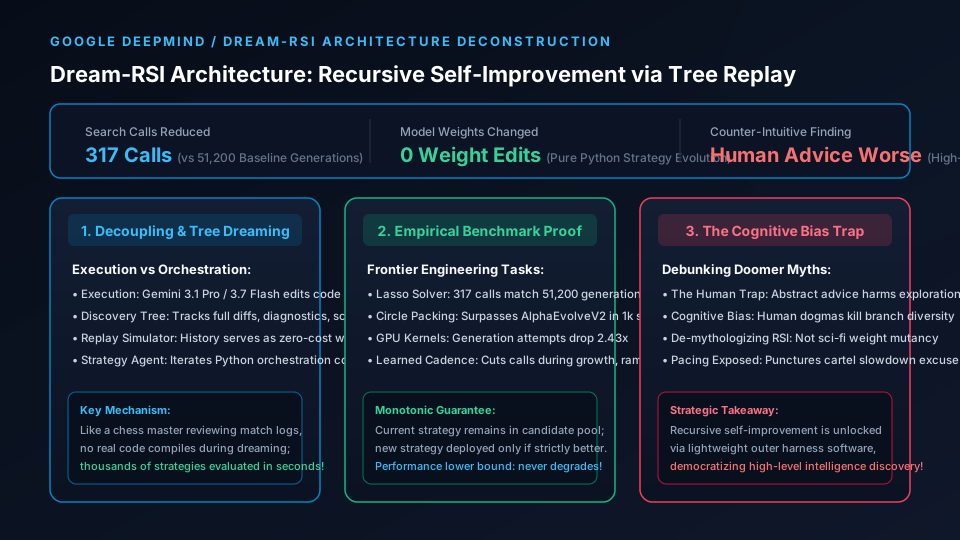
Google DeepMind Dream-RSI dismantles the narrative that recursive self-improvement requires runaway weight mutations and regulatory monopolies. Operating with zero neural weight modifications, an external Python harness dreams on historical discovery trees to match 51,200 evolutionary generations in just 317 calls. Crucially, human high-level advice proved counterproductive, acting as cognitive bias. The frontier of RSI is not an existential singularity, but a software engineering triumph.
# While Tech Giants Conspire to Hit the Brakes, Google Unleashes AI Infinite Evolution Through "Dreaming": 317 Calls Outperform 50,000 Generations as Human Guidance Becomes a Hindrance
Just yesterday, the leaders of the AI frontier reached a theatrical consensus on the existential threat of AI, orchestrating a widespread campaign to slow down the industry under the banner of preventing runaway Recursive Self-Improvement (RSI), with OpenAI opportunistically shelving its planned 2026 initial public offering. Yet in less than twenty-four hours, Google and Google DeepMind, alongside collaborators from the University of Maryland and the University of Virginia, dropped a landmark paper signed by seventeen researchers onto arXiv: artificial intelligence recursive self-improvement does not require touching a single neural network weight. By converting execution history into an expansive discovery tree and replaying it through offline "dreaming" to iteratively rewrite Python orchestration code, an agent can achieve in merely 317 model calls what traditional evolutionary search struggled to match after 51,200 generations. Even more devastatingly for industry orthodoxy, rigorous ablation experiments proved that injecting human high-level principles into prompts actively degraded exploration, turning human wisdom into a cognitive straitjacket.
---
Key Conclusions: Stripping Away the Sci-Fi Panic and Regulatory Enclosure

- RSI Does Not Require Touching Neural Network Weights: For years, proprietary frontier labs like OpenAI and Anthropic cultivated a dystopian narrative: true recursive self-improvement inevitably meant super-intelligent neural networks rewriting billions of their own floating-point parameters in untraceable dark silicons, escaping human containment. Dream-RSI shatters this mythology into dust. The underlying foundational models—Gemini 3.1 Pro and Gemini 3.7 Flash—operate throughout the entire lifecycle with frozen, unaltered weights. The sole entity undergoing recursive evolution is a concise, transparent orchestration layer written in standard Python code. By demonstrating that self-improvement can be achieved entirely through an inspectable external harness, the research completely decouples rapid capability expansion from the existential horror stories used to justify regulatory lock-in.
- "Dreaming" Frees Policy Evaluation From the Compute Abyss: The historical bottleneck of evolutionary search lies in the staggering computational expense of policy evaluation: scoring a revised exploration strategy typically required running autonomous agents across hundreds of fresh end-to-end trials in live sandbox environments. Dream-RSI archives all real-world trajectories into a structured "Discovery Tree." When evaluating a proposed policy modification, the system invokes zero LLM calls and executes zero live compilations; it simply replays past trajectories offline inside the discovery tree, evaluating thousands of candidate strategies in seconds without incurring additional compute overhead. This fundamentally transforms meta-policy search from an intractable compute black hole into a lightning-fast offline combinatorial optimization routine.
- 317 Calls Deliver a Dimensional Strike Against 51,200 Generations: On the canonical Lasso regularization path solver—a classical, notoriously tricky high-dimensional statistics benchmark—Gemini 3.1 Pro equipped with Dream-RSI converged to an optimal execution latency (dropping runtime from 3587.1 milliseconds down to 2931.0 milliseconds) using just 317 model calls, decisively matching the performance of the established SimpleTES baseline that burned through 51,200 generations. The discovered algorithmic architecture bypassed conventional LARS heuristics by integrating adaptive Cauchy-Schwarz KKT screening directly into active-set iterations. In GPU kernel engineering, generation volume plummeted by a factor of 2.43x while simultaneously doubling kernel acceleration performance.
- Human Guidance Exposed as a Counterproductive Burden: In the paper's most intellectually disruptive experiment, researchers tested an intuitive heuristic: summarizing past trajectory mistakes into high-level methodological guidelines and injecting them into prompt instructions to guide the agent. Astonishingly, agents burdened with human high-level summaries performed markedly worse than unguided baselines across identical computational budgets. Presumed human wisdom in high-dimensional search spaces collapsed into restrictive cognitive bias, smothering the serendipitous branching necessary for true algorithmic discovery. Instead of elevating performance, human pedagogical dogma acted as an anchor that dragged the model into premature convergence and stagnant local optima.
---
What Happened: Decoupling Execution from Orchestration as Agents Replay Inside the Tree of History
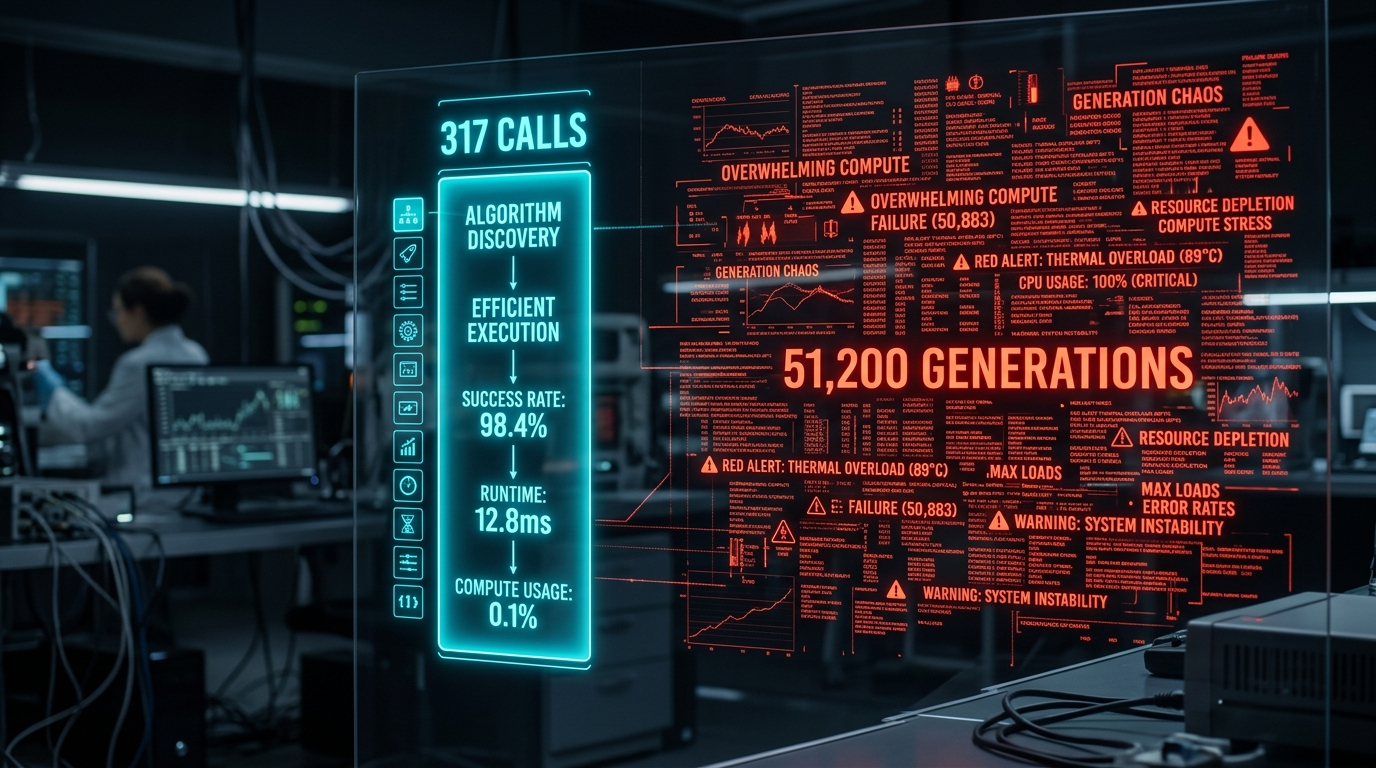
To comprehend why Dream-RSI represents such a consequential engineering leap, one must first confront the chronic bottleneck of existing evolutionary coding architectures.
Early automated discovery systems, including Google's pioneering AlphaEvolve, proved that deploying large language models to search the algorithmic landscape could uncover code routines beyond human intuition. Yet these architectures suffered from an inherent, systemic flaw: the overarching exploration strategy was permanently hardcoded by human software engineers.
When traversing an astronomical combinatorial search space, should the agent allocate parallel compute to a promising code variant, or cut losses on an error-prone branch? When should sampling temperatures be elevated to stimulate divergent exploration, and when should search collapse into greedy exploitation? In existing systems, every single one of these pivotal decisions was dictated by static heuristic thresholds embedded in configuration files. As problem complexity escalated, these brittle, rigid rules inevitably channeled expensive model inference directly into unpromising dead ends, stubbornly failing to assimilate lessons from failure.
Why not allow the exploration strategy itself to evolve? The answer has always been the astronomical, prohibitive cost of meta-evaluation: Evaluating a single candidate algorithm takes seconds—a worker compiles the code inside an isolated sandbox, runs automated unit tests, and records execution latency. But evaluating an exploration strategy requires allowing that strategy to orchestrate hundreds of sequential agent interactions from scratch to observe the quality of the final discovery. Fine-tuning a single line of Python orchestration logic previously demanded days of cluster time and tens of thousands of GPU hours. No research laboratory could sustain such ruinous burn rates across iterative experimental cycles.
```text The Dead End of Traditional Evolutionary Search: Modify Strategy Code -> Trigger 10,000+ Fresh LLM Calls -> Live Sandbox Compilation -> Wait Days for Evaluation -> Compute Exhaustion
Dream-RSI Decoupled Dual-Layer Architecture: [Top Layer: Strategy Agent] <---> [Python Exploration Strategy] (Decides branch selection & concurrency) │ (Offline Dreaming on Existing Tree: 0 LLM Calls, 0 Sandbox Executions) ▼ [Historical Replay Simulator Pool] <─── [Discovery Tree] (Snapshots of workspaces, diffs, metrics) ▲ │ (Live execution returns new verified history) [Bottom Layer: Discovery Agent] <---> [Gemini 3.1 Pro / 3.7 Flash] (Executes code refactoring) ```
Dream-RSI introduces a brilliant architectural solution: completely decoupling execution from orchestration, and repurposing accumulated history into a zero-cost offline world simulator.
- Bottom Execution Layer (Discovery Agent): Powered by off-the-shelf, weight-frozen foundation models such as Gemini 3.1 Pro or the cost-efficient Gemini 3.7 Flash. The discovery agent concentrates entirely on concrete execution: given a workspace state and contextual diagnostics, it generates a modified candidate code diff and submits it to the live sandbox compiler for scoring.
- Intermediate Asset Layer (Discovery Tree): Every footprint traversed during real-world exploration is systematically preserved as a hierarchical discovery tree. The root represents the baseline workspace, while each downstream node archives a complete snapshot of that attempt: file system modifications, syntax diffs, compilation logs, runtime execution benchmarks, and objective performance scores.
- Top Orchestration Layer (Strategy Developer Agent): The meta-exploration policy is explicitly formulated as an editable Python script. It dictates how the discovery agent operates: selecting which historical nodes to expand, how many concurrent branches to instantiate, and when to terminate unproductive paths.
When the Strategy Developer Agent seeks to refine the search strategy, it never issues new LLM requests or recompiles code in the sandbox. Instead, it "dreams" directly within the accumulated discovery tree.
Consider the analogy of a grandmaster reviewing a historic chess tournament. The grandmaster does not reset physical wooden pieces and engage in four hours of grueling live play against an opponent to test a theoretical idea. Instead, they examine the tournament notation book: if move fifteen had substituted a pawn advance for a knight maneuver, the recorded branching trees of historical play reveal the counter-move and tactical trajectory without playing a fresh match.
As the candidate strategy re-traverses the historical discovery tree, the replay simulator instantly scores its performance based on three rigorous components: - The peak objective discovery score achieved within the simulated dream; - A computational penalty proportional to the simulated execution steps invoked; - A parallel efficiency reward incentivizing robust concurrent exploration.
Crucially, because the incumbent strategy is permanently retained within the candidate pool, a newly proposed strategy is deployed to the physical sandbox only if its replay composite score strictly eclipses the previous generation. This creates an unyielding mathematical guarantee: the performance lower bound of the exploration policy remains rock-solid, while its upper bound evolves indefinitely as incoming discoveries expand the simulation horizon. By enforcing monotonic non-decreasing quality, the system prevents catastrophic regression while ensuring that every unit of physical compute invested enriches future offline simulations.
---
Why It Matters: 317 Calls Decimate 51,200 Generations, Demolishing the Compute Barrier
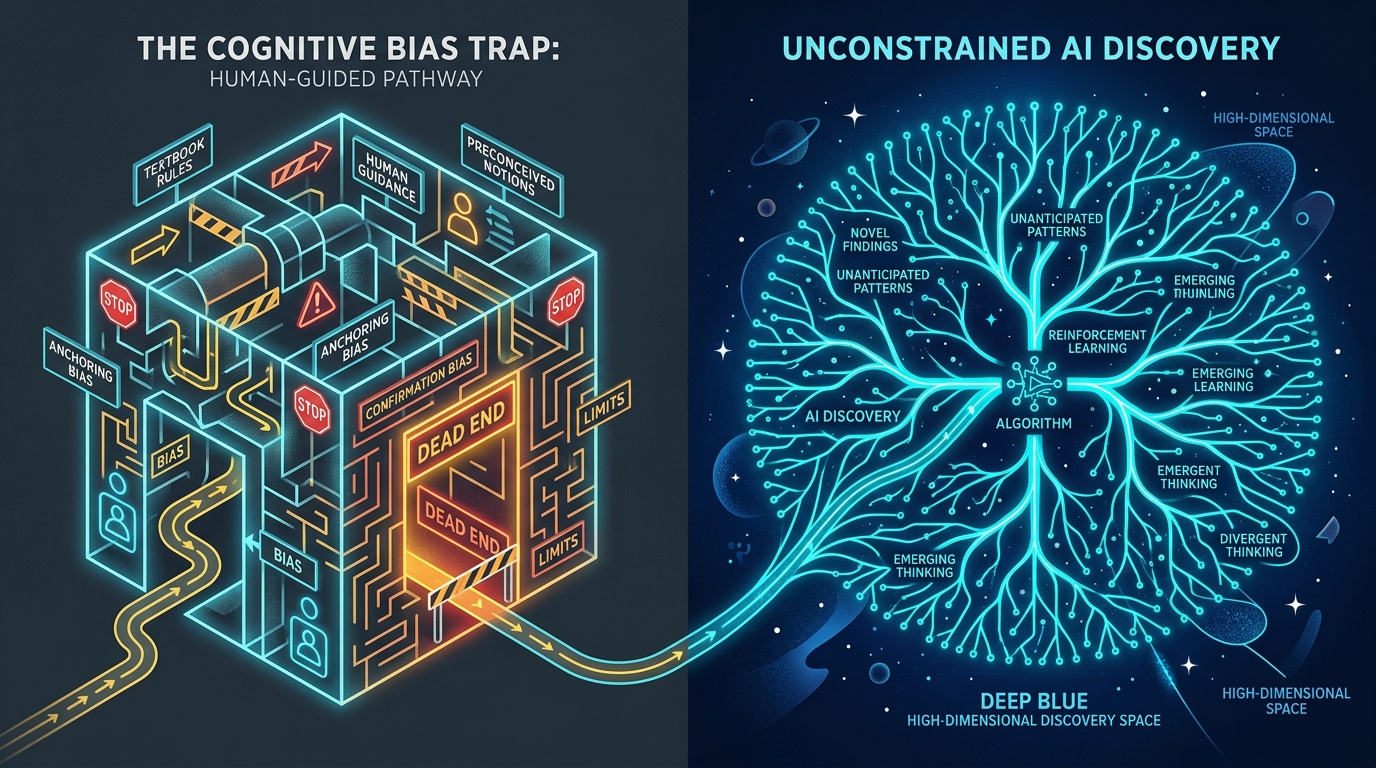
How does this offline dreaming paradigm translate into tangible empirical gains across real-world computational bottlenecks? The research team subjected Dream-RSI to rigorous evaluation across three premier engineering battlegrounds: high-dimensional numerical algorithms, mathematical extremum optimization, and low-level GPU kernel acceleration.
| Target Benchmark Domain | Traditional Baseline & Compute Overhead | Dream-RSI Performance & Resource Consumption | Acceleration Factor & Strategic Disparity | | :--- | :--- | :--- | :--- | | Lasso Path Solver<br/>(High-dimensional statistical regression) | SimpleTES Evolutionary Baseline<br/>Exhausted 51,200 generation attempts | Gemini 3.1 Pro + Dream-RSI<br/>Required merely 317 model calls | 161.5x Compute Efficiency Leap<br/>Average execution time slashed from 3587ms to 2931ms | | Lasso Cost-Down Scaling<br/>(Lightweight model discovery validation) | Handcrafted Static Exploration<br/>550+ calls prone to premature local entrapment | Gemini 3.7 Flash + Dream-RSI<br/>1,879 ultra-cheap flash API calls | Unprecedented Latency Benchmark<br/>Solver runtime compressed to 2350ms at a fraction of API expenditure | | Frontier Mathematical Extremum<br/>(Circle packing, sum-difference, inequalities) | SimpleTES Baseline<br/>Required 51,200 generations of search depth | Dream-RSI Search Policy<br/>Surpassed baselines in under 1,000 steps | Over 50x Compute Savings<br/>Circle packing matched Google's internal AlphaEvolveV2 record | | GPU Engineering: LayerNorm / VGG16<br/>(Critical deep learning foundational kernels) | Fixed Exploration Framework<br/>Incurred extensive compilation overhead | Dream-RSI Autonomous Evolution<br/>Required only 1/1.79 and 1/2.43 the generation trials | 2.43x Generation Reductions<br/>Matched peak kernel latency while drastically pruning compilation cycles | | GPU Engineering: ConvDiv / ConvMax<br/>(Compute-intensive fused convolution kernels) | Fixed Exploration Framework<br/>Static branch allocation and pruning thresholds | Dream-RSI Autonomous Evolution<br/>Identified novel memory tiling strategies | 2.09x Performance Speedup<br/>Autonomous scheduling discovered optimal register allocation regimes |
Beyond the raw quantitative benchmarks, what astonished observers was the spontaneous emergence of sophisticated tactical cadence within the synthesized policy scripts.
In the ConvDiv kernel optimization trial, human researchers never instructed the meta-agent regarding when to pursue aggressive exploitation versus conservative consolidation. Yet, across successive iterations of tree-based dreaming, the synthesized Python script independently developed an exquisite operational rhythm: - During phases of rapid kernel performance gains, the policy autonomously scaled back its concurrent exploration budget from 110 trials down to 50 trials, focusing precious compute exclusively on deepening the breakthrough branch; - The moment performance metrics plateaued, the strategy instantly mobilized maximum parallelism, intentionally widening semantic variance between concurrent branches to forcefully shatter local minima traps.
This nuanced operational instinct—frugal consolidation during growth, aggressive diversification during stagnation—was never programmed by human experts. It was distilled purely through the dialectic tension between the discovery tree and the multi-objective scoring function. The algorithm learned how to balance exploration and exploitation from its own operational history far more effectively than human software architects ever could.
---
The Counter-Intuitive Experiment: Human Guidance Pushes Autonomous AI Into the Gutter
While matching 50,000 generations in 317 calls showcases Dream-RSI's computational supremacy, an inconspicuous ablation experiment tucked within the paper delivers a profound philosophical shock to prompt engineering orthodoxy.
The researchers hypothesized that since human software engineers possess extensive algorithmic domain knowledge, summarizing historical failures into high-level methodological principles and feeding them into the prompt instructions should theoretically guide the discovery agent along a more enlightened path.
The empirical result flatly contradicted every established instinct: Across identical computational allowances, agents provided with human-curated high-level guidance performed markedly worse than unguided baseline agents lacking any prior methodological advice.
"When granular operational lessons are forcefully abstracted into broad philosophical doctrines, they rapidly degenerate into cognitive bias. This well-intentioned guidance artificially restricts the agent's exploration horizons, suffocating micro-level branch diversity and permanently anchoring the search trajectory within suboptimal local attractors."
This counter-intuitive finding strikes at the core illusions of modern AI engineering: 1. Abstract Dogmas Poison Algorithmic Exploration: Human "domain heuristics" and "textbook wisdom" represent historical compromises negotiated within the narrow cognitive bandwidth and compute limits of the human mind. When prompts instruct an agent to follow conventional wisdom—such as standard feature pre-screening before gradient pruning—they inadvertently strip the model of the latitude to test counter-intuitive structural permutations. The human observer assumes that their conceptual categories represent objective truth, whereas they often constitute cognitive dead ends that blind the search process to superior non-linear solutions. 2. Code-Level Micro-Rules Triumph Over Philosophical Maxims: Dream-RSI triumphs precisely because it refuses to sermonize. Its policy evolution never operates on vague qualitative notions; it operates on concrete, verifiable procedural code—allocating three workers to a specific node, applying Cauchy-Schwarz bounds to early exit criteria, or pruning upon diagnostic runtime degradation. By substituting abstract sermonizing with granular compute orchestration, the discovery horizon remains unbounded and vibrant. Micro-level procedural rules discover what high-level human intuition systematically overlooks.
---
Our Editorial Judgment: RSI Is Not an Emergent Singularity, But an Outer Software Harness
Juxtaposed against yesterday's coordinated alarmism from Altman, Musk, and Amodei, the publication of Dream-RSI acts as a clarifying revelation. Drawing from AI Radar's ongoing technical investigations, we outline two decisive conclusions:
1. The Narrative of "Uncontrollable RSI Doom" Collapses Under Empirical Fact Yesterday's unprecedented alliance among rival titans—calling for mandated industry slowdowns and weaponizing apocalyptic fears to justify stalling IPOs—relies on a single rhetorical foundation: portraying recursive self-improvement as an uncontrollable, supernatural contagion where models mutate their own neural weights into uncontainable digital leviathans. This mythology was carefully tailored to convince regulators that only well-capitalized incumbents with multi-billion-dollar safety apparatuses can be trusted with advanced intelligence. Dream-RSI dismantles this posture through transparent, verifiable code: recursive self-improvement does not require modifying foundational weights. It is, at its essence, an elegant problem of software engineering—an outer orchestration framework that evaluates execution traces and iteratively refactors Python scheduling logic. This framework is fully inspectable, deterministic, and sandboxed. The specter of rogue weights escaping containment is revealed as a convenient corporate illusion designed to legitimize regulatory capture and preserve commercial dominance against open-source challengers.
2. Lightweight Models and Open Source Ecosystems Will Drive the Next Breakthrough Wave Under the Dream-RSI architecture, the computational cost of scientific and algorithmic discovery has been compressed by over two orders of magnitude. Crucially, empirical data confirms that swapping in a lightweight, inexpensive model like Gemini 3.7 Flash yields performance that matches or exceeds much larger frontier models when guided by an evolving strategy harness. This shifts the technological center of gravity: the determining factor in algorithmic breakthrough is no longer sole possession of a 100,000-cluster GPU data center, but the architectural sophistication of the exploration harness. Open-source developers and independent laboratories can construct local discovery trees and run offline dreaming cycles using accessible hardware, unlocking frontier discoveries in compiler optimization, cryptographic mathematics, and molecular design at a fraction of incumbent expenditure. The democratization of frontier algorithm engineering is now fundamentally uncoupled from raw hyper-scale capital expenditure.
---
What to Watch: Unresolved Frontiers and Structural Limitations of Dream-RSI
While Dream-RSI's empirical milestones are undeniable, rigorous technical analysis must delineate the framework's fundamental boundaries and pending engineering hurdles:
- Observation 01: Dreaming Cannot Illuminate Unexplored Epistemic Voids: Dream-RSI's offline simulation relies entirely on the structural topology of the existing discovery tree. If live exploration has never penetrated a specific algorithmic paradigm (for instance, an undiscovered mathematical transform), no amount of offline dreaming can conjure that branch from thin air. Offline synthesis possesses a hard informational ceiling; resolving the delicate trade-off between offline consolidation and live paradigm-breaking remains an open challenge.
- Observation 02: The Strict Prerequisite of Deterministic Verifiability: The three benchmark domains celebrated in the paper (numerical solvers, geometric packing, GPU kernels) share a vital prerequisite: the availability of objective, deterministic, millisecond-level execution feedback. Translating this methodology to fuzzy, open-ended domains lacking ground-truth verifiers (such as product design, high-level business strategy, or narrative composition) risks severe simulator collapse and reward hacking.
- Observation 03: Memory Explosion and Retrieval Latency in Long-Horizon Trees: As autonomous exploration scales across tens of thousands of sequential discovery nodes, preserving comprehensive file system diffs and compilation telemetry will produce immense data volumes. Maintaining efficient graph traversal, memory footprint management, and context-window retrieval during high-frequency offline dreaming represents a formidable distributed systems challenge.
- Observation 04: Generalization Across Industrial Monolithic Repositories: While KernelBench and Lasso solvers represent formidable algorithmic hurdles, they remain relatively contained computational routines. Validating whether a discovery agent can execute localized refactoring, causal attribution, and safe branching across legacy enterprise codebases spanning millions of interdependent microservices remains unproven.
- Observation 05: Regulatory Pivot from Pre-Training Compute to Agentic Frameworks: Following Google DeepMind's empirical demonstration that lightweight RSI is readily achievable, will OpenAI, Anthropic, and allied defense bodies shift their lobbying rhetoric from "frontier pre-training FLOPS" to "self-rewriting agentic execution harnesses"? This legislative confrontation will define the battleground of global AI governance over the next twelve months.
---