Gemini is moving into law firms: Google is selling a workflow, not a chatbot
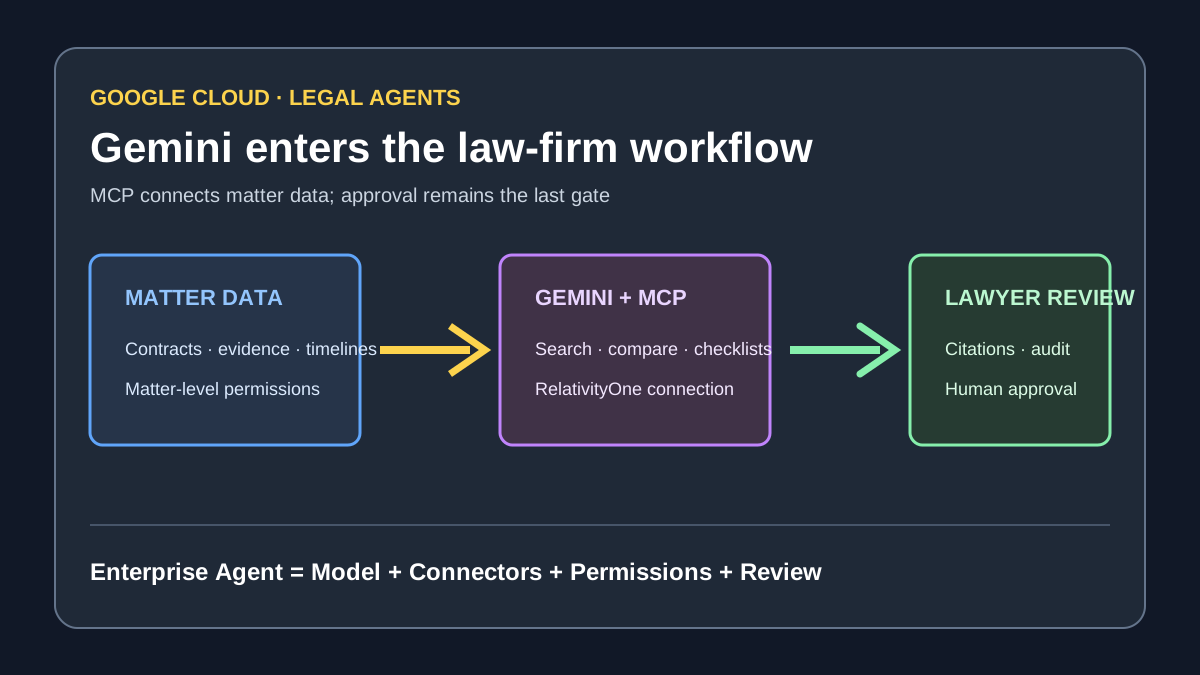
Google Cloud launched Gemini Enterprise for Legal on August 25, positioning Gemini as an Agent workflow product for law firms and corporate legal teams. RelativityOne will connect through MCP, with firms including Weil participating in early partnerships. The shift is from which model answers best to which system can safely connect matter data, retrieval, collaboration and approvals. The announcements establish the product and partnerships, not that legal work is already automated; accuracy, rework and liability data are not public.
Conclusion
Google Cloud launched Gemini Enterprise for Legal today. It is no longer selling only a chatbot that answers legal questions. It is selling an enterprise Agent product meant to connect matter data, retrieval, collaboration and approval workflows.
RelativityOne will connect through MCP, and firms including Weil are early partners. The announcements establish the product path and partnerships. They do not publish accuracy, rework or time-saved data, and they do not answer who is responsible when an Agent makes a legal mistake.
The important shift is that enterprise AI competition is moving from “can the model answer?” to “can the system complete a chain of work inside permissions and audit boundaries?”
What Google actually launched
Google Cloud describes Gemini Enterprise for Legal as a purpose-built solution for global legal organizations to automate complex, end-to-end legal workflows. It is not an isolated chat window; it is meant to connect with the systems, documents and collaboration practices legal teams already use.
The same-day partnerships include:
- RelativityOne integrating with Gemini Enterprise for Legal through MCP;
- Weil partnering with Google Cloud on AI-enabled legal services and early adoption;
- Tribe AI joining the Google Cloud ecosystem for legal and financial services.
The common thread is putting Gemini into an existing workflow rather than asking lawyers to copy all material into a new chat window.
Why MCP is the keyword
MCP can expose tools and data from external systems to a model in a more standardized way. In legal work, the model may need to search matter files, compare versions, produce a checklist, call a knowledge base and hand the result to a human for approval.
But an MCP connection does not create a correct answer by itself. It adds a new risk surface:
- Can the Agent see only the data needed for the current matter?
- Can data from separate clients or matters be mixed?
- Do tool results carry sources and timestamps?
- Can the Agent edit or send a file without approval?
- Can someone reconstruct every tool call after an error?
Legal work ties usefulness to auditability.
The reversal: the competition is workflow capture
Asking whether Gemini can answer a legal question is no longer enough. Enterprises often pay for fewer manual copies, fewer version checks and less document sorting, not for a smarter search box in isolation.
Google's route is therefore model + connectors + permissions + organizational process + human approval. It is the same logic we have seen in coding-agent harnesses: the model is one layer, while the full working system determines the experience.
That also explains the partnership with an incumbent such as Relativity. Where the data lives, how permissions are inherited and how audit records are retained can matter more than a 10% improvement in answer speed.
What legal teams can use first
The safest starting point is not letting an Agent issue final legal advice. Start with bounded, reviewable work:
- find clauses and differences in specified documents;
- organize a matter timeline from a fixed source set;
- create a checklist of documents to verify;
- summarize changes between contract versions;
- return search results with citations for lawyer review.
Before deployment, ask whether matter permissions are isolated, whether answers retain original citations, whether every external action needs approval and whether the full run can be replayed.
Our judgment
Gemini Enterprise for Legal matters not because Google says AI can replace lawyers, but because it moves Gemini into a high-value, permission-heavy and liability-heavy workflow.
If Google can combine MCP connections, enterprise permissions, model quality and human approval, the product may be stickier than a standalone chat app. Legal work will also expose Agent limits faster: an uncited wrong summary can be much more expensive than an ordinary chat mistake.
What to watch next
- Whether Google publishes customer accuracy, rework and time-saved data;
- Which RelativityOne tools the MCP integration exposes and how narrow default permissions are;
- Whether Weil and other early customers are piloting, buying or running it in production;
- How Gemini Enterprise for Legal handles matter isolation, confidentiality and retention;
- Whether regulation and professional liability rules require stronger human approval and audit trails.
Sources and evidence boundary
- Primary source: Google Cloud Press Corner launch announcement;
- Partner announcement: Relativity's MCP integration notice;
- Partner announcement: Weil's AI-enabled legal services partnership;
- This article treats those pages as evidence of the product and partnerships. It does not turn Google's “automate complex workflows” language into a verified production outcome.