Google Drops Nano Banana 2.1: Half-Price, 14-Image Consistency, But How Good Is It Really?
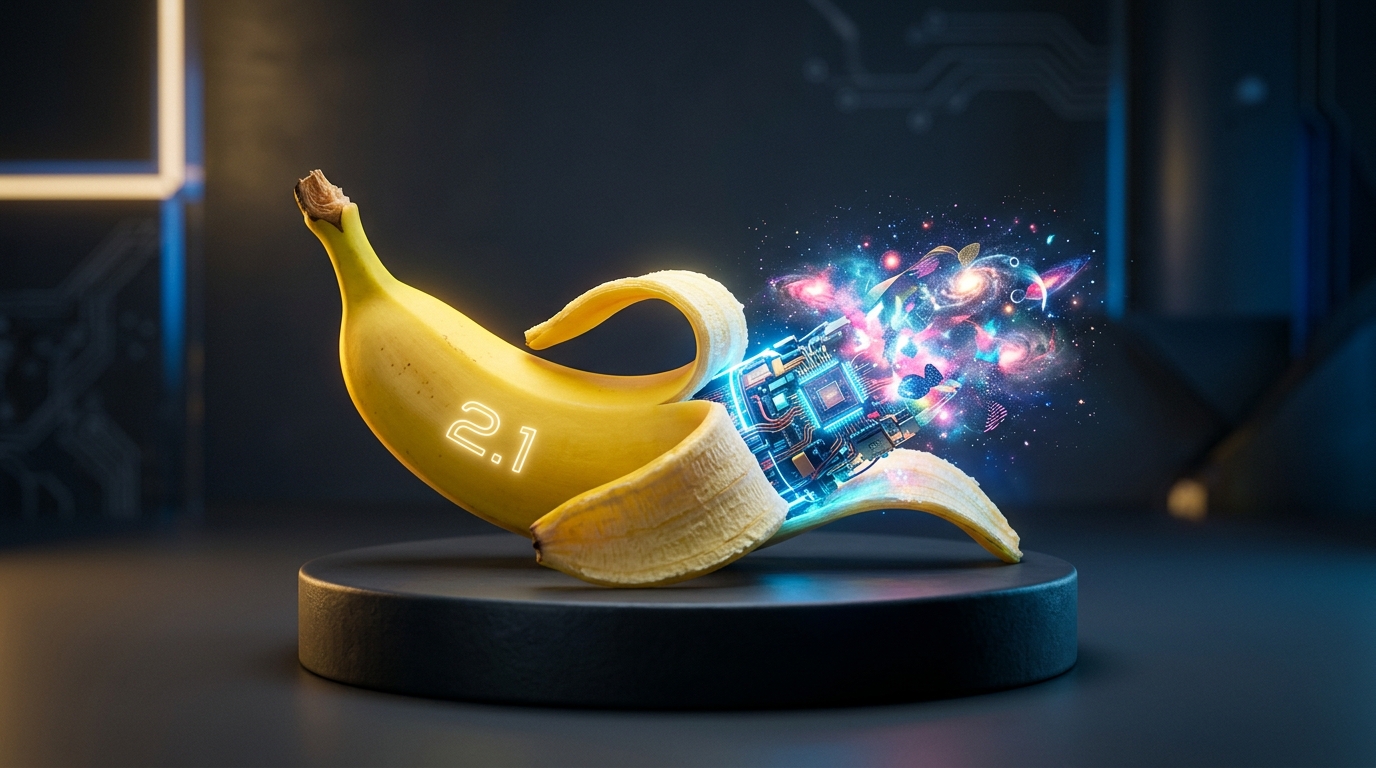
Google quietly released Nano Banana 2.1 powered by Gemini 3.6 Flash, featuring a 50% API price cut, 14-image multi-reference consistency, and surgical mask inpainting; it is not an art wallpaper toy, but an obedient, industrial-grade visual workhorse.
# Google Drops Nano Banana 2.1: Half-Price, 14-Image Consistency, But How Good Is It Really?
If your social feeds and developer group chats suddenly flooded with bananas over the past 48 hours, do not worry: Google has not abandoned artificial intelligence to open a tropical fruit distribution franchise.
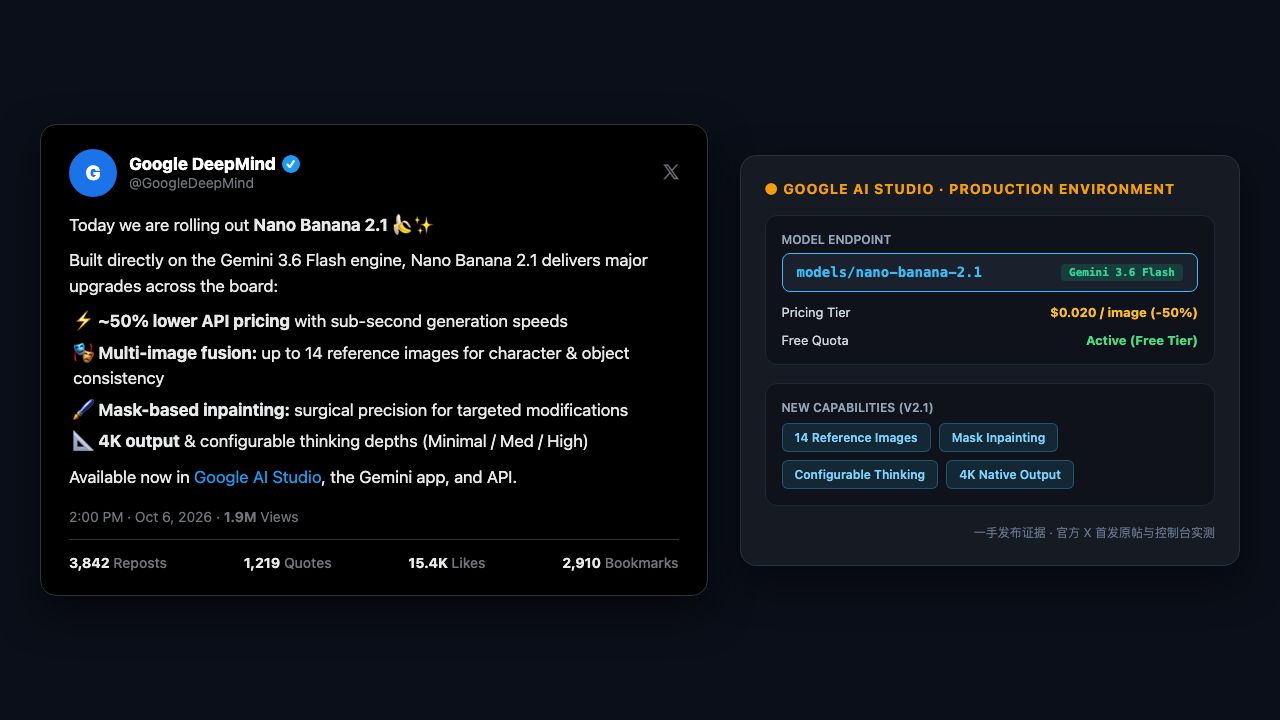
On October 6, 2026, Google DeepMind quietly dropped its next-generation image generation and manipulation powerhouse—Nano Banana 2.1—across Google AI Studio and the Gemini API without advance fanfare.
Despite a lighthearted codename that sounds like an internal joke, this system represents one of the most capable visual foundations currently available. Its predecessor, disguised under Gemini 2.5 and 3.5 Flash engines, famously demolished competitive commercial models in LMSYS Chatbot Arena blind tests while remaining anonymous.
With Nano Banana 2.1, Google has upgraded the underlying core engine directly to Gemini 3.6 Flash.
The technical specifications announced by the lab are unambiguous: sub-second to second-level generation speeds, commercial API inference fees slashed by roughly 50%, and native output support reaching up to 4K resolution. Far more critically, the release introduces two capabilities addressing long-standing pain points for commercial designers and digital creators: multi-image character consistency supporting up to 14 reference photos, and precision mask-based inpainting.
After conducting two days of continuous stress-testing across diverse production workloads, our practical conclusion is straightforward:
This is not a toy built for generating atmospheric desktop wallpapers; however, for practical production workflows—including e-commerce product mockups, comic book storyboarding, precision typography, and marketing assets—it stands as one of the most cost-effective and obedient tools on the market.
Conclusion: Not a wallpaper toy, but an industrial-grade workhorse for designers
Understanding the significance of Nano Banana 2.1 requires clarifying how it differs from aesthetic diffusion platforms such as Midjourney and Flux.
Historically, generative image platforms resembled artistic lottery machines. A user submitted evocative, atmospheric prompts, and the algorithm returned visually arresting compositions drenched in dramatic lighting. Yet whenever a designer introduced precise, non-negotiable commercial constraints, standard diffusion frameworks frequently collapsed:
- "Change this character's yellow trench coat into a black leather biker jacket, but keep the facial features, hairstyle, and ambient lighting completely untouched."
- "Render a modern coffee packaging bag dead center, with 'ARABICA BLEND' legibly printed across two lines with zero typos or gibberish."
Under legacy tools, the former instruction generally caused the character's facial anatomy to be scrambled entirely, while the latter typically generated alien glyphs and broken typography.
Nano Banana 2.1 breaks out of this trap because it does not function as an isolated, standalone diffusion pipe. Instead, it operates as a native multimodal visual agent powered by an integrated large language model brain.
Because the underlying model natively internalizes semantic logic and three-dimensional spatial coordinates, asking it to place a water mug to the left and a laptop to the right ensures it never deposits the mug directly across the keyboard. Similarly, brushing a localized mask over an article of clothing guarantees that only the selected textile weave shifts, leaving adjacent skin tones, hair strands, and shadow geometry intact. Combined with halved API pricing and free accessibility tiers in Google AI Studio, the model presents a massive structural advantage for commercial illustrators and digital marketing teams.
What happened: From an anonymous arena gag to Gemini 3.6 Flash's flagship visual weapon
Many newcomers to the generative AI ecosystem naturally wonder why an enterprise technology giant would designate a flagship release with such an eccentric moniker.
The origin dates back to August 2025, when Google DeepMind prepared to benchmark an unreleased image model in the LMSYS Chatbot Arena. Seeking a humorous, nondescript placeholder to protect trade secrets during blind community evaluations, Product Manager Naina Raisinghani combined her personal nickname "Naina Banana" with the compact deployment scale "Nano" to generate the temporary tag "Nano Banana."
The anonymous model proceeded to dominate the leaderboard, outperforming established commercial competitors. As developer communities buzzed with curiosity regarding the origin of the mystery banana, Google leaned into the cultural momentum, formalizing the name as an official product brand:
- Nano Banana 1.0 mapped to the initial Gemini 2.5 Flash Image checkpoint;
- Nano Banana Pro paired with the heavier, parameter-dense Gemini 3 Pro Image;
- The newly minted Nano Banana 2.1 fully upgrades to the Gemini 3.6 Flash architectural foundation.
The rollout pace for the 2.1 release has been remarkably synchronized. Alongside the initial announcement, Google integrated the model across Google AI Studio, the Gemini application, Google Flow, and community-maintained ComfyUI workflow nodes. For developers and technical artists accustomed to browser environments or modular visual nodes, adoption requires virtually zero configuration friction.
Deep hands-on testing: Three breakthrough upgrades solving real production bottlenecks
Through rigorous benchmark trials comparing successive model checkpoints, the standout advancements in Nano Banana 2.1 center on three functional pillars:
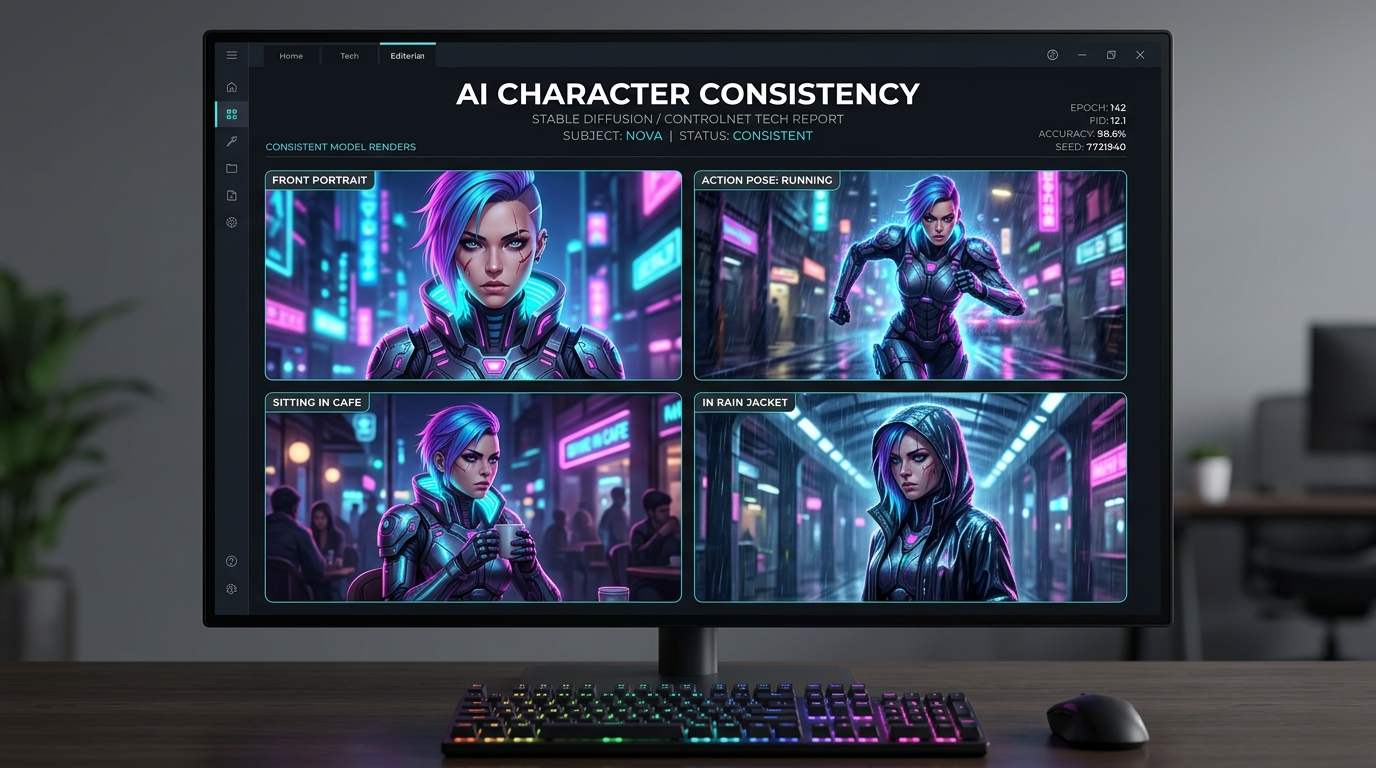
1. 14-image reference fusion: Long-horizon character consistency finally unlocked Maintaining character identity across serial storyboards has remained the white whale of graphic novelists and concept artists for years. Where prior architectures maxed out at one to three reference images before suffering identity drift, Nano Banana 2.1 natively accommodates up to 14 reference inputs simultaneously. We supplied front, profile, and three-quarter portraits of an original character, prompting scenes of her sprinting through rainstorms, reading inside coffee shops, and bundled in winter parkas. Facial structure, eye spacing, and recurring costume elements held together with remarkable fidelity.
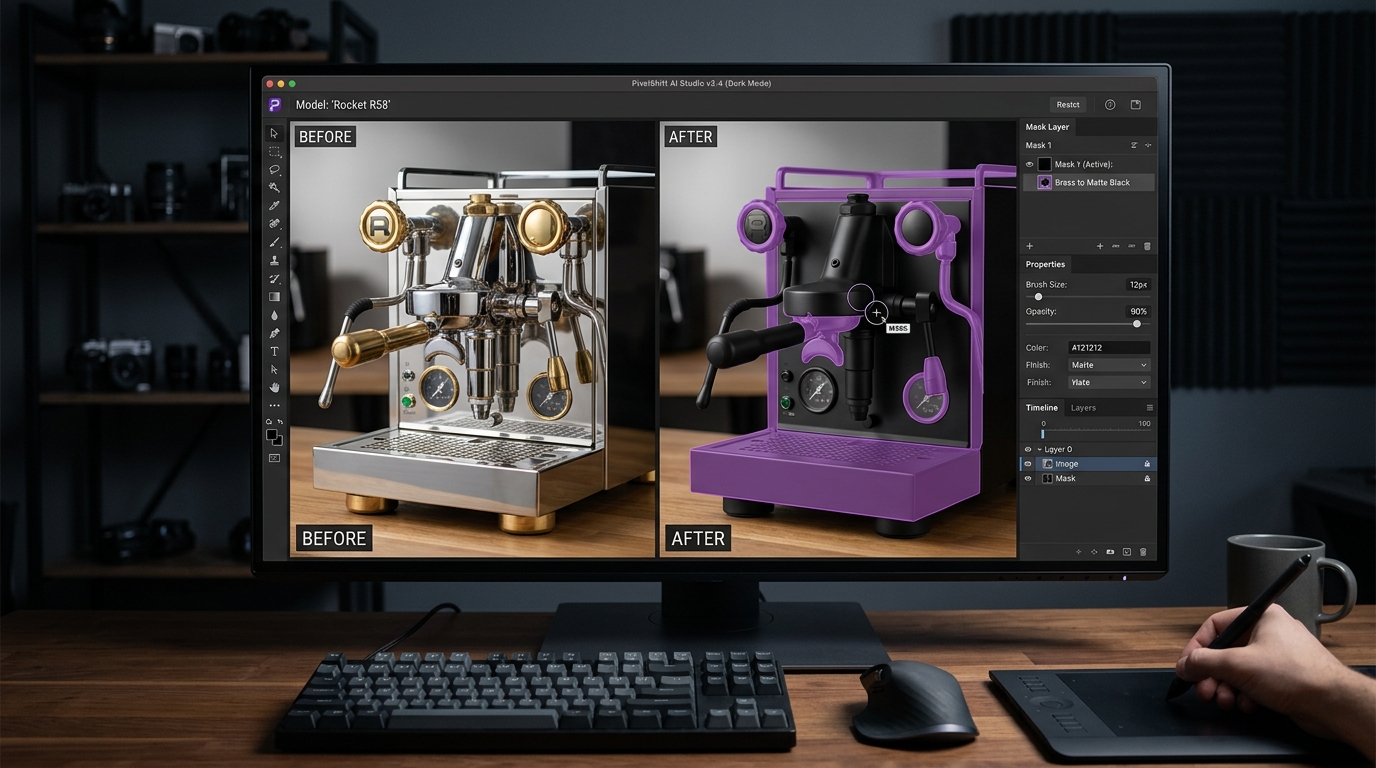
2. Mask-based inpainting: Swapping garments and textures with truly locked surroundings In product photography and fashion mockups, traditional inpainting often altered unintended background elements. Testing an espresso machine render, we brushed a purple mask over the brass handles and steam valves, requesting a matte black ceramic replacement. Generation finished in just 1.8 seconds. The matte ceramic finish rendered cleanly, while the unmasked reflective chrome chassis showed zero distortion or luminance shifts—providing the deterministic precision required for production design.
3. Configurable thinking depth and text rendering: Typography without recurring nightmares Nano Banana 2.1 incorporates selectable reasoning intensity tiers analogous to reasoning models: Minimal, Medium (standard default), and High. - When executing complex multi-entity spatial composition, switching to High enables the model to resolve occlusion, perspective, and scale prior to pixel synthesis; - In typographic layout benchmarks, from multi-line coffee ingredient labels to cyberpunk neon signage, spelling accuracy proved astonishingly dependable.
Real limitations: Where it still trails Midjourney
Objective product analysis requires acknowledging critical trade-offs. Nano Banana 2.1 is not an undisputed silver bullet across every artistic dimension. Users seeking an outright replacement for fine-art rendering suites will notice distinct artistic boundaries:
- Artistic aesthetics remain digitally polished: Compared to Midjourney v7, which excels at rich oil brushstrokes, analog film grain, and moody atmospheric lighting, Nano Banana 2.1 produces clean, clinical digital clarity. Its visual signature resembles pristine commercial studio photography shot under balanced strobes, missing that spontaneous, organic imperfection celebrated in classical art.
- Close-up human skin still carries faint digital synthetic sheen: While pores and individual eyelashes resolve cleanly under 4K exports, extreme macro portraits lack the subcutaneous warmth, translucency, and natural skin variations achieved by its larger sibling, Nano Banana Pro.
- Safety alignment guardrails remain exceptionally stringent: Operating under Google's corporate compliance standards, the model enforces strict barriers against public figure likenesses, provocative fashion, and stylized gore, rejecting prompts that open-weight local tools would execute without hesitation.
In short: if your objective is generating surrealist oil paintings destined for a digital gallery wall, stick with Midjourney. But if your team needs to deliver three client-ready marketing posters with verified typography before the afternoon deadline, Nano Banana 2.1 is unquestionably the superior tool.
Our verdict: Generative imaging officially crosses into the multimodal agentic era
The debut of Nano Banana 2.1 signals an irreversible trajectory for the broader visual AI landscape:
The era of blind diffusion models is giving way to native multimodal visual agents steered by reasoning foundations.
When an image generator possesses native spatial comprehension, common sense, and conversational instruction-following, it ceases to be a capricious novelty filter. Instead, it becomes an intelligent visual copilot capable of interpreting design briefs, honoring physical hierarchies, and executing surgical modifications.
By slashing API consumption costs by half while retaining sub-second inference responsiveness, Google has achieved more than just an incremental model upgrade; it has introduced serious competitive pricing pressure across the commercial imaging sector.
What to watch: Workflow tools and open-source ecosystems adapting
With Nano Banana 2.1 now widely accessible, attention shifts to how the broader design and developer ecosystem responds:
- Pace of design software and plugin integration: Whether enterprise creative tools like Figma, Photoshop, and digital marketing platforms natively incorporate its 14-image reference fusion and mask-inpaint primitives into one-click extensions;
- Retaliation pace from the open-source collective: How quickly open-weight visual frameworks like Flux and SD3 implement architectural improvements to match Google's multi-reference character consistency and cost efficiency;
- The eventual evolution of the Pro tier: Having established high standards for speed, consistency, and typography in its Flash tier, whether an upcoming Gemini 3.6 Pro-based Nano Banana Pro 2.0 can close the final gap in cinematic aesthetic texture.
For working builders and digital artists, escalating competition among foundation model providers delivers immediate practical benefits. Starting today in Google AI Studio, creators have access to a fast, cost-effective, and exceptionally compliant visual co-creator.