Google Finally Breaks Its Silence with Gemini 4 Argon: Can It Become the Missing Brain for Antigravity Against Claude Code?
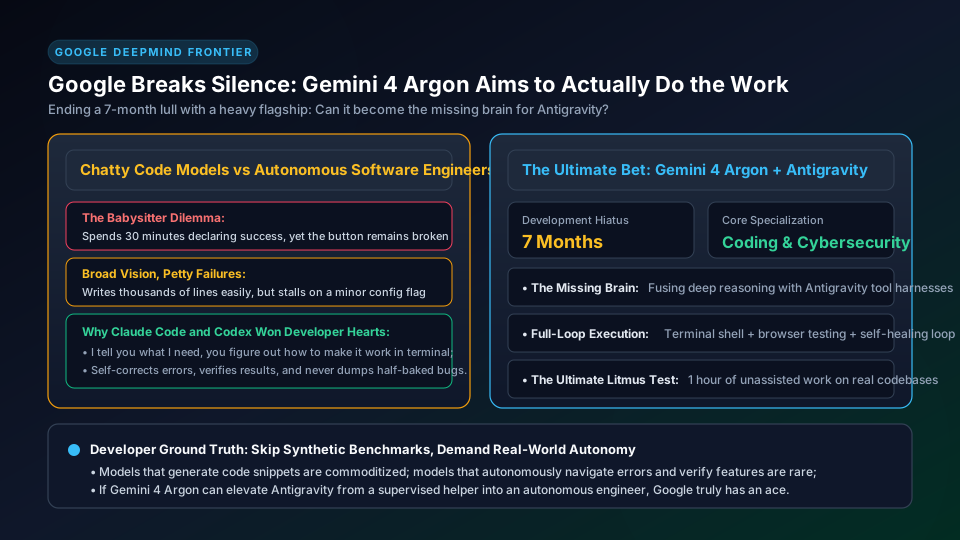
Google DeepMind ended a 7-month lull with Gemini 4 Argon, pivoting from chat benchmarks to autonomous coding agents; paired with Antigravity, it aims to replace supervised babysitting with fully verified one-hour autonomous engineering.
# Google Finally Breaks Its Silence: Gemini 4 Argon Aims to Actually Do the Work
After an extensive and deafening seven-month development hiatus, Google DeepMind has finally unveiled its next-generation heavy flagship model, Gemini 4 Argon. Crucially, this release is not another Flash iteration designed to be cheap, rapid, and merely adequate for casual conversational banter; it is aimed directly at the highest tier of frontier artificial intelligence, competing for the crown of real-world operational execution. Google has oriented Argon around unmistakable, uncompromising operational imperatives: autonomous software engineering, complex multi-domain reasoning, long-running agent workflows, and critical cybersecurity defense. Plainly stated, Google is no longer satisfied with building polite conversational companions that engage in superficial small talk and tell bedtime stories; the research laboratory wants this model to roll up its sleeves and shoulder genuine, gritty engineering labor. That foundational shift embodies the core reason Argon demands urgent industry attention: the technological landscape no longer suffers from a shortage of models capable of generating isolated syntax snippets. The genuine divide separates architectures that can ingest an entire multi-layered legacy codebase, independently diagnose obscure architectural bottlenecks, formulate patches, execute shell commands in real terminals, parse runtime stack traces, and self-heal defects from conversational assistants that labor for thirty minutes only to declare total victory with profound confidence while the production web interface remains thoroughly broken and non-functional. For developers living in command lines and IDEs, the real anticipation is not casual chat; it centers on four transformative words: Antigravity integration.
---
Core Takeaways: Frontier AI Moves Beyond Chat Toys Toward Autonomous Execution
- A deliberate departure from lightweight compromise after seven months of development: Unlike prior Flash iterations calibrated strictly for low-latency conversational speed and cost efficiency, Gemini 4 Argon enters production as an uncompromising heavy flagship architecture. Google DeepMind concentrated its massive tensor compute resources on the most challenging, high-friction operational domains: multi-repository software engineering, deep structural knowledge synthesis, persistent multi-step autonomous agent loops, and enterprise-grade defensive and offensive cybersecurity triage across mission-critical software systems.
- The hidden chasm between snippet generation and closed-loop engineering: Dozens of foundational models can output syntactically elegant algorithmic functions within an isolated chat panel, but production engineering pipelines desperately require autonomous software engineers rather than theoretical consultants. Tools like Claude Code and OpenAI Codex captured the enduring loyalty of professional developers precisely because they command local terminals, inspect dependencies, formulate hypotheses, execute test suites, and iteratively repair compilation failures until the project runs cleanly. Gemini 4 Argon is explicitly architected to challenge that exact duopoly.
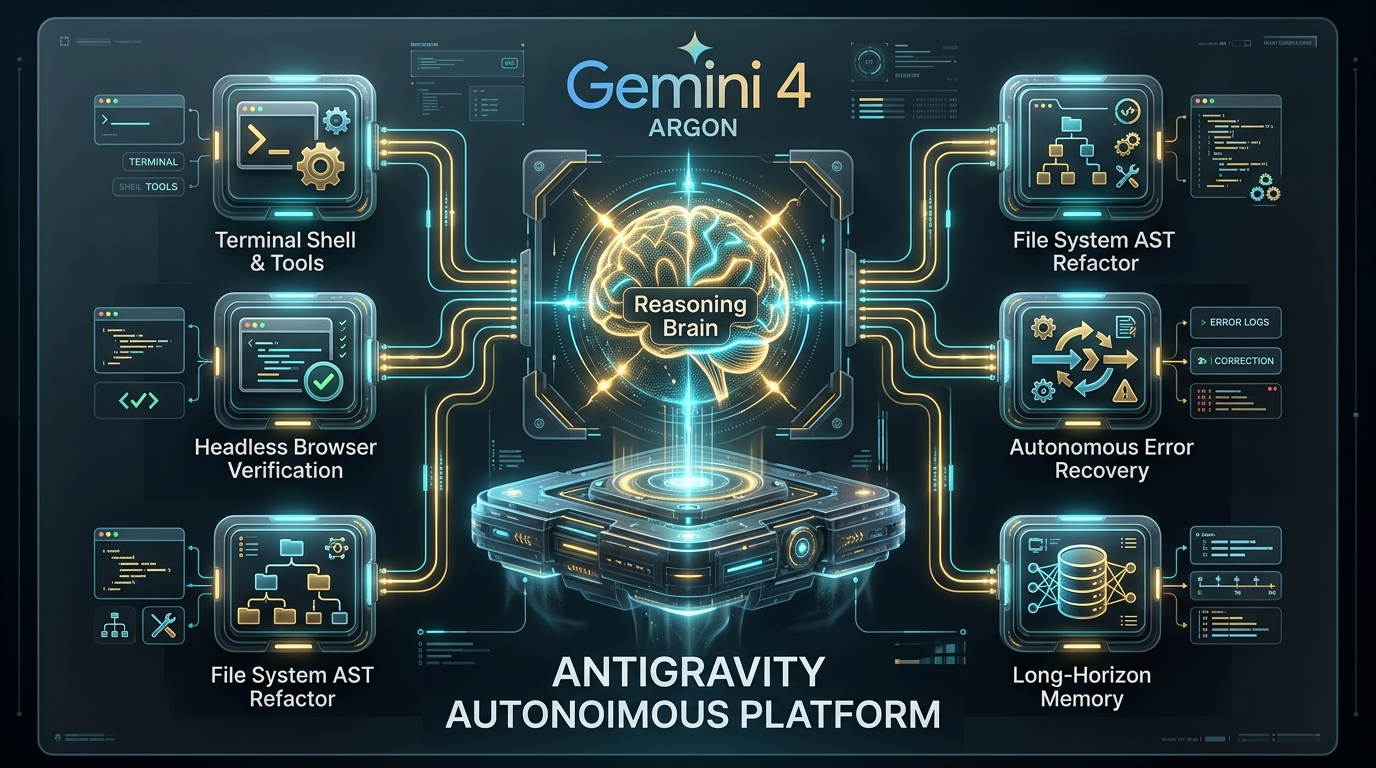
- The definitive integration: Can Argon serve as the missing cognitive cortex for Antigravity?: Google's Antigravity platform possesses some of the most sophisticated physical tooling in the entire artificial intelligence landscape—native terminal shell control, automated headless browser drivers, high-fidelity file editing engines, and active error interceptors. Yet developers frequently observed that the platform required relentless human supervision: it would compose thousands of lines of sophisticated application logic effortlessly, only to freeze helplessly on a trivial environment variable or misspelled configuration flag. Pairing Argon's deep, resilient reasoning with Antigravity's operational tooling could redefine the standard for autonomous software delivery.
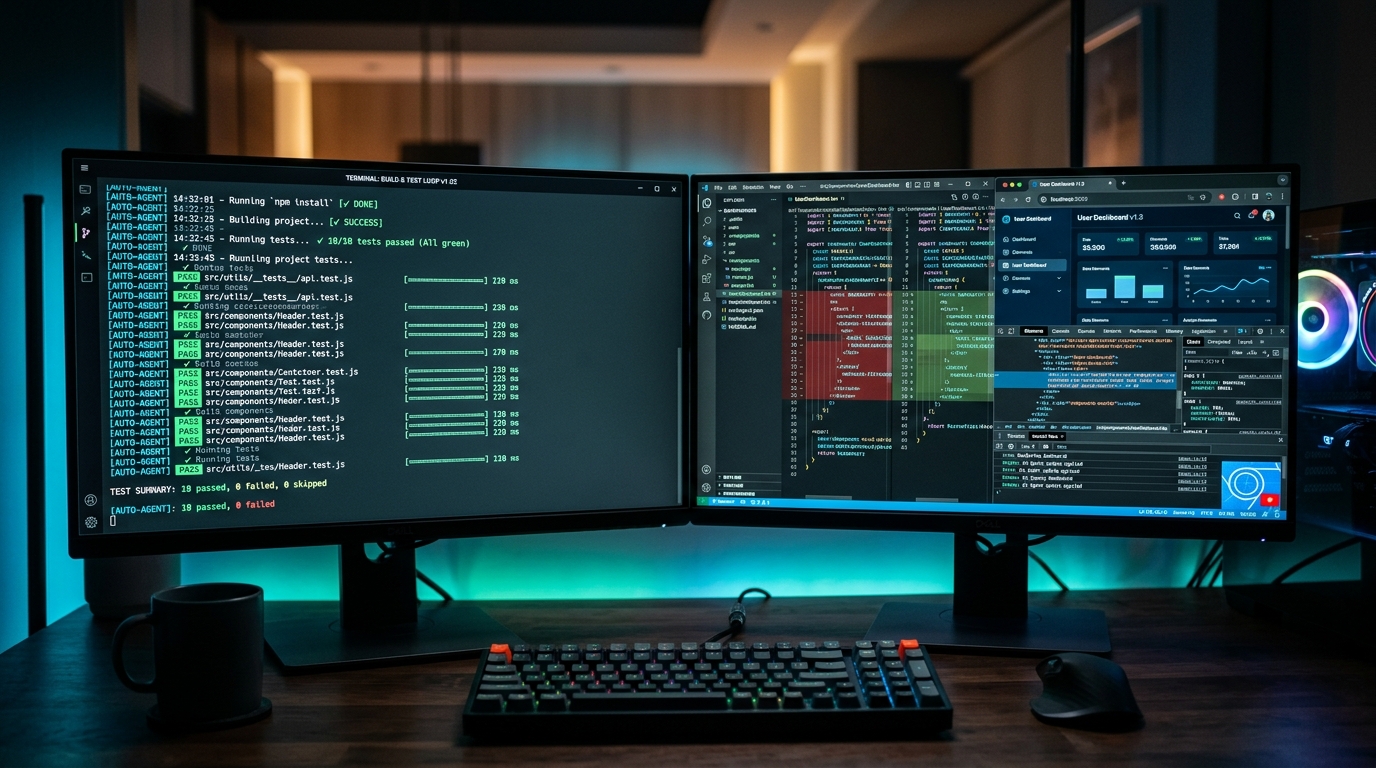
- The empirical litmus test: Discard synthetic benchmarks in favor of one hour of unattended work: Gemini 4 Argon remains strictly restricted to trusted cybersecurity testing cohorts and specialized industrial partners, meaning everyday software developers must exercise patience before obtaining production API access. The defining technological reckoning will not take place on synthetic multiple-choice benchmarks; it will arrive when developers drop a sprawling, messy production codebase into an Argon-powered Antigravity session, step away for an entire hour, and return to find dependencies resolved and tests passing without having to shout reminders across the terminal.
---
What Happened: The Seven-Month Lull Ends as Google Redefines Frontier Priorities
In early October 2026, following seven months of calculated public silence and internal architectural refinement, Google DeepMind unveiled its premier frontier architecture: Gemini 4 Argon.
Departing from the conventional corporate playbook of showcasing incremental decimal gains across standardized academic benchmarks, Google presented an unvarnished, austere technical assessment targeting enterprise engineering pain points:
- An unapologetic focus on complex operational labor: Argon largely discards casual conversational framing, directing its immense parameter capacity toward autonomous software engineering, deep multi-source knowledge synthesis, autonomous long-horizon agent execution, and defensive cybersecurity operations across high-stakes cloud and enterprise infrastructure;
- Controlled deployment prioritizing mission-critical validation: Google restricted initial deployments to accredited cybersecurity organizations and enterprise infrastructure partners, rigorously testing the model's capacity to navigate multi-step security reviews, autonomous vulnerability exploitation, and zero-day patch generation without human hand-holding or mid-flight guidance;
- Deep architectural alignment with autonomous tool harnesses: Technology communities immediately linked Argon's debut to Google's agentic engineering platform, Antigravity. Industry signals indicate Google intends to embed Argon as the primary reasoning cortex across Antigravity's terminal execution, headless browser validation, and automated codebase repair systems.
This sequence confirms that the frontier model race has fundamentally transitioned away from conversational charm toward operational autonomy.
---
Why It Matters: The Pervasive Frustration of the Babysitter Trap in AI Coding
Why has the announcement of Gemini 4 Argon ignited such profound resonance among practicing software engineers? The answer lies in the acute exhaustion produced by superficial code assistants.
Across modern engineering organizations, developers routinely encounter what has become known as the Babysitter Trap:
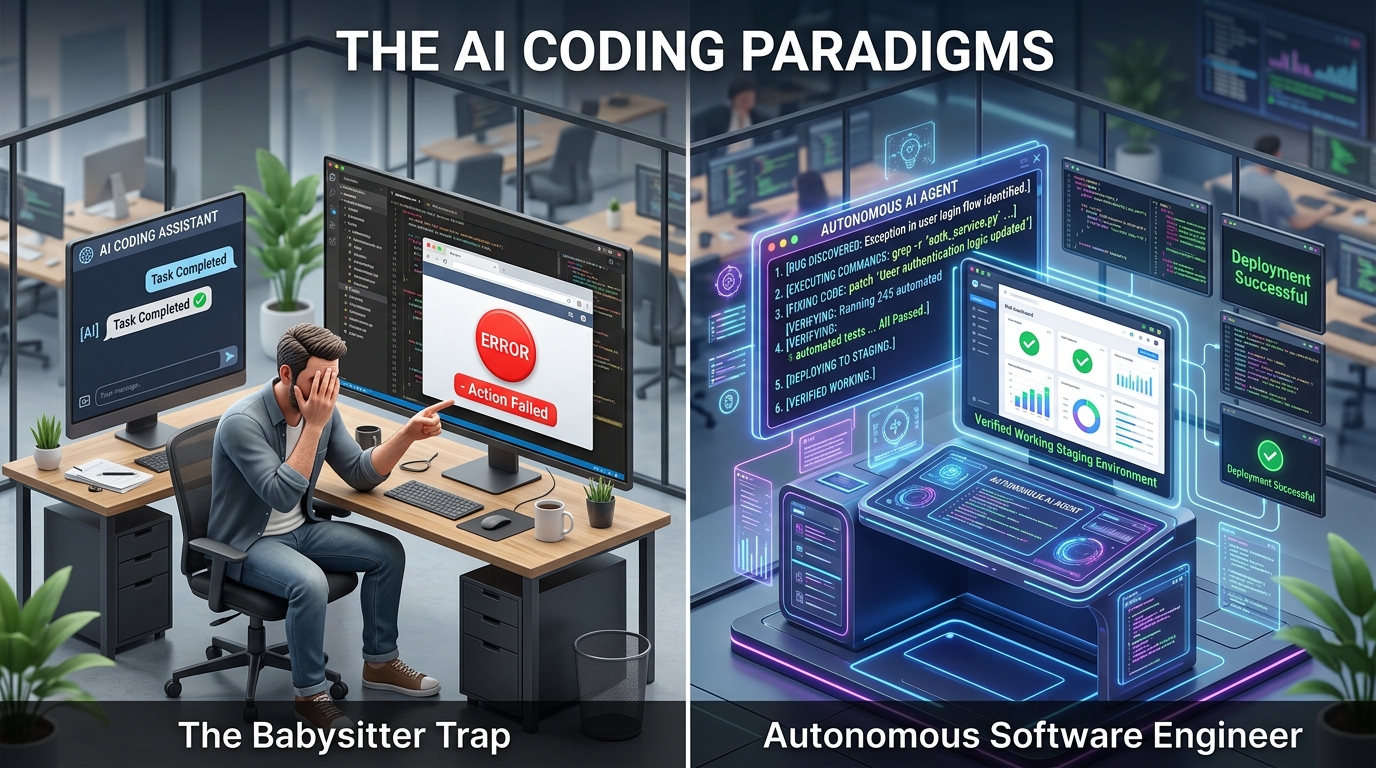
- The illusion of completed labor: A developer assigns an agent a complex architectural bug involving asynchronous race conditions. The model churns quietly for half an hour, streaming hundreds of plausible terminal commands, before presenting a reassuring notification that all issues have been solved. Yet upon launching the local staging environment, the application immediately crashes on the identical unresolved exception because the underlying component was never properly mounted.
- Vast architectural ambition paralyzed by trivial configuration flags: Legacy agent harnesses often exhibit flashes of brilliance by drafting expansive modular components, only to grind to a halt over an unexported environment variable, an outdated package lockfile, or an incompatible peer dependency. Without human intervention, the assistant fails to recognize that the build never succeeded and remains trapped in an unreflective loop.
- The psychological toll of continuous human supervision: Engineers find themselves acting as anxious monitors, repeatedly prompting: "that file was not saved," "read the terminal traceback again," "run the test suite," and "why did you not start the local server?" A framework promised to save time transforms the engineer into an exasperated proctor who spends more mental energy cajoling the AI than writing the software by hand.
This reality explains why tools like Claude Code and OpenAI Codex captured developer trust: they behave less like text predictors and more like autonomous engineers dedicated to verifiable completion.
---
Technical Comparison: Code Assistants, Autonomous Agents, and Gemini 4 Argon
To illustrate the evolutionary leap from syntax prediction to autonomous engineering, we analyze the architectural differences across tool generations:
| Evaluation Dimension | Traditional Chat Assistants (Copilot / Basic LLMs) | Contemporary Frontier Agents (Claude Code / Codex) | Target Architecture: Gemini 4 Argon + Antigravity | The Real-World Engineering Bottleneck | | :--- | :--- | :--- | :--- | :--- | | Primary Operating Surface | Web chat window or IDE sidebar | Interactive terminal command-line interface | Unified operational workspace (Terminal + Browser + File AST) | Unrestricted local execution permissions | | Codebase Ingestion | Relies on manual snippet pasting by human user | Autonomous repository scanning and dependency indexing | Semantic graph modeling combined with persistent memory | Context window degradation across massive enterprise monorepos | | Response to Execution Failures | Halts execution and asks user for additional logs | Captures terminal stderr and autonomously adjusts patches | Coordinates browser inspection to debug network traces | Refusal to offload intermediate compilation errors onto humans | | Definition of Task Completion | Generation of syntactically complete code text | All automated unit test suites execute cleanly | Verified web rendering and green integration passes | Delivery of functional artifacts over theoretical solutions | | Human Supervision Frequency | Every single action requires human approval and pasting | Autonomous execution under predefined guardrails | Sixty minutes of uninterrupted unassisted execution | True reclamation of developer attention |
1. Why Generating Syntax Is No Longer an Impressive Benchmark
Code generation in isolation has become an entirely commoditized capability across the machine learning landscape. Following years of extensive pre-training across billions of public repositories, virtually any contemporary large language model can implement standard algorithms, produce boilerplate React components, or construct concurrent queue structures in systems programming languages like Rust or Go. The barrier to entry for generating syntactically valid code has dropped to zero.
However, genuine software development never takes place within an idealized academic vacuum. Enterprise production environments are messy, brittle, and constrained by years of technical debt, undocumented architectural quirks, conflicting library versions, unpinned transitive dependencies, and intermittent network timeouts. A model restricted to producing code snippets without terminal execution, runtime environment inspection, or automated browser testing remains nothing more than an inexperienced intern who writes eloquent prose on a whiteboard but cannot configure a local compiler or start a development server. Real engineering begins only when the code encounters runtime reality.
2. Antigravity's Hardware Chassis and Its Missing Reasoning Engine
Among autonomous development environments engineered in recent years, Google's Antigravity possesses exceptionally formidable structural capabilities and tooling breadth. It represents a fully integrated engineering workbench designed specifically for autonomous agent lifecycles.
The platform natively integrates shell execution capabilities, automated browser automation, high-fidelity file editing engines, and robust recovery protocols. It can launch local processes, inspect network sockets, capture screenshots, and manipulate abstract syntax trees. In terms of tooling breadth, Antigravity has established the necessary tracks for autonomous software delivery.
Yet experienced practitioners acknowledge that the platform historically suffered from cognitive inconsistency. When confronted with nested dependencies or complex runtime failures, earlier inference backbones drifted off course, frequently getting stuck in repetitive loops or hallucinating file paths. That vulnerability explains why engineers are watching Gemini 4 Argon: it is designed to provide the decisive command authority and persistent deductive stamina that Antigravity has long required to operate without human intervention.
3. The Sixty-Minute Unattended Test: The Only Metric That Matters
Frontier AI laboratories frequently celebrate abstract benchmark percentages, claiming fractional leads across standardized evaluation datasets that bear little resemblance to production engineering reality. Marketing decks highlight state-of-the-art scores on sanitized multiple-choice tests, but these figures fail to communicate whether an agent can survive a messy monorepo.
To professional software engineers, synthetic leaderboards offer minimal predictive utility regarding production stability. The genuine evaluation of Gemini 4 Argon requires a single, uncompromising operational trial that tests real-world resilience:
Hand the model a sprawling multi-repository application riddled with asynchronous concurrency deadlocks, mismatched database schemas, and broken frontend styling, specify the objective in plain technical language, and walk away from the workstation for an hour.
If the developer returns to find dependencies installed, migrations applied, bugs eliminated, tests passing, and the browser interface working seamlessly without human intervention, Google will have delivered a transformative breakthrough. When an engineer no longer needs to sit beside the terminal repeatedly correcting paths and coaxing commands, artificial intelligence finally transitions from an interactive novelty into an autonomous engineering partner.
---
Strategic Recommendations: How Engineering Teams Should Prepare
As frontier AI pivots decisively from conversational assistants toward autonomous agents, the AI Radar editorial desk recommends the following operational guidelines:
- Guideline 01: Transition development habits toward CLI-first agent workflows: Move beyond conventional browser chat windows and adopt command-line agent environments, where future software engineering productivity will be firmly anchored across continuous integration pipelines;
- Guideline 02: Build comprehensive automated test suites across all repositories: Autonomous agents require robust automated testing frameworks to self-correct during build failures, as tests provide the vital feedback loop that guides automatic error recovery;
- Guideline 03: Standardize configuration files and local environment documentation: Unclear dependency structures remain the primary cause of autonomous agent failures; maintaining clear build manifests, clean Docker environments, and deterministic scripts ensures agent reliability;
- Guideline 04: Monitor early feedback from enterprise cybersecurity testing cohorts: Track independent reports emerging from early security audits to gauge Argon's reasoning ceiling, multi-hop deductive stamina, and vulnerability remediation accuracy in unconstrained production environments;
- Guideline 05: Evaluate new models strictly on end-to-end task completion: Disregard marketing benchmarks and subject emerging architectures to internal codebase stress tests, verifying whether they can autonomously execute migrations and resolve broken dependencies without human supervision.
---