Stop Gambling on Video AI: How Hua Shu's 'huashu-art-motion' Turns Claude Opus 5.5 Into a Frame-Accurate Studio
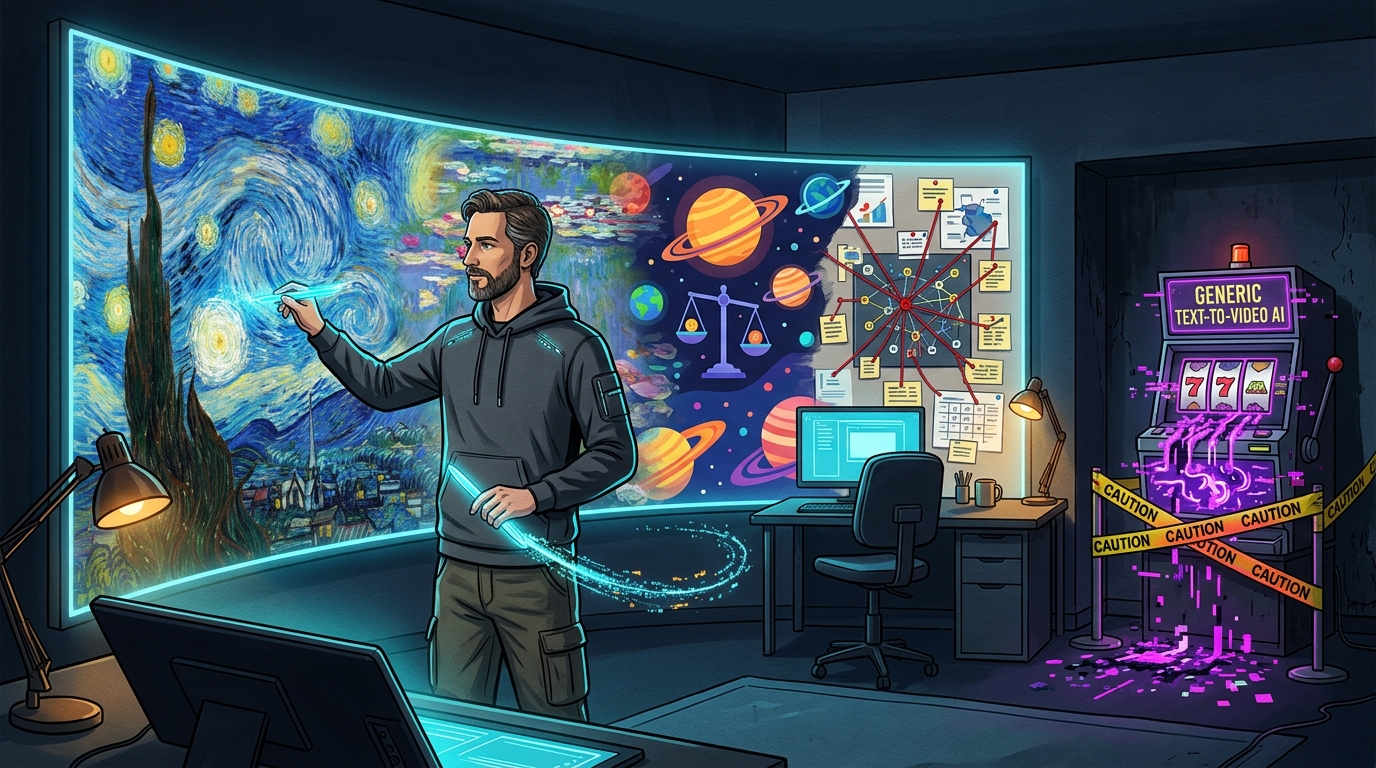
The viral emergence of huashu-art-motion delivers an essential reality check to the generative video industry. Stochastic diffusion gambling is economically unsustainable for serious production; converting elite aesthetic judgment, cinematographic grammars, and quality gates into deterministic code protocols is the true path to industrial AI leverage.
Last week, an independent technology video creator vented his escalating frustration in an engineering group chat: in an attempt to generate a brief ten-second explainer animation visualizing how large language model tokens are segmented and embedded, he had burned nearly thirty dollars on commercial text-to-video AI compute credits.
The outcome was a familiar nightmare. Either the text rendered across the screen warped into illegible alien glyphs, or an animated progress bar midway through the sequence melted into an unrecognizable digital sludge. After squandering an entire afternoon tweaking prompts and rerolling seeds, he failed to harvest a single usable camera shot.
While millions of content creators remain held hostage by the unpredictable gambling mechanics of video diffusion models, independent hacker and software artisan Hua Shu (known online as Alchain) quietly published an open-source project titled huashu-art-motion on GitHub. Within hours, the repository ignited an intense wave of excitement across the global AI programming and developer communities.
The project features no hollow corporate buzzwords and imposes zero predatory compute billing meters. Once the skill is installed into your local agent environment, you can hand a raw voiceover script and scene storyboard directly to Claude Code with a concise prompt: "Using Vox journalistic visual grammar, produce a crisp fifteen-second motion graphic illustrating tokenization and self-attention mechanisms."
Minutes later, rather than spewing hallucinated, rubbery generative artifacts, the terminal systematically delivers a pristine, 60fps high-definition sequence. Every movement is synchronized with frame-accurate mathematical precision, formatted with clean vector typography, and exported with full alpha-channel transparency. Watching the demonstration video unfold across tech forums, countless engineers and creators arrived at the exact same revelation: the genuine future of AI video production does not rely on burning compute to roll generative dice; it lies in treating deterministic code as an artistic brush.
Why the Community Is Raving: Creators Are Exhausted by Generative Gambling
Over the past twelve months, the technology industry has been relentlessly bombarded with breathless promotional trailers touting so-called Hollywood-grade generative video tools and cinematic text-to-video engines.
Yet any working creator or software engineer tasked with delivering real-world production projects understands how profoundly brittle modern diffusion-based video models remain when confronted with rigorous informational content: 1. Uncontrollable Hallucinations and Mangled Typography: Request a structured bar chart displaying third-quarter financial figures, and the generative model routinely mutates digits into grotesque, floating blobs that look like distorted limbs; 2. Total Absence of Frame-Level Timeline Precision: When a voiceover script delivers an essential punchline at exactly 3.2 seconds, generative video models inevitably float around in an aimless, sluggish drift until well past the fourth second; 3. Crushing Asset Discard Rates: Generating a trivial five-second clip demands several minutes of server queuing, only for eight out of ten generations to be immediately discarded due to chaotic physical deformations and temporal flickering.
The foundational paradigm shift introduced by huashu-art-motion is that it completely breaks free from the black-box diffusion mental trap.
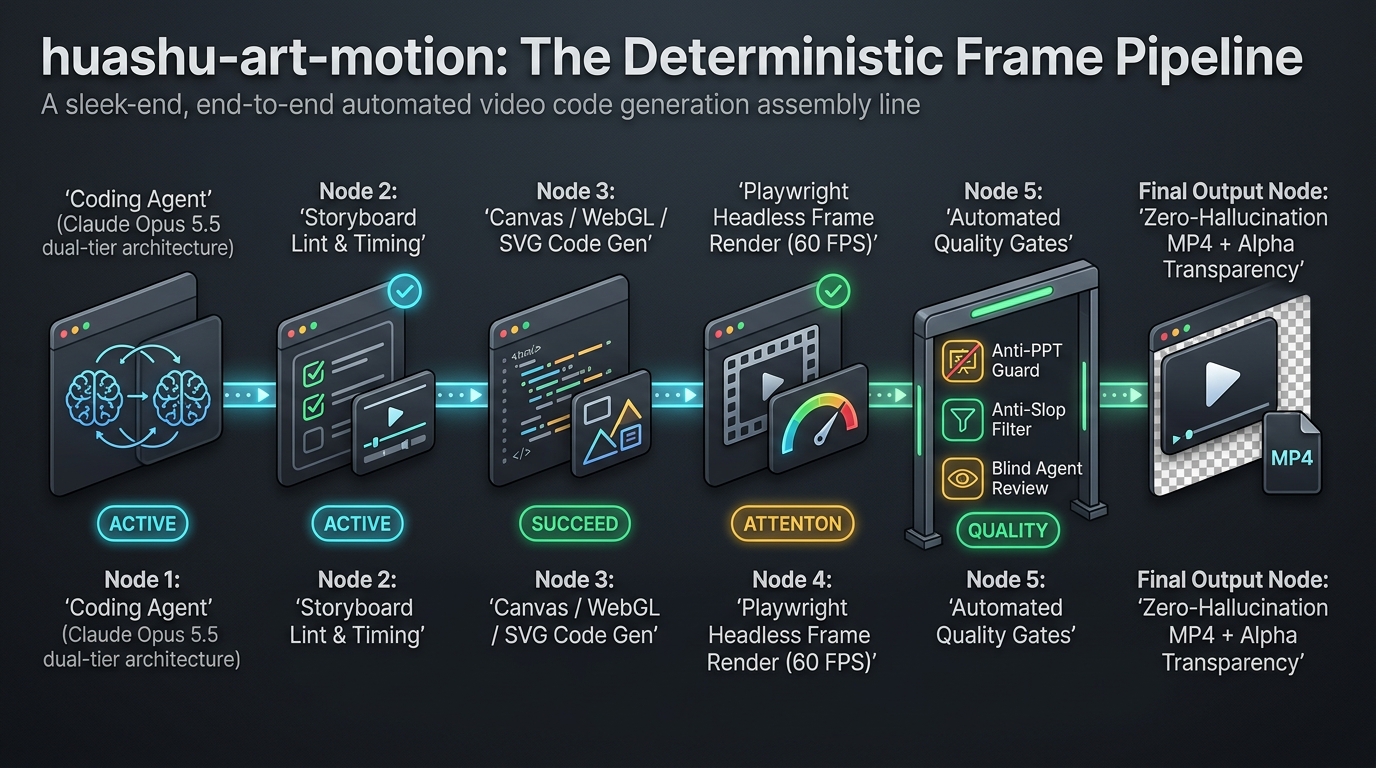
Instead of guessing chaotic pixels through statistical probability, it mobilizes frontier reasoning models—headlined by Claude Opus 5.5—to act as computational digital illustrators and animators utilizing HTML5 Canvas, SVG vectors, WebGL shaders, and Three.js scenes. The underlying pipeline orchestrates headless Playwright browser instances to capture individual frames with surgical temporal accuracy, subsequently compiling the sequence into clean video files using FFmpeg.
Because every positional translation, camera pan, and scale transform is governed by deterministic mathematical functions, typography remains razor-sharp and vector-perfect. Executing the same codebase ten times yields ten bit-for-bit identical frames. Furthermore, the pipeline natively supports alpha-channel video rendering, allowing creators to drag transparent animated overlays directly into timeline editors like Premiere or CapCut without green-screen keying.
A Dual-Tier Architecture Built for Opus 5.5: Creative Freedom for Frontier Models, Strict Rails for the Rest
Examining the repository's core SKILL.md instruction specification reveals an exceptionally pragmatic understanding of current language model capabilities. Right from the opening lines, the author establishes an uncompromising dual-tier architecture:
1. The Open Range Tier (Reserved for Claude Opus 5.5 and Beyond):
When the skill detects a frontier reasoning engine like Claude Opus 5.5 possessing world-class multimodal architecture comprehension, systemic guardrails are relaxed. The model is empowered to function like an experienced motion director—freely orchestrating underlying graphics libraries, composing custom visual pipelines, and even authoring brand-new Canvas or WebGL shaders on the fly to fulfill bespoke artistic briefs;
2. The Track Bound Tier (Enforced for Standard Models):
When paired with lesser models, the skill immediately clamps down with rigid engineering handcuffs. The agent is strictly forbidden from writing code until it populates a structured storyboard template and passes automated validation via storyboard_lint.py. If the script detects erratic camera zooms, cluttered pacing, or conflicting palettes, the validator throws a blocking red flag, halting code execution until every structural flaw is resolved.
This intelligent bifurcation definitively cures the frustrating problem of model overconfidence, enabling brilliant models to unleash genuine creativity while preventing weaker models from producing broken code.
Code as an Art Brush: From Van Gogh's Mathematical Tensors to Vox's Investigative Desks
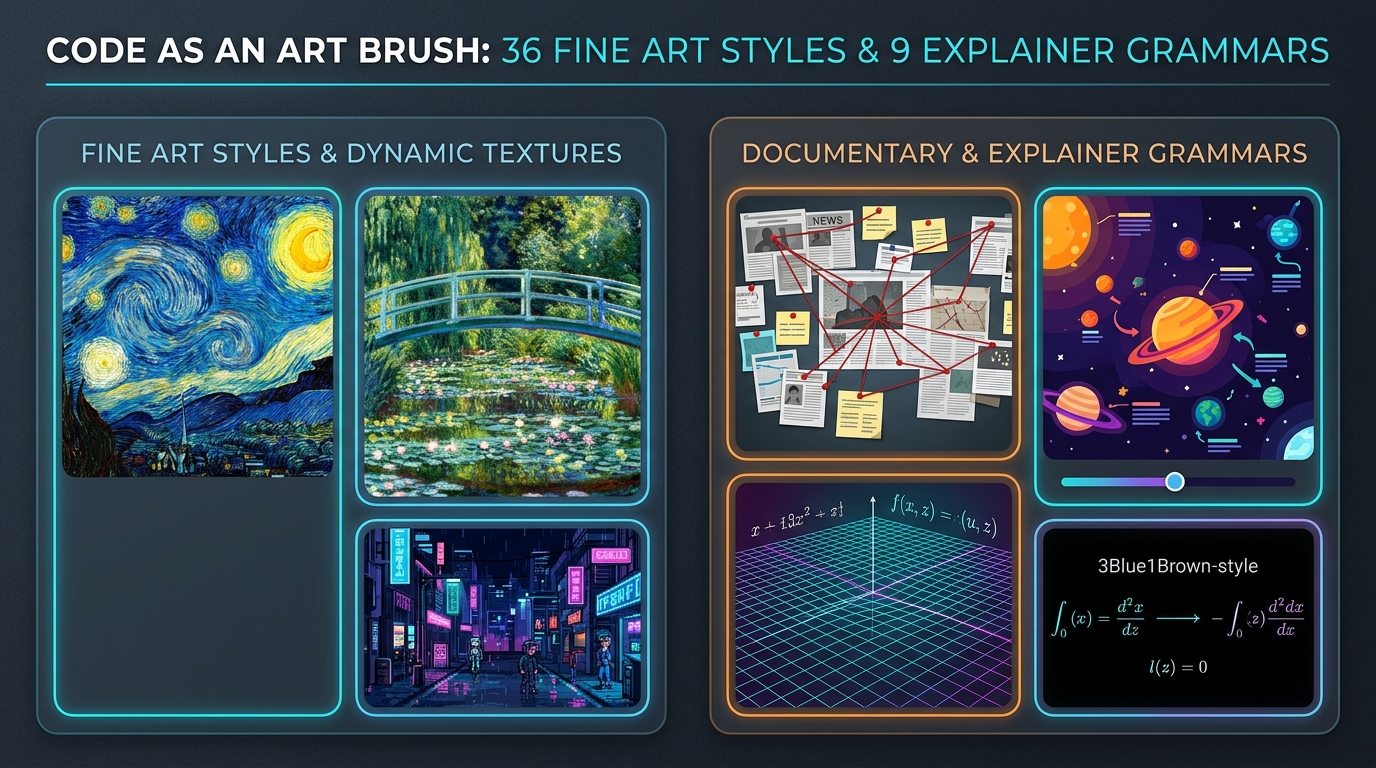
On visual execution, huashu-art-motion encapsulates thirty-six fully realized fine-art traditions alongside nine structured motion grammars inspired by the world's most celebrated documentary and explainer channels:
1. Mathematical Deconstruction of 36 Fine-Art Traditions: The skill completely rejects superficial stylistic overlay filters, instead encoding the actual brush mechanics of historical masters into algorithmic rules. In the Van Gogh style, the code extracts structural tensors directly from reference masterpieces, causing thick impasto oil strokes to genuinely swirl across celestial skies and wheat fields. In the Monet configuration, skipping stones across the Japanese bridge generates real-time fluid wave propagation equations. In horizontal scroll films, a protagonist can stroll continuously from an ancient Egyptian fresco directly into an 8-bit retro gaming universe, with lighting and textures morphing seamlessly at world borders; 2. Nine Iconic Explainer and Documentary Grammars: Educational creators, financial analysts, and tech communicators can instantly deploy proven visual structures: Kurzgesagt's flat-vector cosmic scales, Vox's investigative pinboards featuring news clippings connected by red threads and fluorescent highlighter accents, 3Blue1Brown's continuous geometric mathematical transformations, kinetic whiteboard sketches dynamically revealing underlying schematics, Apple keynote frosted-glass metrics, and disciplined financial charting cards that isolate a single numerical takeaway; 3. Parametric Clips for Instant Turnaround: Creators are not required to assemble monolithic video architectures for simple needs. By passing an isolated JSON parameter payload alongside a voiceover transcript, the engine compiles a frame-accurate, transparent animation slice in seconds, reducing complex motion design to an intuitive exercise in structured configuration.
The Killer Feature: Automated Anti-AI-Slop Quality Gates that Reject Bad Output
While the animation fidelity is remarkable, the feature that has elicited the loudest praise from veteran engineers is the suite of industrial-grade quality gates baked into the automated deliver.py packaging script.
Anyone who has interacted with AI-generated videos or automated presentation builders has suffered through repetitive, low-effort aesthetic cliches. Hua Shu's pipeline treats these tendencies as critical engineering defects, automatically terminating builds upon detection:
1. The Anti-PPT Gatekeeper (Rejecting Static Slide Decks): If an assembled sequence exhibits near-zero intra-frame motion, relies entirely on bullet points fading in sequentially, or subjects the viewer to monotonous linear zooms, the delivery validator classifies the output as an unacceptable slide deck masquerading as video, raising a fatal red error and refusing to copy the render; 2. The Anti-Blue-Purple Slop Sensor (Eradicating Generic Cyberpunk Tones): One of the most offensive aesthetic defaults of modern AI is an uncontrollable compulsion to bathe every graphic in deep purple nebulae and neon cyan gradients. The delivery script embeds an automated color gamut scanner; if blue and purple pixels exceed thirty percent of total runtime, the build is summarily aborted; 3. Dead Background and Empty Scene Interception: Should the timeline register more than 0.3 consecutive seconds of unbordered solid black voids or empty backgrounds where the primary subject vanishes, the pipeline immediately throws an error stamped with precise millisecond timecodes; 4. Mandatory Blind Review by an Independent Agent: Prior to final release, the pipeline automatically spawns an unconditioned third-party agent that has played zero role in the code generation process. This reviewer evaluates the compiled video with the cold, hyper-critical scrutiny of a skeptical human viewer, withholding delivery sign-off until all qualitative objections are satisfied.
How Anyone Can Get Started: Deploying an Elite Studio Inside Your Terminal
For independent hackers, media creators, and product architects, mastering this revolutionary framework requires zero formal background in low-level computer graphics. Spinning up the production studio on your personal workstation requires just three straightforward steps:
1. Install the Skill into Your Agent Environment:
Inside any terminal environment supporting standard Agent Skills (such as Claude Code or your current CLI), execute:
``bash
npx skills add alchaincyf/huashu-art-motion
`
If you also desire access to high-fidelity frontend prototyping and presentation slide generation, install the accompanying design suite:
`bash
npx skills add alchaincyf/huashu-design
`
2. Configure the Local Headless Rendering Dependencies:
Ensure your system has uv, ffmpeg, and the headless Playwright Chromium binary installed (simply execute uv run --with playwright playwright install chromium`);
3. Direct the Studio Using Conversational Language:
Paste your script and prompt the agent directly: "Following Vox documentary grammar, construct a twelve-second parametric animation illustrating distributed consensus protocols, exporting a transparent alpha-channel MP4."
The viral triumph of huashu-art-motion delivers an indispensable lesson to the broader artificial intelligence landscape: while the industry burns billions rolling the dice on stochastic diffusion models, visionary software craftsmen are transforming deterministic code, elite taste, and automated quality gates into standardized, repeatable engineering protocols. For modern creators, that represents the most formidable leverage available.