A Billion-Dollar Reversal: How Soaring Compute Bills Forced OpenAI Into The Advertising Machine
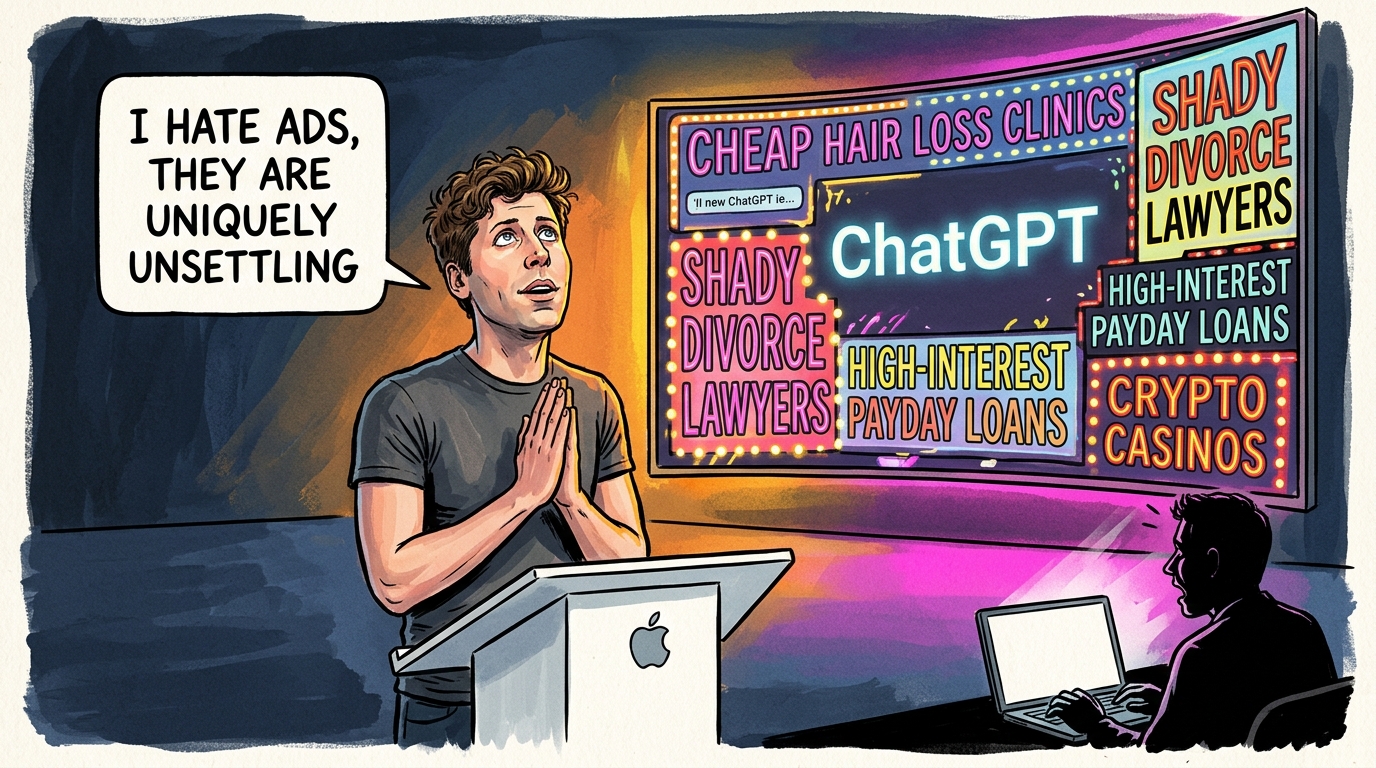
OpenAI rapid advertising ascendancy punctures the final romantic illusions of non-profit idealism in frontier AI. Crushed beneath a $20 billion annual compute burden, leadership had no alternative but to commercialize conversational whitespace. In a universe governed by brute-force hardware economics, financial gravity inevitably conquers moral rhetoric.
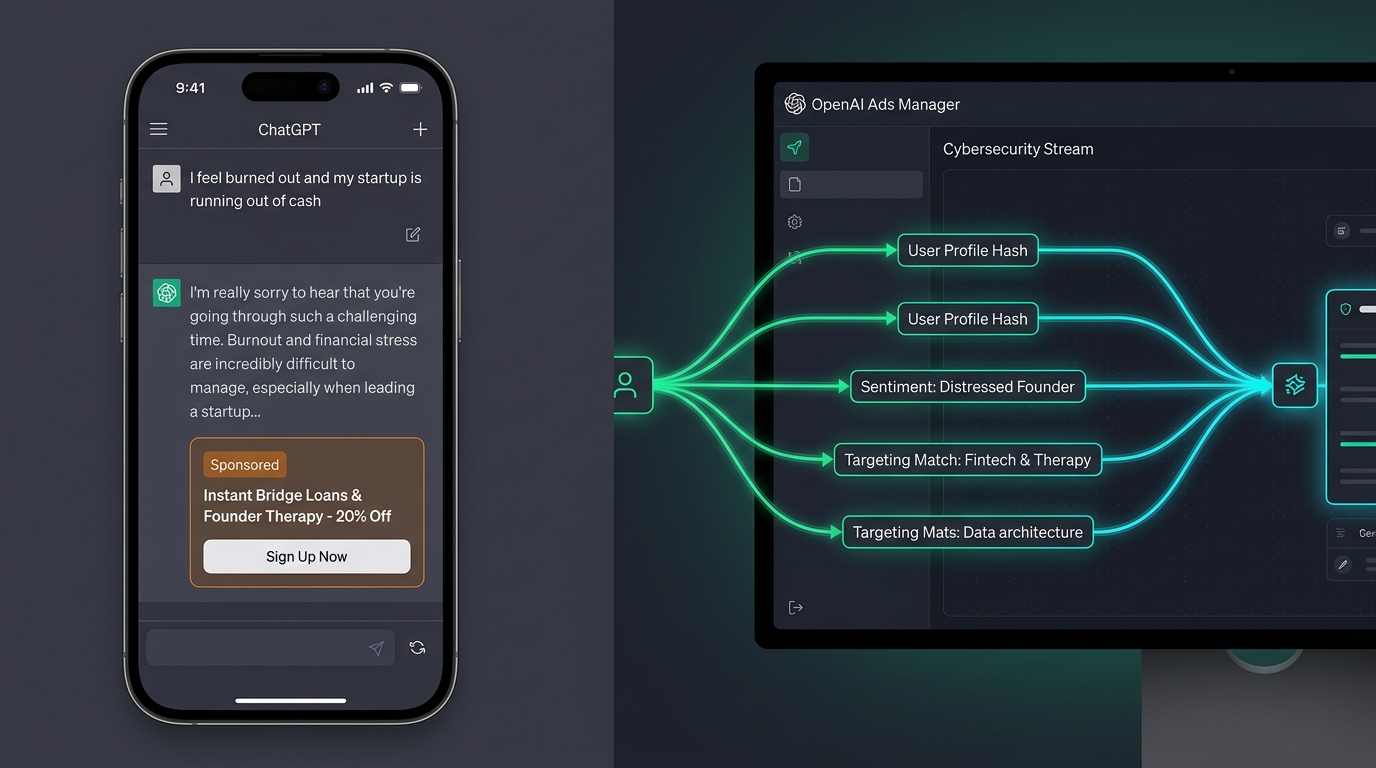
At one o'clock in the morning, an exhausted tech founder in Silicon Valley sat alone in the dark, typing a heavy confession into his ChatGPT prompt window: "I only have one month of runway left in the bank, my technical co-founder wants to quit, I'm completely burned out, and I genuinely don't know what to do."
Across the digital wire, the artificial intelligence responded in its signature gentle, reassuring, and measured tone, generating several thoughtful paragraphs covering tactical cash flow management, investor bridge negotiations, and founder psychological resilience. But right beneath that warm and empathetic advice, an unobtrusive, light-gray rectangular card suddenly materialized:
Sponsored · Founder Emergency Bridge Loans: Code-repository-backed underwriting in seconds. 20% off your first month's interest rate.
In that singular, surreal moment, every lofty Silicon Valley sermon about Artificial General Intelligence (AGI) existing purely for the universal benefit of all humanity collapsed entirely under the brutal weight of programmatic ad targeting.
Altman's "Last Resort": From Aesthetic Disdain to Billion-Dollar Reality
Silicon Valley's collective institutional memory is notoriously short, but it has not faded into complete amnesia just yet.
Back in 2024, during a high-profile keynote conversation at Harvard University and across multiple podcast appearances, OpenAI Chief Executive Officer Sam Altman repeatedly mounted the moral high ground to express open, unvarnished contempt for the advertising business model:
"I hate ads," Altman stated flatly with a visibly furrowed brow. "Marrying large frontier models with advertising is a uniquely unsettling prospect. Users place deep, unprecedented personal trust in an AI assistant precisely because they believe the model is delivering objective, uncompromised answers. If OpenAI ever has to run ads, it will be an absolute last resort when no other options remain."
Yet the commercial realities of the tech industry specialize in delivering brutal, unforgiving irony.
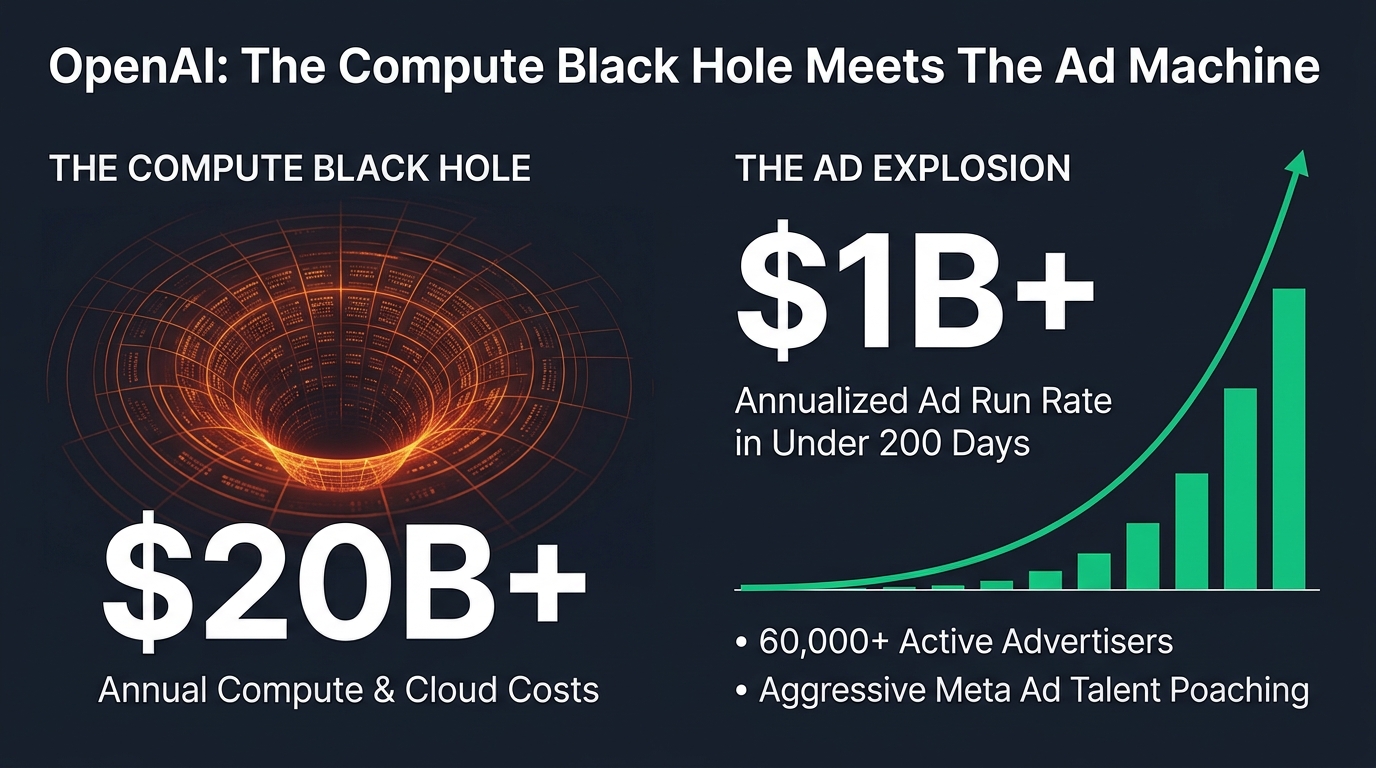
By mid-2026, OpenAI quietly rolled out its proprietary self-serve ad auction infrastructure, the OpenAI Ads Manager. According to recently revealed financial data and internal performance audits, this supposedly distasteful "last resort" has sprinted to a staggering $1 billion annualized revenue run rate (ARR) in under 200 days from launch.
The active advertiser base on the platform has surged well past 60,000 corporate clients, ranging from venture-backed software startups to global consumer brands. To accelerate this high-margin monetization engine, OpenAI has spent millions on executive compensation packages, aggressively poaching senior ad ranking engineers, machine learning auction architects, and commercial monetization directors straight out of Meta and Google.
The very same tech visionary who once sanctimoniously proclaimed his moral disgust for advertising is now orchestrating one of the fastest programmatic ad rollouts in internet history, monetizing the conversational whitespace of hundreds of millions of daily active users worldwide.
The Compute Black Hole: Burning Cash With Every Query
Why did even OpenAI, with all its founding ideals and high-minded mission statements, ultimately surrender to the programmatic ad machine? The answer is brutally straightforward and impossible to evade: the underlying compute bills are astronomical.
According to comprehensive consensus estimates compiled across Wall Street equity research analysts, hardware supply chains, and hyperscale cloud providers, OpenAI's annual expenditures on data center leases, dedicated compute cluster expansion, GPU depreciation, and gigawatt-scale electricity will exceed $20 billion in 2026 alone.
The broader public often assumes that millions of paying subscribers coughing up $20 per month for ChatGPT Plus can comfortably finance frontier AI development. In reality, the fundamental unit economics are deeply upside-down: * With production context windows scaling into the millions of tokens, coupled with widespread image synthesis, native multimodal real-time voice streaming, and compute-heavy reasoning chains that burn thousands of hidden thinking tokens, an active user can easily consume several dollars worth of server inference during a single heavy afternoon research session; * The overwhelming majority of non-paying Free tier users and discounted Go tier users generate zero direct software revenue, acting instead as massive compute vacuums that evaporate precious liquid cash off OpenAI's balance sheet every single day.
Consumer subscription tiers and enterprise developer API contracts simply cannot plug a multi-billion-dollar annual compute drain on their own. When public equity markets, sovereign wealth funds, and private investors demand hard, sustainable monetization metrics to justify multi-trillion-dollar prospective valuation multiples, management had only one realistic lever left to pull:
Follow the well-worn playbook of Web 2.0 advertising giants—packaging hundreds of millions of users' attention, emotional vulnerabilities, and private commercial intent, and auctioning them off to the highest bidder in real time.
A Privacy Ambush Dressed as "Context Matching"
What has profoundly alarmed privacy advocates, legal scholars, and cybersecurity engineers isn't merely the visual presence of sponsored links inside a chat thread, but the intrusive, real-time intent extraction machinery operating beneath the surface.
In defensive corporate statements and carefully worded FAQ updates, OpenAI has insisted that sponsored units do not degrade the objective quality of underlying answers, and that third-party advertisers can never directly read user chat transcripts or raw conversational history.
Yet that defense wilts under rigorous technical scrutiny. Under the operational mechanics of the OpenAI Ads Manager, advertisers target captive audiences through two aggressive, sophisticated mechanisms: 1. Real-Time Intent Context Hints: Internal algorithms parse semantic intent tags dynamically from user prompts during active reasoning. If you discuss insomnia or severe fatigue, the system instantly categorizes you into targeted buckets for clinical sleep aids or telehealth providers. If you ask the AI how to navigate marital distress, you are immediately routed into the target pool for high-ticket coaching services or family law firms; 2. First-Party Customer Hash Matching: Corporate advertisers can upload databases of hashed phone numbers, mobile device identifiers, and customer email addresses directly to OpenAI's advertising dashboard, allowing the platform to match existing consumer profiles against active ChatGPT accounts.
Traditional search engines display commercial links at the exact moment you intentionally type a query into a search bar. ChatGPT, by contrast, functions as a psychological confessional—an intimate digital space where people lower their natural defenses, sharing deeply personal vulnerabilities, raw medical anxieties, and sensitive financial dilemmas. Having those intimate human confessions tokenized in milliseconds to trigger auction bids is, exactly as Sam Altman himself once warned, "uniquely unsettling."
Actionable Takeaways for Everyday Users
As frontier artificial intelligence platforms complete their inevitable economic pivot toward traditional ad-tech monetization, here is how everyday users can protect their personal privacy and professional workflows:
1. Know Exactly Which Tiers Are Monetized:
Commercial ads are currently concentrated on Free and discounted Go consumer tiers across chat dialogues and image generation sessions; premium Plus ($20/mo), Pro ($200/mo), and Team/Enterprise enterprise accounts currently remain ad-free and shielded from sponsored placements.
2. Disable Personalized Tracking Immediately:
Navigate directly to ChatGPT Settings, open the Data Controls menu, and manually toggle off Personalized Ads & Context Sharing. While you may still see generalized contextual ads, this breaks the continuous pipeline that monetizes your immediate conversational intent and behavioral history.
3. Keep Sensitive Queries Out of Free Public Chats:
Never feed confidential corporate financial statements, medical symptoms, legal disputes, or proprietary source code into free consumer chat windows. For private data, migrate immediately to offline local open-weight models (such as DeepSeek or quantized Llama variants) or use dedicated zero-retention enterprise API endpoints.
4. Shed the Non-Profit Myth Once and for All:
Abandon romantic notions that Silicon Valley frontier labs operate purely on altruism or non-profit benevolence. When raw compute represents an ultra-scarce, capital-intensive physical commodity, commercial gravity inevitably pulls every free tool toward the same advertising auction block.