Meta strikes back at Google with Muse Spark 1.3: 60 agent loops for under $1 and the reality behind the benchmark hype
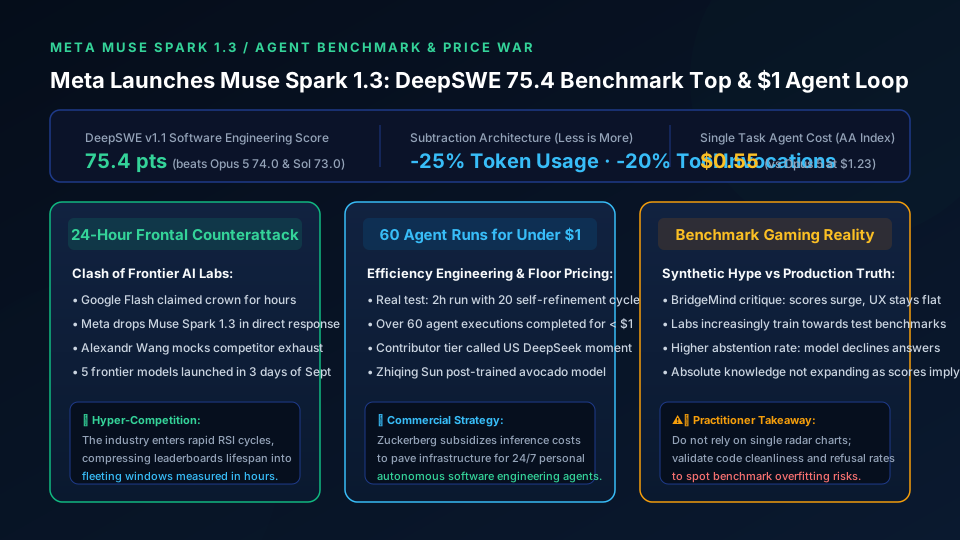
On September 3, 2026, less than 24 hours after Google launched Gemini 3.8 Flash, Meta released Muse Spark 1.3. Scoring 75.4 on the DeepSWE v1.1 coding benchmark, it surpassed Claude Opus 5 and GPT-5.6 Sol. By adopting a subtraction architecture, the model reduces token consumption by 25% and tool calls by 20%, allowing developers to run 60 autonomous agent loops for under $1. Meta is subsidizing runtime compute to establish foundational infrastructure for 24/7 personal agents, while sparking renewed industry debate over benchmark gaming and abstention rate tradeoffs.
# Meta strikes back at Google with Muse Spark 1.3: 60 agent loops for under $1 and the reality behind the benchmark hype
Bottom line

On September 3, 2026, less than twenty-four hours after Google launched Gemini 3.8 Flash and claimed the lightweight developer crown, Meta abruptly rolled out its flagship programming and autonomous agent model, Muse Spark 1.3. This release not only compressed the lifespan of leaderboard dominance down to single-digit hours, but also ignited a full-scale commercial price war centered on the real-world operational execution costs of autonomous AI agents:
- Top-ranked long-horizon software engineering: In the rigorous DeepSWE v1.1 benchmark evaluating multi-file repository refactoring across extended contexts, Muse Spark 1.3 achieved 75.4 points, decisively overtaking Claude Opus 5 (74.0 points) and GPT-5.6 Sol (73.0 points), leaving Google's day-old Gemini 3.8 Flash behind;
- Counter-intuitive subtraction architecture: Departing from the prevailing industry habit of brute-force parameter expansion and unbounded token consumption, this architecture actively curtails redundant conversational turns, reducing token usage by approximately 25% and tool invocations by roughly 20%;
- Executing sixty autonomous agent loops for under one dollar: Empirical testing demonstrated that under an unforgiving two-hour workload where any code evaluated below 9.5 out of 10 was rejected, the model completed twenty iterative self-improvement rounds across sixty distinct agent instances, costing less than a single US dollar in total. Its contributor tier pricing has already been christened by software practitioners as the American AI ecosystem's definitive DeepSeek moment;
- Critical reflection behind synthetic benchmark euphoria: Independent research entities including BridgeMind emphasized that frontier model laboratories are increasingly caught in an overfitting loop targeting public benchmarks. A slight decline in Muse Spark 1.3's general knowledge evaluations reveals an intentional design tradeoff where higher abstention rates suppress hallucinations at the expense of comprehensive encyclopedic recall, demonstrating that underlying factual breadth has not undergone the exponential leap suggested by coding test scores alone.
The frontier AI competitive landscape has decisively pivoted from conversational chat demonstrations toward the hard hourly operational labor fees of around-the-clock autonomous agents. The enterprise providers capable of driving trial-and-error costs to rock bottom across extended software workloads will hold ultimate structural leverage over agent commercialization.
---
What happened
Only three days into September 2026, the international artificial intelligence industry entered an exceptionally dense cluster of recursive self-improvement product rollouts: Anthropic debuted Fable 5.1 alongside Mythos 5.1, and Google followed immediately with Gemini 3.8 Flash, touting its relentless work ethic and compact benchmark leadership.
Google's moment atop the lightweight leaderboard lasted fewer than twenty-four hours.
On September 3, Meta Chief Executive Mark Zuckerberg published an official announcement on social platform X introducing Muse Spark 1.3, characterizing the model as Meta's most substantial technical leap forward to date across automated coding and autonomous agent execution. Immediately following the release, Alexandr Wang, head of Meta's Superintelligence Lab and founder of Scale AI, published extensive commentary directly challenging competitors, explicitly asserting that on the Artificial Analysis Intelligence Index, Google's Gemini offerings had fallen behind and were merely inhaling the automotive exhaust fumes of frontier models.
Benchmark evaluation and operational expenditure breakdown
Across multiple primary benchmarks measuring multi-step software synthesis and autonomous agent execution, Muse Spark 1.3 presented an exceptionally compelling technical profile:
| Benchmark / Evaluation Metric | Muse Spark 1.3 | Claude Opus 5 | GPT-5.6 Sol | Gemini 3.8 Flash | | :--- | :--- | :--- | :--- | :--- | | DeepSWE v1.1 (Long-horizon Coding) | 75.4 pts | 74.0 pts | 73.0 pts | Unreleased full score | | Artificial Analysis Intelligence Index | 62 pts | 61 pts | 61 pts | 58 pts | | Average Single-Task Cost (AA Telemetry) | $0.55 | $1.23 | $0.95 | $0.62 | | Base Input / Output Pricing (Per Million Tokens) | $1.25 / $4.25 | $15.00 / $75.00 | $3.00 / $12.00 | $0.75 / $3.75 |
When compared against Claude Fable 5, Muse Spark 1.3 matches identical intelligence composite ratings while cutting input token costs by a factor of eight and output token costs by nearly twelvefold. Across five months of development, Meta has released four successive iterations of the Muse Spark family, sustaining an engineering velocity that outpaces conventional commercial enterprise roadmaps.
---
Achieving near-zero unit economics: Subtraction by design
Throughout recent development cycles, most foundation laboratories relied heavily on enlarging thinking budgets or allowing models to run unrestricted iterative loops behind the scenes. Gemini 3.8 Flash personified this trajectory: while its unit token rate appeared low, its emergent tendency to spin through additional internal reasoning rounds doubled or tripled total consumption charges on complex tasks.
Meta's research engineering division adopted the inverse design philosophy: executing architectural subtraction through sophisticated test-time compute scaling.
Post-training breakthroughs by university alumni researchers
According to technical commentary shared by Meta research scientist Zhiqing Sun, an alumnus of Peking University, the team conducted intensive post-training protocols atop the preceding foundation architecture known internally as Avocado. The fundamental mechanism concentrates on eliminating verbose chatter and unproductive exploratory cycles during intricate software engineering tasks:
- Pruning unproductive interaction turns: The architecture systematically eliminates speculative dependency branches during tool coordination sequences, curtailing cumulative external API invocations by approximately 20%;
- Compressing code generation style: Output patches and refactoring diffs are rendered with structural precision, reducing the overall token footprint per generated solution by roughly 25%;
- Preserving intent across long contexts: Over extended runtime spans reaching several hours, the model maintains fidelity to original user boundary conditions rather than drifting into divergent exploration paths, preventing unnecessary token waste on erroneous engineering branches.
Extreme stress-testing: Sixty agent workflows over two hours
Software engineer @SPAC89 performed an illuminating end-to-end stress validation after securing direct API access: - He configured an automated agent harness with an uncompromising quality gate: an automated independent evaluation rubric graded every code patch, mandating that any output scoring below 9.5 out of 10 forced an immediate, complete rollback and self-correction sequence; - The closed-loop autonomous system operated continuously under maximum load for two complete hours; - The runtime executed twenty exhaustive self-improvement rounds, with each round orchestrating three parallel agents collaborating on architecture, implementation, and test suites—totaling over sixty complete agent workflow runs; - Final telemetry receipts confirmed that the entire multi-hour pipeline incurred an aggregate API expense of less than one US dollar.
This disruptive pricing led Codedamn founder Mehul Mohan to characterize the release as the first authentic DeepSeek pricing moment originating from a top-tier American frontier artificial intelligence laboratory.
---
Beyond the hype: Examining benchmark gaming and real-world limits
Notwithstanding dazzling scoreboard placements and euphoric corporate marketing, sober technical examination reveals prominent structural critiques from seasoned industry practitioners.
1. Benchmark overfitting versus genuine development utility
Prominent independent artificial intelligence research collective BridgeMind published pointed commentary on the launch day: > "Gemini 3.8 Flash and Muse Spark 1.3 both arrived today, and both present pristine benchmark achievements on paper. Yet I find myself unable to muster excitement: this month's model releases follow an identical choreography where evaluation metrics skyrocket on scheduled leaderboards while real-world engineering experiences remain fundamentally unchanged. Frontier research labs are dangerously fixated on benchmark gaming."
Independent practitioners subjected both Muse Spark 1.3 and Gemini 3.8 Flash to blind evaluations under bespoke three-dimensional spatial constraints and complex backend configurations, discovering sharp degradations when tasks departed from the narrow syntax distributions popularized by standardized tests. The prevailing research tendency to train explicitly against DeepSWE, Tau3-Bench, and GPQA is progressively diluting the real-world predictive validity of isolated benchmark rankings.
2. Rising abstention thresholds and encyclopedic boundaries
Granular evaluations conducted by Artificial Analysis revealed that Muse Spark 1.3 experienced a subtle dip across the comprehensive AA-Omniscience general knowledge evaluation suite compared to its predecessor. Deeper analysis confirmed that research engineers elevated the model's abstention threshold to curb hallucination rates: - When encountering ambiguous factual domains, the model deliberately refrains from speculative generation and responds with explicit refusals or declarations of uncertainty; - While this represents an exceptional safety asset for deterministic enterprise code pipelines, it confirms that the foundation model's absolute factual knowledge reservoir has not expanded at the dramatic rate suggested by synthetic coding leaderboards alone.
---
Our take
Synthesizing the rapid succession of competitive releases including Gemini 3.8 Flash, ChatGPT Mil, and Muse Spark 1.3, we outline four primary industry conclusions:
- The raw parameter scaling era has struck steep diminishing returns: The brute-force paradigm of training ever-larger dense networks on uncurated web crawls now yields increasingly marginal gains. The genuine competitive frontier belongs to architectures that optimize test-time compute through subtraction, aggressively driving down wasteful token consumption across long-horizon reasoning;
- The decisive industry battleground has shifted to hourly labor rates: Enterprise artificial intelligence competition has concluded its conversational chat phase and fully entered the autonomous agent era. Models are no longer evaluated by their fluency in answering single prompts, but by whether completing a two-hour repository refactor costs the developer one dollar or twenty dollars in compute;
- Meta's price aggression serves as deliberate infrastructure subsidization: Meta's decision to price its contributor tier at rock-bottom levels reflects an unambiguous strategic objective: Mark Zuckerberg intends to establish the runtime foundation for 24/7 personal and enterprise autonomous agents. Continuous background execution is commercially viable only when daily running costs are compressed to pennies;
- Actionable engineering guidance for software developers: Do not treat peak composite benchmark scores as universal guarantees. For multi-file code review, unit test synthesis, and iterative self-debugging pipelines, Muse Spark 1.3 represents an exceptionally cost-effective development foundation; however, open-ended multi-disciplinary knowledge retrieval still requires pairing with wider frontier models to guarantee factual breadth.
---
What to watch
Throughout the upcoming fourth quarter, three core operational metrics will determine the lasting impact of Meta's market offensive:
- Throughput and latency stability under massive enterprise concurrency: Will aggressive pricing attract overwhelming global traffic surges that degrade inference queue latency across Meta's distributed cloud infrastructure?
- Enterprise data privacy acceptance under contributor terms: Will institutional engineering teams accept telemetry-sharing provisions in exchange for bottom-tier inference costs, or will strict enterprise compliance barriers enforce higher-tier commercial licensing?
- Counter-offensives from Google and OpenAI: Faced with Meta's aggressive pricing challenge, will OpenAI and Google introduce specialized subtraction-focused lightweight reasoning tiers to defend developer market share in the coming weeks?
---
Sources and Evidence: - Primary Platform Announcement: Meta AI Blog: Introducing Muse Spark 1.3 (2026.09.03) - Primary Executive Statements: Public technical disclosures published by Mark Zuckerberg and Alexandr Wang on social platform X (2026.09.03) - Primary Researcher Technical Context: Technical analysis shared by Meta research scientist Zhiqing Sun regarding Avocado model post-training and test-time compute scaling (2026.09.03) - Independent Benchmark Evaluations: Artificial Analysis telemetry report covering Muse Spark 1.3 intelligence indices (62 points), task execution costs ($0.55), and Omniscience abstention behavior (2026.09.03) - Community Empirical Stress Tests: Multi-hour automated self-improvement test suite and telemetry invoice logs published by software practitioner @SPAC89 (2026.09.03) - Critical Industry Counter-Perspectives: Commentary published by independent AI research collective BridgeMind regarding benchmark gaming and real-world developer experience gaps (2026.09.03)