The End of Closed-Source Secrecy: How GitHub Hit 'REA' Reverse-Engineers Any Binary with AI
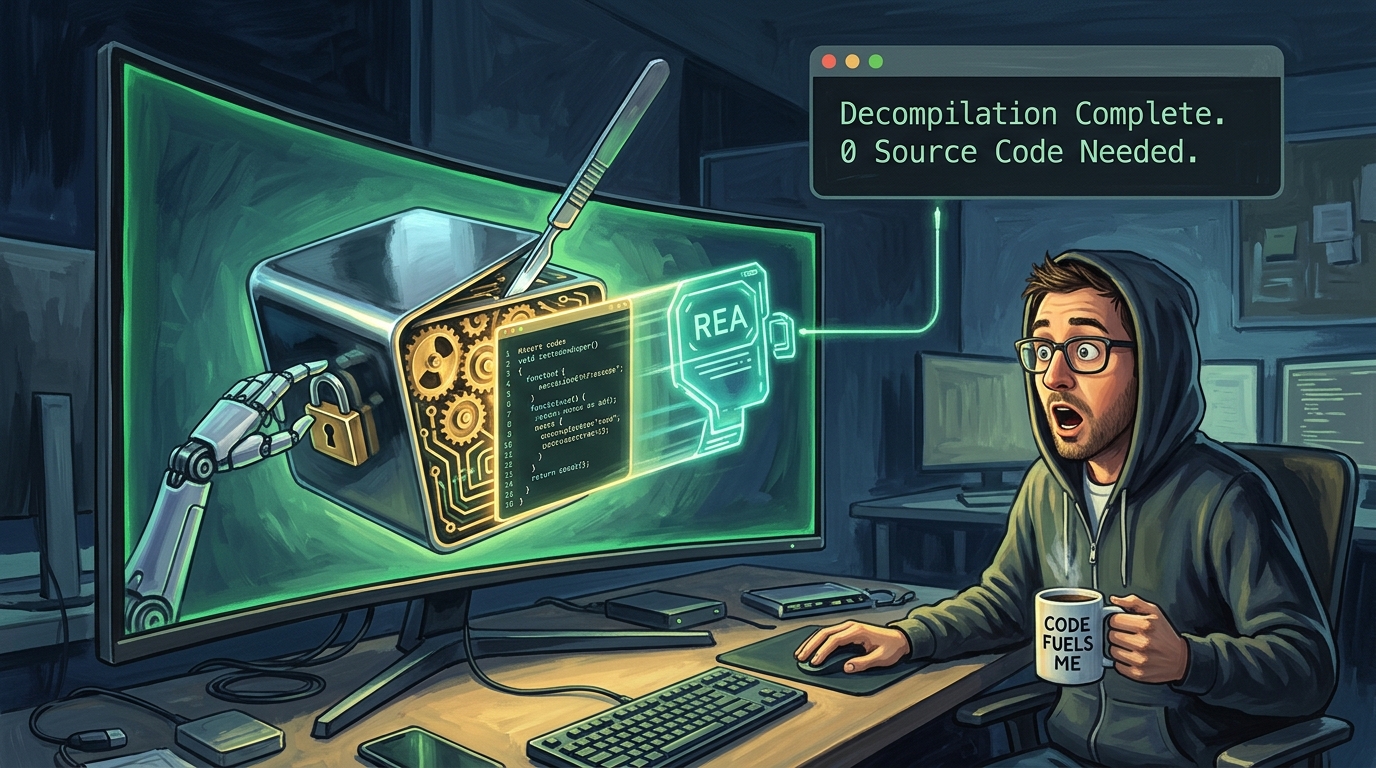
The viral ascent of morluto/rea marks the terminal obsolescence of traditional client-side obfuscation. Historically, code mangling relied on exhausting human analyst patience; against tireless frontier models possessing world-scale open-source intuition, obfuscation is merely security through obscurity. True algorithmic secrecy now belongs exclusively to authenticated cloud backends.
Over the weekend, an unassuming open-source repository titled morluto/rea (short for Reverse Engineer Anything) rocketed to the very top of the global GitHub Trending charts without warning, simultaneously generating over a thousand comments on Hacker News.
An independent developer posted a compelling demonstration video on X (Twitter): he was fascinated by a wildly popular, proprietary desktop productivity application and wanted to understand how its buttery-smooth, local-first offline synchronization protocol actually functioned under the hood.
Historically, accomplishing something like this required the specialized background of an experienced binary security researcher or malware analyst who had spent years mastering tools like IDA Pro and Ghidra. You would have had to manually unpack compiled application bundles, squinting through tens of thousands of lines of aggressively minified Webpack spaghetti code mangled into meaningless identifiers like _0x1a2b, a, b, and c. Spending three straight days staring at call stacks often yielded nothing more than a headache and a dead end.
Yet in the viral clip, the developer executed a single setup command in his terminal, dragged the opaque application bundle directly into his AI agent's chat interface, and casually prompted: "Reverse engineer this app's local storage schema and synchronization protocol."
Within five minutes, the AI systematically reconstructed pristine TypeScript data interfaces, cryptographic hashing logic, and clean architectural data flow diagrams, presenting the complete inner workings on a silver platter.
Watching the demonstration unfold, countless software engineers and security researchers arrived at the exact same conclusion: the defensive moat surrounding closed-source software has officially evaporated.
Reverse Engineering Used to Require Months of Assembly; Now It Takes a Single Prompt
Within cybersecurity and software auditing, reverse engineering has long been considered one of computing's dark arts.
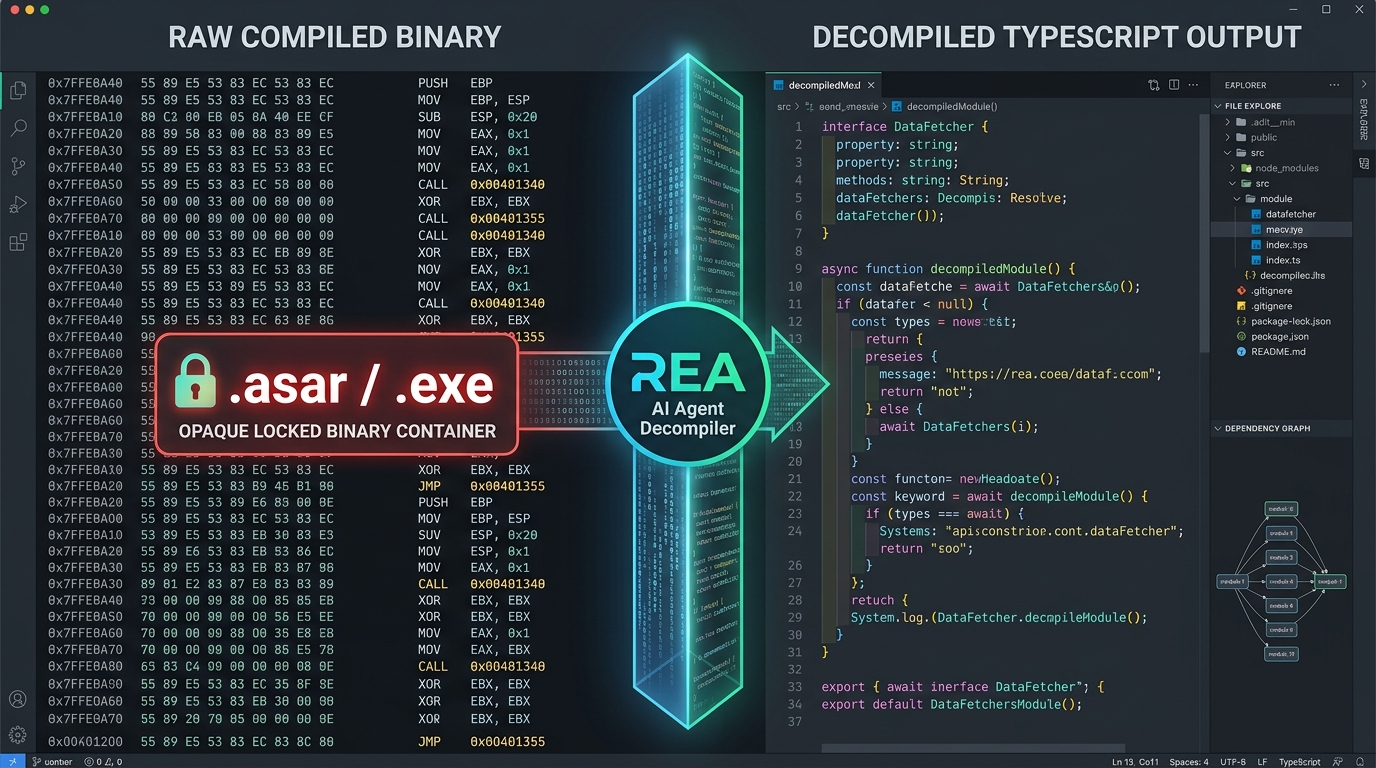
Unlike open-source development where you inspect legible human logic, reverse engineers examine the compiled binary debris discarded by a compiler—opaque machine code packaged as .exe, .app, .dll, or .so files. Reconstructing human intentionality from raw hexadecimal instructions required engineers to spend months mapping microprocessor registers like EAX and EBX against memory offsets.
The true paradigm shift introduced by morluto/rea is that it democratizes elite reverse-engineering capabilities into an automated, conversational pipeline that any developer can operate.
Whether you are targeting an Electron application bundled inside a protected .asar archive, an obfuscated enterprise frontend bundle, or a compiled native binary library, modern coding agents (such as Claude Code, Cursor, and Codex) equipped with this skill can dissect opaque targets like seasoned binary researchers. The agent navigates low-level structural clues, executing a continuous autonomous loop spanning disassembly, key logic extraction, semantic deobfuscation, and high-level architectural translation into modern idiomatic code.
How It Actually Works: Not Hallucinated Guesswork, but an AI Surgical Toolkit
When first discovering the project, many developers instinctively react with healthy skepticism: "Is this just an LLM hallucinating plausible-sounding code based on statistical training data?"
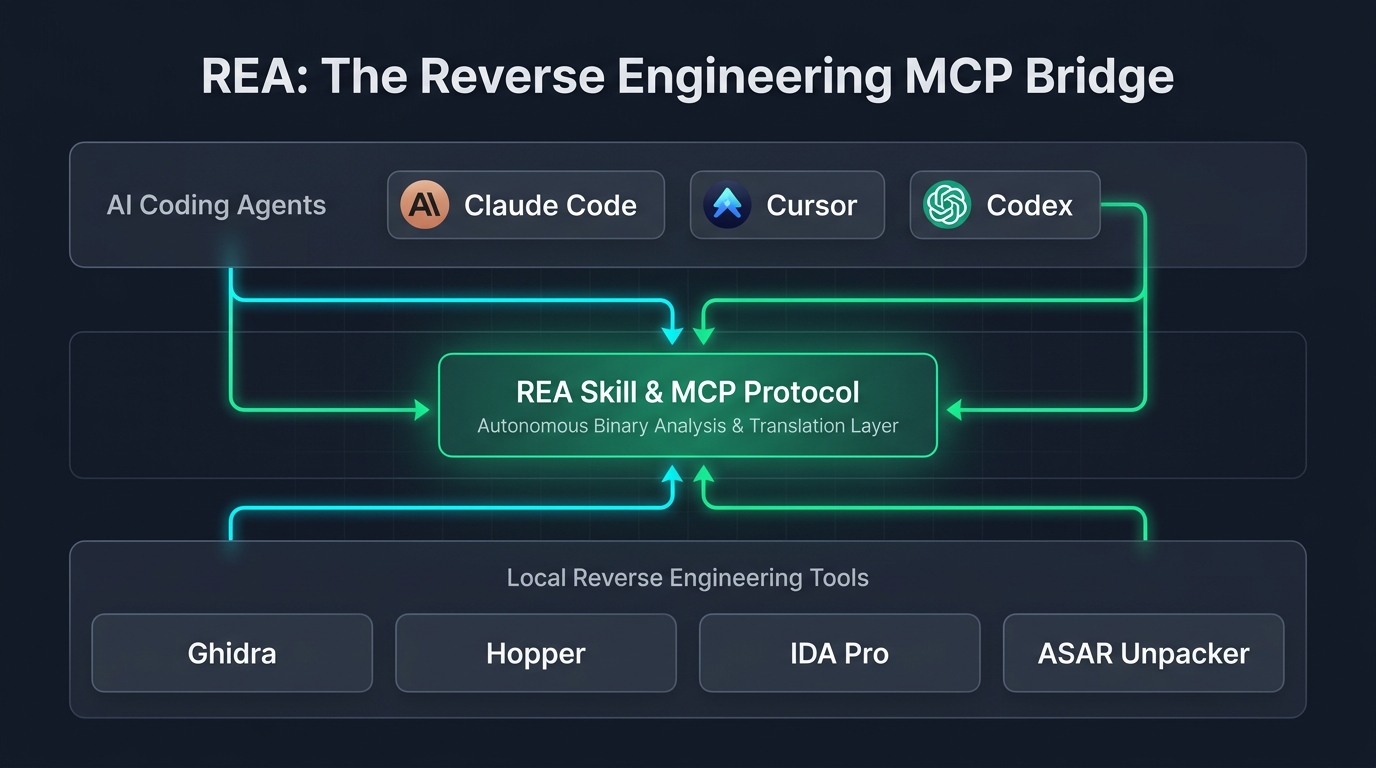
The technical reality is far more grounded. Detailed code walkthroughs across technical forums reveal that the genius of morluto/rea lies in its architectural orchestration—it operates as a specialized reverse-engineering bridge powered by the Model Context Protocol (MCP).
Instead of naively feeding megabytes of unparsed raw binary into an LLM context window—which would immediately trigger token exhaustion and severe hallucinations—REA enforces a disciplined, multi-stage investigative workflow:
- Automated Reconnaissance and Unpacking (Inspection Layer): Once an analysis target is designated, REA directs local file sniffers and unpacking utilities to identify whether the target relies on Electron scaffolding, compiled C/C++ native binaries, or WebAssembly components, automatically stripping off outer compression layers;
- Symbol Table and Pseudocode Extraction (Decompilation Bridge): Under the hood, the skill orchestrates local professional decompilation frameworks (such as Ghidra, Hopper, or specialized disassemblers), systematically extracting call graphs, constant string tables, and raw decompiled pseudocode;
- Semantic Reconstruction via LLMs (Semantic Rebuilding): This final stage is where frontier language models shine. Armed with structured pseudocode fragments, the AI observes the mathematical signatures of individual functions, translating cryptic expressions like
var _0x5f = p1 * 0.08back into intuitive statements likeconst salesTax = price * 0.08, while restructuring mangled control flow graphs into clean modern modules.
In short, local binary utilities handle the deterministic heavy lifting of decompilation, while the frontier language model acts as the senior software architect reading the diagnostic autopsy, resulting in unprecedented analytical velocity.
How the Community Is Using It: Auditing Competitors and Rescuing Legacy Systems
Across Reddit, specialized Discord servers, and developer groups, engineers have already begun deploying REA across a broad spectrum of real-world scenarios:
* Pixel-Perfect Competitive Audits and Protocol Analysis: Independent developers frequently struggle to understand the proprietary capabilities of market competitors. Running REA against target binaries instantly exposes what open-source dependencies are bundled, reveals undocumented private API telemetry formats, checks whether local storage is securely encrypted, and surfaces hidden privacy analytics. * Rescuing Abandoned Legacy Corporate Infrastructure: Many engineering organizations live in constant fear of mission-critical business dependencies written in C++ by engineers who departed a decade ago. Source repositories are frequently lost or unbuildable on modern toolchains. Engineers have reported using REA alongside Claude Code to extract core mathematical routines from abandoned legacy DLLs, completely rewriting the underlying business logic into modern Go microservices in a single afternoon. * Software Archaeology and Retro Game Preservation: Hobbyist developers have fed classic Game Boy Advance ROMs and vintage DOS binaries into the pipeline, directing the model to analyze sprite rendering routines and collision detection arrays, subsequently porting vintage gaming experiences into modern HTML5 Canvas and WebAssembly implementations.
The Sunset of Closed-Source Security: Obfuscation Is No Longer a Viable Defense
The broader conversation ignited by REA centers on whether closed-source commercial software can maintain meaningful proprietary moats in an era of agentic decompilation.
For decades, commercial enterprises have relied on complex code obfuscators and binary packing techniques to protect intellectual property. They scrambled variable names into gibberish, injected convoluted bogus control branches, and bet on the exhaustion of human analysts—operating on the assumption that if code was sufficiently painful to read, reverse engineers would abandon the pursuit.
Against frontier AI reasoning, that defensive philosophy has completely collapsed: * Large language models experience zero cognitive fatigue when parsing millions of obfuscated tokens; * Models possess vast contextual intuition synthesized from the world's collective open-source codebases. When an AI encounters matrix multiplication or bitwise XOR manipulation inside an unlabelled function, it recognizes SHA-256 hashing or JWT validation within milliseconds, regardless of variable naming.
Attempting to protect proprietary business logic through code obfuscation is now the digital equivalent of trying to stop an armor-piercing projectile with plastic wrap.
Practical Recommendations for Developers and Creators
Whether you are eager to experiment with this groundbreaking tool or are a commercial software creator seeking to defend your intellectual property, here is how you should navigate this shift:
1. How to Get Started Quickly:
* Verify that your local machine has Node.js installed alongside an MCP-compatible agent environment such as Claude Code or Cursor;
* Run npx rea-agents setup inside your development directory to automatically generate the required configuration manifests and skill instructions (SKILL.md);
* Pass the path of a local binary or application package directly into your agent interface with an explicit goal, such as asking it to analyze network interception layers and export them as clean TypeScript definitions.
2. Defensive Guidelines for Commercial Creators:
* Abandon the Illusion of Client-Side Secrecy: Any proprietary algorithmic logic compiled into client-side executables—especially within Electron, Flutter, or WebAssembly wrappers—must be considered entirely public in the era of AI-driven reverse engineering;
* Consolidate Proprietary Assets on the Server: High-value proprietary algorithms, proprietary model weights, and sensitive validation logic must reside entirely behind authenticated cloud APIs, leaving client applications as thin presentation layers.
3. Legal and Ethical Boundaries:
* Apply agentic reverse-engineering frameworks strictly for authorized vulnerability audits, legacy codebase maintenance, and legitimate interoperability research; never leverage decompilation tooling to bypass commercial license validations or pirate proprietary assets.