NVIDIA to Acquire Hugging Face for $12.93 Billion: The Open AI Commons Reshuffled
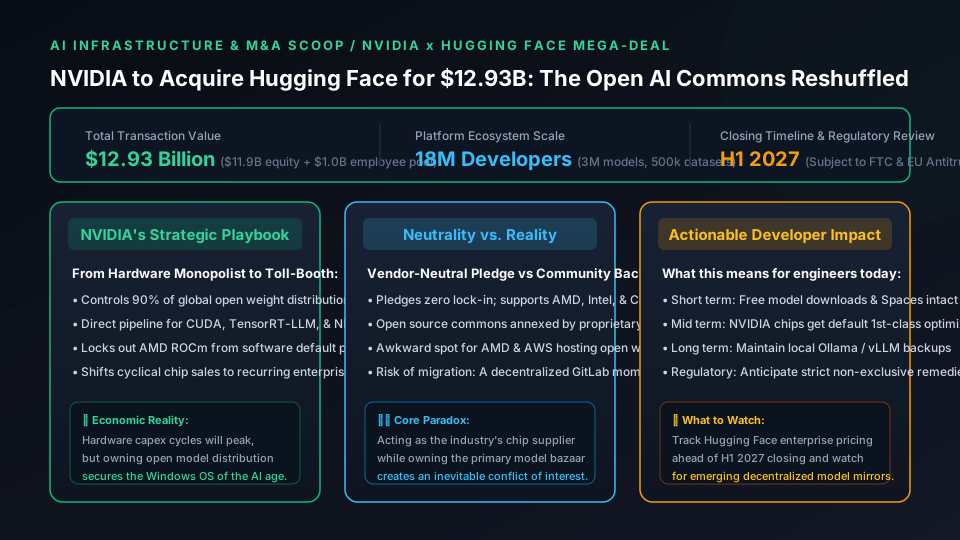
On September 3, 2026, NVIDIA announced a definitive agreement to acquire open-source AI platform Hugging Face for $12.93 billion ($11.9B equity value + $1.0B retention pool), targeting an H1 2027 close pending FTC and EU antitrust reviews. Despite repeated pledges of permanent vendor neutrality and continued support for AMD, Intel, and multi-cloud environments, the deal places 18 million developers, 3 million model weights, and 500,000 datasets under the control of the dominant chipmaker. This structural shift threatens to marginalize AMD ROCm's developer traction, raises data governance concerns among open-source purists, and accelerates the emergence of decentralized model distribution alternatives.
# NVIDIA to Acquire Hugging Face for $12.93 Billion: The Open AI Commons Reshuffled
On the evening of September 3, 2026, global AI compute giant NVIDIA officially announced a definitive agreement to acquire Hugging Face, the world's leading open-source AI repository and developer platform, for an aggregate consideration of approximately $12.93 billion. The transaction structure comprises approximately $11.9 billion in cash and stock consideration payable to Hugging Face equity stockholders, alongside a dedicated $1.0 billion equity retention pool reserved for key engineering leaders and artificial intelligence research personnel. The historic transaction is targeted to close in the first half of 2027, subject to customary corporate closing conditions and exhaustive antitrust regulatory scrutiny from the U.S. Federal Trade Commission (FTC), the Department of Justice, and the European Commission.
Although NVIDIA founder and CEO Jensen Huang and Hugging Face co-founder and CEO Clément Delangue repeatedly pledged in their joint broadcast that the platform will "remain permanently vendor-neutral, impose zero proprietary hardware lock-in, and continue supporting multi-cloud architectures alongside competitor silicon including AMD, Intel, and Google Cloud TPU," the global open-source community and the semiconductor sector were plunged overnight into profound existential uncertainty.
The open-source ecosystem's most celebrated independent lighthouse has officially been acquired by the world's most formidable compute monopolist.
---
What Happened: The Hard Numbers Behind the $12.93B Mega-Deal
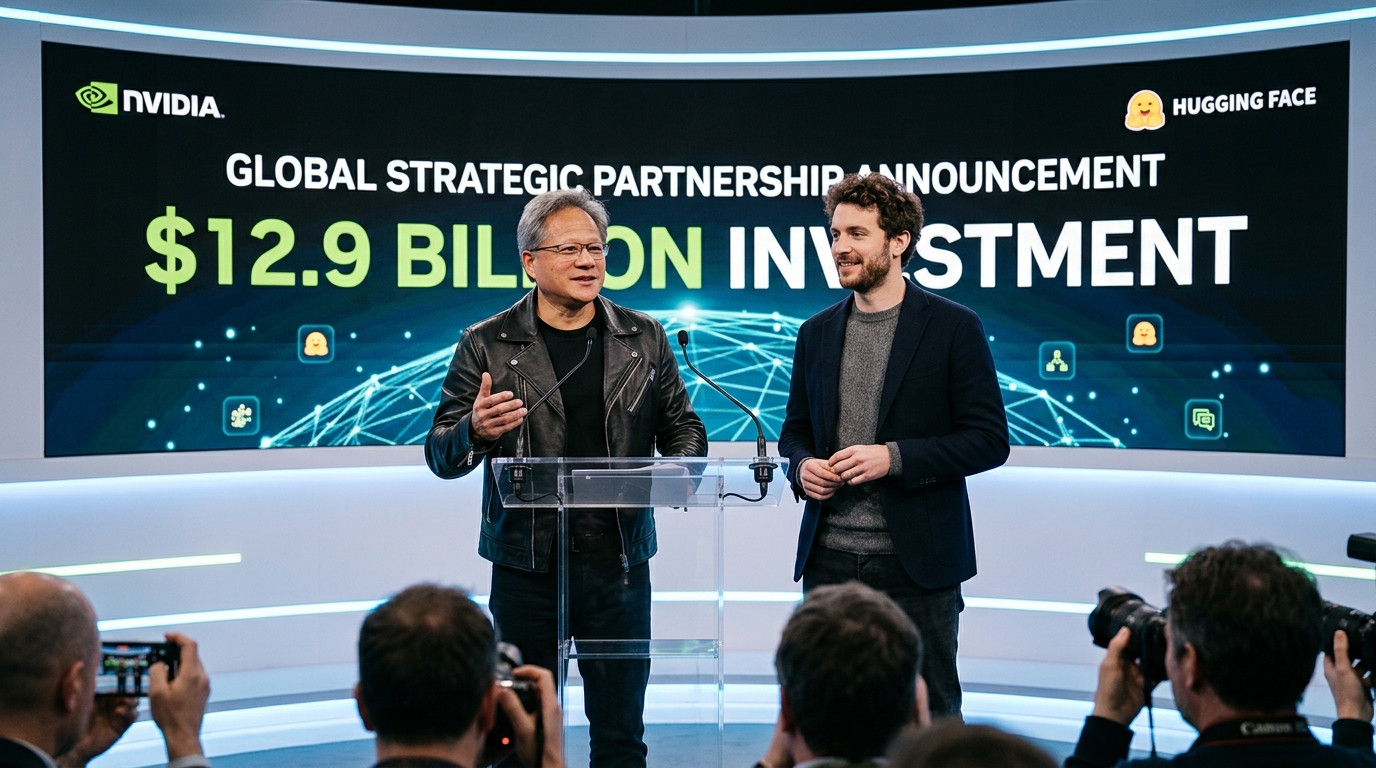
This is no ordinary corporate technology acquisition; it represents the largest, most consequential ecosystem consolidation in software development history since Microsoft's landmark $7.5 billion acquisition of GitHub in 2018.
According to official joint press releases, investor conference calls, and Form 8-K disclosures submitted to the U.S. Securities and Exchange Commission (SEC), the core financial and operational boundaries of the transaction are unambiguous:
1. Transaction Structure and Consideration: An aggregate enterprise deal value of $12.93 billion, split into roughly $11.9 billion in shareholder equity consideration and up to $1.0 billion in multi-year vesting retention restricted stock units (RSUs) specifically earmarked for core Hugging Face researchers, maintainers, and distributed systems software engineers; 2. Platform Scale and Ecosystem Assets: Hugging Face hosts over 18 million registered AI developers, more than 3 million open model weights, 500,000 standardized training datasets, and over 1 million interactive Spaces applications. It operates as the undisputed distribution backbone and collective town square for open-source AI globally; 3. Closing Roadmap and Approvals: Both corporate boards of directors have unanimously approved the definitive merger agreement, establishing an operational closing target in the first half of 2027 pending multinational regulatory clearances; 4. The Official "Vendor-Neutrality" Pledge: - NVIDIA compute architecture will not be mandatory to build on, fine-tune within, deploy through, or consume across the Hugging Face platform; - The platform will rigorously preserve an open multi-cloud deployment posture, actively maintaining engineering collaborations with Amazon Web Services (AWS), Google Cloud Platform (GCP), and Microsoft Azure; - Hugging Face will guarantee comprehensive ongoing interoperability for PyTorch, JAX, AMD ROCm, Intel Gaudi, and Apple MLX across model registry discovery, artifact downloads, and hardware execution backends.
On paper, this reads like an idyllic tech partnership: a balance-sheet titan providing patient, deep-pocketed capital to underwrite an essential, high-bandwidth public commons. But peel back the corporate diplomacy and legal phrasing, and this mega-merger fundamentally reallocates the balance of power across the entire foundation model economy.
---
Why It Matters: From Selling Pickaxes to Owning the Turnpike
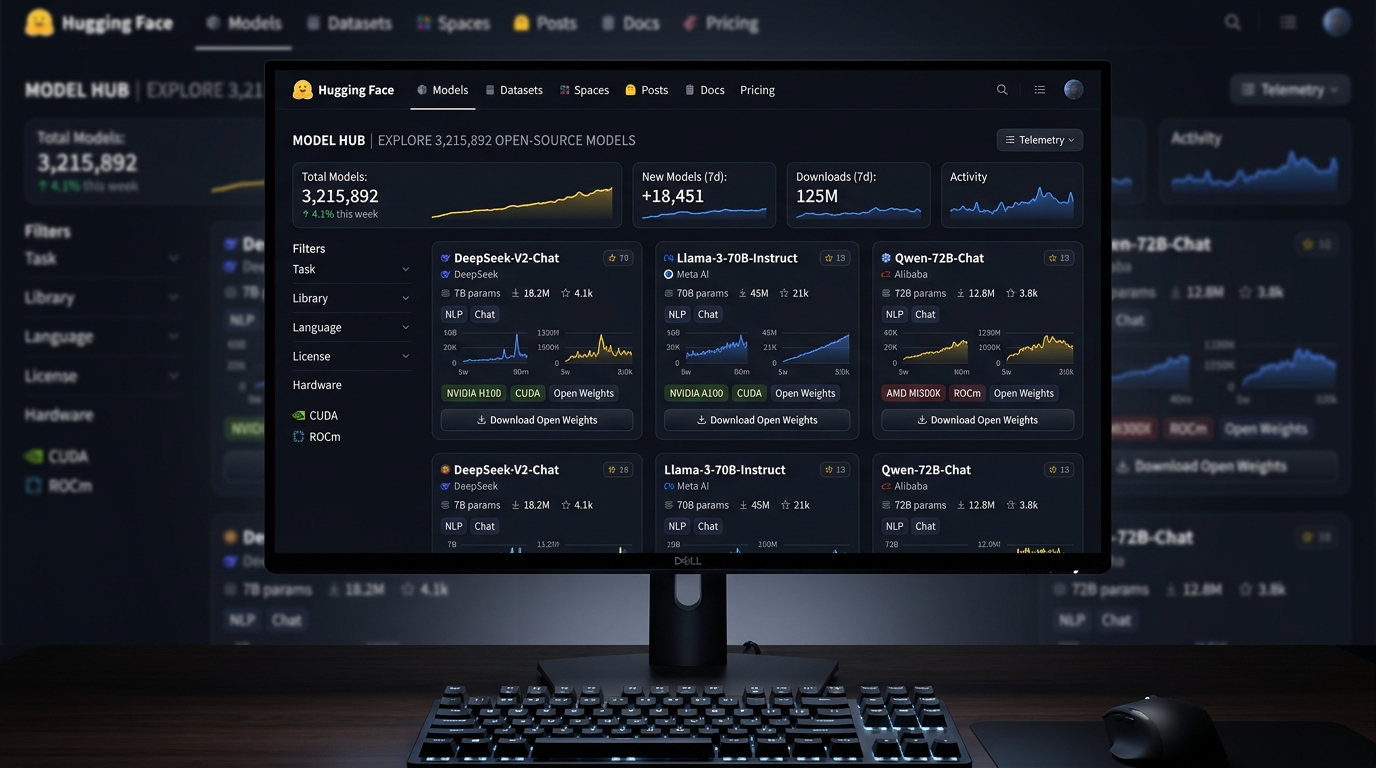
For the past three years of the generative artificial intelligence boom, mainstream Wall Street and Silicon Valley consensus viewed NVIDIA almost exclusively as an indispensable, high-margin compute mint. Riding an 85%-plus market share in datacenter AI accelerators and the seemingly unbreachable developer software moat of CUDA, NVIDIA's market capitalization skyrocketed past $4 trillion.
Yet Jensen Huang understands better than anyone that cyclical hardware capital expenditure booms inevitably encounter macroeconomic gravity.
Hyperscaler datacenter capex cannot compound at triple-digit annual rates forever. Specialized application-specific integrated circuits (ASICs) and sovereign cloud clusters are aggressively carving out market share in high-volume inference workloads. Furthermore, relentless algorithmic efficiency breakthroughs over the past twelve months—exemplified by DeepSeek-style sparse Mixture-of-Experts (MoE) architectures and dynamic context-compression algorithms—have proven that model inference can achieve staggering latency and throughput gains without requiring endless additions of liquid-cooled GPU racks.
By acquiring Hugging Face, NVIDIA decisively transitions from being a hardware merchant selling pickaxes to gold prospectors into a sovereign operating-system monopoly collecting perpetual royalties on the very turnpikes leading into the goldfields.
1. Preempting AMD ROCm's Last Software Counter-Attack AMD has closed significant silicon ground with its Instinct MI300 and MI350 accelerator series, leveraging enormous High Bandwidth Memory (HBM3e) capacities and memory bandwidth to mount genuine cost-performance competition against NVIDIA's H100 and Blackwell systems in large-model inference. Yet AMD's recurring Achilles heel has always been software: the ROCm software stack routinely lags CUDA in out-of-the-box support for the newest frontier model architectures.
Previously, Hugging Face operated as a scrupulously neutral distribution exchange where community developers independently authored and maintained multi-backend hardware compatibility. Under NVIDIA ownership, that dynamic tilts irrevocably. NVIDIA gains direct, day-zero engineering integration pipelines to bake TensorRT-LLM, NeMo microservices, and NVIDIA NIM containers directly into Hugging Face's default, one-click containerization and serverless deployment workflows.
Whenever an enterprise engineer clicks "Deploy" or pulls an inference container on Hugging Face in the future, NVIDIA-accelerated images will be the fastest, lowest-latency, zero-configuration first choice. AMD ROCm, Intel Gaudi, and emerging specialized NPUs risk being sidelined into secondary, community-maintained friction and protracted debugging cycles.
2. Full-Stack Consolidation: Constructing the Toll-Booth for Model Distribution Prior to the acquisition, Hugging Face possessed peerless developer mindshare but grappled with the universal dilemma of commercial monetization. Its revenues relied on modest margins from Inference Endpoints, enterprise on-premise hub licensing, and premium Spaces compute rentals.
NVIDIA fundamentally alters that economic calculus: - NVIDIA does not need Hugging Face to generate standalone quarterly software profits; - It intends to convert Hugging Face into the world's most prolific top-of-funnel customer acquisition engine for DGX Cloud and proprietary enterprise software subscriptions; - Every time 18 million developers train, fine-tune, quantize, or benchmark a model on Hugging Face, the underlying compute cycles will naturally route into NVIDIA hardware or its tier-one sovereign and hyperscale cloud partners.
---
The Neutrality Paradox: Can a Referee Also Play Forward?
Jensen Huang explicitly stated: "Hugging Face will continue to operate as an open, vendor-neutral platform. Anyone can use it without needing NVIDIA hardware."
While legally pristine and public-relations compliant, that assertion creates immediate, unresolved conflicts of interest under real-world competitive commercial pressures.
Paradox 1: Competitors' Core Assets Held Hostage Consider the surreal structural reality this acquisition creates across the modern AI landscape: - Meta's next-generation open Llama weights must be uploaded immediately onto servers and repositories owned and operated by NVIDIA; - Google's open Gemma models and JAX optimization kernels will be indexed and distributed through a property owned by its chief hardware competitor; - Amazon AWS and Microsoft Azure, having poured tens of billions into custom silicon like Trainium, Inferentia, and Maia, must host official deployment templates on a platform owned by their main supplier and competitor; - Even AMD, whose entire long-term corporate roadmap hinges on breaking NVIDIA's proprietary monopoly, must host its official developer hub and hardware verification artifacts on an NVIDIA-owned domain.
When the entire open-source registry and artifact repository of the global AI industry resides within the balance sheet of a single chipmaker, "neutrality" becomes a fragile privilege granted at the operational discretion of the reigning market leader.
Paradox 2: The Black-Box Code Audit and Telemetry Concern In open-source software engineering, transparent provenance and verifiable trust are foundational tenets. Within hours of the announcement, engineering forums across Hacker News, Reddit, and X erupted with data-governance concerns: - When foundation model teams host private repositories containing pre-release checkpoints and proprietary fine-tuning hyperparameters, what structural firewalls prevent NVIDIA from accessing aggregate telemetry, model usage patterns, or early architecture trends? - Under tightening U.S. export controls and national security defense directives, can an entity wholly owned by a publicly traded American semiconductor champion maintain unrestricted, equitable access for international research teams across Europe, Asia, and the Global South?
---
Our Editorial Assessment: The Great Migration and the Open Source Watershed
Reviewing previous tectonic platform acquisitions across modern software history—Oracle's hostile takeover of Sun Microsystems (which swallowed Java and MySQL), Microsoft's acquisition of GitHub, and IBM's purchase of Red Hat—we identify three clear, structural inflection points for the coming cycle:
Assessment 1: Calm in the Short Term, Compute Favoritism in the Medium Term - Next 6 to 12 Months (Pre-Closing): Daily platform operations will remain virtually untouched. To navigate regulatory scrutiny smoothly, NVIDIA will go out of its way to showcase AMD, Apple, and Google compatibility, avoiding any overtly anticompetitive actions; - Post-2027 Closing: Subtle architectural advantages will manifest across the developer interface. NVIDIA NIM containers, NVLink-optimized kernels, and TensorRT pipelines will become frictionless defaults, while support for rival accelerators will face delayed maintenance and elongated bug triage cycles; - Long Term (3+ Years): Hugging Face enterprise offerings will deeply couple with NVIDIA AI Enterprise software licensing, transforming the public commons into an onboarding veranda for proprietary hardware sales and cloud compute contracts.
Assessment 2: Decentralized Hubs (The "GitLab Moment" for Model Weights) When Microsoft acquired GitHub in 2018, GitLab experienced historic momentum, and on-premise self-hosting proliferated rapidly across security-conscious organizations.
In artificial intelligence, that counter-reaction will be significantly magnified. Because model weights span tens or hundreds of gigabytes, bandwidth and storage costs historically deterred smaller competitors from building rival distribution hubs.
NVIDIA's ownership will catalyze intense developer demand and venture investment into decentralized weight mirrors, open BitTorrent peer-to-peer distribution networks, and IPFS/Arweave cryptographic artifact registries. Independent platforms such as ModelScope, the Ollama local registry, and non-profit open-source foundations now face a generational opportunity to capture neutral developer mindshare.
Assessment 3: An 18-Month Regulatory Odyssey A $12.93 billion platform consolidation of this magnitude will face intense antitrust resistance across three continents. NVIDIA is already contending with regulatory inquiries across Washington, Brussels, and London over GPU allocations, pricing practices, and CUDA exclusivity provisions.
Antitrust regulators will inevitably demand sweeping behavioral remedies: independent governance boards, mandatory API interoperability covenants, and strict prohibitions against algorithmic deprioritization of competing silicon. If remedies prove insufficient to appease European and American regulators, the probability of prolonged litigation or formal merger challenges remains exceptionally high.
---
Actionable Takeaways for Developers: What to Do Today
For software engineers and AI startups who interact with Hugging Face daily, there is zero cause for immediate operational panic, but practical risk mitigation should begin immediately:
- Mirror Mission-Critical Weights Locally: Never rely on a single hosted repository as an unbacked point of failure. Back up all production foundation model checkpoints, LoRA adapters, and custom tokenizers to local enterprise NAS storage, private AWS S3 buckets, or self-hosted MinIO clusters;
- Decouple the Inference Runtime: Build rigorous abstraction layers between your model loader and execution backend. Prioritize open, hardware-agnostic runtimes like vLLM, SGLang, TGI, or Ollama that can seamlessly switch between NVIDIA, AMD, and custom cloud silicon without rewriting application logic;
- Establish Automated Mirror Pipelines: Script automated fallback synchronization to alternative hubs like ModelScope or private Git LFS mirrors. In the event of unexpected policy revisions, licensing shifts, or regional access constraints, your core production pipelines can pivot with zero downtime.
---
Unresolved Questions to Watch
- Antitrust Regulatory Conditions: Will the FTC and the European Commission mandate legally enforceable non-discrimination covenants or require structural separation of cloud compute offerings?
- Competitor Retaliation: Will AMD, Amazon AWS, and Meta counter by co-funding a neutral, non-profit open model foundation backed by subsidized multi-accelerator compute?
- Talent Retention at Hugging Face: Can a $1.0 billion equity pool retain core engineers devoted to open-source purism, or will top maintainers depart to launch independent, decentralized alternatives?
---