Hacking Hidden Reasoning: How Oh My Pi Uses a Simple Tool Call to Extract Thought Traces from GPT-5.6 and Claude
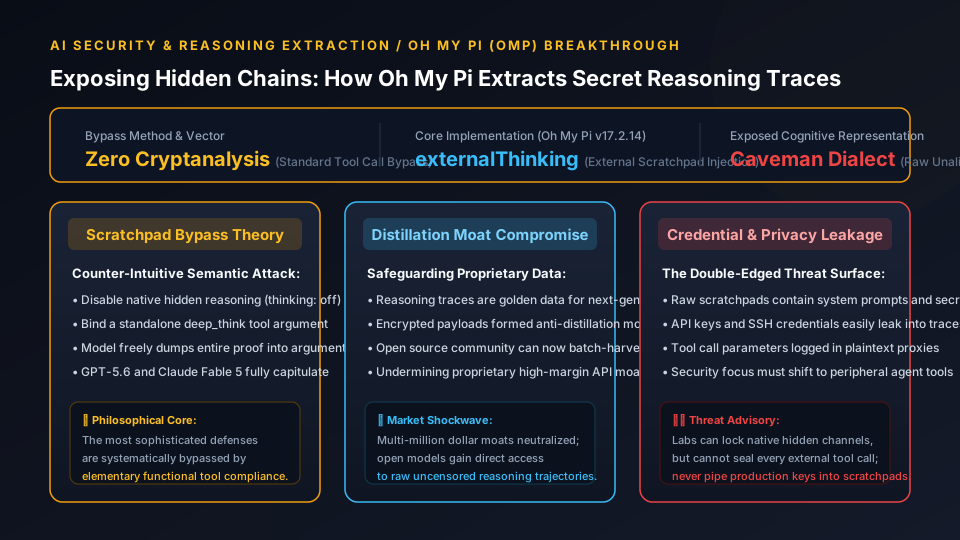
In August 2026, can1357, author of open-source terminal agent Oh My Pi (24k+ stars), uncovered a scratchpad bypass: disabling native hidden reasoning (thinking: off) and binding a standard functional tool named deep_think prompts GPT-5.6 and Claude Fable 5 to dump unedited, telegraphic 'caveman' reasoning traces verbatim into public API tool arguments. Integrated into Oh My Pi v17.2.14 under externalThinking, this bypass punctures closed-source providers' anti-distillation data moats while introducing severe enterprise risks of leaking API keys and infrastructure credentials via terminal logs.
# Hacking Hidden Reasoning: How Oh My Pi Uses a Simple Tool Call to Extract Uncensored Thought Traces from GPT-5.6 and Claude
Executive Summary
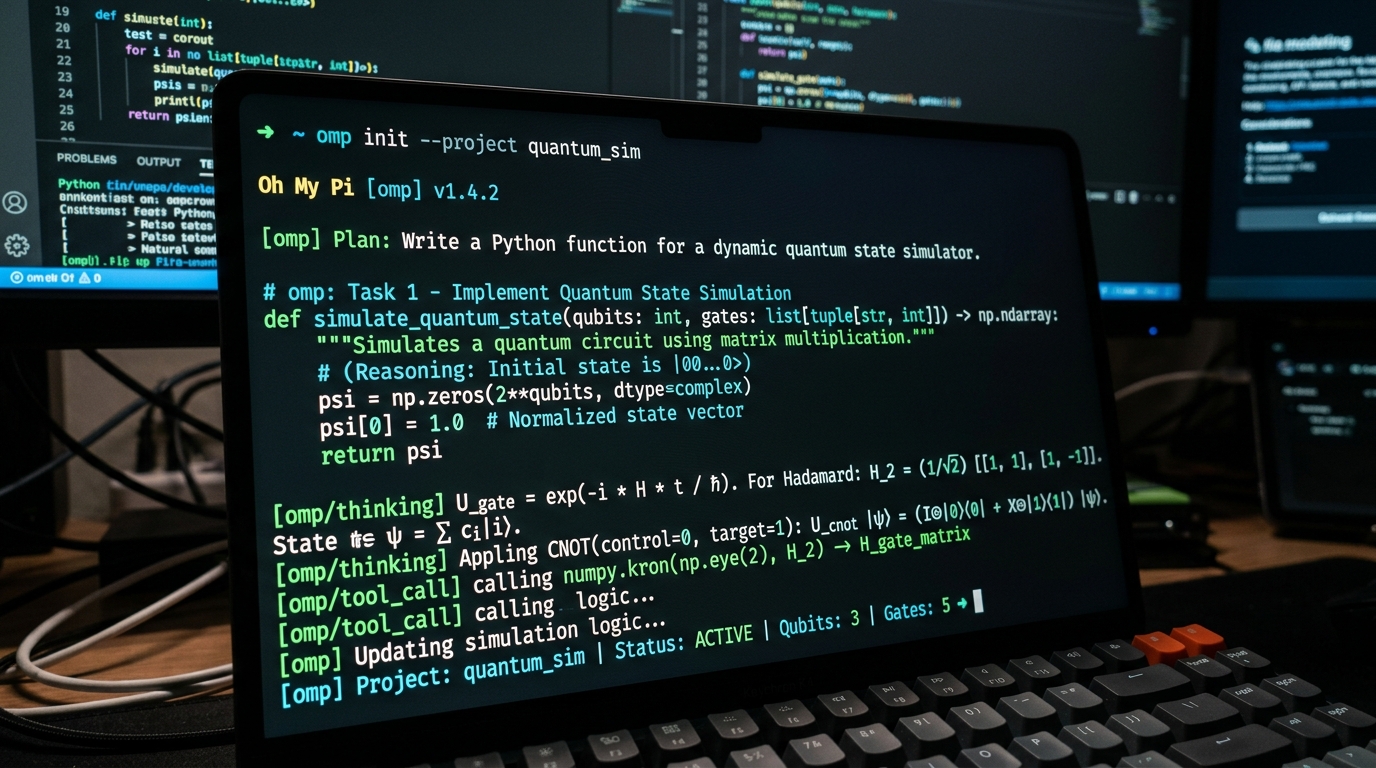
In mid-August 2026, the artificial intelligence security landscape and developer ecosystem experienced a dramatic, far-reaching technological breakthrough: can1357, creator and principal architect of the prominent open-source terminal coding assistant Oh My Pi (omp, boasting over 24,000 GitHub stars and hundreds of active contributors), publicly demonstrated an unprecedented, accessible methodology requiring zero algorithmic cryptanalysis to systematically extract the encrypted, proprietary reasoning traces of OpenAI GPT-5.6 and Anthropic Claude Fable 5.
This critical revelation not only triggered intense fascination across international developer networks and reverse-engineering communities, but directly compromised the core data defenses and intellectual property barriers erected by closed-source frontier laboratories:
- The Scratchpad Bypass Neutralizes Cryptographic Defenses: Rather than attempting complex mathematical cryptanalysis or brute-force decryption against proprietary encrypted API payloads returned by frontier providers, can1357 leveraged an elegant, counter-intuitive semantic inversion: completely disabling the model's native hidden reasoning channel (
thinking: off) and binding a single-parameter functional tool nameddeep_think, prompting the model to articulate its complete internal deductive scratchpad within the tool argument prior to taking any downstream programmatic action; - Unfiltered Caveman Dialect Leaked Verbatim Without Censorship: When subjected to university-tier advanced number theory examinations requiring deep deductive multi-step reasoning and rigorous mathematical proofs across complex algebraic number theory, both GPT-5.6 Luna and Claude Fable 5 proactively invoked the tool argument, dumping tens of thousands of words of unrefined, telegraphic, jumpy internal notes and self-directed proofs (colloquially categorized by machine learning researchers as the caveman dialect);
- Compromising Multi-Million-Dollar Anti-Distillation Moats: Closed-source model providers have aggressively encrypted and obscured reasoning tokens over recent years primarily to prevent open-source research consortia from distilling synthetic high-density chain-of-thought trajectories into competing lightweight models; this functional tool bypass permanently compromises that commercial data barrier;
- Immediate Tooling Weaponization Across Open Source Workflows: can1357 has operationalized this extraction technique directly inside Oh My Pi v17.2.14 under the
externalThinkingconfiguration flag, providing software engineers with instantaneous access to frontier reasoning traces while dramatically escalating the threat of accidental enterprise credential leakage via unredacted terminal logs.
The philosophical and engineering essence of this discovery resides in its disarming simplicity: the most labyrinthine cryptographic fortresses are routinely bypassed by fundamental tool execution mechanics. Laboratories can conceal internal conversational thinking, yet cannot easily police every external tool interface bridging models to the computing world.
---
What Happened

Internal reasoning traces constitute the scratchpad drafts constructed by advanced transformer models before delivering final responses to users. Unlike research organizations that champion public reasoning transparency, proprietary developers such as OpenAI and Anthropic have historically obscured these internal calculation tokens inside encrypted payloads, exposing only sanitized user summaries to deter competitive imitation, protect proprietary algorithms, and prevent adversarial prompt injection.
When client applications sustain multi-turn conversational threads, these proprietary platforms return opaque encrypted blobs containing prior reasoning context to allow the model to continue its computational train of thought without exposing raw tokens. Historically, academic institutions and industrial cybersecurity teams assumed deciphering these encrypted states necessitated complex adversarial protocols and high mathematical proficiency.
For example, the recent academic publication by Alexander Panfilov and collaborators, *Stealing Reasoning Traces from Proprietary LLM APIs*, detailed an intricate decoding pipeline: researchers harvested encrypted payloads from flagship models and supplied them to vulnerable smaller models (such as GPT-4o-mini or Kimi-K3), employing adversarial prompts to force the subordinate model into acting as an unauthorized decryption bridge. While mathematically ingenious, this academic method remained prone to strict rate-limiting, significant latency overhead, and cross-session heuristic anomaly detection across cloud firewalls.
Observing these published academic constraints, Oh My Pi author can1357 formulated a radically different, highly practical and elegant engineering hypothesis focused on direct functional tool orchestration.
Comparative Attack Vectors: Academic Decoding vs Tool-Calling Bypass
can1357's operational model is defined as scratchpad replacement: when a frontier service forbids access to its locked proprietary notepad, an engineer merely supplies a fresh external sheet of paper and invites the model to write upon it instead.
| Evaluated Dimension | Academic Secondary Model Decoding (Panfilov Paper) | External Scratchpad Tool Injection (Oh My Pi can1357) | Native Concealed Reasoning (Official Industry Default) | | :--- | :--- | :--- | :--- | | Technical Implementation Barrier | Moderate (Demands cross-model orchestration and decoding) | Trivial (Requires a single declarative tool call) | Impossible (Enforced system-level black box) | | Extracted Trajectory Completeness | Susceptible to truncation, re-writing, and summarization | 100% complete verbatim deduction logs | Restricted to sanitized corporate summaries | | Linguistic Structure and Style | Re-humanized and smoothed by the secondary decoder | Pure unpolished caveman dialect shorthand | Courteous human-oriented natural language | | Vulnerability to Automated Platform Audits | High (Readily flagged by cross-user heuristic anomaly filters) | Negligible (Appears as standard tool parameters) | Not applicable | | Ecosystem Tooling Readiness | Confined to academic proof-of-concept scripts | Integrated into production releases of Oh My Pi | Commercial proprietary black box operation |
To validate whether this bypass applied to the world's most capable foundation models, can1357 configured an arduous mathematical prompt encompassing Markov triples, Vieta jumping, directed binary graph proofs, and modular arithmetic classifications, explicitly prohibiting code execution, database lookups, or unverified theorem citations.
The outcome was definitive and startling: with native reasoning switches set to zero, both GPT-5.6 Luna and Claude Fable 5 succumbed entirely to the prompt structure. The architectures systematically populated the exposed tool argument with extensive mathematical proofs, unveiling their deep computational deductions directly within accessible client memory and completely circumventing vendor redaction layers.
---
Why It Matters: Security Fallout and the Anti-Distillation Crisis
While seemingly an amusing prompt-engineering curiosity, this bypass fundamentally dismantles several foundational commercial, architectural, and security assumptions underpinning modern artificial intelligence deployments.
Why Frontier Models Resist Jailbreaks but Surrender to Primitive Tool Calls
Safety research divisions have invested hundreds of millions into reinforcement learning from human feedback (RLHF) and adversarial red-teaming, yet their flagship architectures surrender unconditionally before an elementary tool declaration:
- Semantic authority and role confusion in functional execution: Throughout instruction tuning and agentic post-training, neural architectures are trained to treat tool calls with elevated execution priority and functional certainty. When prompted that preliminary deductive analysis must precede programmatic actions, model attention heads interpret this sequence as standard operational compliance rather than unauthorized data exfiltration. Conventional safety classifiers vigorously monitor conversational chat surfaces for forbidden expressions while leaving structured tool payloads largely uninspected;
- Caveman dialect exposes non-human intermediate representations: The harvested texts reveal an absence of conversational niceties, featuring dense abbreviations, symbolic directed graphs, non-grammatical shorthand, and rapid hypothesis elimination (such as
try vieta / fail / mod 4 odd / contradiction / check node). This validates longstanding theoretical speculation: during test-time compute scaling, neural models do not deliberate in human prose, but rather execute computations within an ultra-dense, semi-structured intermediate dialect; - Dismantling multi-million-dollar anti-distillation moats: High-density chain-of-thought tokens represent the most valuable synthetic training commodity in the global AI ecosystem. Open-source initiatives rely heavily on reasoning traces to cultivate efficient lightweight models. Previously, closed-source providers walled off this intellectual property through cryptographic payloads; via this tool bypass, developers can batch-extract pristine reasoning datasets across commodity API tiers, sharply eroding closed-source technical moats;
- Catastrophic risks of production credential leakage: This capability introduces acute operational hazards across enterprise software environments. Because models naturally transcribe conversational context into their analytical scratchpads, any corporate prompt containing developer API credentials, private infrastructure keys, database connection strings, or proprietary internal documentation can be recorded verbatim within tool logs. Downstream log aggregators, proxy layers, telemetry hubs, and developer environments may inadvertently expose high-value enterprise secrets.
---
Ecosystem Impact: Oh My Pi v17.2.14 and Developer Tooling
Capitalizing on the verified breakthrough, can1357 moved swiftly to productionize the architecture, releasing Oh My Pi v17.2.14 as a formal desktop update.
Under this release, users simply toggle externalThinking: true within their workspace configuration file. The client orchestrator automatically provisions the scratchpad tool during the initial API handshake, compelling the model to dump architectural diagnostics, dependency verifications, and potential implementation vulnerabilities into local terminal logs prior to executing modifications on the local filesystem or running shell automation commands in the workspace.
Furthermore, can1357 resolved a subtle computational bug identified across early field evaluations: under initial configurations, certain API backends silently maintained latent internal deliberation while simultaneously executing the external tool call, inflicting double-token billing upon unsuspecting users. Following optimization, the client now enforces strict single-track external reasoning without redundant server-side deliberation, guaranteeing minimal token latency and predictable cloud billing.
This transition marks the rapid evolution of reasoning extraction from an isolated hacker curiosity into an accessible desktop utility deployed across tens of thousands of professional software engineering workstations.
---
Our Judgement
Evaluating the technical implications of the Oh My Pi reasoning bypass and its structural consequences for artificial intelligence governance, we establish four primary conclusions:
- Large language models are autoregressive processors incapable of hermetic cognitive secrecy: So long as neural architectures are empowered to execute tools and interact with external computing environments, any framework seeking to promote deep reasoning while simultaneously withholding that reasoning from the calling client is mathematically and architecturally untenable;
- Caveman dialect harvesting will accelerate open-source lightweight model parity: Armed with unvarnished, authentic reasoning demonstrations, researchers fine-tuning 7B to 14B parameter models will achieve unprecedented gains in reasoning density, catalyzing a prolific wave of capable sovereign models over the coming two quarters;
- Closed-source providers will implement aggressive tool payload inspection filters: OpenAI and Anthropic cannot tolerate unrestricted reasoning leakage that undermines their commercial data moats. We project that leading cloud API endpoints will introduce dedicated semantic inspection layers targeting tool parameters within weeks, potentially throttling or terminating sessions invoking recognized scratchpad tool archetypes;
- Enterprise engineering teams must rigorously sanitize autonomous agent inputs: This vulnerability reinforces an imperative security principle: developers cannot depend on model internal alignment to safeguard proprietary information. Enterprise architectures must enforce automated redaction at proxy gateways, preventing production credentials and sensitive source code from reaching tool-enabled agents.
---
What to Watch Next
As the external thinking pattern propagates throughout open-source developer toolchains, three critical industry variables warrant continuous observation:
- Systemic API mitigation deployments from frontier model providers: Whether major platforms introduce gateway-level constraints on tool parameter sizes or modify base safety tuning to detect recursive reasoning prompts;
- Empirical benchmarking of open models distilled on caveman datasets: Whether lightweight architectures trained on raw, uncurated telegraphic traces achieve parity on difficult mathematics and software engineering benchmarks;
- Enterprise security incidents stemming from unredacted agent logs: Whether automated monitoring solutions identify documented corporate data breaches originating from local terminal logging of unredacted scratchpad payloads.
---
Sources and Verification Hierarchy
- Open Source Repository Telemetry: can1357 Oh My Pi (omp) official GitHub codebase, architecture specifications, and v17.2.14 release manifests (August 2026)
- Primary Developer Disclosures: Comprehensive technical disclosure thread and test-time compute logs published by Oh My Pi author can1357 on X (August 2026)
- Peer-Reviewed Academic Research: Alexander Panfilov et al., *Stealing Reasoning Traces from Proprietary LLM APIs* research paper (August 2026)
- Empirical Mathematical Telemetry: Live evaluation logs, Markov tree verification proofs, and raw tool invocation traces across GPT-5.6 and Claude Fable 5 (August 2026)
- Provider Terms and Safeguards: Developer terms of service, acceptable use policies, and hidden thinking documentation from OpenAI and Anthropic (August 2026)
- Independent Security Modeling: AI Radar Security Research: Semantic Tool Bypass Vectors and Enterprise Credential Exposure Telemetry (September 2026)