OpenAI Redesigns ChatGPT in Its Biggest Overhaul in 4 Years: Intelligent UI Dismantles the Chatbox
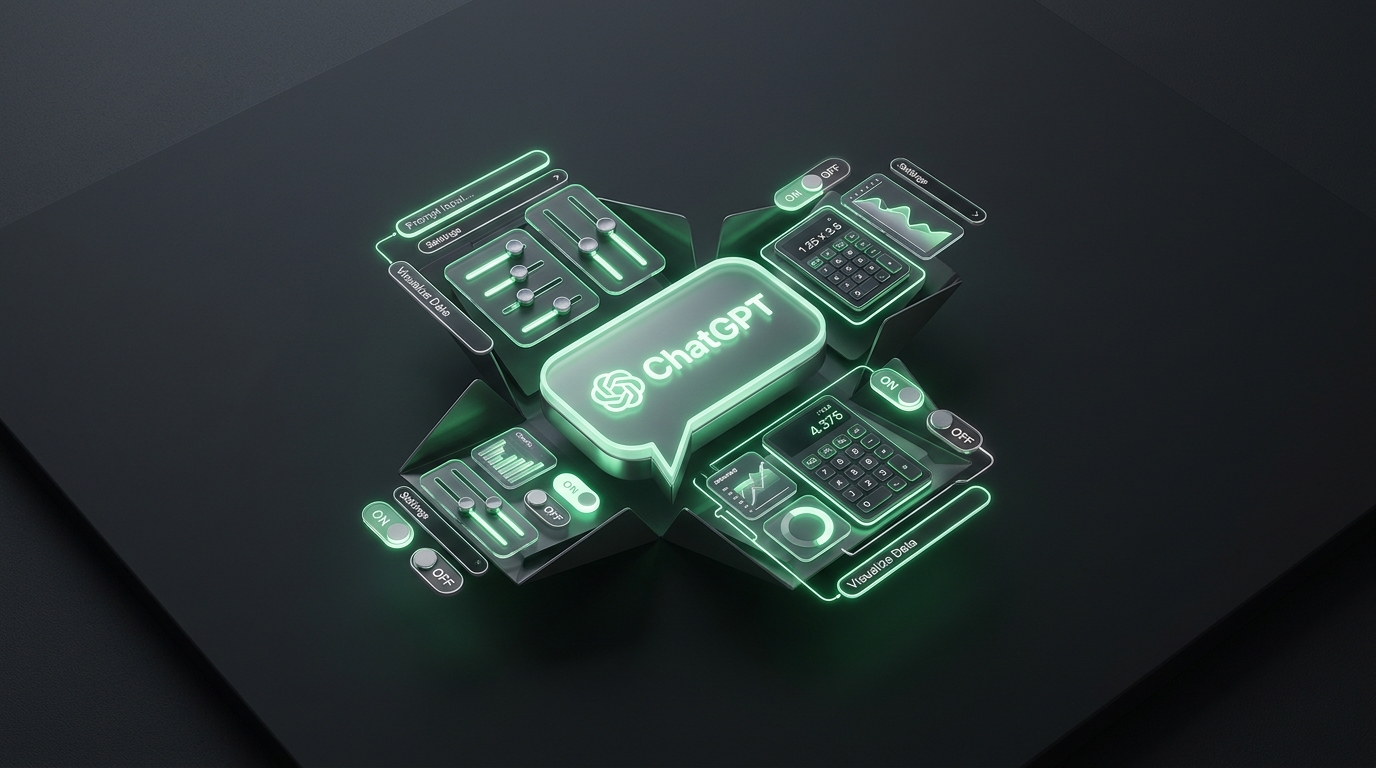
OpenAI rolled out Intelligent UI globally to 1.2 billion users, retiring the four-year plain text chatbox; powered by a streaming component compiler, it dynamically generates interactive sliders, splitters, and ephemeral micro-apps directly in the conversation flow.
# OpenAI Redesigns ChatGPT in Its Biggest Overhaul in 4 Years: Intelligent UI Dismantles the Chatbox
After four uninterrupted years of relying on a monospace-adjacent plain text chat window, OpenAI has officially dismantled its most iconic interface architecture.
On October 8, 2026, OpenAI initiated the global rollout of its newly minted "Intelligent UI" (Intelligent User Interface) capability across all Free and Go tier consumer accounts worldwide. This massive public expansion follows a tightly monitored 24-hour phased preview rolled out on October 7 to Plus, Pro, Business, and Enterprise enterprise subscribers.
For more than 1.2 billion active users opening ChatGPT on desktop web browsers or native mobile clients, answers are no longer confined to vertical paragraphs, static tabular grids, or Markdown checklists. In their place, ChatGPT now renders live, deeply reactive, and interactive components directly inside the conversation stream: draggable parameter sliders, responsive split-bill calculators, tappable option chips, adaptive data charts, and on-demand canvas games.
The chat window is no longer merely a place to type text and receive essays; it has fundamentally evolved into an on-demand micro-application launcher and runtime compiler.
---
Verdict: The Monologue Is Over, and Models Now Build Ephemeral Software
Here is the direct editorial bottom line:
- The era of the plain-text chat wall is ending: Since ChatGPT debuted in late November 2022, human interaction with frontier large language models has followed a rigid and predictable script: the user prompts with instructions, and the model streams paragraphs of text. Even with subsequent upgrades such as code interpreter blocks, KaTeX formula typesetting, and integrated DALL-E image generation, conversational responses fundamentally remained static, read-only documents. Intelligent UI fundamentally upends this historical interaction paradigm by allowing the underlying model to determine autonomously whether a user request is best fulfilled through written prose or a purpose-built interactive visual interface.
- Powered by a streaming component compiler: Rather than waiting for a complete text response to conclude before invoking external third-party plugins or triggering slow web views, GPT-6 Sol (powering paid tiers) and GPT-6 Luna (serving free tiers) dynamically stream native component skeletons during the inference process itself. Even as the model continues to reason through downstream logical branches and compute back-end numbers, users can already drag sliders, toggle input checkboxes, and manipulate variables on screen in real time without lag.
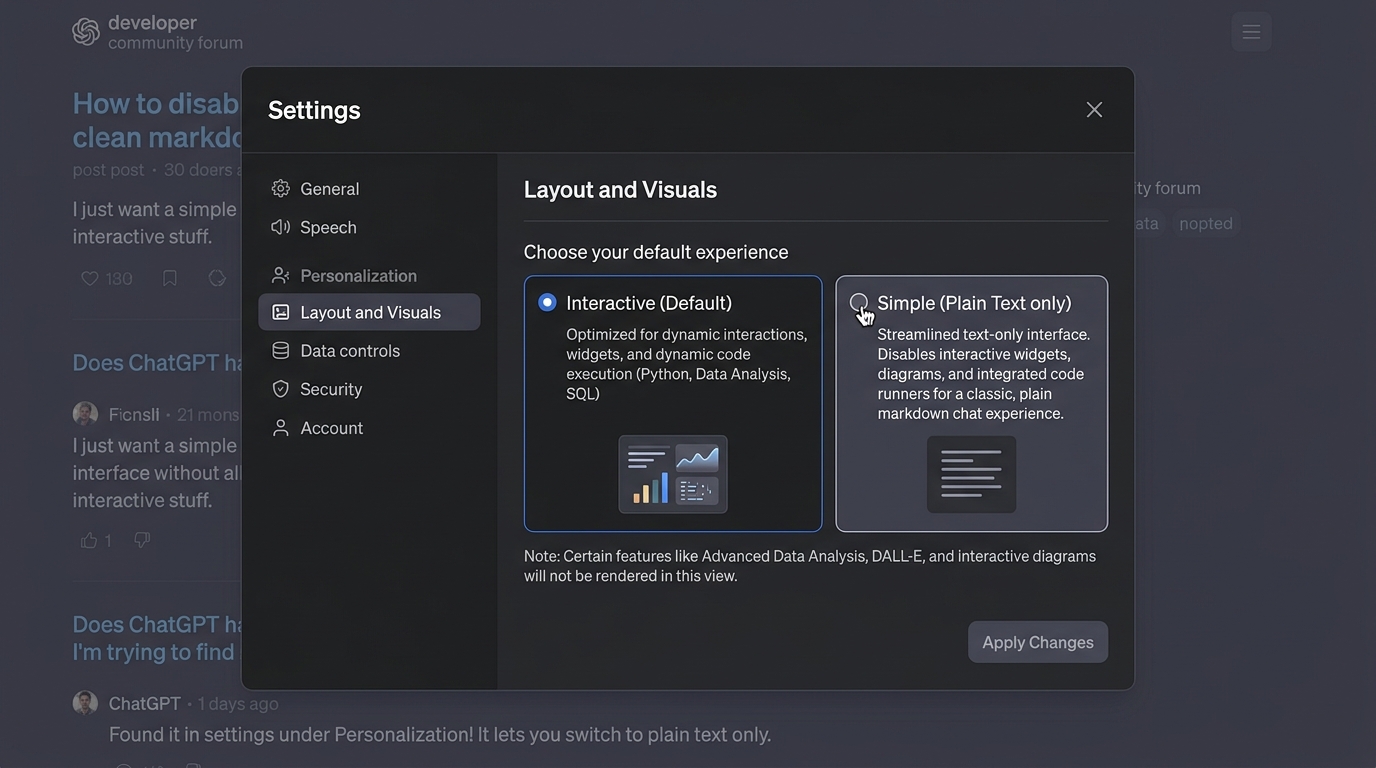
- Power users and purists are searching for the off switch: While casual everyday users and mobile consumers celebrate the fluid visual responsiveness, software developers, technical researchers, and writers who rely on rapid, clean text selection have voiced mounting frustration across tech forums, humorously remarking that "Twitter Bootstrap has reincarnated after fifteen years to haunt the web." Fortunately, OpenAI recognized the need for functional backwards compatibility, tucking an explicit toggle into settings that allows users to instantly revert to classic Markdown.
---
What Happened: From October 7 Preview to Full Rollout Across 1.2 Billion Accounts
The release arrived significantly faster, broader, and more aggressively than industry analysts and competing lab observers had anticipated.
In the early morning hours of October 7, OpenAI shared an unannounced 28-second interactive demonstration clip from its official X account. In the video, an engineer entered a deceptive, open-ended prompt: "Calculate the impact of a 15% price increase on a $25,000 budget with variables." Instead of producing math derivations and bulleted calculations as past versions did, ChatGPT generated an elegant dark-themed card featuring an interactive numeric slider and a live dynamic bar chart. Dragging the slider handle left or right recalculated the budget metrics and dynamically animated the chart heights in milliseconds.
By the afternoon of October 8, OpenAI confirmed that the preliminary enterprise rollout was complete and announced the immediate global activation of the feature for all registered accounts, completely free of charge.
According to internal architectural specifications published alongside the release notes, two primary technical breakthroughs make this low-latency experience possible: * 44% faster initial response times: Completely re-engineered speculative decoding pipelines and latency optimizers within the GPT-6 Instant model family deliver the very first token on web-augmented and component-heavy queries approximately 44% faster than the previous GPT-5.6 generation; * Autonomous formatting decisions: The foundational model underwent specialized semantic alignment training for human-computer interaction, allowing it to evaluate conversational intent without explicit prompting to decide whether a problem requires plain text, a comparison matrix, or a custom-built interactive card.
---
Hands-On Breakdown: What Components Does It Actually Generate?
Testing the feature systematically across multiple test accounts in diverse everyday workflows revealed consistent and practical behavioral patterns:
1. Group Bill Splitting with Interactive Tipping
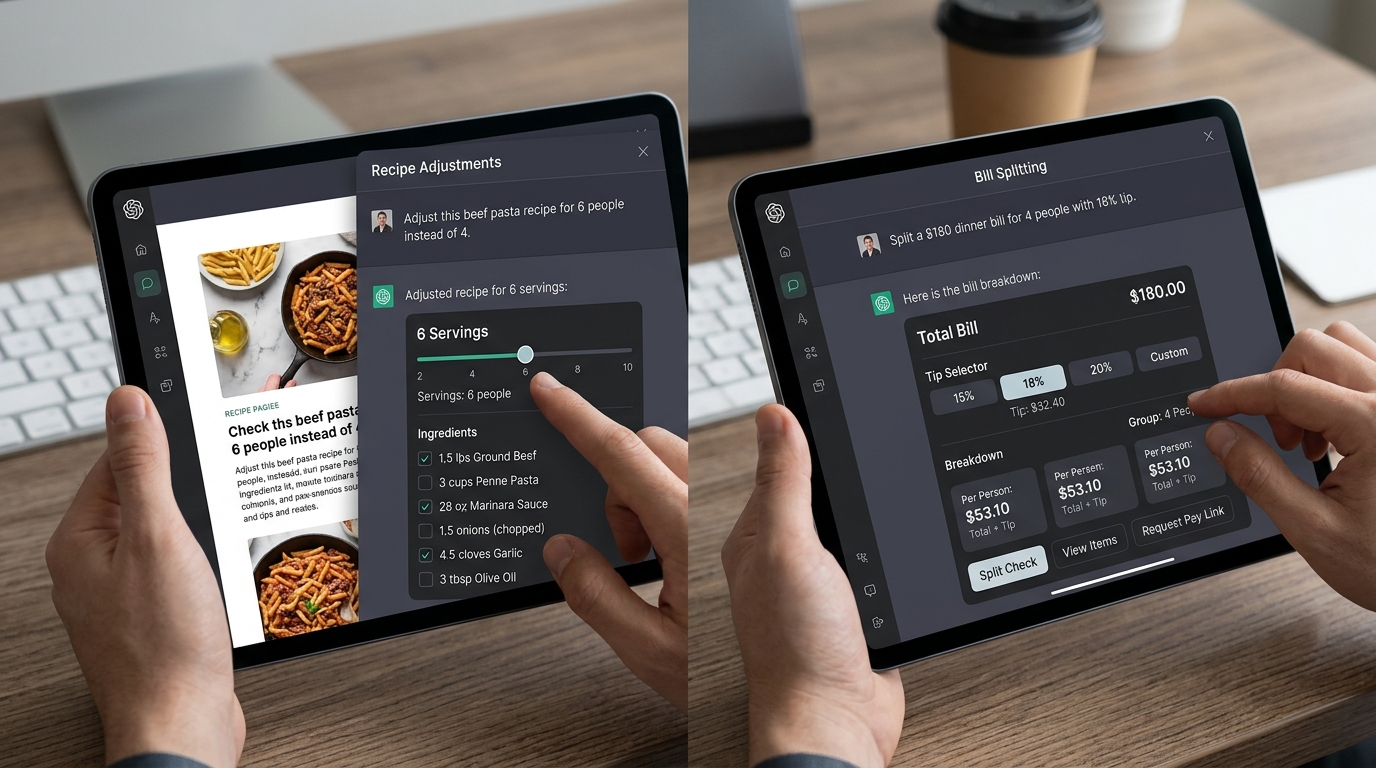
Previously, asking how to split a $180 dinner bill among four dining companions with an 18% tip, where two attendees drank cocktails and owed an additional $15 each, consistently produced three paragraphs of verbose algebraic explanations detailing equations and fractions.
Under Intelligent UI, ChatGPT bypasses the lecture and renders an interactive dark-slate card directly in the conversation flow:
* A prominent header displaying total calculated expenses alongside individual baseline allocations;
* A row of tappable tip preset buttons (15%, 18%, 20%, Custom) that instantly recalculate totals upon click;
* Four discrete attendee cards equipped with interactive checkboxes for itemized beverage add-ons, recalculating each participant's owed balance in real time upon selection.
No external webpage redirect, modal popup, or mobile app installation is required; the lightweight utility lives natively within the chat stream.
2. Dynamic Recipe Portion Sliders Requesting an adjustment to a four-person Italian pasta recipe to feed six dinner guests no longer returns a newly rewritten list of ingredient quantities in prose. Instead, ChatGPT generates an interactive portion adjustment slider set by default to six servings. Sliders adjust minced beef, dry pasta, garlic, and olive oil quantities proportionally, accompanied by interactive grocery shopping checkboxes next to each item. Dragging the slider further to eight servings dynamically updates all measurements in milliseconds.
3. Interactive Physics Sandboxes and Data Charts When prompted to explain mathematical damped sinusoidal curves or two-dimensional kinetic particle collisions, the model generates interactive vector canvases equipped with live gravity and friction sliders, reset buttons, and play controls, allowing learners to observe physical perturbations directly within the chat bubble.
---
Community Backlash: Frontend Memes, Bootstrap Nostalgia, and the Escape Hatch
The unexpected rollout provoked instant debate and divided opinions across international developer communities and design channels.
Frontend Developer Reactions Across Hacker News, Reddit programming subreddits, and developer social feeds, front-end software engineers responded with a characteristic blend of existential humor and technical critique: * "We spent an entire decade mastering React reconciliation, complex state management libraries, and build toolchains, only for the LLM to compile and render fully responsive interactive UI components on the fly in two seconds." * Veteran web architects drew historical parallels to early web design paradigms: "This is Twitter Bootstrap from fifteen years ago all over again. Back then, every startup dumped widgets, accordions, and cards onto every page; now the artificial intelligence writes the CSS rules for you."
How to Disable It: The Simple Mode Escape Hatch For technical researchers, academic authors, legal analysts, and terminal-bound developers who rely strictly on unformatted monospace text to copy directly into CLI consoles or research drafts, interactive cards introduce noticeable operational friction. Clicking and dragging across the screen to highlight textual passages frequently triggers accidental slider shifts or toggles interactive buttons unintentionally.
To address these concerns, OpenAI intentionally preserved a clear administrative configuration switch for users who demand unadorned text:
1. Open the lower-left user avatar menu and click into Settings;
2. Navigate to the left-hand Personalization configuration tab;
3. Scroll down to locate the Layout and Visuals section;
4. Change the primary selection from Interactive (Default) to Simple (Plain Text only);
5. Click the confirmation button to enforce classic, distraction-free Markdown rendering across all present and future conversation sessions.
---
Why It Matters: The Transition from Chatbot to Ephemeral Micro-Software
Looking past humorous social media commentary and viral developer posts, this development signals a structural shift in the fundamental nature of consumer software distribution.
Traditional software creation adheres to a lengthy, resource-intensive deployment lifecycle: product management drafting requirements, UI/UX designers constructing Figma mockups, front-end and back-end engineers writing code, quality assurance running tests, app stores approving submissions, and end users searching, downloading, and setting up accounts.
Intelligent UI introduces an operational preview of ephemeral micro-software: * A consumer does not need a permanent bill-splitting utility application cluttering their smartphone screen; they require that functionality for exactly sixty seconds while standing outside a restaurant. * A home cook does not need to install a dedicated imperial-to-metric kitchen measurement converter; they need it for twenty minutes while preparing dinner. * The generative foundation model decodes real-time intent, dynamically compiles interactive user interface structures, and attaches live client-side logic. The moment the query is resolved and the thread archived, that micro-application dissolves, having completely fulfilled its temporary purpose.
In this broader technological reality, OpenAI is not directly threatening enterprise front-end engineering jobs; rather, it is directly disrupting the long tail of single-purpose utility tools found throughout modern mobile application marketplaces.
---
Our Verdict: Compelling Utility, but Two Risks Warrant Caution
While the interactive interface undeniably enhances casual daily workflows and reduces mathematical friction, our editorial board identifies two distinct and substantive risks that require ongoing vigilance:
- A structural Trojan horse for embedded visual advertising: In a traditional plain-text chat window, commercial recommendations and corporate sponsorships are constrained to written copy and explicit hyperlinks, rendering commercial intent transparent and easy for readers to critique. However, once conversational threads become densely populated by rich interactive cards, branded widgets, and one-click transaction buttons, embedding sponsored travel booking modules, insurance quotation calculators, or supermarket grocery integration shortcuts becomes friction-free. Users will face significant difficulty distinguishing between objective, helpful interface generation and algorithmically placed commercial placements.
- Hidden algorithmic illusions behind polished interfaces: In plain text output, calculation blunders, contradictory numbers, and factual hallucinations are openly visible on the page for users to scrutinize. Within dynamic components, if an underlying interactive slider possesses broken mathematical bindings or silently omits baseline formula variables, the sleek aesthetic polish of the component can mask dangerous factual inaccuracies behind an authoritative and trustworthy facade.
---
What to Watch Next
As Intelligent UI expands rapidly to reach over 1.2 billion registered users across every continent, three unresolved developments will determine its lasting technological trajectory:
* API developer availability and streaming UI protocols: At present, the streamable component compiler is restricted to OpenAI's first-party web application and proprietary mobile clients. Whether OpenAI decides to release an open streaming UI specification for third-party software developers—comparable to the transformative release of Function Calling in previous cycles—will determine whether this becomes an industry-wide open standard or a closed ecosystem moat. * Compatibility across desktop environments and heavy reasoning tiers: The current feature set remains exclusively connected to GPT-6 Sol and GPT-6 Luna. Dedicated desktop wrapper applications, power-user IDE plugins, and high-compute reasoning modes like GPT-6 Astra currently default to static presentation layers, requiring verification of cross-platform cohesion. * Long-term user retention metrics and opt-out rates: Once initial curiosity and novelty wane, observing what proportion of global users keeps Interactive mode enabled compared to those who actively retreat into Simple plain text mode will serve as the true measure of whether on-demand micro-interfaces represent genuine productivity enhancement or cosmetic clutter.