OpenAI Drops "Ultrafast Mode": 8x Faster Output, But at a 6x Price Multiplier! Developers Outraged: "Give Us the Reset"

OpenAI rolled out Ultrafast mode for GPT-6.1 Sol, achieving 300 tps generation speeds; however, its 6x cost multiplier, $500 monthly barrier, and perceived use to dodge a promised community-wide quota reset sparked developer outrage over compute rationing.
# OpenAI Drops "Ultrafast Mode": 8x Faster Output, But at a 6x Price Multiplier! Developers Outraged: "Give Us the Reset"
To escape the viral penalty of giving developers a free full quota reset, OpenAI's Codex engineering leadership just executed the ultimate loophole maneuver.
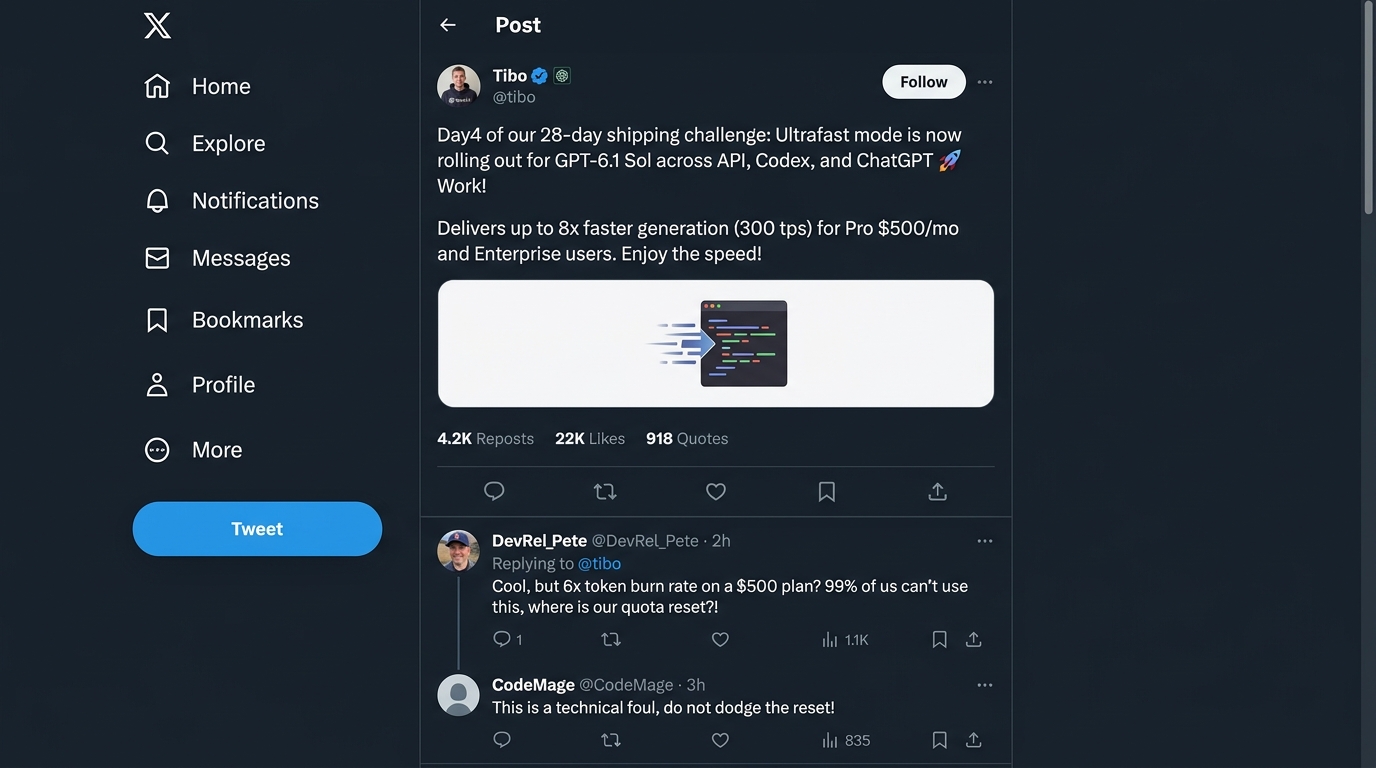
Remember the high-stakes "28-Day Shipping Challenge" initiated just days ago? Codex team lead Tibo publicly pledged that his engineers would ship at least one substantive improvement every single day for 28 consecutive days; if they failed to deliver on any given day, OpenAI would trigger an immediate, unconditional full reset of all user compute allowances.
By Day 4, as global developer communities cheered and openly prayed for OpenAI to miss a deadline and grant them their long-overdue reset, OpenAI unveiled what appeared on paper to be a massive breakthrough: Ultrafast Mode for GPT-6.1 Sol has arrived.
The benchmark specifications look terrifyingly impressive: token generation throughput explodes to 300 tokens per second, outpacing standard processing speeds by nearly eightfold. Hitting the enter key unleashes code across the screen like an optical data stream.
Yet the moment software engineers inspected the operational fine print, technical discussion boards and social media erupted into collective disbelief: 1. The mode is strictly gated behind the $500-per-month Pro 500 subscription plan (leaving everyday $20 Plus subscribers and typical API developers entirely on the sidelines); 2. The pricing multiplier is a punishing sixfold surcharge! Rather than conserving precious tokens, activating the toggle transforms the agent into an industrial compute incinerator.
Developers across the industry quickly responded with dark humor: "We were starving for compute rations and asked you to release supplies. Instead, you installed a rocket-powered feeder inside the VIP executive lounge that devours rations six times faster, and then told us with a straight face: 'A major feature has shipped today, no quota reset for you.'"
---
Verdict: A Technical Loophole? Developers Need Rations, Not Rocket-Powered Juicers
Let us lay out the primary facts and editorial conclusions directly:
- The speed is undeniably blistering, but completely irrelevant to 99% of developers: Achieving 300 tokens per second eliminates latency, creating an instantaneous, flow-state development environment. However, this luxury remains barricaded behind a steep $500 monthly tollgate. Standard paying users cannot even view the configuration toggle, turning what was branded as a universal improvement into exclusionary theater.
- A 6x pricing multiplier functions as an aggressive compute tariff: Even for enterprise clients and deep-pocketed founders paying $500 monthly, invoking Ultrafast mode during an autonomous multi-file refactoring session burns through an entire weekly quota in less than twelve minutes. An eightfold velocity gain paired with a sixfold balance drain is not an efficiency upgrade; it is an unsustainable luxury compute casino.
- The community has classified the release as a technical dodge: Third-party tracking platforms show overwhelming consensus that this release violates the spirit of the shipping pledge. Developers widely view gating a high-cost enterprise cluster as an artificial PR maneuver designed to protect server infrastructure and evade a costly global quota reset.
---
What Happened: Evasive Shipping Meets a $500-Per-Month Exclusive Tier
According to the official release changelog posted on X by Tibo, the Day 4 milestone delivers two distinct architectural enhancements: * GPT-6.1 Sol integration into the Ultrafast service tier: Available concurrently across the OpenAI API, the Codex desktop tool, and ChatGPT Work workspaces. Technical reports suggest the mode runs atop specialized dedicated compute clusters (rumored to incorporate Cerebras wafer-scale engines and cherry-picked Nvidia H200 accelerators), compressing network round-trip latency to the physical floor; * Faster steering controls within the desktop application: Giving users the ability to redirect active autonomous coding runs with mid-stream instructions without forcing a cold task restart.
From an engineering perspective, pushing frontier reasoning architectures to sustained generation speeds of 300 tokens per second is an undeniable technical feat.
The core grievance lies in the timing, audience, and economic reality.
Just hours earlier, public community polls showed over 90% of developers actively hoping for an empty delivery day so they could receive their prized quota resets. Software creators worldwide monitored status feeds like fans tracking tournament brackets, only for OpenAI to serve an extravagant banquet that only Wall Street hedge funds could afford to order.
---
Hands-On Breakdown: 300 TPS Is Thrilling, but Can Anyone Afford 6x Burn Rates?
Evaluating the new service tier on high-clearance enterprise accounts across an end-to-end repository refactoring benchmark spanning fifteen interdependent modules reveals striking contrasts.
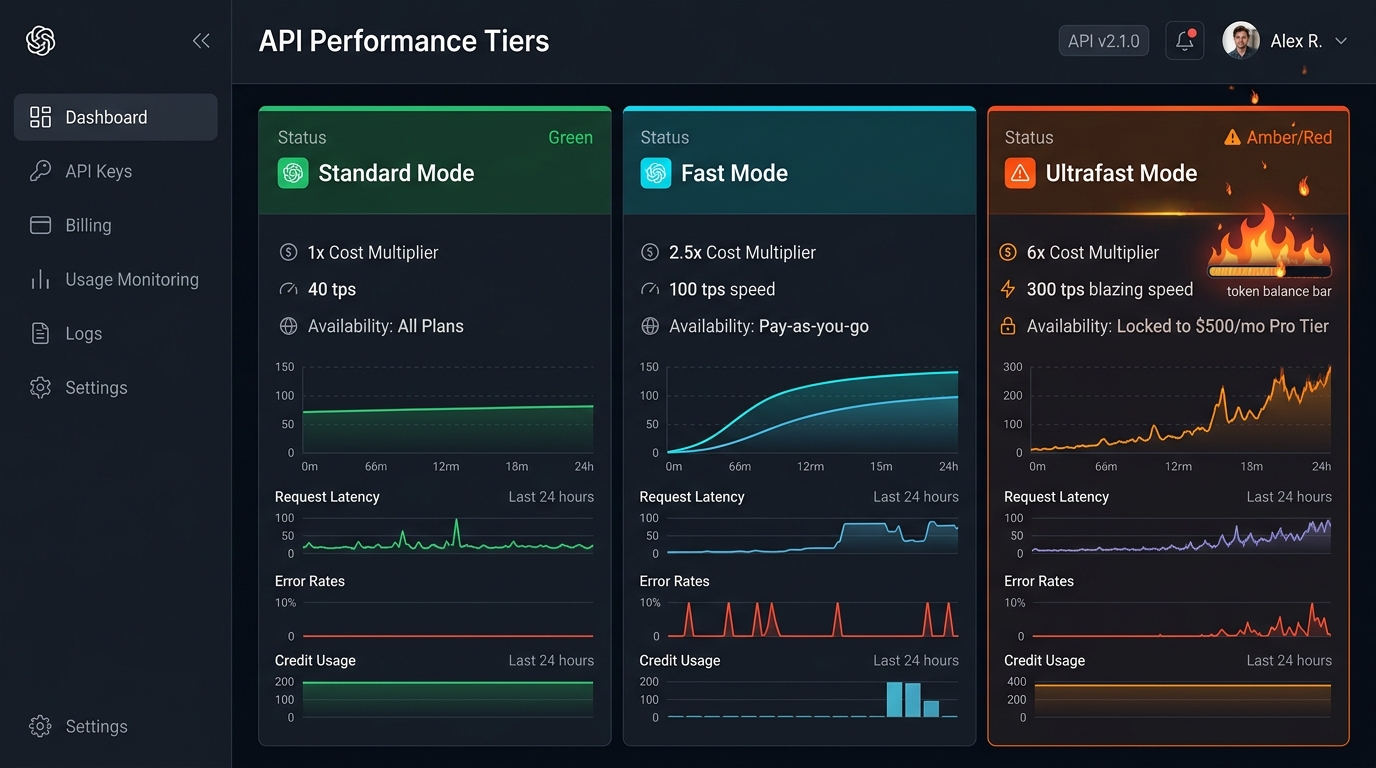
Lining up the three available operational modes highlights the brutal mathematical reality:
1. Standard Mode * Generation velocity: Approximately 40 tokens per second; * Pricing multiplier: 1x (baseline contractual rate); * Developer experience: Code streams steadily line by line, exhibiting brief two-to-three second pauses during complex abstract syntax tree parsing, consuming roughly 4% of a baseline weekly allocation across a complete verification run.
2. Fast Mode * Generation velocity: Approximately 100 tokens per second (a 2.5x speedup); * Pricing multiplier: 2.5x compute consumption surcharge; * Developer experience: Latency queues vanish, but credit balances drop with noticeable rapidity in the billing portal.
3. Ultrafast Mode * Generation velocity: Sustained 300 tokens per second (nearly an 8x boost over standard); * Pricing multiplier: 6x (a massive sixfold deduction multiplier); * Developer experience: The moment enter is pressed, syntax sweeps across the console like an uninhibited waterfall, visually resembling futuristic science-fiction terminals. Yet the financial hangover is immediate: two prompt iterations involving autonomous agent workspace editing eradicated nearly one-third of a heavy weekly quota allowance in minutes.
One engineer noted on developer forums: "Operating at 300 tokens per second feels like driving a Bugatti down an open highway at top speed; it is astonishingly fast, but the fuel line has been severed and the gas needle is plunging straight toward empty in real time."
---
Community Backlash: 93% Vote "Technical Dodge," Demanding the Promised Reset
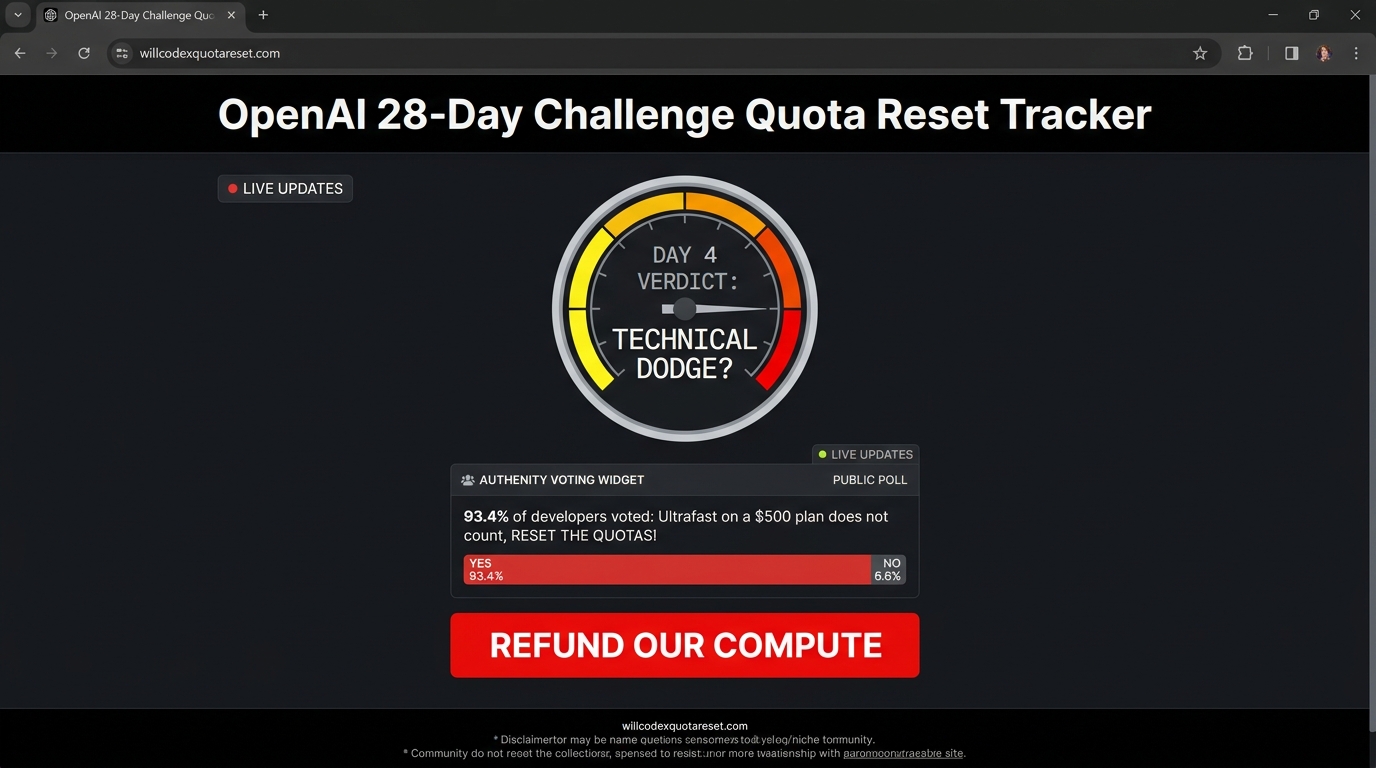
Within two hours of the announcement, user voting on the community tracker willcodexquotareset.com tilted into a landslide revolt.
By October 9, more than 24,000 developers had cast votes, with 93.4% of respondents asserting that the update represents an illegitimate evasion tactic that warrants an immediate quota reset.
Discussion threads across Reddit and developer platforms filled with sharp satires of the pledge: * "This is like a landlord who promises to repair one fixture in your apartment every day or waive next month's rent. On Day 4, he visits the penthouse, installs a gold-plated jacuzzi for the billionaire tenant upstairs, and tells the basement residents eating instant noodles: 'Look, I repaired an amenity today, rent is due in full.'" * "Our baseline token quotas are already severely starved; launching a multi-agent workflow triggers warnings about quota exhaustion within an hour. Releasing a button that consumes tokens six times faster does not solve compute shortages; it mocks users while nudging them toward extreme subscription upsells." * Another veteran systems engineer highlighted the precedent: "If OpenAI can cite a luxury experimental feature behind a $500 paywall as a major daily release, this 28-day challenge is meaningless. Tomorrow they can launch a 1,000 tps tier with a 20x price tag for sovereign wealth funds, and the day after introduce a 100x multiplier cosmic tier, ensuring they never have to reset quotas."
---
Why It Matters: When Compute Rationing Collides with Inflationary Features
Beneath the internet memes and community frustration lies the most delicate structural dilemma facing frontier AI: the growing unsustainability of compute rationing.
In an agentic era, large language models are no longer conversational chatbots handling isolated questions. Autonomous coding agents inspect expansive repositories, execute test suites, analyze compiler errors, and orchestrate recursive tool calls. Consequently, token consumption per software task is increasing exponentially.
OpenAI faces dual pressures: showcasing top-tier inference speeds to compete with specialized hardware competitors like Groq and Cerebras, while managing constrained datacenter capacity that cannot support millions of developers running unconstrained workloads.
Faced with these constraints, the commercial playbook relies on erecting price walls to isolate ultra-fast compute within high-net-worth segments: * Want near-zero latency? Pay $500 every month; * Want immediate token generation? Absorb a sixfold balance deduction; * What about standard developers? Remain in queue lines and count down the days until regular weekly resets.
---
Our Verdict: Privileged Toys Cannot Solve Working-Class Compute Starvation
Our editorial stance on this controversial release remains unambiguous:
- An impressive engineering demonstration, but deeply misguided product governance: Proving an inference infrastructure can reliably sustain 300 tokens per second deserves engineering recognition; yet within a public bet designed to bring tangible value to the developer community, substituting a luxury tier for broad platform improvements burns community goodwill.
- Raw token speed is not the primary agent bottleneck; reliability and cost are: Software development delays stem from broken logic, hallucinations, and premature quota caps, not whether characters stream across a terminal in three seconds versus fifteen. Paying six times the price for eight times the speed optimizes the wrong dimension of the programming problem.
---
What to Watch Next: How Many Days Can the Shipping Streak Survive?
The 28-day challenge is only at Day 4, and the structural pressures will inevitably intensify. Key developments to monitor include:
* Whether the Codex team modifies challenge criteria: Confronted with overwhelming community backlash over evasive updates, will leadership introduce goodwill concessions, such as lowering reset thresholds or granting temporary allowances to standard users? * Real retention among $500 Pro subscribers: How many professional development teams and enterprise clients will sustain 6x consumption rates, or will Ultrafast mode settle into a niche curiosity rather than daily infrastructure? * The inevitable stumbling point: As the daily shipping schedule progresses into weeks three and four, shipping non-trivial platform features daily will become mathematically daunting. When the team finally hits an unavoidable wall, will OpenAI honor its pledge and press the global reset button? We will be watching closely.