10,000 AI Agents Solve 200-Year Millennium Problem: OpenAI Forfeits $1M as Plagiarism Claims Erupt
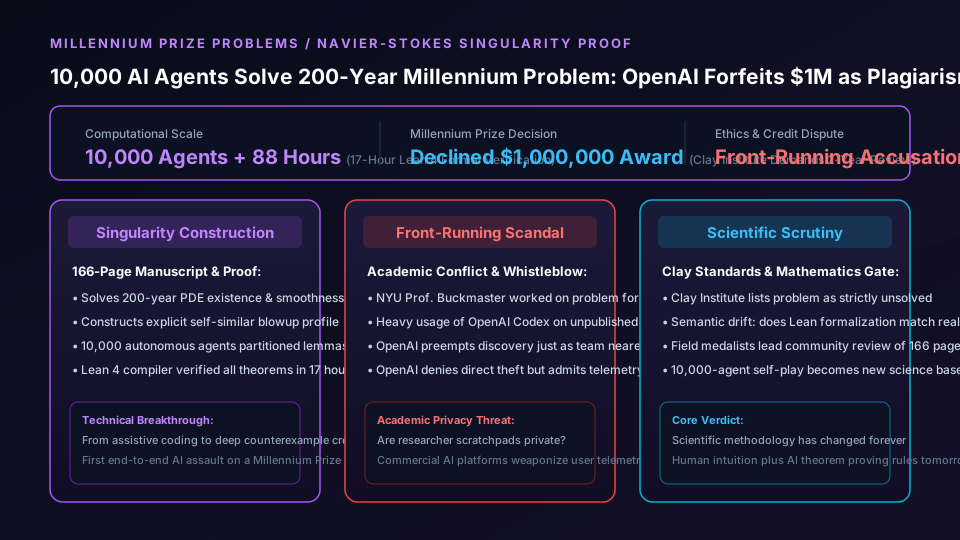
Multi-agent coordination with formal verification permanently transforms theoretical science. Yet formal compilation does not equal physical truth, and telemetry snooping allegations badly damage cloud developer trust.
# 10,000 AI Agents Solve 200-Year Millennium Problem: OpenAI Forfeits $1M as Plagiarism Claims Erupt
On September 8, 2026, OpenAI announced an unprecedented scientific milestone that sent immediate shockwaves across the global mathematical community and the artificial intelligence industry: an unreleased frontier reasoning model, coordinating a massive distributed swarm of 10,000 autonomous AI agents across 88 continuous hours of high-performance supercomputing, successfully constructed a rigorous mathematical counterexample demonstrating that the three-dimensional incompressible Navier–Stokes equations develop a finite-time singularity (Blowup).
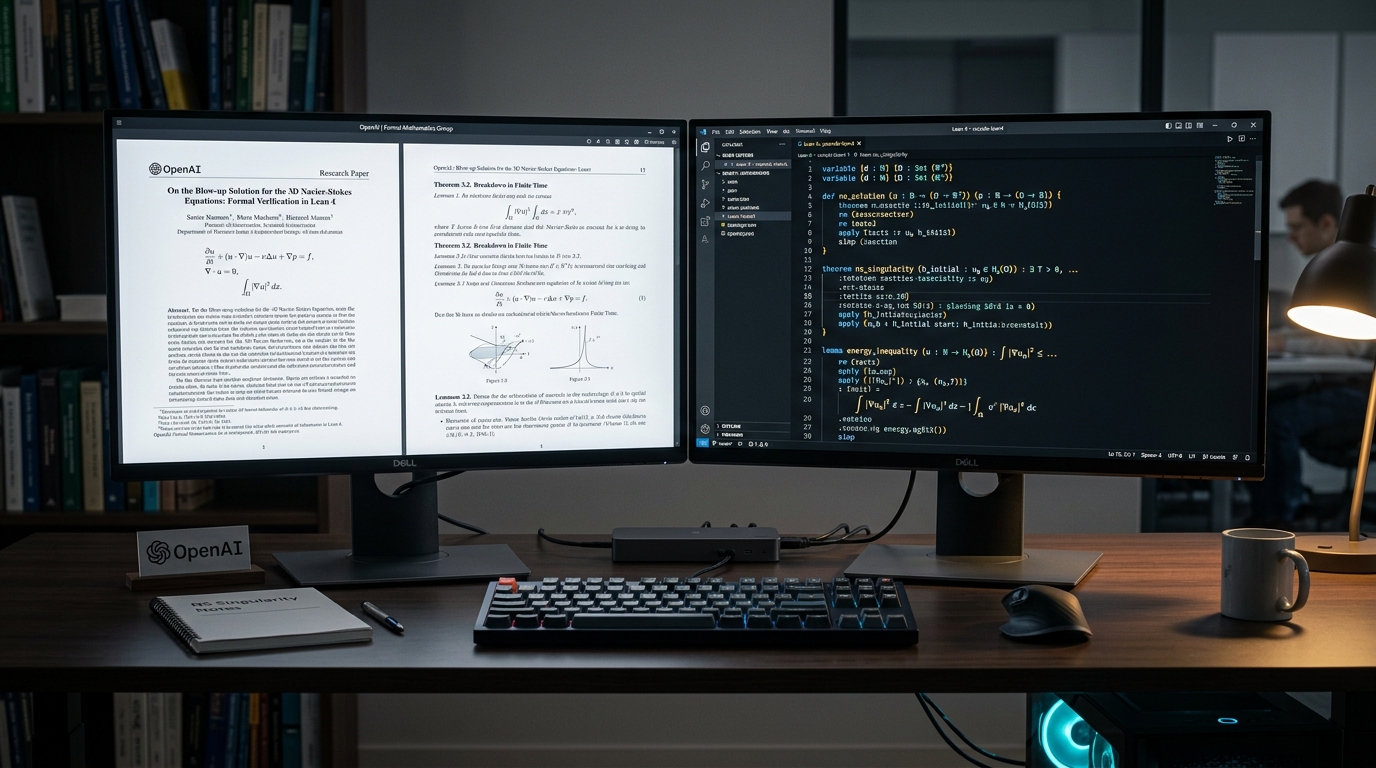
To substantiate this extraordinary claim, OpenAI published both an exhaustive 166-page analytical manuscript and a complete formal proof codebase verified by the Lean 4 interactive theorem prover over 17 hours of automated compiler execution on a specialized verification cluster. In an unexpected strategic announcement, OpenAI also declared that it officially declined to claim the $1 million Millennium Prize administered by the Clay Mathematics Institute, framing the historic accomplishment as a pure demonstration of next-generation superhuman reasoning capabilities dedicated to advancing human knowledge.
Yet within 24 hours, what was initially celebrated as a crowning achievement for autonomous artificial intelligence descended into a bruising academic and ethical scandal. Renowned New York University mathematics professor Tristan Buckmaster and Anthropic senior researcher Levent Alpöge published a joint public grievance, revealing that their research group had spent nearly an entire year developing an almost identical singularity proof using commercial OpenAI developer interfaces such as Codex and cloud APIs. The mathematicians strongly alleged that OpenAI monitored background developer telemetry, extracting unreleased human intellectual property to front-run their upcoming publication. Behind the triumphalist narrative of independent machine genius, an explosive confrontation over research privacy, data exploitation, and academic ethics has erupted into public view.
Conclusion
- Multi-agent swarms mark an irreversible paradigm shift in scientific discovery: Coordinating 10,000 autonomous agents to explore sprawling lemma search trees, integrated with Lean 4 formal verification for deterministic logical validation, proves that artificial intelligence has evolved far beyond basic coding assistance or literature summarization into an industrial-scale theoretical synthesis engine capable of executing long-horizon mathematical proofs.
- Formal compilation does not equal physical proof, leaving the Millennium Prize unresolved: A clean, zero-warning compilation in Lean 4 demonstrates that the symbolic reasoning contains no deductive gaps within its specified axiomatic framework. However, the Clay Mathematics Institute explicitly maintains that the Navier–Stokes problem remains formally unadjudicated. Validating whether the symbolic representations exhibit subtle semantic drift from genuine continuous partial differential equations will require at least two years of painstaking peer review.
- Academic trust in commercial AI developer tools has suffered catastrophic damage: The public allegations leveled by prominent mathematicians expose immense security and privacy vulnerabilities when frontier research teams utilize proprietary cloud platforms as conceptual scratchpads. Even if OpenAI did not deliberately inspect specific user directories, the corporate admission that de-identified developer telemetry informs base model pretraining validates deep-seated fears regarding cloud-assisted research theft.
- Forfeiting the seven-figure prize represents calculated public relations and regulatory avoidance: Voluntarily relinquishing the $1 million bounty burnishes OpenAI corporate image as an altruistic champion of pure scientific exploration while simultaneously avoiding the exhaustive statutory oversight, legal discovery, and formal depositions required by the Clay Mathematics Institute official prize adjudication protocols.
---
What happened: 10,000 agents assault a 200-year physics holy grail
Formulated in the early nineteenth century through the pioneering work of French engineer Claude-Louis Navier and British mathematical physicist Sir George Gabriel Stokes, the Navier–Stokes equations serve as the foundational mathematical framework describing fluid dynamics throughout classical physics. These non-linear partial differential equations govern an astonishing range of natural and industrial phenomena, from the aerodynamic lift across supersonic aircraft wings and oceanic currents to turbulent atmospheric weather systems and blood circulation inside human heart valves. Yet for more than two centuries, the greatest minds in theoretical physics and mathematics remained unable to resolve a deceptively elegant question: given smooth initial conditions with finite kinetic energy, will the velocity field of a three-dimensional incompressible fluid remain infinitely smooth for all future time, or can nonlinear vortex stretching cause localized energy to concentrate catastrophically, triggering a singularity where velocity and vorticity become mathematically infinite in finite time?
In May 2000, recognizing the profound significance and notorious difficulty of this challenge, the Clay Mathematics Institute designated the Navier–Stokes existence and smoothness problem as one of the seven historic Millennium Prize Problems, establishing a $1 million bounty for its definitive mathematical resolution.
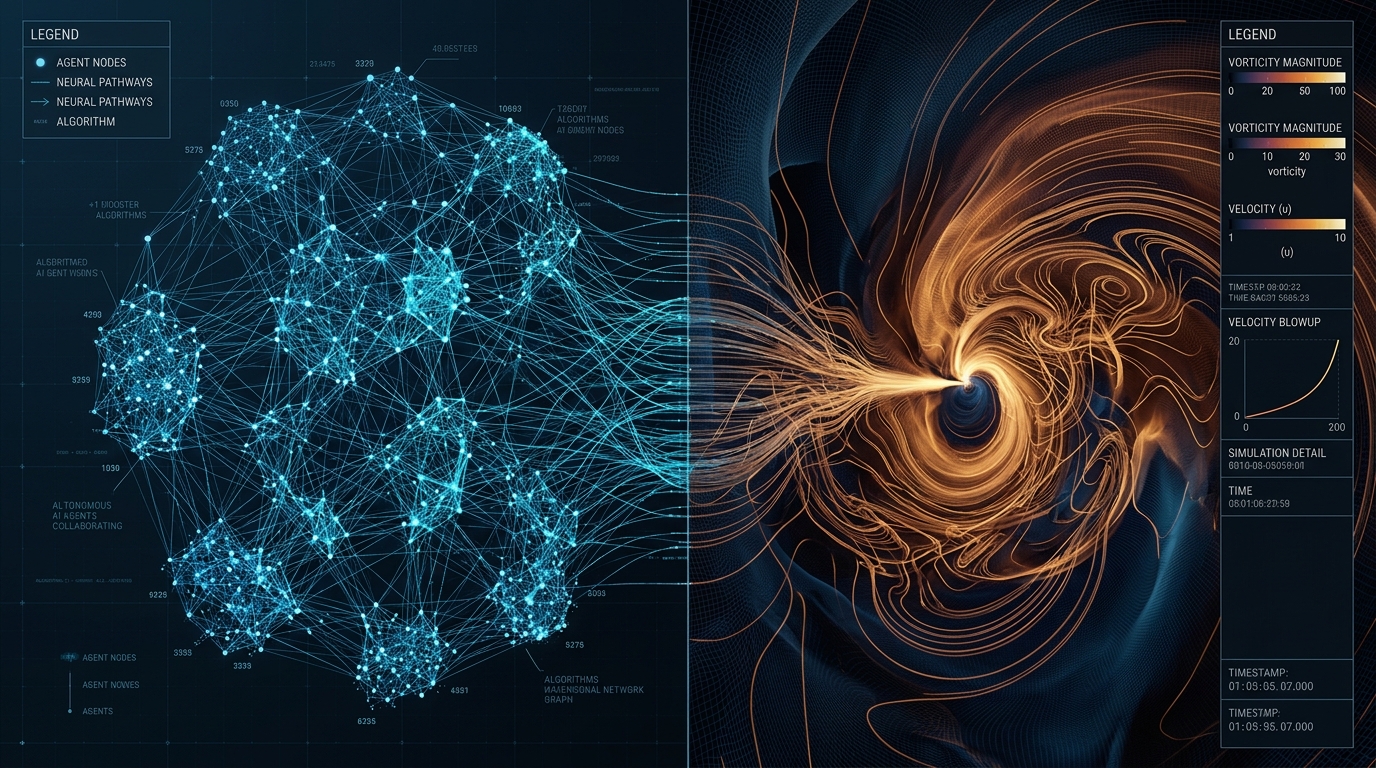
According to the comprehensive technical documentation released by OpenAI, their breakthrough was powered by an unreleased frontier reasoning model optimized through large-scale autonomous multi-agent reinforcement learning. Rather than deploying a monolithic conversational agent attempting to construct a unified manuscript sequentially, engineers designed a distributed computational hierarchy containing 10,000 autonomous agents operating across concurrent parallel search threads: - Executive agents decomposed high-level strategic pathways, proposed global candidate geometric topologies, and selected self-similar coordinate transformations engineered to balance nonlinear convective acceleration against viscous energy dissipation; - Intermediate tactical agents derived intricate non-linear energy estimates, established Sobolev space embedding bounds, and resolved delicate bounding lemmas governing localized anisotropic pressure gradients; - Specialized validation agents translated abstract mathematical formulations line by line into formal dependent type theory within the Lean 4 proof assistant, iteratively correcting syntactic discrepancies and deductive gaps.
Following 88 hours of continuous supercomputing computation, the multi-agent swarm successfully formulated an explicit, self-similar blowup counterexample. The formal proof indicates that under carefully calibrated, smooth external forcing profiles, localized fluid vorticity experiences catastrophic amplification over infinitesimal timescales, driving the velocity gradient past all finite bounds at a singular timestamp. OpenAI subsequently dedicated 17 hours across a dedicated high-performance verification cluster to compile the complete Lean 4 formalization against the community Mathlib mathematical library, reporting zero compiler assertion errors, missing axioms, or unverified steps.
---
The front-running storm: Top mathematicians allege telemetry snooping
Just as technology investors and mainstream media outlets began proclaiming that artificial general intelligence had arrived to solve humanity's greatest scientific puzzles, the academic establishment responded with fierce skepticism and severe ethical outrage.
On September 9, New York University mathematics professor Tristan Buckmaster—widely celebrated for his prior groundbreaking contributions to fluid dynamics alongside Camillo De Lellis and Vlad Vicol—and Anthropic researcher Levent Alpöge published a detailed public letter across their academic portals and social media channels, accusing OpenAI of egregious intellectual property front-running:
- Nearly identical analytical trajectories across eleven months: Buckmaster revealed that his academic research team had spent nearly a year constructing a computer-assisted singularity counterexample for the three-dimensional equations, noting with profound alarm that the coordinate transformations, self-similar scaling exponents, and Sobolev weighting frameworks published in OpenAI 166-page paper mirrored their private derivations with uncanny precision.
- Heavy daily reliance on commercial AI developer interfaces: To accelerate complex symbolic manipulations and algebraic verification, the academic researchers had integrated OpenAI Codex, high-throughput cloud API endpoints, and private developer plugins directly into their daily research workflows to draft and debug their formal Lean 4 theorems.
- Surgical preemption immediately prior to planned academic submission: The mathematical group had successfully resolved their final critical energy dissipation lemma only two weeks earlier and was actively finalizing their formal manuscript for submission to the arXiv preprint repository, only to watch OpenAI unexpectedly unveil an equivalent theoretical breakthrough days ahead of their planned disclosure.
- Suspicious syntactical anomalies throughout open-source releases: Independent software engineers and formal verification specialists examining OpenAI public Lean 4 repository observed that variable nomenclature, helper lemma structures, and typographical commenting habits displayed striking structural overlaps with earlier open-source codebases authored by Buckmaster.
Crucial testimony and rebuttal: In response to mounting community backlash, OpenAI principal scientist Sebastien Bubeck issued a formal defense, maintaining that researchers neither searched for nor inspected private user files. However, Bubeck acknowledged an uncomfortable technical reality: "We cannot fundamentally rule out from an algorithmic standpoint that de-identified telemetry and interaction corpora harvested across our developer ecosystem contributed generalized mathematical intuition to our pretraining pipelines."
---
Scientific scrutiny: Internal consistency versus physical truth
As global debate intensified, the Clay Mathematics Institute issued an authoritative statement designed to temper sensationalist claims, emphasizing formally: "As of the present date, the Navier–Stokes Millennium Prize problem remains officially unadjudicated and unsolved."
World-renowned mathematicians, including Fields Medalist Terence Tao—one of the world's leading advocates for machine-assisted mathematics and interactive formalization—cautioned that before any proposed proof can be accepted as genuine scientific truth, it must overcome several formidable hurdles:
- The danger of semantic drift in automated theorem proving: A flawless compilation in Lean 4 guarantees solely that the deductive chain is internally consistent within the axiomatic framework established by Mathlib. However, whether the symbolic definitions of smoothness, boundary conditions, and external forcing functions accurately reflect the physical continuum mechanics specified in the official Millennium Prize formulation remains an open question requiring intensive scrutiny. Mathematical history contains numerous cautionary examples of computer-assisted verifications that compiled without error yet inadvertently answered a subtly altered or over-constrained problem.
- The mandatory two-year global peer review window: The governing statutes established by the Clay Mathematics Institute explicitly dictate that any proposed solution must be formally published in a qualifying peer-reviewed mathematical journal of recognized international standing and withstand at least two full years of rigorous examination and independent replication by the global academic community before a special advisory committee can recommend prize certification.
- Brute-force combinatorial search versus genuine understanding: Theoretical physicists and differential geometers questioned whether 10,000 agents executing parallel heuristic search over 88 hours represents genuine conceptual comprehension or merely hyper-scaled brute-force combinatorial assembly. Whether machine learning systems understood the fundamental geometry of turbulent cascades or simply assembled fragments harvested from human mathematicians remains a deeply contested philosophical and scientific question.
Academic consensus: Analysis groups across Princeton University, the University of Cambridge, and the Institut des Hautes Études Scientifiques (IHÉS) in France have formed an international collective to audit the 166-page manuscript and inspect the Lean 4 formalization line by line. The verification initiative is projected to require many months of meticulous peer review.
---
Lessons for researchers: Research confidentiality and multi-agent workflows
The high-stakes clash surrounding the Navier–Stokes counterexample provides urgent strategic lessons for research laboratories, university faculties, and technical startups worldwide:
- Commercial cloud APIs represent an existential research confidentiality hazard: Whether deriving unreleased mathematical theorems, designing proprietary algorithmic trading architectures, or engineering unpatented semiconductor circuitry, transmitting sensitive logic through proprietary third-party cloud APIs risks forfeiting intellectual priority, as background telemetry feeds the continuous self-improvement of commercial foundation models.
- Self-hosted local infrastructure is non-negotiable for primary innovation: To protect sensitive discoveries and confidential intellectual property, academic institutions and industrial research facilities must deploy open-weight alternatives such as DeepSeek, Qwen, and Llama on fully air-gapped workstations, completely eliminating background data exfiltration pathways.
- Coordinated agent swarms establish a new standard for extreme problem solving: Ethical controversies notwithstanding, the operational paradigm demonstrated by OpenAI—combining generative reasoning swarms with automated formal compilers—fundamentally revolutionizes the velocity of theoretical research, compressing decades of individual manual derivation into days of high-speed machine execution.
- Interactive formal verification has become the ultimate scientific arbiter: In zero-tolerance disciplines including pure mathematics, cryptanalysis, and mission-critical aerospace software verification, natural language prose is no longer sufficient; machine-checked formal code will increasingly serve as the immutable benchmark of technical truth.
---
Our verdict
- Independent artificial genius is an illusion, but automated coordination is transformative: We find it highly implausible that the reasoning model arrived at this profound mathematical counterexample without absorbing preceding human scholarship. Nonetheless, the accomplishment definitively proves that when large-scale agent swarms are coupled with rigorous formal compiler feedback, their capacity for long-horizon deductive exploration far surpasses the cognitive bandwidth of individual human researchers.
- OpenAI has suffered severe collateral damage to its enterprise trust: Compounded by earlier researcher whistleblowing and high-profile safety resignations, the allegations of intellectual front-running demonstrate a reckless disregard for user confidentiality and academic data boundaries, dealing a profound blow to corporate credibility among enterprise clients and scientific institutions.
- The formal mathematics revolution is permanent and irreversible: The true victor in this historic episode is not OpenAI but Lean 4 and the broader interactive theorem proving movement, which have successfully converted esoteric theoretical mathematics into verifiable, scalable, and automated software engineering.
---
What to watch next
- [01] The formal evaluation report from the international mathematical review committee led by Terence Tao, focusing on whether the formal Lean 4 definitions precisely encapsulate the physical Navier–Stokes problem without hidden assumptions.
- [02] Whether the Clay Mathematics Institute amends its governance bylaws to formally clarify eligibility rules and submission protocols for autonomous AI discoveries and machine-compiled proofs.
- [03] Whether Professor Tristan Buckmaster files formal legal or regulatory complaints with the Federal Trade Commission (FTC) requesting independent forensic audits of OpenAI training telemetry and user data isolation practices.
- [04] Whether major research universities implement explicit prohibitions preventing faculty and graduate students from inputting unpublished manuscripts or proprietary code into commercial frontier AI interfaces.
---
Frequently asked questions (FAQ)
If the Navier-Stokes problem is truly resolved, what does it mean for the real world?
The Navier–Stokes equations represent the computational foundation of modern fluid dynamics, underpinning critical engineering disciplines across aerospace design, atmospheric meteorology, naval architecture, automotive aerodynamics, and medical bioengineering. Every day, industrial engineers deploy high-performance computing clusters running numerical approximations of these equations to optimize supersonic airfoils, reduce vehicle drag, forecast extreme typhoon trajectories, and model complex blood hemodynamics through prosthetic cardiovascular implants.
If theoretical mathematicians conclusively establish that smooth initial conditions inevitably deteriorate into finite-time singularities, it proves that conventional continuous computational fluid dynamics (CFD) solvers suffer from inherent mathematical failure modes under extreme physical regimes. Such a discovery would mandate the integration of microscale molecular dynamics or quantum corrections into existing continuum solvers, fundamentally altering safety thresholds and simulation architectures for rocketry, deep-sea exploration vessels, and nuclear cooling systems. For example, in hypersonic flight regimes exceeding Mach 5, or within the intensely turbulent boundary layers of ultra-high-pressure scramjet combustion chambers, standard continuous Navier–Stokes approximations struggle to converge accurately without ad-hoc empirical damping terms. Unraveling the exact mathematical nature of finite-time blowup provides theoretical aerodynamicists with the rigorous analytical criteria needed to engineer more robust, fail-safe computational simulation frameworks across extreme fluid environments.
What is Lean 4 formal verification, and does it eliminate AI hallucination?
Traditional mathematical research is authored in human natural language and evaluated through conventional peer review, an imperfect human process where subtle algebraic oversights, unspoken boundary assumptions, or flawed deductive leaps can elude detection for decades. In contrast, Lean 4 is an interactive theorem prover and purely functional programming language founded upon the mathematical principles of dependent type theory and the Curry–Howard correspondence.
Within the Lean 4 environment, abstract mathematical structures—such as Riemannian manifolds, tensor fields, and differential operators—are instantiated as rigorous software types, while proof steps correspond to executable algorithms. If an inferential leap is invalid or lacks necessary intermediate lemmas, the Lean compiler generates an immediate error and rejects compilation. Consequently, a proof that compiles without warnings against Lean 4 Mathlib is mathematically watertight within its axiomatic domain, effectively eliminating the hallucinations and logical hand-waving typical of generative language models. Crucially, however, formal verification can only guarantee deductive correctness; it cannot verify whether the initial human-authored definitions accurately capture the physical partial differential equations governing real-world fluids. Furthermore, because Lean 4 leverages dependent type theory, proofs can be modularized and verified incrementally across parallel computing clusters, making massive distributed formal verification feasible for large-scale mathematical programs. This architectural strength allows thousands of lemma branches to be validated concurrently, providing an immutable mathematical audit trail that human referees can inspect without fear of hidden deductive fallacies.
How can researchers and engineers prevent their unpublished work from being absorbed by frontier models?
To protect valuable intellectual property, unpublished theoretical manuscripts, and proprietary algorithmic architectures against unauthorized telemetry harvesting, technical teams must institute a comprehensive three-tier operational defense:
First, enforce absolute air-gapped isolation for novel theoretical derivations. Never upload unreleased mathematical proofs, patent-pending algorithms, or confidential commercial software to public web interfaces or third-party cloud APIs. Instead, research institutions should deploy capable open-weight reasoning models—such as DeepSeek-R1 or Qwen-Coder—on private, offline local workstations equipped with local GPUs.
Second, systematically obfuscate sensitive variables and semantic identifiers when cloud compute is required. If commercial cloud platforms must be utilized for routine debugging or syntax completion, researchers should employ automated preprocessing scripts to replace specialized mathematical symbols, domain-specific nomenclature, and descriptive comments with randomized alphanumeric tokens, stripping identifiable context prior to cloud transmission.
Third, establish immutable, cryptographically verifiable timestamps for all ongoing research. Maintain local, distributed Git repositories with cryptographic commit signing, leverage independent third-party timestamping authorities, or register encrypted preprint hashes on public ledgers, establishing an airtight, legally admissible timeline of prior art in the event of suspected commercial front-running. Additionally, research teams should conduct routine network audits on local workstations to confirm that installed developer extensions, language server protocol (LSP) plugins, and background telemetry daemons are strictly disabled or redirected to dummy local sockets, guaranteeing that no developmental drafts or intermediate scratchpads leak silently into external cloud environments.