Brawling on Stage While Valuations Bleed: OpenAI and Anthropic Clash as the Trillion-Dollar Bubble Deflates
The simultaneous valuation haircuts imposed on OpenAI and Anthropic mark the definitive end of venture-subsidized speculative euphoria. As negative unit margins, astronomical compute mortgages, and cooling institutional demand collide, the AI bubble is deflating through the tangible mechanics of quota cutbacks, stealth price inflation, and downscaled funding rounds. For practicing developers and technical founders, the strategic imperative is clear: never anchor critical infrastructure to vulnerable proprietary monopolies. By deploying hot-swappable multi-model architectures, cultivating sovereign open-weight local instances, and focusing ruthlessly on positive operational cash flows, builders can thrive through the inevitable flight to economic rationality.
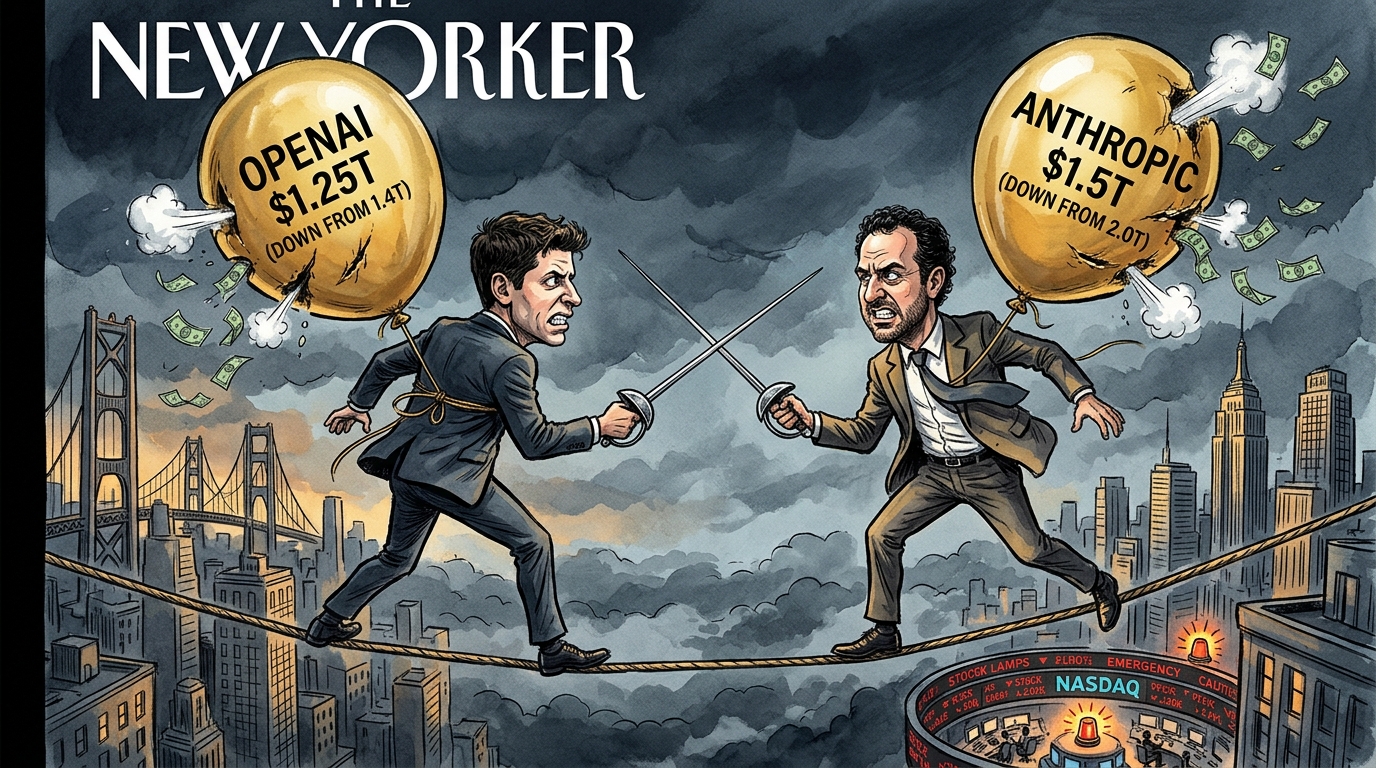
Early on a Monday morning in an established tech hedge fund overlooking San Francisco's Union Square, a managing partner received two strictly confidential investment memorandums within minutes of each other. Displayed on the left monitor was an updated private offering distribution from Morgan Stanley handling OpenAI's latest equity round: the astronomical $1.4 trillion pre-money valuation aggressively pitched across Silicon Valley roadshows had quietly retreated to $1.25 trillion, accompanied by a steep $10 billion haircut to its total capital target, downsizing from $30 billion to $20 billion. On the right display, Goldman Sachs syndicate desks updated pricing guidance for Anthropic's imminent Nasdaq debut: the breathless $2 trillion paper valuation floated weeks prior had been firmly rejected by institutional mutual funds, hammered down to a grounded $1.5 trillion baseline.
The partner removed his titanium-rimmed glasses, rubbed his bloodshot eyes, and gazed out into the chilly November marine layer rolling across the California skyline. Over the past calendar year, these two reigning titans of generative intelligence had escalated their public antagonism into total corporate war: whenever OpenAI surprised developers with a GPT-6 iteration, Anthropic retaliated within hours by dropping an entire Claude 5.5 suite; the moment OpenAI revitalized Codex with autonomous desktop workflows, Claude Code swept community leaderboards with record-breaking bug-repair benchmarks.
Everyday software engineers and breathless media outlets celebrated each skirmish, convinced they were witnessing the undisputed golden dawn of computational progress. Yet peeling back the consolidated balance sheets supporting these nearly three trillion dollars in speculative valuations reveals a sharply different reality: an acrid stench of burning venture capital and staggering infrastructure debt.
The theatrical sabre-rattling on stage can no longer conceal the profound hemorrhage unfolding backstage. When the two most capitalized, technically sophisticated organizations in modern computing are forced to accept simultaneous valuation haircuts on Wall Street's operating table, debating when the AI bubble will pop is no longer a theoretical exercise. Right before our eyes, with methodical and uncomfortable precision, the trillion-dollar balloon has already begun to leak.
Two Trillion-Dollar Morning Memos: Simultaneous Valuation Haircuts
The venture capital ecosystem has not witnessed such a synchronized repricing of apex predators in decades. Judging strictly by corporate press releases, OpenAI and Anthropic remain untouchable sovereign entities dictating the terms of global digital evolution. Yet pivoting to secondary transaction desks and sovereign wealth investment committee minutes reveals an abrupt tonal shift from sci-fi triumph to defensive liquidation.
OpenAI's latest multi-billion dollar capital campaign—initially engineered as a triumphant $30 billion private round—ran straight into institutional resistance. Wealth management distribution pipelines targeting high-net-worth family offices reported uncharacteristically tepid demand; institutional allocators who waved blank checks six months prior suddenly balked at governance terms and burn rates. Sam Altman's executive team was forced to accept unprecedented concessions: slashing the round's target by a third while actively knocking $150 billion off their headline enterprise valuation. For an outfit claiming unassailable leadership on the direct path to AGI, formally trimming its own valuation cap during an active capital campaign is a tacit admission that investor tolerance for ungrounded growth multiples has reached its ceiling.
Directly across the bay, Anthropic encountered an identical dose of public market sobriety after filing its landmark S-1 registration statement to list on the Nasdaq under ticker symbol "ANT". The fantastical $2 trillion valuation ceiling floated during initial investment banker bake-offs shattered immediately upon contact with buy-side discounted cash flow models. Driven by an unnerving deceleration in quarter-over-quarter revenue growth and astronomical compute liabilities, underwriters were forced to mark their pricing expectations down by $500 billion, retreating into the $1.5 trillion corridor.
This double retrenchment is far more than a temporary balance-sheet hiccup for two individual enterprises. It marks the first coordinated macroeconomic brake applied by global capital allocators against unchecked generative AI euphoria. When the two undisputed market champions simultaneously step backward at the bargaining table, no serious operator can continue clinging to the myth of frictionless compute expansion.
The Fiercer the Stage Battle, the Deeper the Hemorrhage

The dual predicament ensnaring both titans stems directly from the scorched-earth, zero-sum war of attrition they have waged across the developer ecosystem. Tracing the trajectory of their recent releases illuminates an almost suicidal competitive loop:
- The Red-Lined Benchmark Arms Race: The moment one laboratory captures a fraction of a percentage point lead on a standardized evaluation, the other mobilizes around-the-clock engineering sprints to deploy an immediate counter-model within forty-eight hours. This brutal cadence has compressed model development lifecycles to an absurd degree; newly crowned flagship checkpoints barely hold the throne for a fortnight before being dethroned, consuming vast fortunes in pre-training and reinforcement compute merely to shift decimal places on a synthetic radar chart.
- The Pixel-for-Pixel Tooling Mimicry: In the high-stakes arena of developer tooling and agentic terminal workflows, the two camps have locked into total functional symmetry. When Anthropic released Claude Code to widespread community acclaim, OpenAI immediately tore up its roadmap to overhaul Codex; when Anthropic teased enterprise-grade computer operation through Cowork, OpenAI promptly forced its Work automation engine directly into the primary consumer chat stream. Both firms are desperately spending billions to conquer developer desktops, only to discover their technical moats are paper-thin and easily replicated by a few system prompt modifications.
- The Covert Cannibalization of User Quotas: While both platforms continue to broadcast idealistic slogans about democratizing abundance, behind closed doors they are frantically engineering stealth mechanisms to plug gaping inferential holes. OpenAI just announced that starting this December, ChatGPT and Codex will be shoved into a single shared quota pool to aggressively throttle heavy coding loops; simultaneously, Anthropic introduced a steep $200 monthly Ultra tier, using the removal of restrictive session caps as leverage to coerce power users into doubling their subscription commitments.
The economic fallout of this mutual escalation is devastating: neither enterprise has achieved an unassailable monopoly, yet their relentless cross-fire has driven the marginal unit economics of foundation model inference into a bloodbath. Sophisticated developers freely bounce between free tiers and subsidized interfaces, while backend datacenter electricity meters spin at thousands of dollars per second.
Wall Street Lifts the Hood: Twenty Billion in Revenue Against a Compute Mortgage
The catalyst that decisively punctured Wall Street's suspension of disbelief was the cold, unvarnished disclosure mandated by Anthropic's public S-1 filing.
Throughout the private funding cycle, artificial intelligence startups sustained investor euphoria by teasing explosive topline metrics: annual recurring revenues doubling quarter-over-quarter and consumer adoption graphs ascending vertically. But when independent auditors laid the audited income statements bare, what emerged was an infrastructure debt trap of historic magnitude:
Across the first six months of 2026, Anthropic generated an extraordinary $16.3 billion in revenue, demonstrating commercial scaling velocity unmatched in the annals of enterprise software. Yet directly beside that revenue figure sat a jaw-dropping net loss of $80.7 billion, accompanied by multi-year, non-cancellable compute obligations to cloud hyperscalers like Amazon and Google scaling into the hundreds of billions of dollars.
Here lies the structural trap at the core of the foundation model business: every incremental dollar of revenue carries an inverse multiplier of inferential cost. Every long-context API call and recursive reasoning session devours staggering quantities of high-bandwidth memory and power. On paper, these laboratories are priced as hyper-scalable software monopolies; in reality, their operational cash flows resemble leveraged public utilities operating as indentured subcontractors for semiconductor manufacturers and regional energy grids.
The moment Wall Street realized that even twenty billion dollars in annual revenue yields gross margins insufficient to cover five years of server depreciation, the valuation multiples inevitably buckled. Institutional investors are finally demanding an answer to a simple question: if humanity's brightest computational minds require four hundred billion dollars in capital infrastructure simply to deploy chatbot interfaces that draft unit tests and summarize status updates, how does this economic equation ever achieve sustainable escape velocity?
The Compute Economics Audit: Stop Guessing When the Bubble Pops
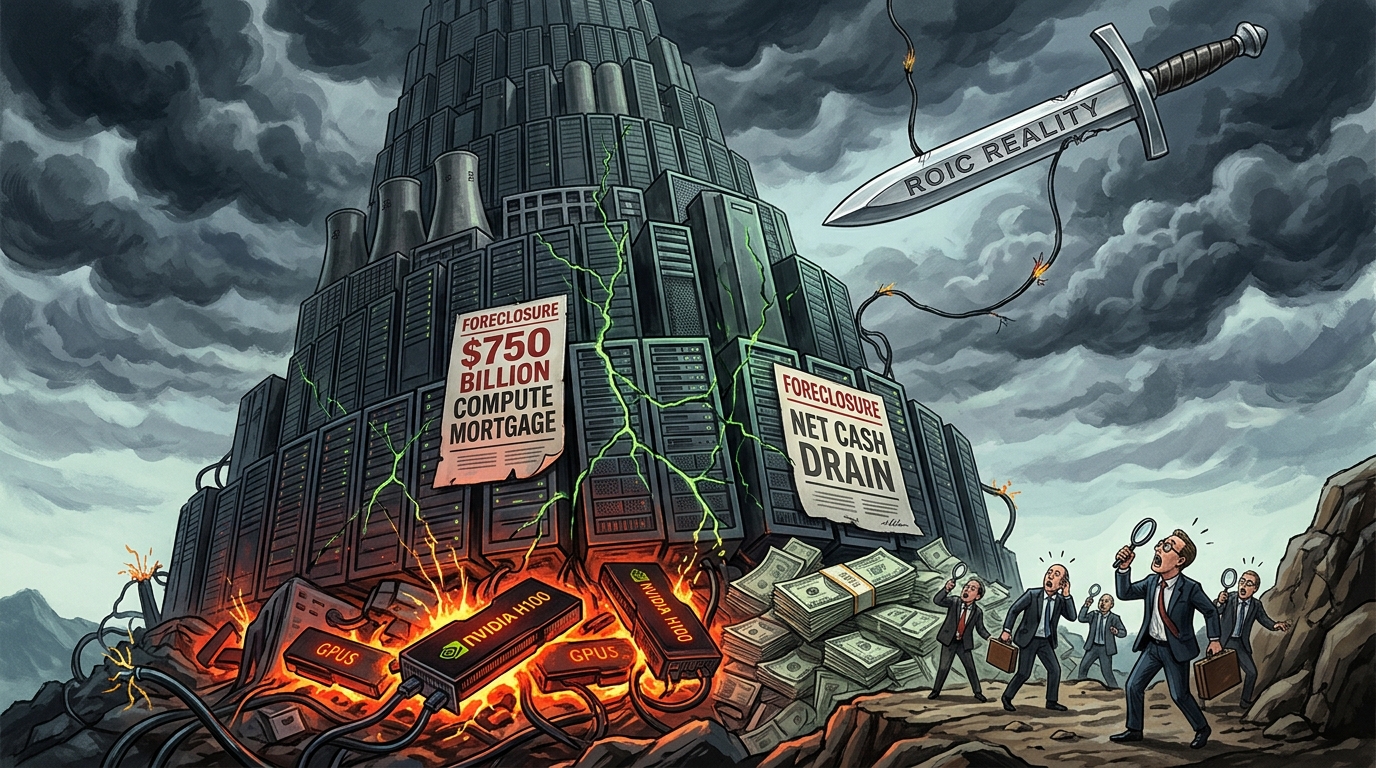
Market commentators routinely compare the current artificial intelligence frenzy to the dot-com collapse of 2000, perpetually scanning the horizon for a singular, dramatic Lehman Brothers moment. But in the physical reality of the modern compute economy, bubbles do not burst with a cinematic detonation.
Instead, they deflate like an overpressurized industrial tire, hissing gas from structural stress fractures across the entire value chain:
The first hisses of decompression echoed through Big Tech earnings reports. Alphabet's quarterly capital expenditures exploded to $51.4 billion, plunging its free cash flow into a negative $9.1 billion chasm; Meta executed an unprecedented $95 billion equity issuance anchored by semiconductor vendors to circularly finance hardware deliveries; Microsoft, despite reporting $36.6 billion in quarterly profit, initiated structural workforce reductions and buyouts simply to cushion the staggering cost of its datacenter buildout.
Now, that institutional chill has traveled directly up the supply chain to OpenAI and Anthropic. When public equity markets punish hyperscalers for excessive capital expenditures, private equity allocators can no longer justify handing pre-profit model developers two-trillion-dollar blank checks.
Valuation markdowns are merely the opening chapter of this structural reckoning. What inevitably follows across the wider technology sector is a systemic contraction of computational generosity: free tiers will be systematically curtailed, hidden API throttles will proliferate, and subsidized all-you-can-eat developer subscriptions will dissolve until every kilowatt of electricity and every reasoning token is billed directly to the end user at true physical cost. The bubble deflates the day venture capital permanently refuses to subsidize humanity's collective computing invoice.
The Developer Survival Doctrine: When Titans Stumble, Hoard Your Leverage
Surrounded by warring tech giants and contracting capital valuations, practicing software engineers, startup founders, and technical architects need not panic over the fate of corporate billionaires. However, builders must immediately deploy practical defenses to insulate their daily workflows against the coming structural shock:
- Sever Single-Vendor Architecture Lock-In: Refuse to anchor core code generation, enterprise retrieval pipelines, or agentic frameworks to a solitary proprietary API endpoint. As OpenAI and Anthropic grow increasingly desperate to protect unit margins, sudden modifications to pricing structures, rate ceilings, and context windows will accelerate. Maintaining dynamic multi-model routing and hot-swappable fallback providers is the fundamental baseline of modern engineering prudence.
- Harvest Subsidized Vendor Capital While It Lasts: While long-term price inflation is mathematically certain, during this transitory period of fierce platform rivalry, both labs will intermittently float tactical discount tiers and promotional compute grants to defend user mindshare. Leverage these subsidized capabilities ruthlessly for short-term velocity, but treat them strictly as expendable consumables rather than permanent structural dependencies.
- Accelerate the Migration Toward Sovereign Local Compute: With the arrival of massive open-weight milestones like the 1-trillion parameter Mistral Large 4 and specialized fine-tunes from the DeepSeek ecosystem, open architectures are rapidly closing the capability gap with closed commercial flagships across routine engineering domains. When your core linting, syntax verification, and unit testing run privately on local silicon, fluctuating Silicon Valley valuations cannot disrupt your delivery velocity.
- Eliminate Speculative Narrative Valuation From Your Own Business: If you are building software products atop foundation models, instantly discard pitch decks predicated on the thesis that reselling foundation model intelligence constitutes an enduring business moat. When institutional investors no longer believe OpenAI's $1.4 trillion narrative, they will certainly not fund thin wrapper applications. Concentrate entirely on verifiable free cash flow, proprietary private data moats, and solving tangible business friction.
The divine aura surrounding frontier AI laboratories is dissipating, and the multi-trillion-dollar mirage is returning to earth. As tech oligarchs bend beneath the unforgiving discipline of audited financial statements, the era of unhinged storytelling is yielding to hard economic gravity. For the pragmatic hackers and disciplined engineers who quietly build things that actually work, the deflation of this speculative bubble marks the moment real technological progress truly begins.