Silicon Valley's Most Absurd Tech Feud: How OpenAI and xAI Banter Spawned a Viral Indie Pixel Game
The tibo.dog saga is more than an endearing Silicon Valley comedy; it represents the definitive real-world proof of agentic, conversational software development. By leveraging Grok Bot and Cursor to collapse the entire asset creation, state logic, and deployment lifecycle into an afternoon prank, a single engineer proved that the friction between whimsical human imagination and global software distribution has effectively vanished. For modern software practitioners, this absurd commercial feud offers a liberating takeaway: when generative tools reduce the cost of creation to near zero, preserving your creative curiosity and playful velocity remains the ultimate competitive advantage.
At a cultural moment when global technology publications are consumed by grave discussions surrounding multi-trillion-dollar valuation markdowns, semiconductor supply chain chokeholds, and geopolitical trade sanctions, two prominent engineers inside Silicon Valley's fiercest artificial intelligence laboratories managed to drag the multi-billion-dollar enterprise software war into an arena of pure, unadulterated absurdity.
The central protagonists of this saga are well-known to anyone inhabiting tech circles: Tibor Blaho (affectionately known across the developer community as Tibo), a hyperactive OpenAI contributor famous for unearthing unreleased feature toggles and pushing rapid product updates on X (formerly Twitter); and Lauren Tan, a seasoned systems hacker previously instrumental in the rise of the AI-native editor Cursor who now serves in an engineering role within Elon Musk's xAI.
Under conventional industry logic, when senior practitioners commanding the world's most formidable GPU clusters cross paths in public forums, one would expect high-altitude technical discourse dissecting autoregressive transformer optimizations, sparse mixture-of-experts routing, or distributed interconnect topologies. Instead, inspecting their public comment feeds reveals an aesthetic indistinguishable from two competitive schoolboys squabbling over plastic shovels in a playground sandbox. Their long-running public duel centered around a singularly childish taunt: your team does nothing except hand out quota resets to frustrated users, while our laboratory actually ships functional software upgrades every single week.
What began as an informal exchange of tongue-in-cheek developer roasts gradually escalated into an unrelenting twenty-eight-day shipping sprint, culminating in a legendary finale: an indie 2D pixel-survival shooter forged through Grok Bot and Cursor in a single afternoon, deployed triumphantly upon a petty $5.99 custom domain.
Late-Night Twitter Banter: You Only Reset Quotas While I Ship Features
The catalyst that transformed casual banter into an engineering marathon originated from a public challenge laid down when the xAI camp hit a sensitive nerve.
As one of OpenAI's most enthusiastic public-facing builders, Tibo routinely absorbs the full brunt of community impatience whenever user usage limits freeze or releases face delays. Weary of rivals constantly insinuating that his team's sole utility consisted of manually clicking the reset button on stalled customer quotas following backend outages, Tibo threw down a defiant gauntlet: starting immediately, he pledged to ship a substantive, observable product improvement every single day for twenty-eight consecutive days; if a single calendar day elapsed without a worthy feature drop, he promised to formally concede defeat by issuing widespread account quota resets across the user base.
For four grueling weeks, the international developer community watched with popcorn in hand as Tibo juggled feature rollouts like an acrobatic performer on a tightrope: from dark mode refinements and token usage tracking toggles to subtle API parameters and workflow enhancements. The public exchange generated an endless cascade of inside memes and witty retaliations, prompting community enthusiasts to compile a dedicated tracking dashboard archiving their entire social skirmish in real time.
As the twenty-eighth and final day approached, it appeared that Tibo was about to achieve a clean victory. But just as the finishing line came into view, Lauren decided to bypass traditional social replies and drop a creative tactical nuke.
An Autocorrect Disaster: The Mythical Bug-Fixing Cyber Hound
To appreciate the sheer comedic precision of Lauren's counter-attack, one must first revisit a hilarious linguistic blunder Tibo committed on social feeds earlier that week.
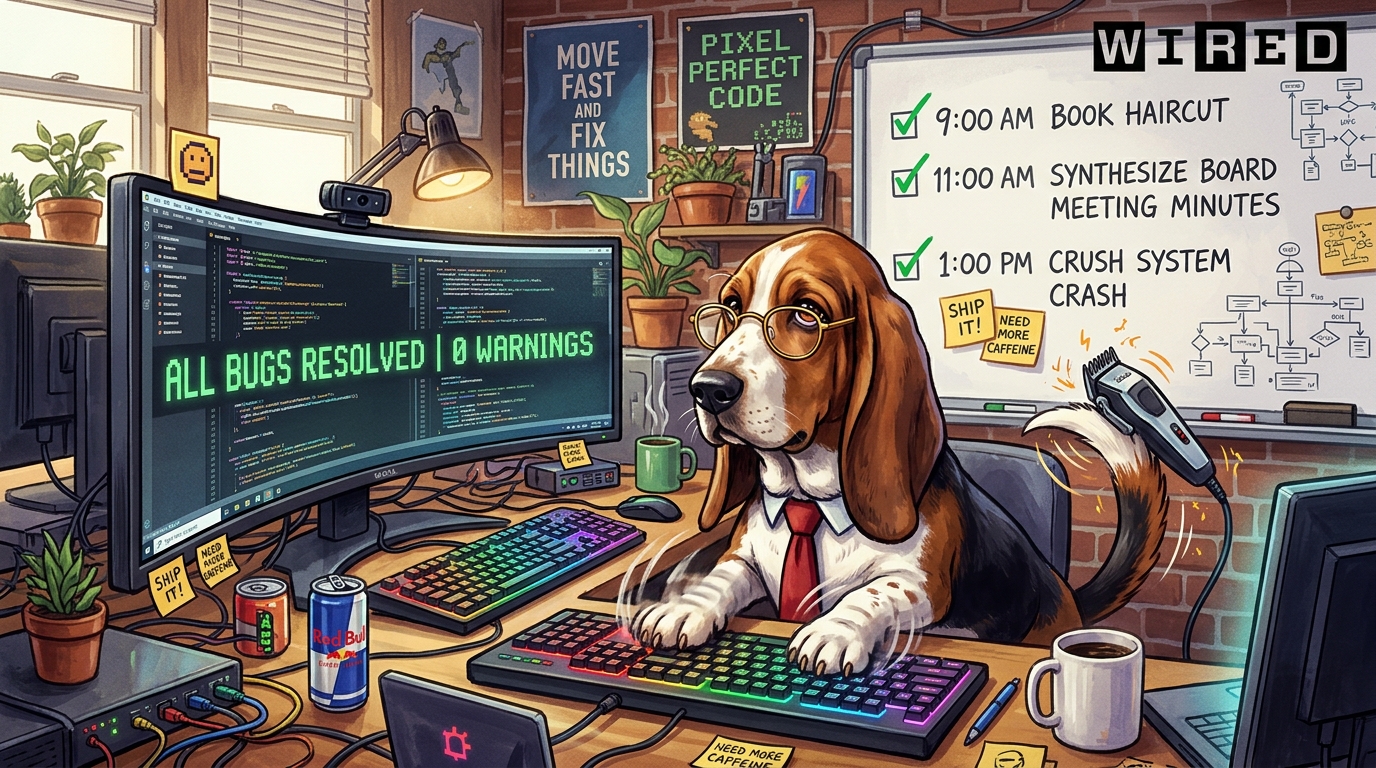
Exhausted in the middle of his intense shipping marathon, Tibo posted a late-night complaint detailing the infuriating behavior of his smartphone keyboard: every time he attempted to type OpenAI's upcoming feature name "Dot", the aggressive auto-correct dictionary stubbornly replaced it with the word "dog". Pushed to his wits' end by the relentless typo, Tibo leaned into the absurdity, launching into a deadpan, satirical stand-up monologue extolling the supernatural administrative and technical prowess of his mythical canine companion:
- Autonomous Executive Calendar Coordination: Tibo deadpanned that his dog possessed native voice comprehension and direct calendar API access, enabling it to phone the neighborhood salon every morning to lock in director-level grooming appointments.
- High-Level Corporate Meeting Synthesis: Whether dealing with a dense two-hour distributed systems review or closed-door executive strategy briefings, the hound reportedly snoozed beneath the boardroom table while seamlessly distilling nuanced arguments into polished executive memos distributed to team leads.
- Production Codebase Triage and Remediation: In the ultimate display of whimsical bragging, Tibo asserted that whenever live production clusters suffered severe memory leaks or cascading deadlocks, this mythical dog hopped onto the workstation keyboard to identify root causes and compile functional pull requests within thirty minutes.
The viral thread generated thousands of amused shares as engineers celebrated the tired developer's self-deprecating wit. Yet nobody anticipated that this mythical hound would manifest as a playable digital entity within a matter of hours.
Flooded with Reset Requests: A Revenge Game Built with Grok and Cursor
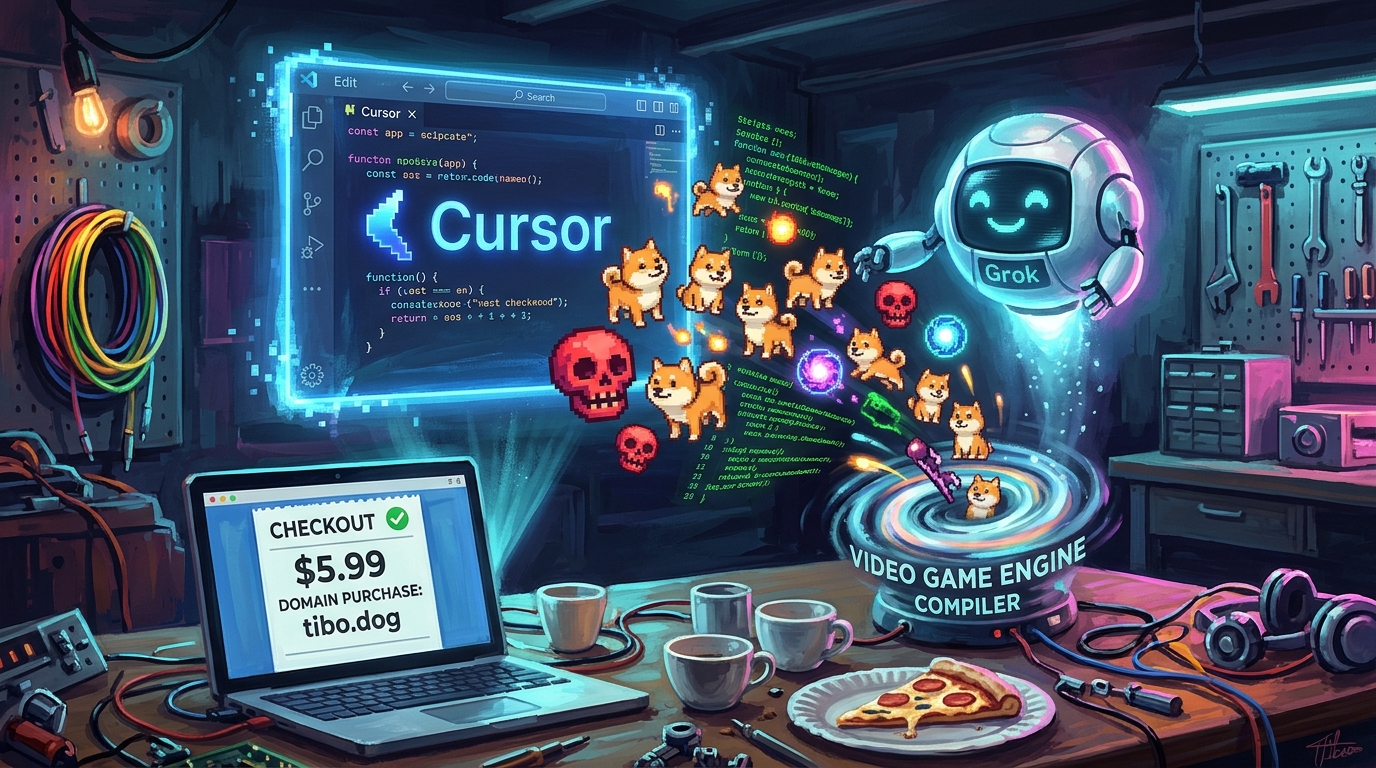
On the final day of the challenge, Lauren produced a credit card, spent exactly $5.99, and registered the domain name destined for developer folklore: tibo.dog.
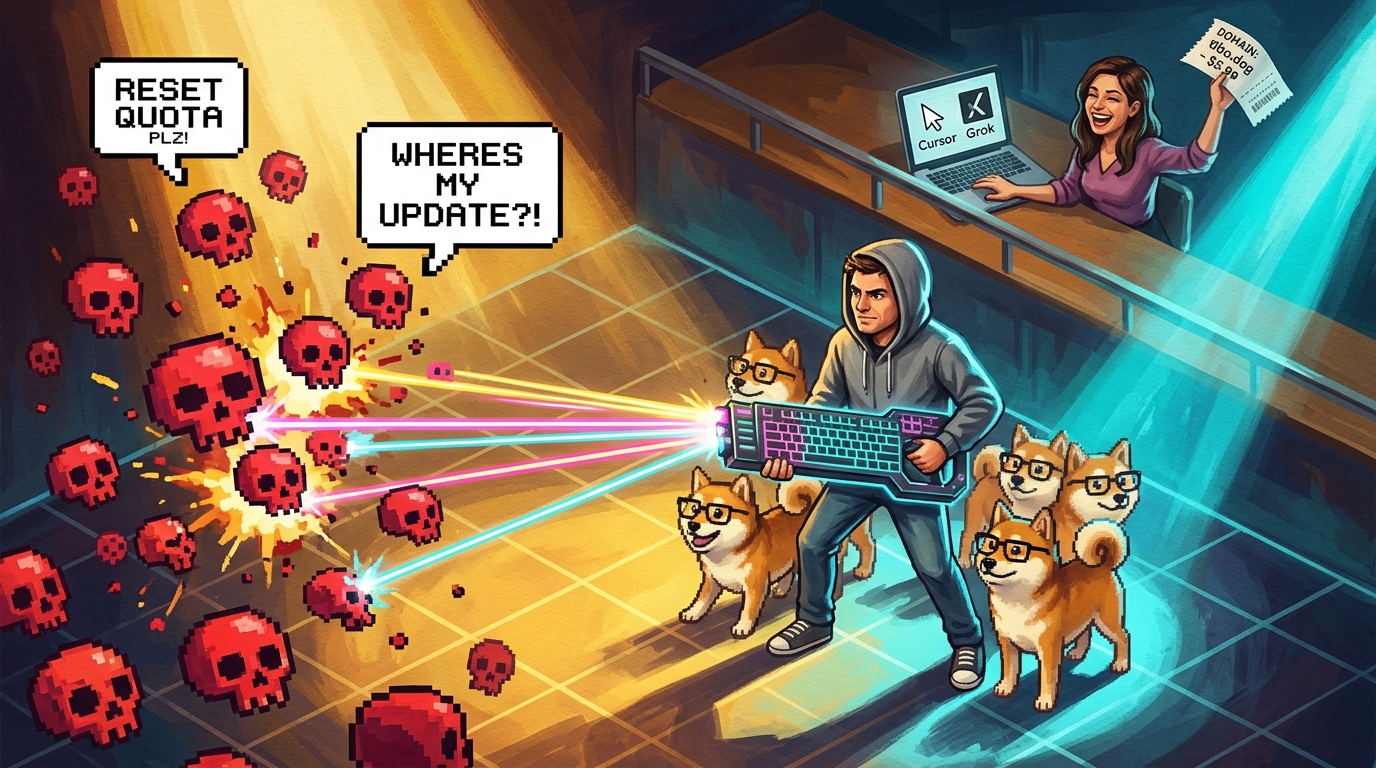
Hosted behind this whimsical URL sits a retro-styled, top-down isometric survival arena game conceived through conversational prompt engineering inside Grok Bot and rapid code assembly inside Cursor. The core gameplay loop is as delightfully frantic as it is addictive: the player assumes direct keyboard and mouse control over an avatar of Tibo, dropped into an electrified cybernetic colosseum encircled by high-voltage neon barriers. Flanking his sides is the legendary pack of pixelated Shiba Inu hounds, faithfully summoned from his viral typo.
The adversarial hordes surging from the perimeter are not traditional fantasy ghouls or pixelated slimes. Instead, they represent the concrete daily nightmares that haunt every front-line software builder: swirling red compilation error dialogues, flashing server timeout warnings, and endless swarms of shrieking text bubbles screaming "RESET QUOTA PLZ!" and demanding immediate feature deliverables.
The player must dynamically maneuver Tibo and his code-repairing canine strike force through dense, kaleidoscopic bullet-hell patterns, dodging red syntax error waves and toxic rate-limit spikes, collecting dropped GPU compute canisters while vaporizing infinite waves of quota-starved phantoms. The entire package requires zero client downloads or local binary compilation; utilizing modern WebGL rendering embedded directly inside native social feeds, users can jump into the arena with a single click. By weaponizing an opponent's inside jokes, minor typos, and industry-wide compute rationing into an interactive cultural artifact, the stunt sent ripples of laughter across the global developer community.
A Six-Dollar Commercial War: When AI Vaporizes the Barrier to Playful Coding
Dismissing this episode as an ordinary peer-group prank fundamentally overlooks its deeper significance within the evolution of modern software engineering. Beneath the laughter, this six-dollar digital skirmish provides a stunning, visceral demonstration of software creation in the agentic era:
- Instantaneous Concept Prototyping and Velocity: In previous development paradigms, transforming an impromptu social media punchline into a fully realized, responsive 2D arena game required multiple days of sprite design, state-machine scripting, and physics collision tuning. By orchestrating conversational generation through Grok paired with intelligent autocompletion inside Cursor, a top-tier engineer collapsed the entire design and implementation pipeline into a casual afternoon coffee break.
- Frictionless Production Deployment and Zero-Ops Hosting: From domain procurement and DNS propagation to deploying WebGL canvas pipelines inside modern static hosting environments, modern tooling has completely eliminated operational deployment friction. Modern conversational AI-assisted development toolchains have completely compressed the temporal lag between an absurd human impulse, its automated code generation, and its live global cloud deployment down to nearly zero.
- The Rise of Social In-Stream Software Experiences: Rather than forcing prospective players through walled-garden mobile app stores or multi-gigabyte client installers, modern conversational software embeds directly into ambient social discourse. A user can transition from reading an austere quarterly earnings breakdown to navigating an interactive arcade battleground within the same browser viewport, showcasing a fluid relationship between content and software unachievable in legacy ecosystems.
This may well represent the most capital-efficient, creatively devastating, yet utterly endearing commercial retaliation in contemporary business history. Far more memorable than dry corporate cease-and-desist warnings or polished public relations spin, an engineer's response written directly in runnable code carries an enduring technical charm.
Smiling Through the Screen: Remembering Why We Fell in Love with Coding
As the foundation model industry matures into a high-stakes, capital-intensive corporate battlefield dominated by macroeconomic anxiety, infrastructure debts, and ruthless pricing adjustments, this lighthearted collision between two rival builders feels like a desperately needed breath of fresh air.
It provided a timely, heartwarming reminder to millions of fatigued software practitioners grinding through enterprise backlogs: beneath the monumental financial narratives and institutional spreadsheets, the true magic of programming has never been about balancing compute depreciation ledgers for sovereign wealth funds. It has always been about the unrestrained, joyful power to breathe life into arbitrary ideas, solve playful problems, and share genuine laughter with peers across the globe.
Nobody lost their livelihood or reputation in this showdown. Tibo cemented his status as a legendary shipping machine by fulfilling his rigorous twenty-eight-day marathon, Lauren demonstrated the astonishing velocity achievable with modern agentic development environments, and the wider tech community walked away with a brilliant digital playground to enjoy during brief work pauses.
In a hyper-serious industry racing toward artificial general intelligence, who could have anticipated that the most delightful breakthrough of the month would be an accidental autocorrected cybernetic hound, heroically deflecting error logs and debugging code amid a hail of digital laser fire?