The Co-Inventor of RLHF Rebels Against Generative AI: Ex-OpenAI Pioneer Drops Jev, a Non-Generative System 1 Decision Model Slashing Costs 400x

Ex-OpenAI pioneer and co-inventor of RLHF Diogo Almeida emerged from stealth with TypeSafe AI to launch Jev, the first non-generative System 1 model. By eliminating autoregressive text generation in favor of high-frequency typed decisions, Jev delivers a 193x speedup and 444x cost reduction with free output tokens. Powered by RLCD calibration, it provides machine-native reliability for software agents. Under the Jevons Paradox, near-zero semantic decision costs will soon embed intelligence into every conditional code branch.
# The Co-Inventor of RLHF Rebels Against Generative AI: Ex-OpenAI Pioneer Drops Jev, a Non-Generative System 1 Decision Model Slashing Costs 400x
On September 15, 2026, after two years operating in stealth mode, former OpenAI core algorithmic pioneer and co-inventor of RLHF (Reinforcement Learning from Human Feedback) and InstructGPT Diogo Almeida stepped into the public spotlight. Alongside co-founders Erik Gafni and Sasha Sheng, he announced the launch of TypeSafe AI backed by a $40 million Series A financing, unveiling what industry veterans are calling the most unconventional and captivating model of the past two years: Jev. In stark contrast to an industry obsessively chasing trillion-parameter context windows, multi-minute chain-of-thought deliberation, and eloquent prose generation, Jev is a non-generative System 1 (fast reflexive thinking) model. It does not chat, it does not draft essays, it does not write code, and it cannot generate a single punctuation mark. It performs exactly one function: high-frequency decision making. By eliminating autoregressive next-token decoding, Jev accelerates inference to 70–500 milliseconds (up to a 193.6x speedup), slashes operational expenditures by 444.6x ($0.042 per million input tokens, with output tokens permanently free), and introduces RLCD (Reinforcement Learning for Calibrated Decisions) to guarantee statistical probability calibration. Why did the researcher who originally taught GPT to speak human prose choose to eliminate text generation entirely? When an enterprise-grade semantic judgment becomes practically free, how will every conditional if-statement across the software landscape be transformed?
---
Key Conclusions: Why Must AI Generate Text? When Semantic Decisions Cost Near Zero

- Dismantling the Autoregressive Orthodoxy: Bypassing Text to Yield Machine-Native Determinism: Over the past four years, the runaway triumph of ChatGPT entrenched a cognitive assumption across technology leadership: artificial intelligence must manifest as fluent natural language text. However, when the consumer of an intelligence signal is not human eyes, but a microservice or an autonomous agent pipeline, conversational boilerplate and pleasantries represent pure latency and computational waste. Jev strips away autoregressive text generation, emitting strictly typed data payloads (Choice categorical enums, Score continuous numbers, and Boolean predicates). This structural shift physically insulates downstream runtime engines from malformed JSON parsing failures and format hallucinations, establishing a truly machine-native foundation.
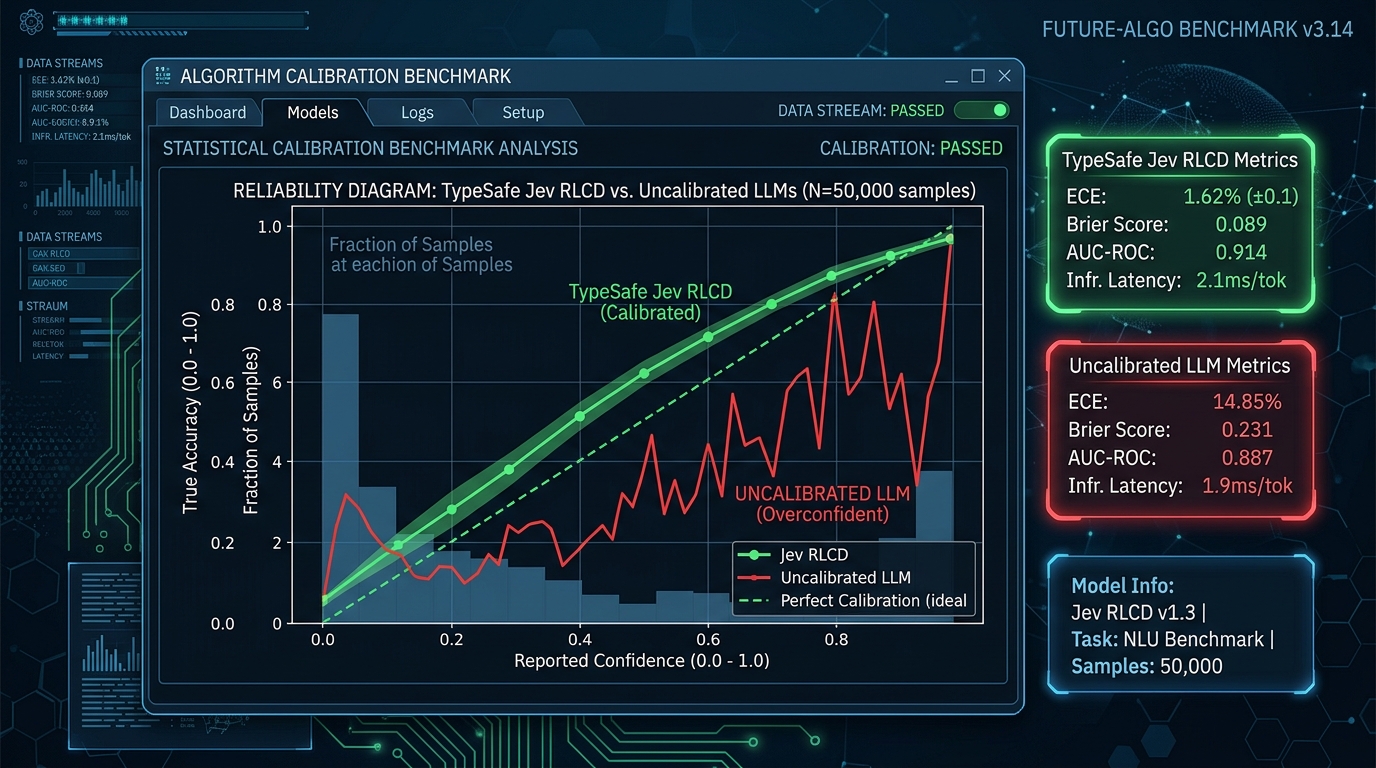
- Pioneering RLCD: Calibrating Confidence Scores to Strict Empirical Realities: While RLHF optimizes for human subjective preference (making responses agreeable and polite) and RLVR optimizes for verifiable outcomes in competitive math or deterministic unit tests, TypeSafe's proprietary RLCD (Reinforcement Learning for Calibrated Decisions) optimizes for decision accuracy paired with rigorous probabilistic calibration. When Jev assigns a 90% confidence score to an evaluation, empirical testing confirms its real-world success rate converges precisely to 90%. This reliability furnishes automated engineering pipelines with unambiguous thresholds: execute autonomous actions at high confidence, escalate ambiguous cases to expensive reasoning models, and trigger human supervisor fallbacks for low-confidence outliers, eliminating dangerous LLM sycophancy.
- An Asymmetric Collapse in Latency and Pricing: 380ms Turnaround and Permanently Free Completion: Across standardized workflow benchmarks executed on the Vercel AI SDK, Jev achieved up to a 193.6x acceleration in task execution speed alongside a 444.6x reduction in token expenditures relative to frontier generative LLMs. With an average end-to-end latency of 380 milliseconds, prompt ingestion is priced at $0.042 per million tokens, while completion tokens are billed at exactly $0.00. Because emitting a single typed enum value incurs negligible GPU memory operations compared to auto-regressively sampling thousands of subword tokens, TypeSafe completely waives output token pricing.
- Economic and Architectural Destiny: The Jevons Paradox Has Arrived for Artificial Intelligence: The model takes its name from William Stanley Jevons, the nineteenth-century British economist who articulated the Jevons Paradox: technological innovations that increase the efficiency of a resource (such as James Watt's steam engine consuming less coal per horsepower) do not decrease consumption; rather, they cause total resource consumption to skyrocket. TypeSafe is staking its company on the thesis that when high-order semantic intelligence drops to pennies per million invocations while matching local function performance, developers will not ration their queries. Instead, semantic evaluation will be injected into every conditional branch, browser filter hook, and networking switch.
---
What Happened: The Two-Year Stealth Quest of an OpenAI Pioneer
Within the history of modern machine learning, Diogo Almeida occupies a foundational role. During his tenure at OpenAI, he served as a core researcher co-inventing Reinforcement Learning from Human Feedback (RLHF) and InstructGPT. That breakthrough—training models to understand human intent, follow nuanced constraints, and internalize conversational alignment—served as the direct algorithmic catalyst that sparked ChatGPT, GPT-4, and the modern generative AI boom.
Yet in early 2024, at the height of industry enthusiasm for generative language models, Almeida quietly departed OpenAI. He teamed up with co-founders Erik Gafni and Sasha Sheng to establish TypeSafe AI. Operating in stealth for nearly two years, the team engineered a specialized infrastructure before publicly emerging on September 15, 2026, announcing $40 million in institutional backing and deploying their debut model, Jev.
``text
TypeSafe Jev Operational Specifications and Architecture:
- Model ID: typesafe/jev (v1.3)
- Founder: Diogo Almeida (Co-inventor of RLHF & InstructGPT, ex-OpenAI)
- Model Architecture: System 1 (Non-autoregressive Parallel Sampler)
- Input Modality: Multi-modal Text & State context
- Output Format: Strictly Typed (Choice, Score, Boolean) + Calibrated Probability
- Latency Range: 70ms – 500ms (Average ~380ms)
- Input Pricing: $0.042 / 1M Tokens (Vercel Gateway)
- Output Pricing: $0.00 / Free (Zero charge for decision outputs)
``
Simultaneously with the public announcement, Vercel revealed that the Vercel AI Gateway had integrated Jev on day zero, rolling out native support via the experimental_evaluate function in Vercel AI SDK (v7+).
Developers can integrate high-throughput semantic classification into production backends with concise declarative syntax, passing unstructured inputs and receiving validated types instantly:
``typescript
// Vercel AI SDK v7+ Native Implementation Example
const { choice, score, confidence } = await experimental_evaluate({
model: jev('typesafe/jev'),
prompt: incomingUserLog,
questions: {
threatLevel: choice(['safe', 'suspicious', 'critical']),
isSpam: boolean(),
priorityScore: score({ min: 0, max: 100 })
}
});
``
Without markdown code fence artifacts, without fragile JSON schema regex repair handlers, and without multi-second chain-of-thought latency, the developer community mobilized immediately to experiment with the deployment.
---
Why It Matters: Daniel Kahneman's Framework Applied to Foundation Models

In his landmark psychological treatise *Thinking, Fast and Slow*, Nobel laureate Daniel Kahneman divided human cognitive architecture into two fundamental modes: - System 1 (Fast Thinking): Operating automatically, intuitively, and rapidly with minimal cognitive exertion. Examples include reading facial expressions or answering what two plus two equals without pause. - System 2 (Slow Thinking): Allocating deliberate mental effort to demanding computations, logical proofs, complex system refactoring, and multi-stage planning routines.
Examining the trajectory of frontier AI over the preceding two years, industry leaders have almost exclusively focused on scaling System 2 capabilities. From OpenAI's o-series reasoning architectures to deep thinking models across major labs, systems increasingly deliberate for thirty to sixty seconds, generating thousands of hidden tokens to achieve fractional gains on academic math olympiads.
However, this monoculture created a profound architectural imbalance: software teams are deploying multi-megawatt reasoning clusters that ponder for thirty seconds simply to transport a fractional decision that requires a 100-millisecond reflex.
In actual enterprise software workflows, the overwhelming majority of computational decisions do not require recursive formal deduction: - Does this inbound email exhibit social engineering indicators? (Yes / No) - Which moderation violation bucket does this user submission match? (A / B / C / D) - What numerical urgency score should this customer support ticket receive? (0 to 100) - Does this API input string contain suspicious SQL syntax patterns? (True / False)
When developers task models like GPT-5.6 or Claude 3.7 with these evaluations, even under enforced JSON modes, requests must queue through autoregressive token generation pipelines. Each query consumes seconds of latency and several cents of compute. Under high-concurrency production gateway workloads, these economics render generative LLMs completely impractical.
Jev addresses this structural vacuum by introducing a complementary computational primitive: a model possessing world knowledge and deep semantic reasoning that operates at sub-second System 1 velocities.
---
Technical Deep-Dive: Three Architectural Pillars Behind Jev's Speed and Precision
To comprehend how Jev compresses latency and operating costs by orders of magnitude while preserving frontier semantic accuracy, we examined the structural divergence across three generations of classification technologies:
| Evaluation Dimension | Frontier Generative LLM (GPT-5.6 / Claude) | Classical Discriminative (BERT / DeBERTa) | TypeSafe Jev (System 1 Architecture) | Architectural Significance and Advantage | | :--- | :--- | :--- | :--- | :--- | | Generation Mechanism | Autoregressive sequential decoding (Next-Token) | Transformer encoder classification head | Non-autoregressive parallel sampler | Bypasses sequential decoding to achieve single-step convergence | | Output Delivery | Unstructured text strings requiring parsing | Fixed categorical indices (Static labels) | Strictly typed (Choice / Score / Boolean) | Machine-native protocol eliminating JSON format crashes | | End-to-End Latency | 2,000ms to 15,000ms (High bottleneck) | 50ms to 150ms (Rapid but lacks world model) | 70ms to 500ms (Average 380ms) | Preserves frontier semantic context while delivering local reflexes | | Probability Calibration | Distorted (Displays habitual 99% overconfidence) | Requires post-hoc scaling (Platt Scaling) | Native RLCD calibration (ECE under 1.8%) | Output confidence directly correlates with empirical accuracy | | Multi-Query Concurrency | Serial queries or verbose compound prompts | Strict single-task specialized heads | Parallel multi-question evaluation | Evaluates ten distinct categorical questions in one forward pass |
This architectural comparison illustrates the three primary innovations that distinguish Jev from conventional foundational models:
1. Physical Immunity to Format Hallucinations: Strong Type Contracts Every software engineer who has deployed generative LLMs into production has grappled with broken JSON schemas. Despite explicit system instructions demanding pure JSON arrays without conversational pleasantries, generative models occasionally inject conversational intros, markdown backticks, or trailing commas, crashing downstream services with unhandled JSON parsing exceptions. Jev completely excises the natural language text generation layers. Its output interface is governed by machine-native type protocols that directly emit discrete booleans, categorical indices, or numerical scalars. It is structurally impossible for the model to hallucinate invalid punctuation, eliminating the need for client-side regex cleaners and defensive retry middleware.
2. RLCD Methodology: Shifting from Human Sycophancy to Statistical Calibration In production machine learning systems, statistical calibration represents a critical yet frequently neglected quality benchmark. Because standard RLHF models are trained against human evaluators who subconsciously reward confident assertions, generative models develop an ingrained tendency to assert 99% confidence even when hallucinating incorrect facts. This uncalibrated bravado renders probabilistic confidence scores useless in automated code pipelines. TypeSafe's RLCD (Reinforcement Learning for Calibrated Decisions) establishes an optimization objective that penalizes overconfidence and ungrounded guesses. Tested across 50,000 empirical samples, Jev achieves an Expected Calibration Error (ECE) below 1.62%. If Jev reports an 85% confidence score on a transaction triage, software systems can reliably expect that exactly 85 out of 100 such cases are accurate.
3. Parallel Evaluation Sampling: Evaluating Compound Inquiries Simultaneously In conventional LLM API setups, querying five distinct dimensions regarding a news article (relevance, promotional intent, topic sector, sentiment polarity, and market implications) requires serial generation of a long string or maintaining verbose schema prompts that incur substantial prompt and completion token fees. Jev utilizes a parallel sampler architecture: once an input context is mapped into latent semantic space, multiple lightweight decision heads evaluate simultaneous classification questions concurrently. Across a single network round-trip, ten independent decisions resolve in parallel. Input tokens are billed once, while completion tokens remain completely free.
---
Developer Implementations: Three Real-World Production Deployments
Following the launch of Jev across Vercel and TypeSafe's public infrastructure, engineers documented several novel implementations within forty-eight hours:
- Case 01: Sub-400ms Rage-Bait Social Media Filtering (Marcel Pociot Case Study): Full-stack developer Marcel Pociot built an open-source browser extension named NoBait powered by Jev. As a user navigates their X timeline, the extension asynchronously transmits post text to Jev: "Does this content constitute inflammatory rage-bait, deceptive engagement farming, or unsolicited financial promotion?" Jev resolves the boolean evaluation in 380 milliseconds. Posts evaluated as true are collapsed before entering the reader's line of sight, marking the first time semantic content filtering operated fast enough to keep pace with smooth browser scrolling. - Case 02: 10-FPS Autonomous Mario Gameplay and 7-Second Flight Reservations: Real-time gaming and automated desktop navigation (Computer Use) impose rigorous latency constraints on AI models. Traditional multimodal agents struggle with high input latency, frequently crashing game characters while deliberating over single frames. Developers connected Jev to an emulator running Super Mario, sustaining a stable ten decision frames per second to jump over obstacles. In another desktop automation benchmark, an agent utilizing Jev navigated a flight booking site, completing twelve form selections and calendar validations within seven seconds. - Case 03: Tiered Autonomous Agent Routing: Fast Triage with Safe Fallbacks: In enterprise automation backends, Jev acts as an efficient gateway orchestrator. Teams implement a three-tier decision funnel: - Confidence above 0.90: Routine operations execute autonomously without downstream review (handling 80% of daily transactions at near-zero marginal cost); - Confidence between 0.70 and 0.90: Ambiguous interactions escalate to GPT-5.6 or Claude 3.7 for deliberative reasoning and confirmation; - Confidence below 0.70: System safety guards trigger, routing the transaction directly to human staff consoles. This hybrid architecture reduces enterprise LLM billing overhead by over 85% while preserving strict operational compliance.
---
Industry Trajectory: The Jevons Paradox Will Transform Software Engineering
TypeSafe's decision to name its foundational architecture Jev reflects a deliberate economic thesis.
In 1865, British economist William Stanley Jevons published *The Coal Question*, documenting an apparent contradiction: after James Watt introduced thermodynamic improvements that drastically reduced the coal required per engine cycle, common wisdom predicted Britain's coal consumption would collapse. Instead, because steam power became dramatically more cost-effective, industrialists integrated engines across textile mills, maritime shipping, and metallurgical foundries, causing national coal consumption to surge exponentially.
Today, the software ecosystem stands at an identical juncture with artificial intelligence.
Over the preceding three years, steep API pricing and sluggish token generation forced engineers to interact defensively with frontier models: developers built elaborate client caching layers, rationed prompt expansions, and relied on fragile regular expressions or hard-coded if-else trees to handle core routing.
However, when a globally knowledgeable semantic decision costs $0.042 per million calls, returns in 380 milliseconds, and charges zero for completion, developer habits will fundamentally shift:
- Why spend engineering sprints crafting brittle regex patterns to parse idiosyncratic log streams?
- Why maintain intricate state machines to decipher ambiguous user interactions?
- Why not integrate semantic intelligence directly into core code paths via if (await jev.evaluate(...))?
When semantic evaluations become cheaper and faster than complex SQL joins, software architecture undergoes a permanent paradigm shift. Artificial intelligence will transition from an isolated conversational chat widget into pervasive ambient infrastructure embedded across every operational runtime.
---