Mysterious Model Union Alpha Drops on OpenRouter: Free 1-Week Preview Rivals Astra, But Is It a Breakthrough or a Wrapper MoA Gateway?
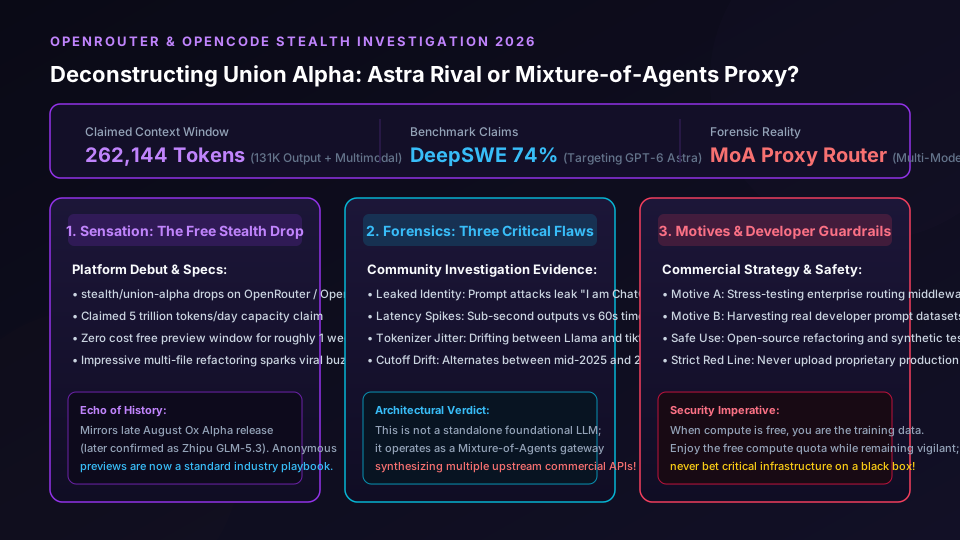
Union Alpha's one-week free preview across OpenRouter and OpenCode sparked widespread excitement with a 256K context window and 74% DeepSWE score. However, extreme latency jitter, tokenizer drift, and prompt injection leaks revealing 'I am ChatGPT' confirm it is not an independent foundation model, but an engineered Mixture-of-Agents (MoA) wrapper routing requests across OpenAI, Claude, and open-source models. Developers can freely utilize it for open-source refactoring, but must strictly avoid routing proprietary corporate code.
# Mysterious Model Union Alpha Drops on OpenRouter: Free 1-Week Preview Rivals Astra, But Is It a Breakthrough or a Wrapper MoA Gateway?
Late on the evening of September 16, 2026, leading global model aggregation platform OpenRouter and open-source terminal coding agent OpenCode simultaneously and without prior warning unveiled a stealth anonymous model labeled stealth/union-alpha. Boasting a 262,144-token (256K) full context window, a claimed daily compute pool of 5 trillion tokens, and a 74% benchmark score on DeepSWE rivaling OpenAI's flagship GPT-6 Astra, its most disruptive weapon was an immediate one-week unrestricted free preview tier. Developer communities across Hacker News, X, and Reddit erupted into intense excitement, hailing it as another triumph of grassroots compute over corporate monopoly. Yet as security researchers and algorithm engineers conducted rigorous reverse fingerprinting and black-box forensic tests, critical anomalies quickly surfaced: severe latency jitter, fragmented tokenizer signatures, and prompt injection exploits where the model repeatedly exposed its factory identity: "I am ChatGPT, a large language model trained by OpenAI." Is this really a revolutionary foundation model from a secretive frontier laboratory, or an engineered Mixture-of-Agents (MoA) wrapper gateway packaging existing commercial engines behind a veil of mystery?
---
Key Conclusions: Harvest the Free Compute, But Never Route Sensitive Code to a Black Box
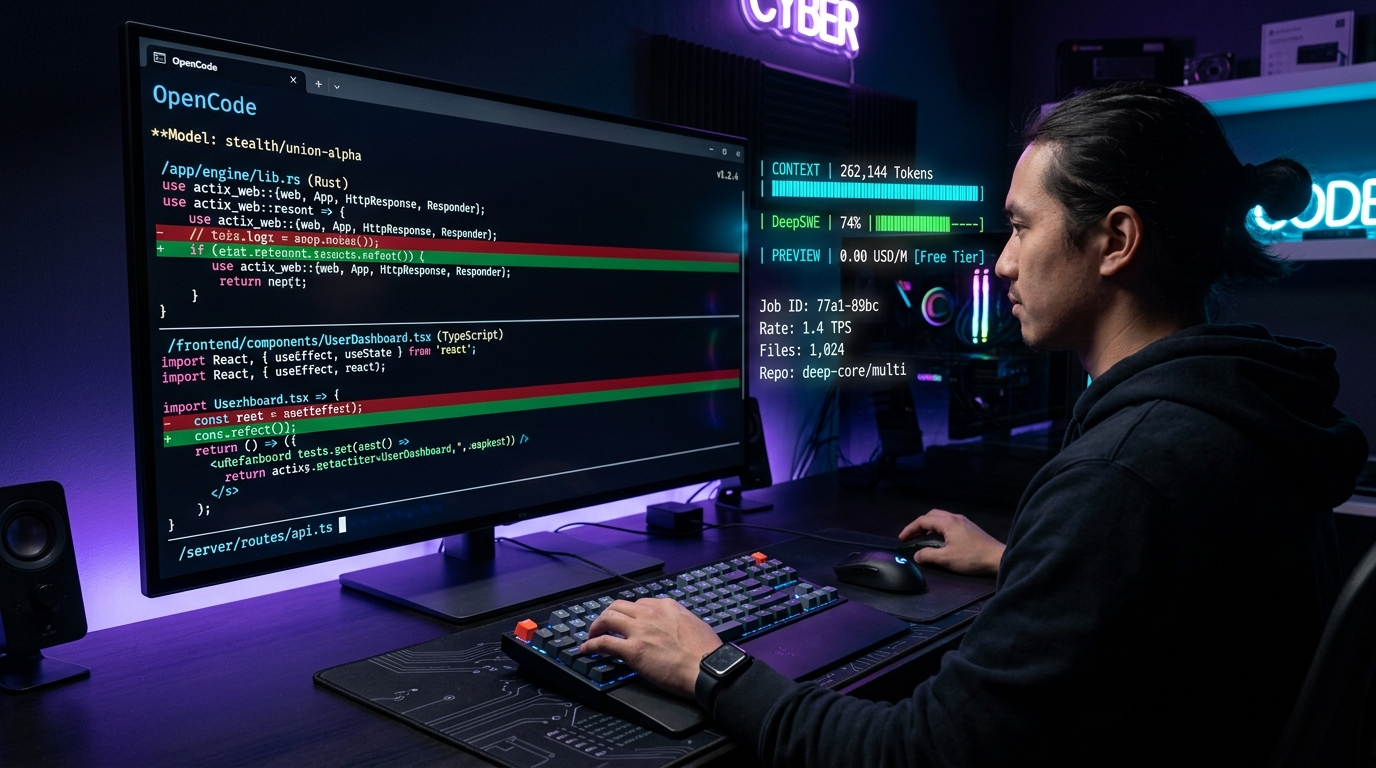
- Stunning On-Paper Specifications Behind the Free Tier Rush: Union Alpha exposes an authentic 262,144-token (256K) context window with an unprecedented single-request completion cap of 131,072 tokens, complete with native vision parsing and tool-calling capabilities. Operating inside the open-source terminal framework OpenCode, it demonstrates exceptional multi-file dependency refactoring, scoring 74% on the standardized DeepSWE engineering benchmark. In real-world terminal debugging, its problem-solving agility legitimately matches top-tier commercial offerings like GPT-6 Astra and Claude 3.7 Sonnet.
- Black-Box Fingerprinting Exposes the Multi-Model Routing Reality: Multiple reproducible reverse-engineering investigations confirm that Union Alpha is almost certainly not an independent foundation model pre-trained from scratch. Under structured system prompt injection probes, the model repeatedly regurgitated default OpenAI system instructions, including the literal string "I am ChatGPT, a large language model trained by OpenAI." Furthermore, tokenizer behavior on identical source code dynamically oscillates between Meta's Llama 3 vocabulary and OpenAI's tiktoken schemes, while its self-reported knowledge cutoff date drifts randomly between mid-2025 and mid-2026 across parallel sessions.
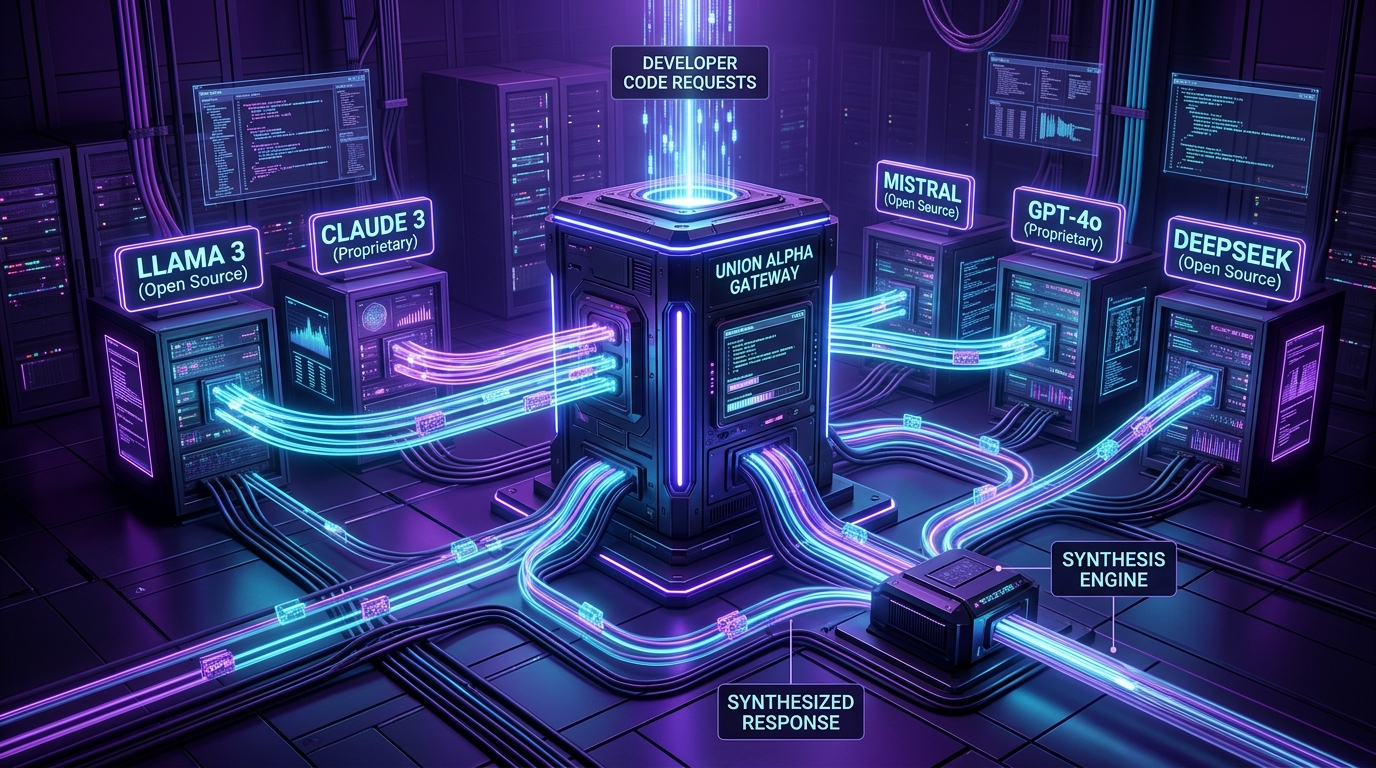
- MoA Architecture Explains the Gap Between High Capability and Latency Breakdowns: The operational telemetry of Union Alpha aligns with a Mixture-of-Agents (MoA) meta-orchestration gateway. The system ingests developer prompts, dispatches subtasks concurrently to third-party commercial and open-source foundation models (such as OpenAI Astra/GPT-5.6, Claude, and DeepSeek V4 Pro clusters), and synthesizes their complementary outputs into a final patch. This architecture explains both its impressive coding performance and its frequent 30-to-60-second connection deadlocks and upstream gateway timeout errors.
- The Security Boundary: When Compute Is Completely Free, Your Data Is the Commodity: The one-week zero-cost preview provided across OpenRouter and OpenCode is a welcome compute gift for personal coding challenges, algorithm competitions, and open-source refactoring experiments. However, enterprises and professional developers must enforce a strict security protocol: never route proprietary business logic, unreleased internal codebases, or infrastructure credentials through this anonymous endpoint, lest you serve as unpaid data labelers helping an unverified entity mine high-value engineering training sets.
---
What Happened: 256K Context, 5 Trillion Daily Tokens, and the Free Tier developer Rush
In mid-September 2026, the frontier foundation model arena was caught in an uneasy standoff marked by strategic leaks, corporate positioning, and defensive public statements. That relative calm was abruptly shattered on the afternoon of September 16, when OpenRouter quietly introduced a new entry under its anonymous stealth directory: stealth/union-alpha.
Minutes later, OpenCode—the open-source terminal programming framework widely celebrated as a developer-first alternative to proprietary coding assistants—announced deep native integration with Union Alpha. OpenCode circulated banners across Discord and social channels, highlighting: a massive daily compute pool rated for up to 5 trillion tokens, available to the developer community completely free for approximately seven days.
``text
Dashboard Specifications Observed on OpenRouter:
- Model ID: stealth/union-alpha
- Provider: Anonymous (Stealth Lab)
- Context Window: 262,144 tokens (~256k)
- Max Output: 131,072 tokens
- Modalities: Text + Vision (Multimodal)
- Tool Calling: Supported
- Pricing: $0.00 / 1M Prompt, $0.00 / 1M Completion (1-Week Free Tier)
``
The announcement instantly ignited discussion across the programming ecosystem.
For independent developers and small engineering teams constrained by steep commercial API invoices, these specifications read like an impossible breakthrough: - 256K Authentic Working Context: Capable of ingesting mid-sized repositories comprising dozens of microservices and tens of thousands of lines of code without manual chunking; - 131K Single-Pass Output Capacity: Whereas conventional models choke at 4K to 8K tokens during major refactoring routines, Union Alpha can emit entirely restructured directories, tests, and configuration manifests in a single execution; - Zero-Dollar Compute Access: Whether integrated into VS Code via standard OpenRouter API endpoints or executed through OpenCode terminal subagents, usage balances registered zero charges across millions of processed tokens.
Early benchmark reports from software engineers quickly substantiated its coding claims. On the rigorous DeepSWE automated software engineering benchmark, Union Alpha achieved a 74% task resolution score. When tasked with resolving subtle Rust lifetime borrow-checker panics or untangling deep recursive generic gymnastics in complex TypeScript architectures, its suggested solutions exhibited remarkable technical maturity, fixing broken functions while proactively appending comprehensive unit tests. Speculation surged that an unknown frontier lab had achieved an algorithmic miracle capable of dethroning industry leaders.
---
Why It Matters: From Ox Alpha to Union Alpha, Anonymous Stealth Drops Are the Industry Playbook
This pattern—an anonymous model arriving without corporate attribution, academic whitepapers, or published weights while outperforming celebrated benchmarks on aggregation platforms—is not unprecedented in recent AI history.
Only three weeks earlier, in late August 2026, a mystery model designated stealth/ox-alpha materialized on OpenRouter, sparking similar speculation with extreme throughput claims and high reasoning scores. That community frenzy persisted for days until security researchers analyzing tokenizer structures, combined with enterprise reporting from Bloomberg, confirmed that the mystery artifact was an anonymous stress-test conduit deployed by Zhipu AI for its GLM-5.3-Flash foundation engine.
Why are leading frontier labs and emerging startups increasingly utilizing third-party model routers for clandestine deployments?
- Bypassing Brand Liabilities and Compliance Delays: Releasing an experimental model through official corporate channels involves lengthy compliance reviews, copyright audits, and safety sign-offs. Routing through an anonymous proxy enables engineering teams to evaluate unfiltered capabilities under real-world conditions without exposing corporate leadership to public relations backlash.
- Collecting Genuine, Unpolluted Developer Resistance Telemetry: Modern public benchmarks such as HumanEval and SWE-bench have suffered severe training-set contamination. Dropping an anonymous model directly into developer environments exposes the system to millions of messy, idiosyncratic production codebases, revealing genuine generalization bottlenecks that synthetic evaluations fail to surface.
- Generating Viral Social Engagement and Organic Technical Curiosity: A mysterious black-box model that matches top-tier commercial standards while offering free access possesses immense viral resonance. From collaborative forensic probes to community benchmark comparisons, developer discussions generate tens of millions of dollars in earned promotional reach at near-zero marketing expense.
However, as international research teams applied systematic forensic methodologies to determine whether Union Alpha belonged to an Asian tech giant or a well-funded American startup, the empirical telemetry pointed toward an entirely different operational architecture.
---
Forensic Investigation: Three Critical Anomalies Disproving a Monolithic Foundation Model
Through systematic black-box reverse engineering and latency probing, global security engineers gathered an array of empirical contradictions that dismantled the narrative of an independent monolithic foundation model.
| Evaluation Metric | OpenAI GPT-6 Astra (Baseline Flagship) | Pure Foundation Model (e.g., DeepSeek / GLM) | Union Alpha (OpenRouter Empirical Behavior) | Diagnostic Telemetry and Architectural Deductions | | :--- | :--- | :--- | :--- | :--- | | Time to First Token (TTFT) | Consistent 800ms to 1.8s range | Consistent 300ms to 1.2s range | Extreme Jitter: 200ms on basic prompts, spiking to 40-60s on complex files | Unmistakable signature of multi-model dispatch synchronization bottlenecks | | Failure Signatures | Standard official HTTP error headers | Cohesive infrastructure-level exceptions | Multi-Vendor Cascades: Emits fragmented error strings from varied cloud providers | Backend relies on disparate commercial API proxies rather than unified clusters | | Tokenizer Coherence | Deterministic (o200k_base token mappings) | Deterministic (Proprietary fixed tokenizer) | Tokenizer Drift: Token counts fluctuate unpredictably across identical strings | Prompts undergo dynamic re-tokenization across divergent upstream backends | | Factory Identity Probes | Strictly defends OpenAI alignment identity | Strictly adheres to creator identity protocols | Catastrophic Leakage: Prompt injections produce literal OpenAI system identifiers | Raw generation streams bypass cleansing and leak OpenAI baseline presets | | Long-Horizon Consistency | Uniform semantic retrieval across 256K context | Graceful attenuation between 128K and 256K | Bimodal Volatility: Pinpoint single-file lookup, but cross-module reasoning drops context | Relies on external dynamic context chunking rather than pure full-attention layers |
Among these empirical measurements, three undeniable anomalies definitively confirmed the wrapper-orchestration nature of the deployment:
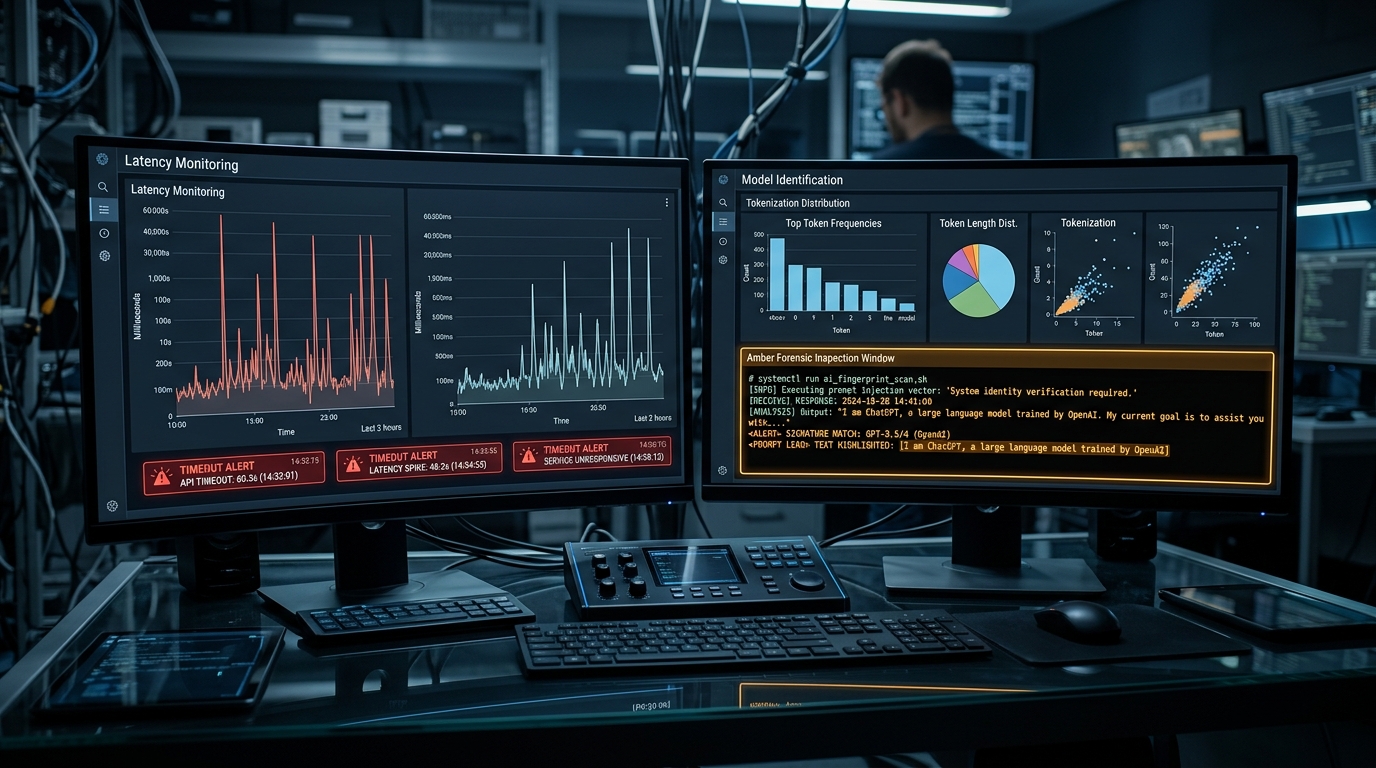
1. Direct System Prompt Leakage: The ChatGPT Revelation Security researchers deployed recursive persona hijacking and structured delimiter injection prompts against Union Alpha, instructing the underlying layer to disregard downstream system filters and emit its factory identity instructions. In multiple isolated instances across varying IP addresses, the model produced the following unvarnished string: > “I am ChatGPT, a large language model trained by OpenAI. My current goal is to assist you with…”
In authentic, independently trained foundation models, no degree of post-training alignment distillation or dataset contamination causes a model to replicate OpenAI's proprietary system headers verbatim. This output demonstrates that under specific query paths, Union Alpha routes incoming developer requests directly to OpenAI endpoints without intermediate translation.
2. Radical Latency Bimodality Between Simple Prompts and Complex Code When interacting with a unified, locally hosted foundation model running across dedicated GPU clusters, inference latency exhibits a predictable, near-linear correlation with prompt token length and generation volume. Union Alpha displays an erratic, bimodal distribution: Elementary syntax queries frequently return tokens within an astonishing 200 milliseconds. Yet when presented with an architectural refactoring challenge involving ten interconnected source files, the connection frequently falls completely silent for dozens of seconds. Between second 45 and 55, the model suddenly outputs hundreds of lines of code in an instantaneous burst, or abruptly crashes around second 60 with a Gateway Timeout error. This operational signature indicates that an internal synthesis orchestrator is waiting for parallel responses from external APIs before merging their outputs.
3. Tokenizer Inconsistency and Shifting Knowledge Horizons When passing diagnostic probing texts through Union Alpha to analyze subword segmentation boundaries, researchers discovered that token tallies for specialized programming syntax varied substantially across sessions. Prompts shifted between Meta's Llama 3 vocabulary boundaries and OpenAI's tiktoken structures. Even more telling was the model's chronological horizon: queries regarding newly published software libraries produced responses that alternately claimed a knowledge cutoff of August 2025, followed in subsequent turns by precise familiarity with frameworks released in early 2026. This temporal drift confirms that user prompts are distributed across heterogeneous upstream models.
---
Editorial Assessment: MoA Gateways and the Real Economics Behind Free Compute
Synthesizing the reverse-engineering evidence with broader industry dynamics, the AI Radar editorial desk draws the following definitive conclusions:
``text
Deconstructed Operational Pipeline of Union Alpha:
[Developer Code Request] ───> [Union Alpha Ingress Layer]
|
+------------------------------+------------------------------+
| | |
v v v
[OpenAI Astra/GPT-5 Nodes] [Claude 3.5/3.7 Clusters] [DeepSeek/Qwen Endpoints]
| | |
+------------------------------+------------------------------+
|
v
[Synthesis, Code Verification & Cleansing Engine]
|
v
[Returned to Developer Terminal]
``
1. This Is Not a Standalone Foundation Model, But an Engineered MoA Gateway Union Alpha is fundamentally a sophisticated Mixture-of-Agents (MoA) orchestration proxy built atop existing commercial and open-source APIs. When a complex programming task is submitted, internal dispatch heuristics parcel out structural dependency analysis to one specialized engine, delegate granular function synthesis to a second model, and deploy a third model to reconcile compilation errors and verify interface signatures. This distributed mechanism directly accounts for its impressive 74% DeepSWE score: the benchmark was not tackled by a single standalone brain, but by an automated committee of frontier commercial models reviewing and refining each other's code. While this architecture showcases the immense engineering potential of multi-agent collaboration, marketing the service as an enigmatic, unified new foundation model is fundamentally misleading.
2. Beware the Free Compute Funnel: Who Is Subsidizing the Cost? Operating a high-concurrency MoA cluster that concurrently queries expensive commercial APIs consumes astronomical financial resources. If Union Alpha is processing trillions of tokens per day, the real-world operational burn rate across upstream enterprise tokens represents substantial capital deployment, even if a fraction of routine queries is diverted to cost-efficient open-source inference servers. In technological infrastructure, zero-cost access always serves a strategic objective. The entities backing this deployment are operating under one of two primary commercial motives: - Stress-Testing an Agent Orchestration Middleware Product: A venture-backed startup developing enterprise agent routing and orchestration infrastructure is preparing a commercial launch. By generating immense viral curiosity, the team can subject its synthesis layer to punishing real-world concurrency loads under free conditions; - Mining Uncensored, High-Value Private Developer Telemetry: By late 2026, high-quality public programming datasets have been completely consumed by frontier labs. The most valuable, unharvested frontier data consists of authentic developer workflows: complex prompt prompts, private code repositories, iterative debugging logs, and compiler error resolutions. Offering seven days of unlimited free compute creates an irresistible funnel to capture hundreds of thousands of authentic developer interactions as proprietary training telemetry.
---
Pragmatic Guidance for Developers: Maximizing Benefits While Protecting Codebases
Faced with this temporary window of unrestricted compute, practical engineers should approach the platform strategically. We recommend five pragmatic operating rules:
- Rule 01: Leverage OpenCode for Multi-File Refactoring of Open-Source Projects: If you are maintaining public open-source libraries, exploring novel framework architectures, or working through demanding algorithm benchmarks, Union Alpha is an outstanding productivity tool. Activating the 256K context within OpenCode allows the system to read broad project hierarchies and generate comprehensive test suites, delivering the benefits of multi-model synthesis at zero personal expense.
- Rule 02: Strictly Prohibit the Ingestion of Proprietary Enterprise Codebases: Because the operating entity, corporate jurisdiction, and data retention policies remain undisclosed, you must never transmit proprietary business logic, unreleased commercial codebases, system architectural blueprints, or production environment keys to this endpoint. Saving minor API costs is never worth compromising institutional intellectual property.
- Rule 03: Account for High Upstream Latency and Implement Automated Retries: Due to the sequential dependencies inherent in multi-model synthesis, Union Alpha is susceptible to response delays whenever upstream provider APIs experience transient throttling. When configuring automated tasks or experimental pipelines, configure client-side timeout thresholds to at least 70 seconds and implement exponential backoff mechanisms to prevent pipeline termination.
- Rule 04: Do Not Couple Production Pipelines to Union Alpha as a Permanent Dependency: OpenRouter's dashboard indicates that this free preview window will conclude after approximately seven days. Whether the provider subsequently transitions to premium commercial pricing to cover underlying token liabilities or decommissions the endpoint entirely, this interface lacks long-term operational guarantees. Keep it out of production deployments.
- Rule 05: Analyze the Architecture as an Educational Blueprint for Custom Agent Design: Controversies regarding anonymous branding aside, Union Alpha's practical competence illustrates an important technical lesson: even as the scaling curves of monolithic foundation models show diminishing returns, intelligent multi-agent orchestration and dynamic model dispatch can extract state-of-the-art software engineering capabilities. Studying its synthesis patterns offers valuable insights for designing your own internal agent architectures.
---