Courtroom foes, military allies: OpenAI and Musk’s Grok both deploy to the Pentagon as ChatGPT Mil goes live
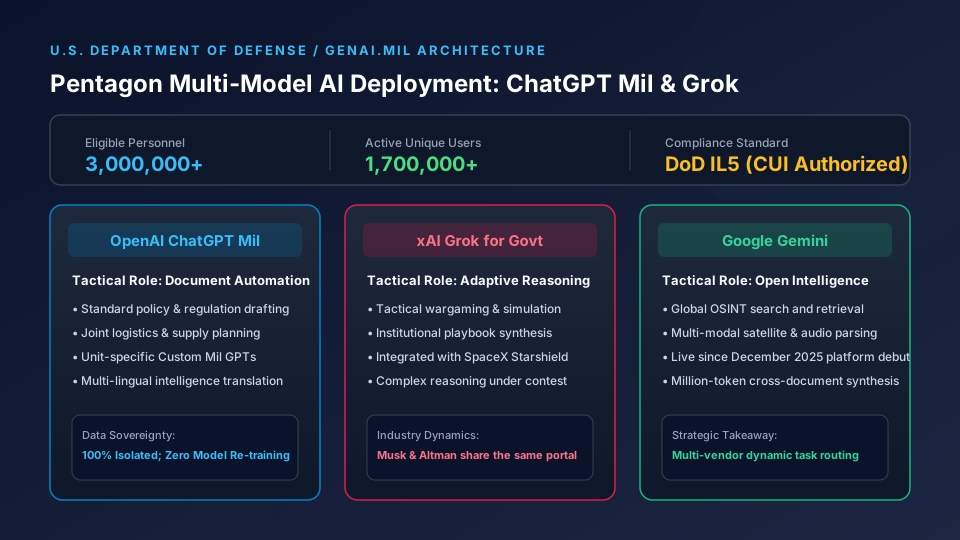
On August 31, 2026, the U.S. Department of Defense officially deployed ChatGPT Mil alongside xAI’s Grok for Government on its enterprise platform GenAI.mil. Accessible to over 3 million personnel with 1.7 million active users, both systems achieved Impact Level 5 (IL5) accreditation for processing Controlled Unclassified Information. ChatGPT Mil handles administrative policy, logistics, and custom GPTs, while Grok delivers deep tactical reasoning, complementing Google Gemini's open-source retrieval. This cements sovereign defense contracts as a cornerstone of generative AI commercialization and sets fierce legal adversaries Sam Altman and Elon Musk side-by-side inside the Pentagon’s core infrastructure.
Bottom Line

On August 31, 2026, the U.S. Department of Defense (DoD) officially deployed a specialized, customized military edition of OpenAI's core technology, ChatGPT Mil, on its enterprise generative AI platform, GenAI.mil, alongside the simultaneous integration of Grok for Government (powered by xAI and SpaceX's Starshield defense division).
This milestone represents the large-scale operational integration of frontier generative AI systems into core national defense, intelligence, and military administrative infrastructure: - Massive Operational Scale: Available across the Department of Defense's global workforce of over 3 million military and civilian personnel, with more than 1.7 million unique active users already onboarded and executing daily workflows; - Highest Security Compliance Standard: Both ChatGPT Mil and Grok for Government achieved full Impact Level 5 (IL5) security authorization, specifically engineered to process sensitive Controlled Unclassified Information (CUI) with air-gapped guarantees that zero operational telemetry or user prompt data will ever leak into external commercial model training or fine-tuning pipelines; - Tripartite Tactical Division of Labor: Establishing a robust multi-model ecosystem alongside the previously integrated Google Gemini—Gemini delivers broad-scale open-source intelligence (OSINT) and multi-modal document synthesis, ChatGPT Mil automates document-intensive military policy, cross-theater logistics, administrative operations, and custom unit-specific Mil GPTs, while Grok for Government delivers deep-thinking adaptive reasoning and tactical institutional knowledge playbooks.
This development marks not only OpenAI's complete historical transformation from its founding non-profit charter banning military use into a premier defense infrastructure provider securing multi-billion-dollar sovereign defense contracts, but also creates one of the most compelling spectacles in modern tech competition: fierce courtroom adversaries Sam Altman and Elon Musk now sit side-by-side within the same Pentagon enterprise portal, competing directly for the daily prompts and operational workflows of 3 million military personnel.
---
What Happened: The Pentagon’s Multi-Model Arsenal
On August 31, 2026, the Chief Digital and Artificial Intelligence Office (CDAO) of the Department of Defense announced a landmark capability expansion of its internal enterprise platform, GenAI.mil, officially onboarding OpenAI's ChatGPT Mil and xAI / SpaceX's Grok for Government into defense-wide operational procurement.
This historic deployment demonstrates three foundational characteristics of modern, defense-grade artificial intelligence infrastructure:
1. IL5 Security Compliance and Data Sovereignty Isolation
- Rigorous Physical and Logical Cloud Isolation: ChatGPT Mil operates within dedicated, high-isolation sovereign cloud environments built to satisfy strict Department of Defense Impact Level 5 (IL5) requirements. Unlike commercial ChatGPT Enterprise offerings, this architecture enforces cryptographic data residency, immutable forensic audit trails, and strict role-based access controls across all service branches.
- Absolute Exclusions from Commercial Re-Training: Department of Defense regulations strictly mandate that all Controlled Unclassified Information (CUI), personnel records, strategic planning memos, and tactical logistical datasets processed inside GenAI.mil remain entirely quarantined within the defense perimeter, with zero exposure to OpenAI or xAI model weight updates, distillation pipelines, or commercial analytics.
2. Functional Specialization Across Three Frontier Models
Rather than risking vendor lock-in or relying on a single commercial monopoly, the Pentagon engineered a pragmatic division of labor across GenAI.mil: - OpenAI ChatGPT Mil: Specifically optimized for document-intensive administrative automation, drafting military regulations, translating multi-lingual intelligence cables, orchestrating complex cross-theater supply chains, and empowering individual combat units to build specialized Custom Mil GPTs; - xAI Grok for Government: Focuses on deep adaptive reasoning, tactical wargaming simulations, and institutional playbook synthesis, supported by SpaceX Starshield high-resilience satellite communication links; - Google Gemini: Continues handling large-scale open-source intelligence (OSINT) aggregation, cross-document analysis across million-token contexts, and multi-modal satellite reconnaissance parsing.
| Frontier Model / Provider | Primary Tactical Role | Deployment Vector / Infrastructure | Security Clearance & Boundary | | :--- | :--- | :--- | :--- | | OpenAI ChatGPT Mil | Policy drafting, logistics orchestration, Custom Mil GPTs | Isolated military cloud sandbox | DoD IL5 accreditation, Controlled Unclassified Info (CUI) | | xAI Grok for Government | Deep adaptive reasoning, tactical wargaming, readiness manuals | SpaceX Starshield secure links | DoD IL5 accreditation, zero commercial data retrain | | Google Gemini | Open-source intelligence retrieval, multimodal tactical search | Google Cloud defense partitions | Large-scale defense information aggregation and triage |
---
Why It Matters: From "No Military Use" to 1.7 Million Defense Users
The official launch of ChatGPT Mil inside the Pentagon highlights profound shifts in Silicon Valley corporate ethics, sovereign AI geopolitics, and the underlying revenue models of frontier artificial intelligence laboratories.
1. OpenAI’s Strategic Transformation: Sovereign Defense as an ARR Pillar
At its inception, OpenAI explicitly prohibited "military and warfare" use cases in its public terms of service. However, as the capital expenditures required to train and serve frontier foundation models escalated into the hundreds of billions of dollars, relying exclusively on consumer software subscriptions and advertising became economically insufficient.
After quietly removing its blanket prohibition against military applications in early 2024, the August 2026 activation of ChatGPT Mil cements sovereign government and national defense procurement as one of OpenAI’s most vital and enduring annual recurring revenue (ARR) pillars. The Department of Defense's massive multi-year digital transformation budget is now serving as a stabilizing financial bedrock for frontier AI research.
2. Rivals on the Same Dashboard: Musk and Altman Inside the Pentagon
Adding a layer of Silicon Valley drama, Elon Musk is actively waging a high-profile lawsuit against OpenAI and Sam Altman in California state courts, accusing the company of betraying its original founding mission. Yet inside the Pentagon's GenAI.mil web portal, defense personnel can effortlessly switch between "ChatGPT Mil" and "Grok" from a single unified drop-down menu.
This operational reality demonstrates that sovereign defense procurement fundamentally transcends private interpersonal rivalries and corporate lawsuits. The Pentagon's unwavering commitment to building a resilient, multi-vendor AI ecosystem ensures that no single private monopoly can capture strategic national security infrastructure, forcing leading frontier labs to compete transparently under uniform military performance and security standards.
---
Our Take: Sovereign AI Shifts Toward "Defense-Grade Compliance" and Private Workflows
Analyzing the strategic implications of the Pentagon's deployment of ChatGPT Mil and Grok for Government, AI Radar outlines three major structural trends that will govern the enterprise and sovereign AI landscape over the coming 6 to 12 months:
1. IL5 Accreditation Is the Ultimate Enterprise Moat
While consumer benchmarks and public leaderboards dominate social media discourse, stringent government security accreditations (such as DoD IL5, FedRAMP High, and sovereign air-gap isolation) form the true commercial barrier to entry in multi-billion-dollar enterprise and public-sector markets. AI developers incapable of meeting rigorous data sovereignty, zero-data-retention, and forensic audit standards will be completely locked out of the most lucrative sovereign contracts.
2. Multi-Model Aggregation Will Become the Standard Enterprise Architecture
The Pentagon's refusal to award an exclusive monopoly contract to OpenAI or any single vendor proves that large, sophisticated organizations will build unified internal gateway platforms (like GenAI.mil) that route specific tasks dynamically to the most capable model. This aggregation model will be rapidly replicated by Fortune 500 multinationals, major financial institutions, and global healthcare systems.
3. Workflow Integration Trumps Raw Conversational Chat
The rapid adoption of ChatGPT Mil (which has already crossed 1.7 million active defense users) proves that enterprise and defense utility is driven by embedded operational workflows, policy templates, and custom domain-specific agents rather than generic chat prompts. The AI platforms that succeed in capturing enterprise market share will be those that integrate seamlessly into complex procurement, logistics, and compliance pipelines to replace legacy enterprise software.
---
What to Watch Next
- CUI Reliability and Hallucination Risks in High-Stakes Operations: As defense personnel expand their reliance on ChatGPT Mil and Grok for operational logistics and policy interpretation, how effectively will these models suppress hallucinations during high-pressure exercises?
- Procurement Budget Allocation and Token Consumption Dynamics: Among the 3 million eligible personnel, which model (ChatGPT Mil, Grok, or Gemini) will capture the majority of daily token throughput, and will the Department of Defense subsequently onboard Anthropic or open-weight models?
- Antitrust Dynamics and Legal Repercussions: Will ongoing antitrust litigation between Elon Musk and OpenAI spill over into defense procurement challenges, and will the Pentagon's multi-vendor strategy serve as an effective defense against monopoly scrutiny?