Banned by Washington, Unleashing the Beast: DeepSeek Open-Sources 'DeepInfer' with 155 Trillion Daily Tokens

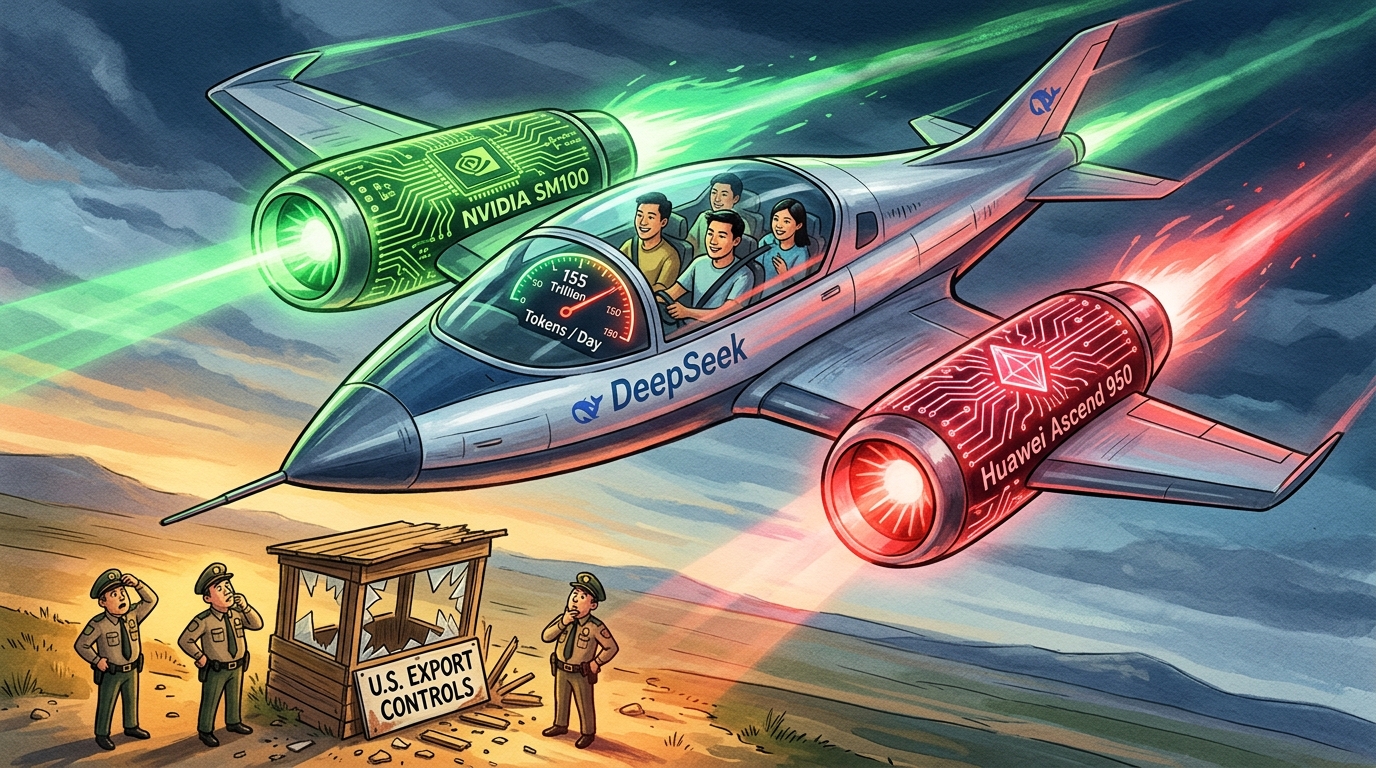
The open-sourcing of DeepInfer signals a historic evolutionary transition from algorithmic breakthroughs to full-stack infrastructure sovereignty. In answering federal bans and chip controls with a cross-platform engine scaling across both NVIDIA and Huawei Ascend silicon at 155 trillion tokens a day, DeepSeek proves that extreme engineering efficiency and radical open source remain the ultimate antidote to geopolitical containment.
Over the past several days, information technology directors across major United States federal civilian agencies have been scrambling through an administrative firestorm. The U.S. Department of Homeland Security (DHS) abruptly issued a sweeping federal procurement directive, ordering all civilian executive branch agencies to systematically identify, purge, and permanently ban all DeepSeek-associated APIs, derivative open weights, and third-party commercial wrappers from federal networks.
Across social media, a vocal cohort of Western commentators and technology pundits seized upon the announcement with barely concealed schadenfreude. They swiftly proclaimed on X (Twitter) that, crushed beneath strict semiconductor export prohibitions and punitive federal government bans, China's breakout artificial intelligence lab was finally meeting its Waterloo, destined to degenerate into an isolated computational backwater.
Yet the premature victory laps barely had time to circulate before being answered with a deafening counter-offensive.
Rather than issuing predictable, boilerplate diplomatic complaints or defensive public relations statements, DeepSeek simply pushed an unprecedented commit to GitHub. Under the permissive Apache 2.0 open-source license, the lab released DeepInfer—the exact high-throughput production engine powering its commercial enterprise APIs and cloud infrastructure worldwide—accompanied by deepseek-recipe, its standardized output token parsing library.
What truly sent shockwaves through the engineering corridors of Silicon Valley was the staggering production benchmark disclosed on the repository page: a verified single-cluster throughput of 155 trillion tokens per day. Even more consequential was the hardware acceleration manifest: standing side-by-side on day zero was full native optimization for both NVIDIA's flagship architecture (SM100) and China's domestic Huawei Ascend 950 NPUs. Watching the open-source release reverberate globally, countless software engineers and infrastructure architects arrived at the exact same conclusion: just as observers assumed DeepSeek was cornered by geopolitical sanctions, the company casually flipped the entire industry's table.
Banned by Washington in the Morning, Dropping a 155-Trillion-Token Nuclear Arsenal by Night
Examining the chronological progression of the past week reads like a high-stakes geopolitical techno-thriller.
The administrative mandate from the Department of Homeland Security was deliberately comprehensive. Operating under the Federal Acquisition Supply Chain Security Act, it did not merely forbid federal personnel from querying DeepSeek directly; it categorically barred any third-party commercial software containing DeepSeek components from federal procurement contracts, leaning on familiar allegations of data exfiltration vulnerabilities and foreign surveillance risks.
Under conventional industry playbooks, an AI startup singled out for targeted regulatory suppression by a global superpower would typically enter a protracted defensive crouch characterized by internal compliance reviews, commercial retreat, and cautious damage control.
However, DeepSeek has consistently demonstrated a radically different operational ethos: answering geopolitical and political friction with overwhelming, unanswerable technical velocity.
Only days prior, the laboratory surprised the international developer community with its sudden DeepSeek-V4.1-Flash (1017) release. That checkpoint not only established a punishing new performance-to-cost Pareto frontier on competitive engineering harnesses like mini-swe-v2, but also demonstrated astonishing single-prompt wishful programming—compiling interactive 3D historical palaces and fully playable web games in a single turn—while opening its proprietary billion-page web Search API to the public at nominal utility pricing.
Now, before the technology sector could even digest that model leap, DeepSeek open-sourced the underlying computational turbine driving the entire ecosystem: DeepInfer.
Giving Away the Crown Jewels: Commercial Production Infrastructure for Free
Any systems architect who has orchestrated large-scale distributed inference across high-concurrency cloud environments immediately recognizes the profound gulf separating DeepInfer from the toy benchmark scripts typically published on academic forums:
1. Battle-Tested Commercial Serving Rather Than Synthetic Benchmarks:
Historically, when frontier laboratories open-sourced serving libraries, they invariably released sanitized, stripped-down frameworks. In stark contrast, DeepInfer represents the authentic, battle-hardened engine that DeepSeek operates daily to service hundreds of millions of enterprise and developer requests. Delivering 155 trillion tokens per day per cluster, this production-grade architecture boasts performance metrics that induce profound anxiety among proprietary cloud hyperscalers;
2. Aggressive Asynchronous Hardware Saturation:
Under the hood, the framework achieves flawless asynchronous overlapping between host CPU batch scheduling and device kernel execution. Leveraging custom compilation pipelines via TileLang, DeepInfer deploys highly specialized communication parallelism across self-attention modules and Mixture-of-Experts (MoE) routing layers, ruthlessly extracting maximum memory bandwidth and tensor efficiency from every participating accelerator;
3. Speculative Decoding with Dynamic Confidence Scoring:
By coupling speculative draft token generation with continuous confidence evaluation, the pipeline validates multiple forward tokens within a single computational pass. This architectural breakthrough dramatically truncates end-to-end latency during long-context reasoning tasks, definitively eliminating the sluggish token-by-token latency bottlenecks that plague complex agent workflows.
DeepSeek bundled this proprietary engineering infrastructure—refined through millions of dollars in empirical production trials—into an unencumbered Apache 2.0 distribution, allowing global enterprises to inspect, modify, and deploy the code without commercial restrictions.
The Definitive Rebuttal: Seamless Day-Zero Parity Across NVIDIA and Huawei Ascend

Yet amidst the avalanche of technical specifications, the detail that truly unnerved Western industry observers was DeepInfer's total hardware agnosticism across rival silicon ecosystems.
For years, the dominant geopolitical assumption held that frontier AI capabilities were inextricably handcuffed to NVIDIA's proprietary CUDA software monopoly. Under this thesis, cutting off access to cutting-edge Western silicon would inevitably cause rival technological progress to grind to an immediate, catastrophic halt.
DeepInfer's day-zero cross-platform deployment definitively shatters this comforting illusion:
1. Bleeding-Edge Optimization for NVIDIA Silicon (SM100): Within compliant overseas data centers, the framework aggressively leverages the microarchitectural strengths of NVIDIA's premier enterprise accelerators, maximizing compute-to-communication overlap to deliver pristine token economics; 2. First-Class Native Support for Domestic Huawei Ascend (Ascend 950): Simultaneously, the codebase provides native, day-zero deployment pipelines optimized directly for Huawei's Ascend 950 neural processors. The identical MoE routing logic, identical API conventions, and identical speculative scheduling run seamlessly across domestic semiconductor clusters, demonstrating industrial-grade throughput on indigenous silicon.
The profound geopolitical significance of this engineering achievement cannot be overstated: far from suffocating computational momentum, hardware sanctions have inadvertently catalyzed the birth of a universal, cross-silicon serving engine capable of seamlessly bridging rival semiconductor paradigms.
Selling Ads in Chatbots Versus Slashing Inference Bills to the Bone
Evaluating this confrontation against broader industry developments over the past seventy-two hours presents a devastating philosophical contrast.
Only days ago, OpenAI—buckling under an unsustainable annual data center lease burden exceeding twenty billion dollars—finally abandoned its longstanding philosophical aversion to advertising. Faced with relentless compute deficits, the company began injecting commercial sponsored cards for bridge loans and consumer products directly into the conversational whitespace of free users to subsidize its infrastructure electricity bills.
Meanwhile, DeepSeek chose the exact opposite path: opening a self-developed web search API for roughly seventy cents per thousand calls, while freely bestowing an enterprise-grade inference engine upon the global open-source commons to drastically slash electricity and hardware overhead for all developers.
While certain Western monopolies retreat behind commercial walled gardens and convert private conversational sanctums into programmatic ad auctions, DeepSeek is utilizing radical open-source engineering to systematically dismantle computational rent-seeking. In the final calculus of technological democratization, developers worldwide are voting with their git repositories.
Actionable Strategy: How Developers and Enterprises Should Navigate the Shift
Confronting this volatile intersection of geopolitical maneuvering and infrastructure evolution, engineering leads and independent developers should implement several pragmatic maneuvers:
1. Infrastructure Architects and DevOps Teams:
Immediately clone and evaluate deepseek-ai/DeepInfer alongside deepseek-recipe on GitHub. If your organization is struggling under exorbitant cloud GPU invoices—particularly teams managing heterogeneous clusters containing diverse accelerator generations—prototyping DeepInfer's asynchronous pipeline and speculative drafting routines offers the potential for immediate multi-fold throughput expansion and drastic cost reductions;
2. Global Application Developers Facing Western Markets:
Maintain an accurate, realistic assessment of the U.S. federal directive's legal boundaries. The current DHS prohibition applies strictly to internal U.S. federal civilian agency networks and government procurement channels; it does not constitute a blanket ban on American private citizens, retail users, or commercial enterprises. Nevertheless, teams engineering commercial products for North American enterprise clients should establish multi-model fallback routing architectures, while consumer application builders should avoid unnecessary panic;
3. Strategic Decoupling from Single-Hardware Dependencies:
DeepInfer's verified dual-platform stability across NVIDIA and Huawei Ascend demonstrates that the era of single-silicon hardware lock-in is drawing to an inevitable close. Architectural roadmaps conceived today must reject tight coupling to proprietary instruction sets, actively embracing generalized kernel abstractions and heterogeneous compilation layers as the primary defense against unexpected geopolitical disruption.