DeepSeek's new vision model is cheap at 384 tokens per image, but do not rush to trust the Opus claim
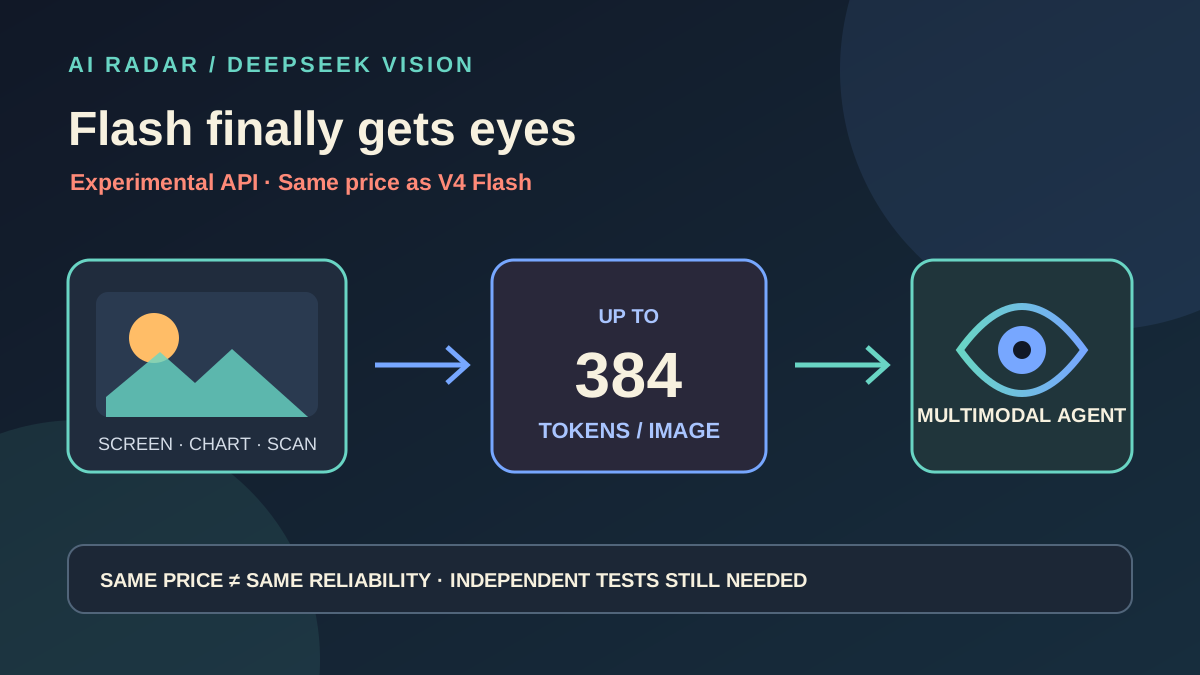
DeepSeek-V4-Flash-Vision-Exp brings native image understanding to low-cost V4 Flash: each image uses at most about 384 input tokens, and DeepSeek's own agent benchmarks come close to or exceed Claude Opus 4.8 in some tasks. A first Hacker News landmark test also found a confident Wells Cathedral-to-Salisbury Cathedral error, while screenshot tool results do not yet form a complete loop everywhere. Run a small A/B test on real work; do not replace a production vision model yet.
The bottom line
DeepSeek has finally given V4 Flash eyes: its own benchmark table puts it close to, and occasionally ahead of, Claude Opus 4.8 on visual-agent tasks. The first real-world test also delivered the warning label: a good score does not stop the model from confidently seeing the wrong building.
DeepSeek-V4-Flash-Vision-Exp launched on August 21. It is the first V4 Flash release that accepts images directly and keeps visual understanding inside an agent workflow. It can read screenshots, web pages, charts, PDF pages and product images. Each image consumes at most about 384 input tokens, at the same price as V4 Flash.
This could become an important low-cost entry point for visual agents. The Exp suffix still matters, though. “Approaches Opus 4.8” is DeepSeek's own comparison, not proof of an across-the-board tie.
The vendor table is strong, but it is not a clean sweep
DeepSeek reports three wins over Opus 4.8: DeepSWE at 59.3 versus 58.0, Agents' Last Exam at 27.3 versus 25.7, and ZeroBench Pass@5 at 35.0 versus 34.0. Terminal Bench 2.1 is also close, 83.9 versus 85.0.
The gaps are real elsewhere: NL2Repo is 57.7 versus 69.7, DSBench-Hard is 63.6 versus 71.7, and ApexBench is 36.5 versus 39.4. The defensible reading is narrower: a much cheaper Flash model is now close on some visual and agent tasks, while complex repositories and data-science work remain behind.
These are vendor-reported results. The code-agent runs used a particular DeepSeek Harness configuration, and text-only Flash could not read the multimodal elements in some tasks. The numbers deserve attention, then outside replication.
The number that changes the cost curve is 384 tokens
DeepSeek resizes each image before converting its visual content into tokens; one image is capped at 384 tokens. Vision-Exp uses V4 Flash pricing: one million input tokens cost RMB 1.5 off-peak or RMB 3 at peak, with output at RMB 4.5 or RMB 9.
That matters more for an agent taking repeated screenshots than a one-point leaderboard lead. Open a back office, find an order, inspect the page, take another screenshot and verify the result: a single task can involve dozens of images. The input cost per look is tiny; repeated observation, retries and long outputs are what can inflate the bill.
Compression is also the trade-off. Large images are reduced to roughly an 800-by-800 information budget. A landscape or product hero image may survive; a 4K webpage, dense spreadsheet, ERP microtext, contract page or complicated dashboard may not. The best marketing number is also the constraint that needs an A/B test.
On day one, a user found a confident misidentification
After launch, a Hacker News developer ran a public-landmark test. The photograph was Wells Cathedral. The question asked whether it was Salisbury Cathedral. DeepSeek answered yes and elaborated that it was the west front of Salisbury Cathedral. The tester said DeepSeek missed or misclassified noticeably more examples in his sample than ByteDance's Seed 2.1 Turbo.
This is one user's benchmark, not evidence that Seed is universally better or that Vision-Exp is poor. It does show the failure mode agents dislike most: the model does not say “uncertain”; it turns a mistaken visual guess into a confident explanation. In a browser workflow, that can become a false state that triggers an email, a CRM update or a closed task.
Image understanding is not yet a complete computer-use agent
The same discussion raised a practical limitation. Today the natural path is still “the user feeds an image to the model.” A full loop would be: a tool takes a screenshot, returns it as a tool result, the model checks the outcome, then clicks again or repairs the mistake. That hand-off is not yet equally smooth across harnesses, MCP and ACP implementations.
DeepSeek Harness 0.1.1 added the model; /goal and /plan can accept images, and OpenCode Go moved quickly to support it. Public usage pages began showing thousands of sessions and substantial token volume soon after release. Developers are trying it inside agents, not just reading the announcement.
Our judgement: test it, but do not remove Opus yet
Vision-Exp's best role may be a visual workhorse: cheaply inspect screenshots, product images, charts and documents, then escalate difficult cases to a stronger model. It is a sensible test for teams already on V4 Flash, products doing visual triage at scale, and developers who need a low-cost API entry point.
Run a small A/B test on real work: web screenshots, tiny-text OCR, chart reading and post-action state checks. Track errors, screenshot count, latency and total cost. One vendor chart is not a reason to replace a production vision model.
What to watch
- Whether independent evaluations reproduce 59.3, 27.3 and 35.0, and whether the NL2Repo and DSBench-Hard gaps narrow;
- The real loss from 384-token compression on tiny text, dense tables and precise UI targeting;
- Whether screenshot tool results form a stable loop in mainstream agent harnesses;
- Version stability, rate limits, latency and whether the experiment becomes a production model.
Our one-line take: the price is compelling and the capability is real; “vision close to Opus” still needs more human testing.