The Chipmakers' Loan to the Chip Buyer: Nvidia, AMD, and Meta's $95B 'Circular Capital' Machine
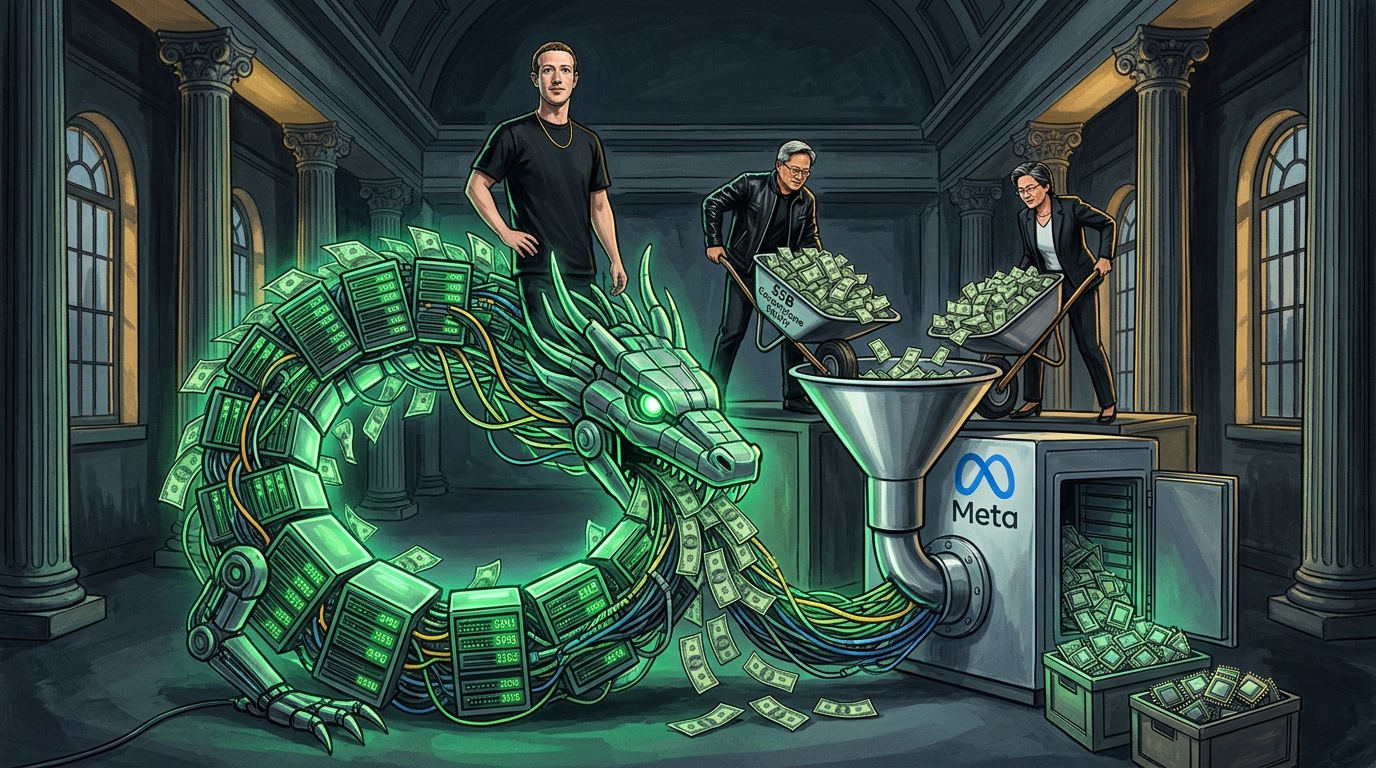
Meta's historic $95 billion offering exposes the defining reality of the AI scaling era: frontier competition has evolved from algorithmic innovation into an unprecedented financial loop orchestrated between semiconductor monopolies and platform giants. By cycling chip profits directly into customer equity, the tech elite prolongs an astronomical infrastructure race. Yet regardless of how brilliantly financial engineers structure non-voting shares and forward contracts, physics and economics eventually demand downstream real-world returns. Until that reckoning arrives, leveraging subsidized open weights remains the developer community's best strategic play.
If you walked through the bustling trading floors of major Wall Street investment banks over the past few days, you would have witnessed quantitative traders staring in disbelief at their Bloomberg terminals. Meanwhile, on the top floor of Meta's Menlo Park headquarters across the country, Mark Zuckerberg—clad in his trademark black streetwear tee and a understated gold chain—casually sipped an iced Americano as his finance team clicked submit on a historic filing with the Securities and Exchange Commission.
That filing detonated an immediate magnitude-ten shockwave across global capital markets: Meta formally initiated a massive equity offering to raise up to ninety-five billion dollars.
This transaction represents the single largest corporate equity financing executed by an individual technology firm in modern commercial history. Yet what truly left institutional analysts and veteran fund managers gasping was not merely the staggering magnitude of the capital figure, but three specific names revealed among the offering's cornerstone investors: Nvidia, AMD, and Broadcom.
The most surreal corporate spectacle in Silicon Valley history has arrived: the very semiconductor suppliers selling the hardware are stepping forward with cold hard cash to bankroll their own customer so that the customer can afford to keep buying their chips.
Wall Street Is Stunned: The Largest Equity Raise in Tech History Becomes a Circular Financial Illusion
In standard textbook corporate economics, the relationship between suppliers and buyers is clear and transactional: money moves forward, goods move backward.
Yet as the generative artificial intelligence arms race accelerates into late 2026, classical economic mechanics have been thoroughly crushed beneath the gravitational pull of raw semiconductor compute. According to underwriter disclosures, the triumvirate of Nvidia, AMD, and Broadcom collectively committed up to five billion dollars as cornerstone investors to absorb tranches of Meta's newly issued equity.
When one translates this transaction into plain language, the reason Wall Street commentators began referring to the arrangement as a financial Ouroboros—the ancient mythological serpent consuming its own tail—becomes immediately obvious: Meta relentlessly broadcasts to global markets that its open-weight Llama models and autonomous reasoning agents are reshaping digital society, and to maintain that computational supremacy, Zuckerberg must pour billions of dollars every quarter into specialized silicon racks operated by Nvidia and AMD; Observing that Meta's operational cash reserves are rapidly being consumed by hardware invoices, Jensen Huang and Lisa Su do not demand immediate cash austerity; instead, they graciously reinvest a portion of their massive semiconductor profits back into purchasing Meta's equity; Armed with ninety-five billion dollars in fresh capital proceeds, Meta turns right around and submits purchase orders that lock up delivery queues for next-generation GPU server clusters for the next three years.
The hardware supplier lends its profits to the customer to finance purchases of its own chips, while the customer utilizes the supplier's money to bolster its balance sheet and buy even more chips. The fabled perpetual motion machine that physicists proved impossible in the natural world has been successfully engineered across corporate balance sheets by the tech oligarchs of Silicon Valley.
Burning One Hundred and Forty Billion Annually: Even Zuckerberg's Ad Engine Was Consumed by Hardware Invoices
Many casual industry observers might wonder why Meta, a digital advertising titan generating tens of billions in free cash flow from billions of daily active users, would ever need to execute the largest equity financing in corporate history.
A brief review of the capital expenditure tables inside the offering prospectus provides a sobering explanation: According to Meta's audited financial disclosures, the company projects its annual capital expenditures for 2026 to reach between 135 billion and 145 billion dollars.
To place that sum into perspective: combining the entire annual development budgets of every Hollywood movie studio, the world's major music labels, and several global automotive manufacturers would still fall short of what Meta incinerates inside its data centers over a ten-month stretch. Faced with an infrastructure engine evaporating capital at hundreds of millions of dollars each day, Zuckerberg bifurcated the massive offering into two calculated phases:
1. Phase One: Thirty-Five Billion Dollars in Immediate Operational Liquidity: Executed through forward sale agreements alongside mandatory convertible preferred stock, this immediate institutional tranche delivers thirty-five billion dollars in cash to settle immediate balance sheet liabilities for hundreds of thousands of newly delivered GPUs and dedicated utility substation builds; 2. Phase Two: A Sixty Billion Dollar Non-Voting Capital Reservoir: Following the formal registration of a newly established Class C equity structure in early 2027, Meta will initiate an at-the-market program allowing it to tap up to sixty billion dollars over multi-year cycles to underwrite private silicon research, long-term power purchase contracts, and nuclear energy agreements.
Lending Gold to the Miner: How Nvidia and AMD Engineered the Circular Silicon Loop`
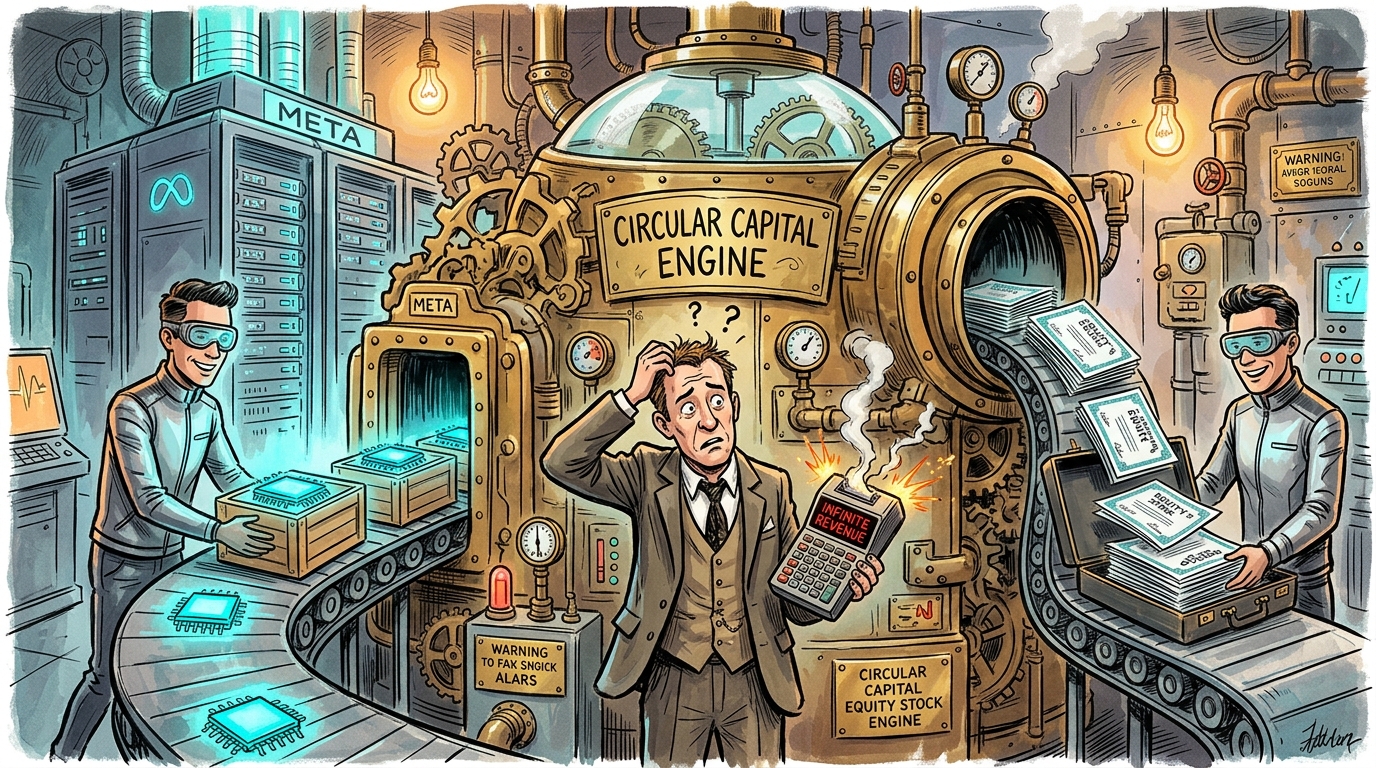
Within this financial drama, the semiconductor architects acted with cold, deliberate calculation:
1. Massive Chip Margins Converted into Guaranteed Customer Longevity: For Nvidia, operating margins consistently exceeding seventy percent created a balance sheet overflowing with idle corporate liquidity. Rather than allowing tens of billions of dollars to collect modest treasury yield, deploying capital as cornerstone equity into its single largest cloud customer establishes an unbreakable floor under future demand. So long as Meta remains flush with Wall Street capital, Jensen Huang's order book remains perpetually insulated from cyclical downturns; 2. Deep Strategic Alignment for Custom Silicon: Broadcom and AMD Secure Territory: The participation of Broadcom and AMD reflects a calculated territorial land grab. By acting as cornerstone anchors for Meta's capital raise, Broadcom secured exclusive multi-year foundry agreements for Meta's custom MTIA application-specific silicon pipelines, while AMD successfully leveraged its capital participation to integrate Instinct server clusters directly into computing facilities once monopolized exclusively by Nvidia.
Every participant departs the transaction satisfied, celebrating record valuation multiples across public equity markets while printing unprecedented top-line projections.
Raising Nearly One Hundred Billion Dollars Without Surrendering a Single Millimeter of Control

Beyond the circular capital mechanics, the element of the transaction that left corporate governance scholars in genuine awe was Zuckerberg's masterful defense of unilateral executive authority.
Under conventional corporate finance conventions, any enterprise that floods the public market with ninety-five billion dollars in secondary equity would see its founder's ownership stake diluted into minority representation, inevitably surrendering significant board influence to underwriting syndicates. Yet Zuckerberg deployed a dual-class equity architecture that provided a masterclass in modern corporate fortress building:
The entirety of the sixty-billion-dollar second phase will be funded exclusively through newly created Class C shares that carry zero voting rights. Public pension systems, sovereign wealth funds, and private hedge funds can provide billions in real capital, but in the boardroom, they remain strictly non-voting financial passengers.
Following the conclusion of this historic ninety-five-billion-dollar liquidity draw, Zuckerberg sits comfortably atop his server-cable throne, his fifty-eight percent supervoting majority completely untouched and absolute.
Who Ultimately Pays the Bill: The Damoclean Sword Hanging Over the Open-Source Ecosystem
Looking beyond the dizzying financial wizardry from the perspective of software builders and the broader technology landscape, two practical realities emerge:
1. The Tactical Dividend for Developers: Capitalize on Subsidized Open-Source Abundance: So long as this circular perpetual motion machine continues to cycle capital between semiconductor fabricators and hyperscalers, Meta will continue freely releasing state-of-the-art open-weight models to the global commons to protect its ecosystem moat. For enterprise startups and engineering leads, extracting maximum value from these heavily subsidized weights to build proprietary, localized applications represents the single most rational strategic play available today; 2. The Long-Term Macro Warning: The Fragility of Circular Capital When the Music Stops: Builders must remain conscious of basic macroeconomic reality: no perpetual motion machine survives indefinitely without external thermodynamic input. If an infrastructure ecosystem consumes nearly one hundred and forty billion dollars in annual capital expenditures while consumer-facing downstream applications fail to generate equivalent commercial revenue, the moment liquidity tightens anywhere across the loop, the entire web of semiconductor receivables, non-voting shares, and speculative multiples will confront a brutal reckoning.
During the legendary California Gold Rush, the old proverb held that the merchant selling picks and shovels walked away with guaranteed riches while the gold miners assumed all the operational risk. In late 2026, Silicon Valley has brought that ancient adage to its ultimate technological evolution: the merchant selling the shovels became so astonishingly wealthy that he began lending money to the prospector, stipulating that the loan can only be spent buying more expensive shovels from his own store. As to whether the mountain actually contains that much gold beneath the surface, until the music stops playing, nobody in the ballroom seems to care.